

AI and machine learning now have a hand in revolutionizing how companies manage everything from supply chain operations to demand forecasting. AI-based forecast tools in retail can predict customer needs, optimize inventory management, and boost profits. It comes as no surprise that the future demand forecasting is growing so rapidly at a CAGR of 45.8 % from 2024 to 2029.
In fact, market research shows that AI-based demand forecasting mechanisms can automate up to 50% of workforce-management tasks, resulting in cost reductions of 10–15 %. But this is only a small part of the most important business indicators that are influenced by the use of modern forecasting technologies.
In this article, we’ll talk about retail tasks, problems, and issues that can be addressed with the help of machine learning demand planning models. We'll also explore the specifics of the most effective customer demand forecasting models and ways to measure their accuracy.
Key Takeaways
Demand planning impacts all key retail departments—from commercial to logistics and marketing.
ML models outperform traditional methods in scalability, automation, and adaptability.
LightGBM stands out as a top performer in demand forecasting tasks.
Accurate forecasting of seasonal peaks depends heavily on model sophistication.
Forecast accuracy hinges on the right time horizon, aggregation level, and error metric.
Financial metrics are essential to evaluate the real impact of forecasting tools.
Why Demand Planning Tools and Techniques are Important in Retail
Many company departments depend on forecasts in one way or another. The specific nature of the company and the purpose of the department in question determine which forecasts they rely on.
Commercial departments
These departments mostly work with sales forecasts in monetary terms and at the category level to assess whether sales targets will be met, and that is how the S&OP starts.
Operational departments
Daily accurate demand forecasts in quantities are crucial for resource strategic planning and ensuring smooth day-to-day operations.
Purchasing departments
Customer demand forecasts at the item-location level are vital. The forecast horizon is flexible and depends on the supply chain's lead time. Sometimes, purchasing departments rely on the sales forecasts to understand and plan their promotional activities properly, together with the commercial departments.
Logistics and transportation departments
These departments focus on downstream metrics derived from customer demand forecasts, such as incoming shipments, outgoing shipments, quantities, volumes, and pallets. It helps with resource planning and warehouse load management. They need it to understand both the capacity of the central warehouse and the capacity of transportation to avoid supply chain disruptions. In fact, according to the McKinsey study, companies have seen logistics costs drop by 15 % and inventory levels improve by up to 35 % with the help of AI supply chain forecasting models.
Marketing development departments
Marketing departments are influenced by demand forecasts as well. They may be responsible for the promotional forecasting process at the item level for specific campaign periods or sales forecasts for new stores.
Comparing ML Models and Statistical Methods in Demand Planning Process
There is a difference between traditional (statistical) demand forecasting methods and machine learning methods. Statistical models are based on historical data and statistical analysis methods. They help analyze data using established mathematical structures, allowing you to identify simple patterns, test hypotheses, and make informed predictions.
AI and ML-based demand planning techniques use artificial intelligence and machine learning to predict future demand for products. Advanced algorithms enable the analysis of complex data, such as market trends, consumer trends, and past sales data, and the identification of intricate patterns.
From a cost standpoint, ML-technologies are a bit more expensive than traditional forecasting techniques. However, the accuracy of the forecast, the ability to adapt to changes in data, and the complex interdependencies between different types of data and categories considered by machine learning all justify the added expense.
In addition, machine learning provides scalability, automation, flexibility, and explainability of results. Although when using traditional statistical methods, companies are accustomed to greater explainability of results—a simple formula that provides a clear understanding of dependencies and expected results. Nevertheless, machine learning models use a different, equally intuitive approach to visualizing results and explaining them.
Comparing ML models with statistical methods in demand forecasting:
| Criterion | ML models | Traditional methods |
|---|---|---|
| Accuracy of forecasts | ✅ | ❌ |
| Adapting to changes in data | ✅ | ❌ |
| Complex interdependencies | ✅ | ❌ |
| Scalability | ✅ | ✅ |
| Automation | ✅ | ✅ |
| Flexibility | ✅ | ❌ |
| Explainability of results | ✅ | ✅ |
| Cost of implementation and support | High | Low |
«According to LEAFIO's results, the percentage of machine learning forecasting accuracy is at least 7 % higher compared to traditional statistical methods or models», says Helen Kom, COO at LEAFIO AI, Inventory Optimization Expert.
Types of Demand Forecasting Models for Accurate Forecasts
There is a range of different models from simple moving averages to other models, including ARIMA, such as:
- Life cycle modeling
- Simple moving average
- Adaptive smoothing
- ARIMA (Autoregressive Integrated Moving Average)
- ARIMA including regressors
There are also a few examples of the different AI-based models that can be used for futuredemand forecasting tasks:
- N-BEATS
- Facebook Prophet
- Random Forest
- XGBoost
- LightGBM

LEAFIO AI Platform, for example, tested and utilized different types of models for customer demand forecasting, such as N-BEATS, Random Forest, XGBoost, and LightGBM. However, the last one is the platform's go-to model, and for a good reason. LightGBM model has consistently delivered the best results in LEAFIO's AI projects. Based on research and international forecasting competitions, LightGBM is fast, efficient, and highly effective for future demand forecasting.
LightGBM Model — Key Features for Demand Forecasting
Why LightGBM demonstrates high results in demand forecasting:
- Fast and Efficient. If a retailer works with large batches of data—both historical data and new incoming data—accuracy is important, but speed is equally crucial. The ability to generate fast results is why LightGBM is so well-regarded, and Kaggle competition results confirm its effectiveness in forecasting tasks.
- Industry-Leading Accuracy. Research and results from the Kaggle competition recognize LightGBM as one of the leading models for forecasting tasks, consistently delivering top-tier accuracy.
For example, it is sometimes very difficult to identify categories with high seasonality, let alone make accurate forecasts for them during peak demand periods. In such cases, everything really depends on the chosen model. Such categories need to be forecast using effective forecasting methods and special factors that are used here.
Based on the uploaded data, the LightGBM model can autonomously identify and mark:
- High-season categories
- High-season products
- Off-season periods, transition periods into/out of season, and recovery periods for sales
- Events and holidays with a variable date
- Independently restore sales: replacing missing sales with average sales in price/weight quarters or using analog products.
After six months of using the LightGBM model at NOVUS, one of the largest supermarket chains in Eastern Europe, the accuracy of the chain's forecasts increased by an average of 7 %.
Factors that Demand Planners Must Consider
When it comes to factors that need to be considered when forecasting demand, these vary depending on the forecasting horizon. Short-term forecasts typically take different factors into account than long-term forecasts, where additional factors come into play.
Demand Factors
Historical sales data is the most important part of demand forecasting. By analyzing this data, the system can find patterns that may repeat in the future.
The main demand factors are:
- Last week's sales
- Sales for the 4 previous weeks
- Sales for the same period of time during the previous year
- MAX sales quantity
- Atypical sales
- OOS (optional)
Calendar Factors
Demand for certain goods varies depending on the season, day of the week, and even time of day. Understanding these patterns and cycles helps retailers ensure they have sufficient stock available when needed and avoid supply chain disruptions.
Calendar factors to be taken into account when making a forecast are:
- Number of weeks in the year
- The day of the week
- The number of weeks in a month
- Holidays and holidays with variable dates
Promotional/Price Factors
Price elasticity has a significant impact on demand forecasting. Even if there are no promotional campaigns, simple price fluctuations can greatly affect demand.
Promotional and price factors that need to be considered are:
- Promotional mark (Yes/No)
- The quantity of SKUs in the promo for a particular date
- The change in the SKU's sales price compared to the average sales price of the previous week
- SKU average price
- The quantity of promotional days during the last week
- The quantity of promotional days during the last 4 weeks
- Promotional analogues
SKU Characteristics
When forecasting demand, several characteristics of each SKU are considered by the system to create accurate predictions:
- Category
- Net Weight
- Brand
- Additional Product Characteristics
How to Measure Forecasting Accuracy
The accuracy of forecast measurements depends on selecting the right assessment horizon, aggregation level, and error calculation method. These choices are tailored to the retailer's needs to ensure the most relevant and actionable insights.
The forecasting accuracy results will differ significantly, for example, at the daily and monthly levels. Of course, at the monthly level, we can get much better forecasting accuracy compared to the actual data. The higher the aggregation level used to measure forecasting accuracy, the better the results you get.
The Size of the Error
In general, there is a range of metrics for calculating forecasting error:
- PE—percentage error
- MAE—mean absolute error
- BIAS—bias in the forecast
- WMAPE—weighted average absolute percentage error
- RMSE—root mean square error
«If we are talking about WMAPE, the benchmarks in different industries show the range starting at between 10% to 25%. This is on the company level, depending on the horizon, but generally, it’s a weekly or monthly result. It’s better to compare the actual results and the benchmark to understand whether there are any gaps in forecasting and if those gaps can be improved with the help of the latest technologies», said Helen Kom, COO at LEAFIO AI, Inventory Optimization Expert.
The Financial Planning
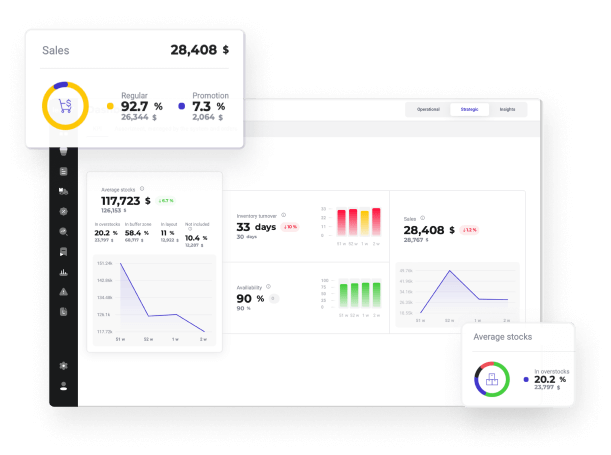
Financial metrics provide a comprehensive view of business performance, beyond just forecast error. It is important to track the following indicators and their influence on the forecasts:
- Sales Plan vs. Facts
- Overstocks
- Turnover
- Availability% and OOS
Even if a retailer has a very high level of forecasting accuracy, e.g., around 95%, they can still get bad results in terms of execution. You need to look under the hood of processes, not just forecasting accuracy, but also understand the ways in which the forecast is utilized and what financial outcomes you are achieving with the solution.
LEAFIO AI Demand Forecasting: Driving Retail Efficiency Through Accurate Predictions
LEAFIO's AI-Powered Demand Planning software takes effective demand planning to the next level by utilizing advanced machine learning models such as LightGBM. Using artificial intelligence, the system analyzes a wide range of data sources, taking into account internal and external factors. The system provides the most reliable demand forecasts, which have already helped hundreds of companies improve their sales results. Unlike traditional methods, the system is improved in real time, adapting to changes in the market, economic trends, and customer satisfaction level.
Conclusion
AI-driven demand forecasting is not just about better predictions—it’s about reshaping how retail businesses think, plan, and execute. The ability to capture subtle shifts in demand, respond instantly to market signals, and coordinate action across departments turns forecasting into a strategic engine for growth. Tools like LightGBM don’t just crunch numbers—they surface patterns invisible to the human eye and build the foundation for smarter, faster, and more profitable decisions to meet customer demand.
If you’re ready to move from static reports to intelligent foresight, request a demo. LEAFIO AI Demand Planning isn’t just software—it’s a shift in capability, mindset, and results.


Have a question?

Kristi Miller
Retail optimization expert