











Toy House operates 67 stores and an online store across 18 regions in Eastern Europe, offering more than 50,000 SKUs.
Toy Retailer
LEAFIO AI Multi-Echelon Inventory Optimization Software (MEIO) takes into account the unique characteristics of goods supply and generates highly accurate safety stock forecasts for managing inventory in both regional and central warehouses.
Multi-echelon inventory replenishment software provides numerous advantages for retailers with complex supply chain network, enabling more efficient stock management and greater responsiveness to market fluctuations.
Potential inventory reduction at DC with increased availability in stores
Improvement of turnover in the entire chain
Reducing of excess inventory at DCs
Decrease in storage expenses due to stock reduction
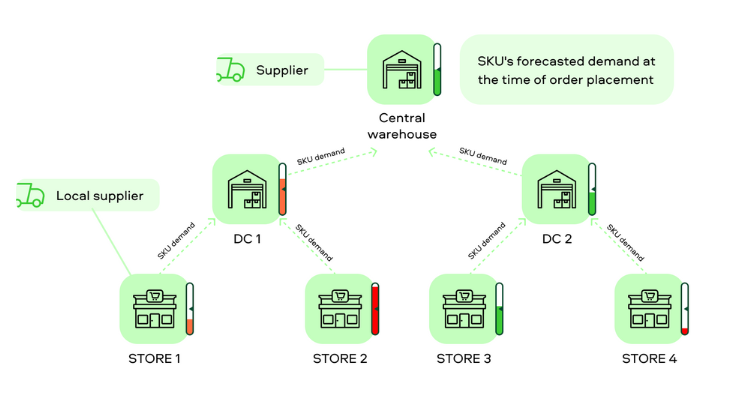
The LEAFIO AI multi-echelon inventory optimization (MEIO) software was designed to manage inventory at all levels of the supply chain: from a retail store, pharmacy, or supermarket to the chain of regional and central warehouses. Due to the tight connection in the elaborate multi-echelon forecasting algorithm, it is possible to accurately assess the current and future demand for goods on the lead time of an external supplier to the central warehouse concerning the supply schedule of a product to stores.
Transparent unified inventory management process in the entire retail chain due to the close connection between demand and supply of goods at all levels of the supply chain.
The product range rotation in terms of inventory management becomes automatic and transparent.
There is the possibility of really flexible algorithm settings, regarding all the necessary factors and features of the goods delivery process.
The system evaluates the current demand for goods at each store, which is replenished through the distribution centre.
Estimation of the forecast demand for goods is made for each store, which is replenished through the DC. The following is taken into account: the number of deliveries of goods by an external supplier to each store based on the DC delivery schedule, seasonality, promotional activities and other factors.
The current demand for the product at each level and the forecast demand taking into account seasonality, promotional activities and other factors, results in total demand for the product across the chain.
Calculation at the warehouse level occurs whether they are intermediate or wholesaler. In this case, the forecast demand is estimated to meet the needs of the warehouse(s) on the supply leg, taking into account all the necessary factors.
There is a general aggregation, order optimization, if it is necessary based on the supplier's conditions, the order is rounded up to the multiplicity factor.
A final check of the order correctness so as not to miss anything.
The order is generated and sent to the supplier automatically or accepted by the manager, depending on the settings selected for a particular supplier.
The total demand of stores for the product on the delivery lead time is estimated.
In case of pick by line and pick by zero schemes, when the supplier's packaging can be unpacked at the warehouse and divided into smaller lots based on the lower distribution of goods from the DC to stores, the system can evaluate the order quantity and make a decision on the order based on the needs of stores in units of measurement of the DC multiplicity.
There is a general aggregation, order optimization, if it is necessary based on the supplier's conditions, the order is rounded up to the multiplicity factor.
A final check of the order correctness so as not to miss anything.
The order is generated and sent to the supplier automatically or accepted by the manager, depending on the settings selected for a particular supplier.
The same solution forecasts store and warehouse demand, adjusts it for promotions and seasons, and shows what every imbalance costs.
Explore Inventory Optimization SolutionWe’re happy to discuss your business’s needs and share how LEAFIO’s market-leading, unified platform can help you drive profitable growth across your sales and distribution channels.
A forecast rarely stands alone. These modules use the same demand data to plan promotions, handle perishables, and show what stockouts and surplus cost you.
Learn moreReplenishment doesn't work in isolation. These modules supply the demand signal behind each order and show you the result once it's placed.
Learn morePerishables have their own module, but they run in the same system as the rest of your assortment. These modules calculate the orders, adjust for the season, and track write-offs after the fact.
Learn more