











The fundamental goal of a retail business is sales, and the main asset is inventory. What inventory level is needed to meet expected sales? What KPIs should be planned for the next year?
You can answer these and other critical managerial questions with the most accurate AI-powered demand planning software from LEAFIO AI.
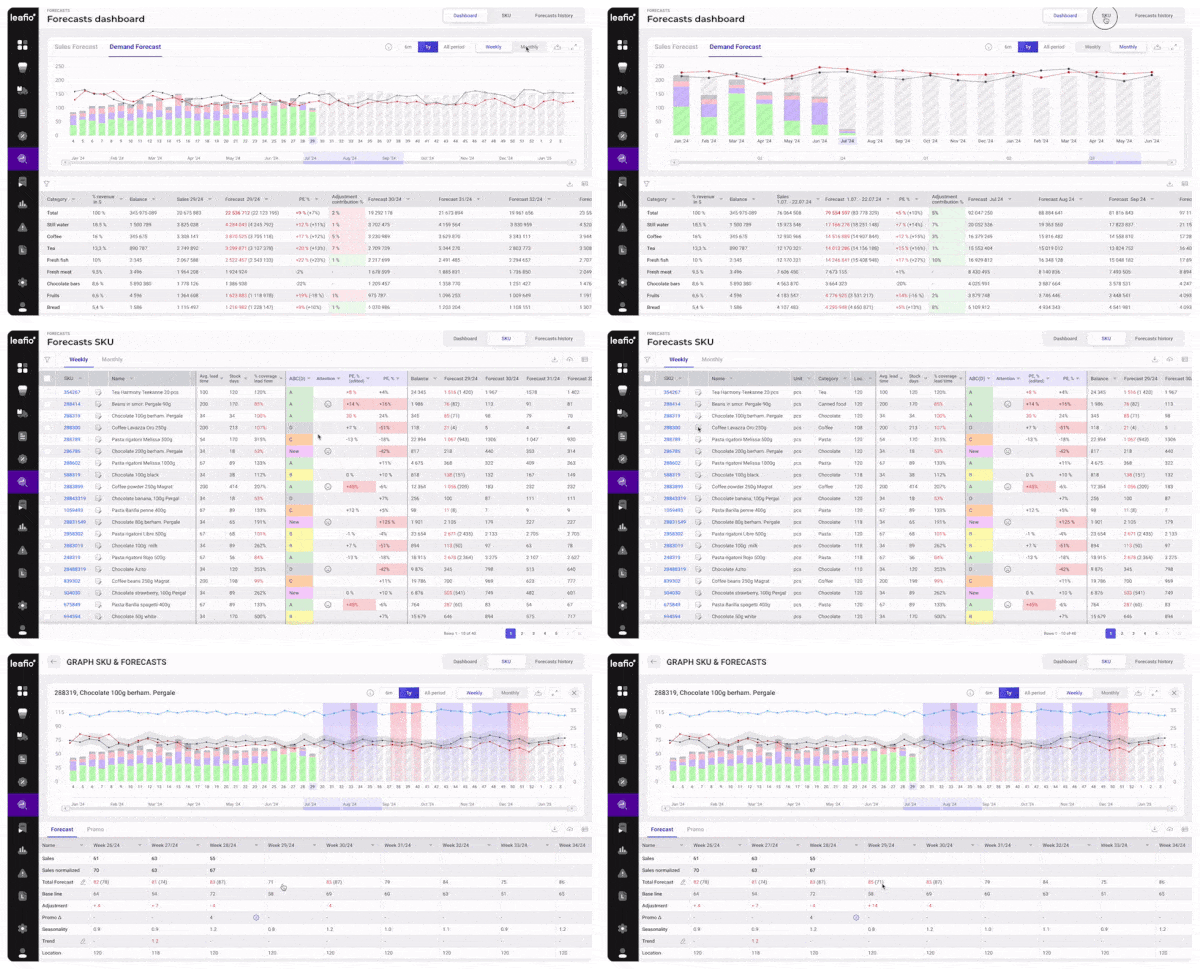
LEAFIO’s AI-powered demand planning solution uses advanced ML algorithms to predict future demand for each item with maximum accuracy. It analyzes full sales history, promotions, store traffic, seasonality, and even external factors like weather—evaluating their non-linear impact while filtering out irrelevant noise. This ensures optimal stock levels to prevent lost sales without overinvesting in excess inventory, while significantly reducing the time planners spend on forecasting.
Demand planning depends on a wide set of internal factors (traffic, sales, promotions, product seasonality) and external influences (weather, regional differences, seasons, public events, etc.). Even experienced managers and analysts can struggle with this complexity, often leading to inaccurate forecasts, unnecessary costs, and missed revenue. LEAFIO AI’s retail demand planning software uses advanced ML algorithms to account for all these variables, filter out noise, and evaluate non-linear effects—significantly improving forecast accuracy while reducing the time required from your team.
Easily identify forecast discrepancies and focus attention on key products requiring adjustments. Customizable metrics like Percentage Error (PE) or advanced options (RMSE, MAE, BIAS) track accuracy, while category-specific thresholds trigger notifications for deviations. By prioritizing critical items, the system optimizes resource allocation and ensures efficient AI-powered demand planning.
Adjust forecasted volumes directly within the system based on historical sales trends, promotional impacts, or business insights. With detailed product views and clear breakdowns of sales categories (regular, promotional, irregular), users can analyze deviations, identify root causes, and make precise adjustments to improve alignment with business goals.
Easily make large-scale adjustments across multiple products by applying demand variation coefficients. This feature allows you to account for seasonal trends, market shifts, and promotional activities, keeping your demand planning accurate and aligned with changing conditions.
Maintain balanced stock levels despite unpredictable supplier schedules. The AI-powered demand planning software for retailers analyzes lead time and stock days to identify coverage gaps, alerts users to potential risks, and enables replenishment orders to be created directly within the interface, ensuring accurate replenishment planning for seasonal demand spikes or long-term stock needs.
increased forecast accuracy
reduced lost sales
reduced overstock
This feature enables you to manage inventory at all levels of the supply chain: from retail stores, pharmacies, and supermarkets to regional and central warehouses. It ensures precise evaluation of current and future demand for goods, factoring in the lead time of an external suppliers to central warehouses and aligning with product supply schedules for stores.
Learn moreThe promotional excellence functional block allows you to prepare for a planned promotional activity timely, automatically receive a calculated promotional forecast, adapt the stock to the actual promotional sales, complete it with the minimum stock, and analyze its effectiveness.
Learn moreA comprehensive feature that includes automatic calculation of quantity requirements per order, automatic generation of orders, automatic dispatch of orders, automatic editing of submitted orders based on feedback from the supplier, and control of order execution.
Learn moreAI demand planning improves accuracy by learning from real sales patterns instead of relying on static averages. It adapts forecasts to seasonality, promotions, and local demand shifts, reducing guesswork. This helps retailers avoid chronic overforecasting, underforecasting, and constant manual corrections that undermine trust in planning.
Retailers typically start with sales history, basic product data, and available inventory information. Even when data is inconsistent or incomplete, the system can work with real-world limitations. Project teams help structure raw data so retailers don’t have to delay demand planning until data is “perfect.”
Demand planning software connects with existing inventory and ERP environments to share forecasts and actual sales data. This alignment ensures forecasts translate into practical inventory decisions, preventing the common pain point where planning outputs look good on paper but fail to improve availability or stock balance.
The first improvements usually appear in forecast accuracy and on-shelf availability, followed by better inventory turnover and fewer emergency replenishments. Retailers often notice reduced manual overrides early on, which signals more stable planning and fewer operational firefighting situations.
Most retail teams begin seeing measurable improvements within the first few planning cycles after rollout. Early wins often come from better visibility and reduced forecast volatility, while deeper financial impact builds as teams rely less on manual adjustments and more on consistent demand-driven planning.