

Competition, information overload fatigue among buyers, and rapidly changing trends are the conditions that modern retailers have to work with. Customers no longer just walk in and buy a product. They expect a seamless customer experience in all stages of their interaction with the store. This means that online stores, mobile apps, physical points of sale, and all other online and offline channels must create a holistic customer journey.
Retail digital transformation is more than necessary to achieve this. It significantly increases a company's competitiveness through real-time response to factors, high-quality forecasting, and precise process management. Simply put, digital technologies in retail are changing processes and outdated approaches and tools can and will drag you down.
Key Takeaways
Digital transformation replaces outdated tools, boosting efficiency and eliminating errors caused by manual or disconnected systems.
AI-driven automation and forecasting empower retailers to make faster, data-based decisions that reduce losses and increase revenue.
Ecosystem oriented retail platforms give companies a true competitive edge by unifying processes, improving visibility, and turning data into profit.
Modern digital technologies for retail provide real-time inventory synchronization, automatic replenishment, personalized loyalty, and continuous analytics.
Why have Digital Retail Solutions Become a Trend?
Leading retailers are becoming less and less like traditional merchants and more like big technology companies. Artificial intelligence, the Internet of Things, and big data analytics have become the main tools. In 2024, the global market for digital transformation in retail was ≈ $118.632 million. The projected CAGR from 2025 to 2030 is 28.6%. This trend is characteristic of all areas of business: in 2024, 78% of organizations used AI in at least one business function (compared to 55% a year earlier).
The result of this approach is more accurate and faster business decisions. For example, digital demand forecasting reduces errors by 30–50% and losses from missed sales by 65% due to out-of-stock items. Retailers are focusing on supply chain optimization, data-driven insights, and integrated POS systems. This is allowing them to remain competitive.

Benefits of Digital Transformation for the Retail Industry
Let's take a look at how digital transformation enables retailers to increase productivity and lay the foundation for strategic growth.
Personalized Customer Experience
Digital transformation allows you to personalize the experience on a massive scale: create small customer segments, interpret behavioral patterns, launch individual promotions, and create offers that truly resonate with the wishes and preferences of almost every specific buyer. This happens at all stages of interaction, including online support. Interestingly, in 2025, 54% of consumers are likely to interact with an AI chatbot.
Flexible and Fast Operations
Optimizing retail operations means real-time inventory visibility, price monitoring and changes, order automation, creating digital planograms based on customer behavior data, and much more. System integration, data exchange, and continuous monitoring make it possible to avoid overstocking or shortages and adapt to fluctuations in supply and demand.
Informed Management Decisions
Information about sales, supply, inventory, customer data, and other data sets needs to be processed and interpreted correctly. Modern systems take care of this: they find patterns, predict trends, and generate reports. Based on this, it is much easier to make informed strategic and tactical decisions. 93% of business leaders say this directly impacts their company's revenue growth.
A Seamless Customer Journey
Digital transformation allows you to combine physical and digital channels and provide a seamless omnichannel experience. It is possible to combine the following into a single journey:
- e-commerce tools and platforms
- points of contact in physical stores
- mobile applications
- all service channels
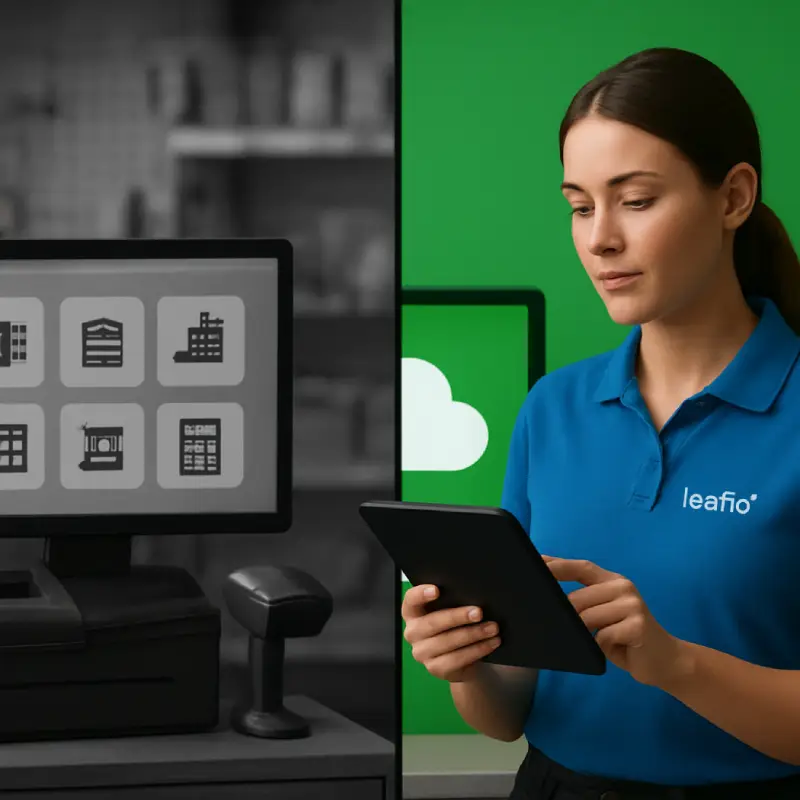
However, many retailers continue to use outdated tools. And the problem there is not just lower efficiency. In fact, old systems cause errors, hinder the integration of new tools, and prevent a complete picture of operational activities from being assessed.

Common Outdated Retail Management Tools
Let's take a look at common retail legacy systems that make inventory management inefficient. We will also analyze the risks of using them and suggest modern alternatives.
Standalone Spreadsheets (Excel/Google Sheets)
Many retailers still rely on free spreadsheets to manage orders and inventory, as well as track sales. A McKinsey study shows that 73% of supply chain managers still use spreadsheets for planning.
These tools are accessible and simple. However, the key problem is the extremely high risk of errors. Each value must be entered manually, so even a small mistake leads to incorrect values.
As the volume of data grows (and in retail, this happens quickly), spreadsheets become slow and cumbersome. Quick updates and working with data take a lot of time. Even to simply change prices, you have to spend several working hours or even days. Dynamic pricing? Definitely not with this software.
Disconnected POS Systems
Basic POS systems that are not integrated with warehouses, accounting software, or e-commerce platforms are a weak point in retail stores. If store, warehouse, and accounting systems operate separately, there is a need for double data entry. This leads to unnecessary time consumption, risks of inconsistency, and a lack of a holistic view of processes.
This problem is common even in modern systems. It is common for POS systems at different retail outlets within a chain to not interact with each other or send data to a single source. This significantly complicates the work of the head office. There is no question of making informed and timely decisions: it takes too much time to reconcile all the reports.
Isolated, Single-Function Software
It is common practice to use narrowly specialized software. For example, separate applications for accounting, stock management, supply planning, etc. This “best-of-breed” approach leads to extreme fragmentation of data and processes. Maintaining individual systems becomes too complex, and operational processes become inefficient.
As a result, managers spend their working time inefficiently, as they are forced to manually reconcile data between systems. While modern retail digital marketing is based on flexibility and speed, single-function software slows down processes. As a result, launching a simple promotion can take not a few hours, but days or even weeks, because each system must be analyzed and updated separately.
Paper or Physical Loyalty Cards
Some physical stores still use traditional cards that need to be stamped (or marked with stickers or other means to indicate used promotions). On the one hand, this is convenient. On the other hand, each purchase requires manual confirmation, and cashiers have to search for bonuses in slow, outdated systems. Customers cannot track their points and opportunities, and retailers cannot analyze their purchasing behavior.
Only a digital customer loyalty program is capable of enhancing operational efficiency. Such a program not only collects data for analytics but also personalizes rewards. This significantly increases customer lifetime value and meets the needs of the modern market.
Basic Shelf Calculators and Planogram Sketches
Many retailers still use manual planning for shelf layout. Merchandisers draw planograms on paper or use simple tables to allocate shelf space. Such planning is labor-intensive and prone to errors. The consequences are obvious: lost sales due to outdated data and the inability to control results.
Half-empty or poorly organized displays cause customers to buy less, which leads to a decrease in the average check and forces staff to spend hours correcting layout errors. Manual methods cannot keep up with market dynamics, leading to excess inventory of unpopular items and a shortage of bestsellers.
How LEAFIO AI enables Retail Digital Transformation
Modern integrated platforms eliminate most risks and combine all data into a single ecosystem. An example of such a platform is LEAFIO AI, which consolidates all key retail functions, combines physical and digital touchpoints, and operates on the basis of artificial intelligence and machine learning. Among the available options for retailers are:
- Demand forecasting reduces errors by 20–50% and lost sales due to shortages by 65%.
- Automatic generation of planograms based on sales data and convenient control of layout compliance using mobile applications.
- The ability to optimize the supply chain with Replenishment Software: this significantly reduces errors and optimizes inventory.
- A large number of other software solutions exist for optimizing processes and improving efficiency.
Conclusion
The transition from disparate spreadsheets, cash registers, and separate applications to a unified AI platform allows retailers to avoid errors and efficiency losses.
Seamless omnichannel integration is now essential as customers expect one connected experience across online and in-store touchpoints.
The implementation of a retail digital marketing strategy is based on the use of large amounts of data and deep personalization.
Investing in modern integrated platforms enables customers to shop conveniently, while retailers gain an important competitive advantage in today's market.


Have a question?

Mary Makarchuk
Retail Optimization Expert