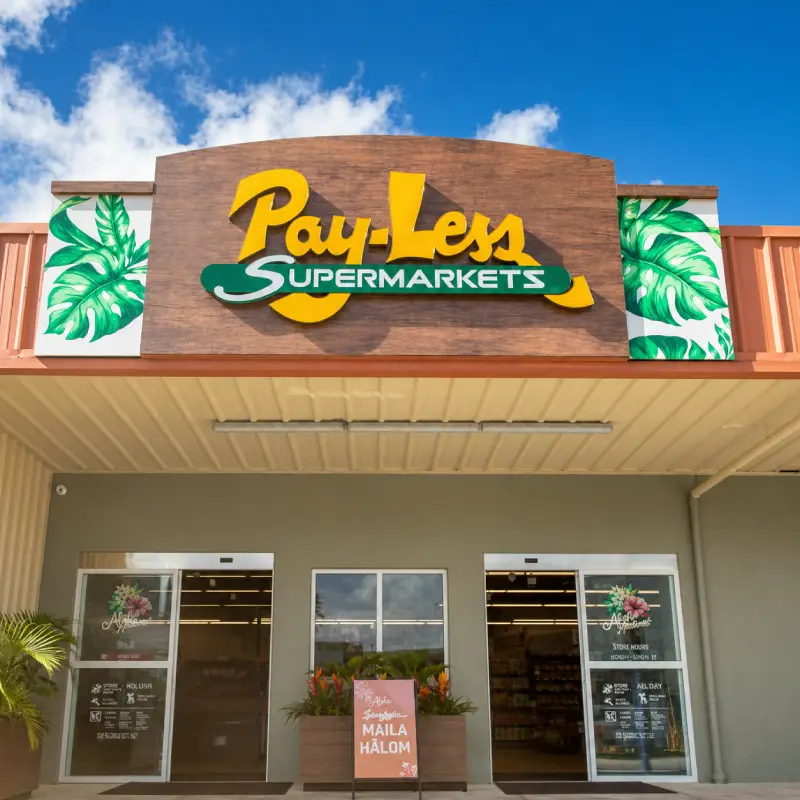
Pay-Less Supermarkets is one of the leading retail chains in Guam, serving local communities with a wide assortment of grocery and everyday products. Operating in a highly competitive and logistically complex island market, Pay-Less focuses on operational efficiency and consistent in-store execution to maintain strong performance.
The Challenge: Manual Processes and Limited Control
Prior to the implementation of LEAFIO AI, Pay-Less relied heavily on manual and fragmented processes for merchandising and planogram management.
The process relied on constant coordination between category managers and store teams, which slowed down updates and made execution difficult to control.
Key challenges included the following:
- No centralized system for planogram creation
- Low store compliance
- Limited visibility into execution
- Lack of analytics to evaluate planogram effectiveness
“Before LEAFIO AI, our merchandising and planogram processes were highly manual and lacked visibility at the store level. We were spending too much time coordinating updates and still didn’t clearly understand what was actually working.”
Consequently, the team lacked a clear method to assess the actual effect of changes on sales.
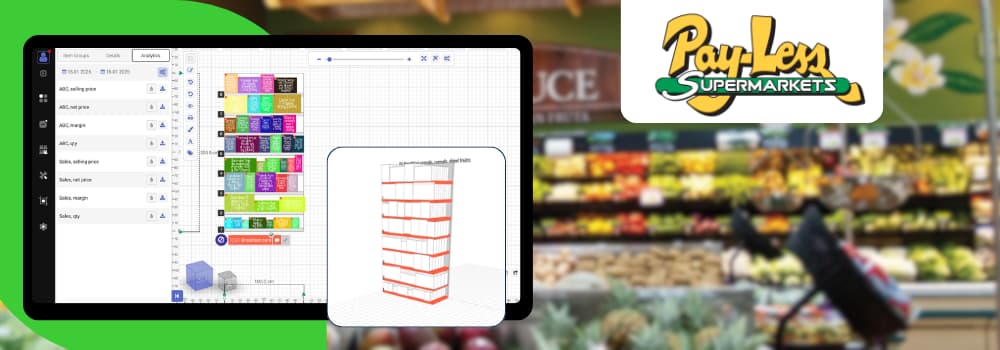
The Turning Point
The key trigger for change was the need to automate planogram generation based on real sales data.
Pay-Less sought to eliminate manual processes and create a system that would enable quick, consistent merchandising decisions based on actual performance.
Why LEAFIO AI
LEAFIO Shelf Efficiency was selected for its ability to directly connect merchandising with real sales and inventory data while also providing strong analytics and reporting tools.
This allowed Pay-Less Supermarkets to:
- Replace assumptions with data
- Centralize merchandising processes
- Gain full visibility into execution and results
Process Transformation
- Automated Planogram Creation
Previously, planograms were created manually, requiring significant time and effort. With LEAFIO AI, they are generated automatically based on real sales data. - More Data-Driven Decision-Making
Decisions were largely experience-based, with limited analytical support. Now, they are fully data-driven. - Improved Execution Visibility
Store-level execution was difficult to track. LEAFIO AI provides full visibility across all locations. - Continuous Feedback Loop
Performance insights were delayed and fragmented. Now, monitoring is continuous.\ - Enhanced Speed of Updates
Updating planograms used to take weeks. With LEAFIO AI, it takes days. - Less Manual Effort, More Strategic Focus
Teams spent significant time on routine tasks. Automation reduced manual workload.
| Aspect | Before LEAFIO AI | With LEAFIO AI | Why It Matters |
|---|---|---|---|
| Planogram creation | Manual, time-consuming | Automated based on real sales data | Reduces human error and ensures shelves reflect actual demand |
| Decision-making | Subjective, experience-based | Data-driven and analytics-backed | Improves accuracy of assortment and increases sales potential |
| Execution visibility | Limited visibility at store level | Full transparency across stores | Enables faster identification of issues and corrective actions |
| Feedback loop | Weak, delayed | Continuous performance monitoring | Creates a closed loop between planning and execution |
| Speed of updates | Weeks to implement changes | Days to update and deploy | Allows faster response to demand changes and trends |
| Workload | High manual effort | Significantly reduced through automation | Frees up time for strategic tasks instead of routine work |
Key Reports Used for Decision-Making
At this stage, the Payless team relies on several core reports within the system that provide the most actionable insights for daily merchandising decisions.
- Shelf Productivity Report: This report shows how efficiently each shelf space generates revenue. It helps the team understand which categories and products deliver the highest return per meter and adjust space allocation accordingly.
- Planogram Compliance Report: The report tracks how accurately stores follow the assigned planograms. It allows the team to quickly identify execution gaps and ensure that merchandising strategies are consistently implemented across all locations.
- SKU Performance Report: This report provides detailed insights into the sales performance of individual products. It helps identify top-performing items as well as underperformers, enabling timely assortment optimization and better product placement decisions.
Key Results
Even within a 1-month trial period, Pay-Less achieved clear improvements by implementing planograms, analyzing their performance, and adjusting execution accordingly.
Sales performance showed a 6% increase, indicating an overall uplift driven by improved shelf organization and more effective product placement. By aligning planograms with real demand, stores were able to convert shelf space into higher revenue.
At the same time, profit grew by 3.6%, reflecting better margin management through optimized assortment and smarter allocation of shelf space. This suggests that not only more products were sold, but they were also better positioned from a profitability perspective.
In terms of volume, units sold increased by 6.6%, highlighting improved product availability and visibility. Customers were more likely to find and purchase the right products, thanks to clearer and more efficient shelf layouts.
Together, these results confirm that even at the pilot stage, structured and data-driven merchandising can deliver both top-line growth and operational improvements.
| Metric | Improvement | Business Impact |
|---|---|---|
| Sales Dynamics | +6% | Indicates overall uplift driven by better shelf organization and more effective product placement aligned with real demand. |
| Profit Dynamics | +3.6% | Shows improved margin through smarter assortment and placement — not just more volume, but better profitability per unit. |
| Units Sold | +6.6% | Reflects increased product availability and better visibility. Customers found and purchased the right products more consistently. |
“With LEAFIO AI, we were able to automate planogram creation and significantly speed up updates. What used to take weeks now takes days, and we finally have clear visibility into how our merchandising decisions impact sales.”
These results were measured against a comparable store, confirming the direct impact of data-driven merchandising.
Operational Improvements
In addition to financial gains, Pay-Less also achieved meaningful process improvements:
- Reduced manual workload for category managers
- Faster planogram updates (from weeks to days)
- Improved control over in-store execution
- Better alignment between planning and actual shelf performance
Conclusion
By implementing LEAFIO Shelf Efficiency, Pay-Less Supermarkets transformed merchandising into a centralized, data-driven process.
The company now operates with the following:
- Greater speed
- Better visibility
- Stronger execution control
Most importantly, merchandising decisions are now based on real data, enabling consistent, measurable impact on both sales and profitability.