
Artificial intelligence is no longer just something found in sci-fi movies but a key success factor in retail today. In fact, the global AI in the retail market was valued at USD 5.43 billion in 2024 and is projected to reach USD 41.23 billion by 2033. The retail supply chain is part and parcel of that – this area has experienced a lot of changes in recent years, and supply chain planners are actively implementing advanced technologies that show enormous potential.
The retail supply chain is complex and involves the work of many departments, including procurement, quality control, and manufacturing, but AI-powered supply chain management solutions are providing retailers with more and more opportunities to improve these processes and gain deeper insights into supply chain data.
In this article, we will look at how AI in supply chain operations works and the challenges and benefits of implementing specialized AI solutions.
Key Takeaways
AI in supply chains cuts costs & adapts faster to shifts.
Predicts disruptions early.
Automates reorder decisions.
Optimizes multi-echelon inventory.
Forecasts transport capacity.
Enables scenario planning.
AI in supply chain: examples and explanation
The use of AI in supply chain management is manifold, from monitoring product quality and balancing inventory levels to identifying the most efficient delivery routes. It optimizes supply chain operations, improves decision-making, increases efficiency, and reduces risk. Here are a few examples:
- Automation. With AI-based solutions, retailers can automatically create and manage purchase orders, monitor shipping processes, notify partners of delivery times, and more. Most routine processes can be automated, reducing the workload of managers and supply chain professionals and minimizing the number of ordering errors.
- Data analytics and machine learning algorithms. Machine learning algorithms are employed to analyze huge amounts of data from various sources in real time. Algorithms can detect patterns and anomalies, indicating potential delays or bottlenecks. Data-driven insights can improve efficiency, reduce costs, and increase customer satisfaction.
- Predictive algorithms. Retail predictive analytics leverages data and statistical algorithms for demand planning and procurement. For example, a store can prepare for the coming Christmas season by using predictive analytics to find items most likely to see higher or lower sales.
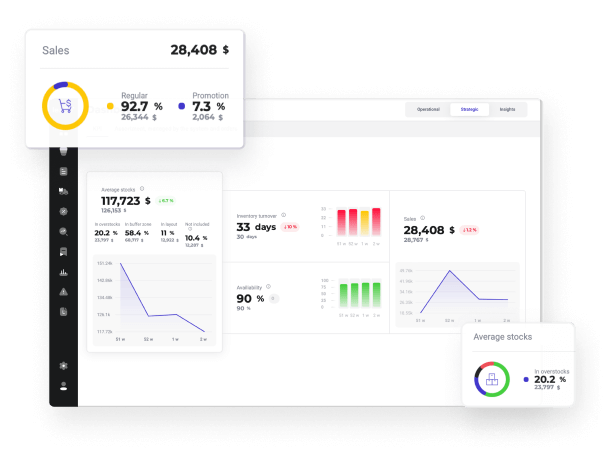
In the past, traditional supply chain management relied heavily on historical data and intuitive decision-making. Today, however, this approach lacks the precision needed to navigate the complexities of modern supply chains. AI is significantly better at precise forecasting needed for ordering optimal quantities of goods to meet demand. This demonstrates its ability to identify patterns and connections that are often invisible to humans or non-AI systems. This leads to a growing demand for AI systems: the global AI in Supply Chain Market size is expected to grow at a CAGR of 42.7% during the forecast period from 2024 to 2033, according to Market.us.
Top 5 Benefits of AI in Supply Chain
Various forms of AI-based technologies can provide a number of benefits to retailers seeking to optimize their supply chains. Here are just the main ones:

#1 Unmatched Efficiency
AI in supply chain management helps optimize operations by automating routine tasks and reducing the time and effort required to manage supply chains, which allows supply chain managers to focus on more strategic tasks. For example, after the implementation of the AI-based solution LEAFIO Inventory Optimization, 99.5% of replenishment orders in Daily supermarket chain are generated and sent by the system automatically without the need for managerial intervention.
#2 Data-driven Decision Making
Artificial intelligence is able to make fast and accurate data-driven decisions that increase operational efficiency. In addition, real-time insights and predictive analytics enable professionals to make more informed management decisions in response to changing market conditions and global events.
#3 Cost Savings & Resource Optimization
According to a 2024 McKinsey survey, organizations are already seeing material benefits from AI use, reporting cost decreases in the units deploying the technology. In 2022, respondents reported that the highest cost cuts owing to AI are in supply chain management.
AI for supply chain management reduces operational costs by automating repetitive tasks, minimizing errors, and improving demand forecasting accuracy. It also enables smarter resource allocation by analyzing data with a wide range of influencing factors, ensuring inventory, labor, and transportation are used more efficiently.
#4 Predictive Power
By analysing historical sales data, market trends, and manual inputs (or personal insights), AI supply chain planning solutions can build highly accurate forecasts. By taking into account a variety of factors, AI can precisely predict customer demand and market trends, recommending optimal inventory levels for different products based on the forecasts.
#5 Improved Customer Experience
AI enhances customer experience by accurately predicting demand, ensuring popular products are in stock whenever and wherever customers need them. Through real-time data analysis, AI helps optimize delivery routes and reduce shipping times. As a result, customers receive faster service, fewer stockouts, and a more seamless shopping journey.
Where AI in Supply Chain is Making the Biggest Impact
Let's take a look at the areas in which AI-based solutions are showing their full potential and contributing to the improvement of supply chain management efficiency.

Demand Forecasting & Inventory Management
Retail Week’s annual Supply Chain 2024 report says that one of the retailers’ paramount supply chain and IT priorities is achieving more accurate stock levels. AI-powered systems can automatically manage the flow of goods to meet retail demand, ensuring that the right products are delivered to stores at the right time and in the right quantities.
LEAFIO Inventory Optimization software ensures demand planning, automates order generation, on-time replenishment, and keeps every level of the supply chain running smoothly. Using this solution guarantees highly accurate orders. According to the results of LEAFIO projects, the system helps retailers increase sales by 8%, reduce waste by 15%, reduce excess inventory by 50%, and accelerate inventory turnover by 30%.
Procurement
With AI-powered automation, retailers can significantly accelerate and enhance the procurement accuracy through auto-ordering. Intelligent algorithms handle orders without human intervention, freeing staff from routine tasks and allowing them to focus on more strategic priorities. AI technologies work with financial management systems to authorize and document expenses and create a clear audit trail for future cycles.
Product Lifecycle Management
In the field of product lifecycle management, strategic alignment, innovation, steadfast planning, and foresight are always the priority aspects. This is exactly what artificial intelligence was made to do since it expands problem-solving capabilities, allowing product managers to decipher complexities, predict future trends, and effectively mitigate risks.
Predictive Analytics
Companies can prepare to respond to potential risks that could arise anywhere in the supply chain by using predictive analytics that run scenarios based on historical data to determine possible outcomes.
Risk Management
AI algorithms are used to predict and identify potential risks in supply chain management. For example, to predict possible supplier failures or market fluctuations. This allows businesses to develop effective contingency plans and increase supply chain resilience.
Assortment Planning
AI-powered assortment planning ensures that you have the right mix of products to meet customer demand, increasing sales and satisfaction. It helps to optimize inventory, reduce overstocks and shortages, and improve supply chain efficiency.
For example, LEAFIO Assortment Planning software simplifies the creation of an assortment management strategy, provides convenient tools for product range optimization, and analyzes the sales performance of each item in the assortment matrix. The solution provides companies with accurate data to understand which products are suitable for what store.
What are the Challenges of Using AI in Supply Chains
The AI-technology implementation in a company's supply chain operations is not a one-day task. Moreover, it is associated with certain challenges that may slow down the company's decision-making on changes in supply chain management.
Data Privacy and Security
The integration of AI solutions involves the transfer of large amounts of data and access to existing company systems, which raises concerns about data confidentiality (especially when using cloud services). Therefore, the availability of reliable encryption methods and secure access control is an important part of the AI integration process. It is also necessary to regularly audit the system to identify and eliminate security risks.
AI Integration with Legacy Systems
An important obstacle to innovation is the integration of AI into the legacy supply chain planning system. Many companies still work with outdated on-premises systems that cannot instantly integrate with new AI technologies. Existing software needs to be designed to integrate with modern AI solutions, or there will be compatibility issues and disruptions in the system's functionality.
Skilled Workforce
For artificial intelligence to reach its full potential in the supply chain, skilled employees remain a fundamental factor. It's essential that your team understands the value of new technologies and is willing to learn and adopt them. Fortunately, modern providers like LEAFIO AI not only implement the system and optimize business processes but also offer comprehensive user training along with ongoing expert and technical support.
High Initial Investment
The lack of understanding of the long-term ROI of AI implementation causes management to fear initial costs, which is why many companies resist new solutions. Indeed, the upfront costs of AI implementation, including software, hardware, and skilled personnel, can be high. However, after a thorough cost-benefit analysis, anyone can see that the efficiency gains justify the initial investment.
How to Get Started with AI in Your Supply Chain: A Step-by-Step Action Plan
Here are some tips on how to set up the process of implementing artificial intelligence in supply chains to create maximum value.

Step 1: Assess Your Current Supply Chain
Analyze key areas of the supply chain to identify bottlenecks, slowdowns, repetition, errors, or tasks that require too many resources. Determine where AI can have the greatest impact on your processes and increase efficiency. Focus on high-impact areas such as inventory management, demand forecasting, or logistics optimization.
Step 2: Selecting the Right AI Solution for Your Needs
Choose AI platforms or tools that meet the needs of your supply chain. When choosing AI tools, it is important to consider factors such as business size, supply chain complexity, suppliers, supply chain partners, and specific needs. Ensure that the AI systems can scale as your needs grow, including your data load.
Step 3: Testing and Piloting Retail AI Solutions
After selecting a technology provider, the company begins the implementation process. At the initial stage, it is important to test the software before full deployment to all processes. This is necessary to implement the solution with minimal disruption to the company's operations. In addition, after the pilot phase, certain bottlenecks may be identified that need to be worked out before scaling up.
Step 4: Full Integration and Scaling
Provide your supply chain managers with the necessary training to ensure that they understand all aspects of the new solution and fully utilize its potential. The process of full integration should be carried out in close cooperation between the responsible department of the company and the project team of the software provider
Step 5: Continuously Optimize and Refine
Once fully implemented, continuously monitor and evaluate the effectiveness of AI, making adjustments as necessary. Regularly track the impact of the new solution on key indicators and adjust algorithms according to the results. Use real-time analytics to continuously optimize supply chain systems powered AI.
Conclusion: Is Your Supply Chain Ready for AI?
Artificial intelligence in supply chain operations promises greater efficiency, enhanced supply chain visibility, and adaptability across every stage – from demand forecasting to inventory management and logistics. By automating routine tasks and unlocking powerful data insights, AI empowers businesses to make faster, smarter decisions. As a result, companies can reduce costs, respond to market changes in real time, and create more resilient supply chains. Now is the time to evaluate your readiness and take the first steps toward AI adoption – whether it's investing in predictive analytics, automating warehouse operations, or assortment optimization.
Embracing AI doesn't require a complete overhaul, but it does require vision and a willingness to evolve. Remember, AI in the supply chain isn’t just a fad – it’s the foundation of the future supply chain transparency, and it is going to reshape how goods move and decisions are made across the globe.
AI in Supply Chain FAQ:
What is the new technology in the supply chain?
The latest technologies based on artificial intelligence and machine learning models are no longer just the future of global supply chain management. These are modern solutions that are already being actively used by companies in many areas from route planning to inventory balancing.
How is AI used in supply chain optimization?
Companies are using AI for supply chain to optimize delivery, warehouse management, inventory control, demand forecasting, and assortment management, as well as to help ensure security in global supply chains.
What challenges should companies consider when implementing AI in supply chains?
Most challenges faced by retailers and supply chain organizations when implementing artificial intelligence in supply chain management have to do with privacy and security, AI integration with legacy systems, the need for a skilled workforce, and the necessity of high initial investment.


Have a question?

Kristi Miller
Retail optimization expert