


But growth comes with pain and competition. C-stores face labor shortages, operational inefficiencies, shrinkage, space constraints, and supply chain disruptions caused by instability. As pressure mounts, AI technologies are gearing up to help convenience retailers reimagine every shelf, every stockroom, and every second of the shopping journey.
In this article, we look at how AI is shaking things up and why it’s a game-changer for staying competitive and increasing profits.
С-store AI Application and Real-life Examples
These are the latest examples of how artificial intelligence is tackling the significant industry challenges.
Smarter checkout: AI-powered automation
Long queues are deal-breakers for c-store customers. When it comes to instant gratification, every second counts, and the industry is moving toward AI-enabled, cashierless checkout systems.
For example, Wesco, a Michigan-based chain, introduced AI-powered self-checkout Mashgin kiosks that use computer vision to identify multiple items at once without barcodes. As a result, checkout times are down and customer satisfaction is up.
Robotics and labor optimization
The labor crunch is real. AI-driven robotics is stepping in to help with repetitive in-store tasks.
In Japan, Telexistence has installed its TX SCARA robots in 300 FamilyMart stores. These bots autonomously restock refrigerated shelves around the clock, dramatically reducing labor costs and ensuring availability.
Inventory management
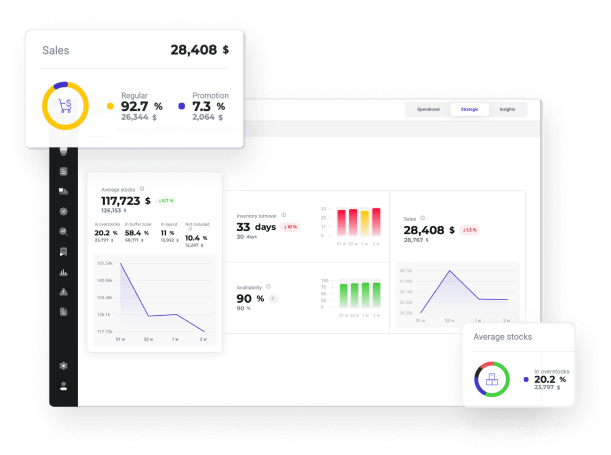
Inventory is both a lifeline and a liability. Too much stock shrinks margins; too little stock, and customers might take their business elsewhere. AI platforms help c-stores forecast demand, track goods in real time, and automatically place replenishment orders with unprecedented precision.
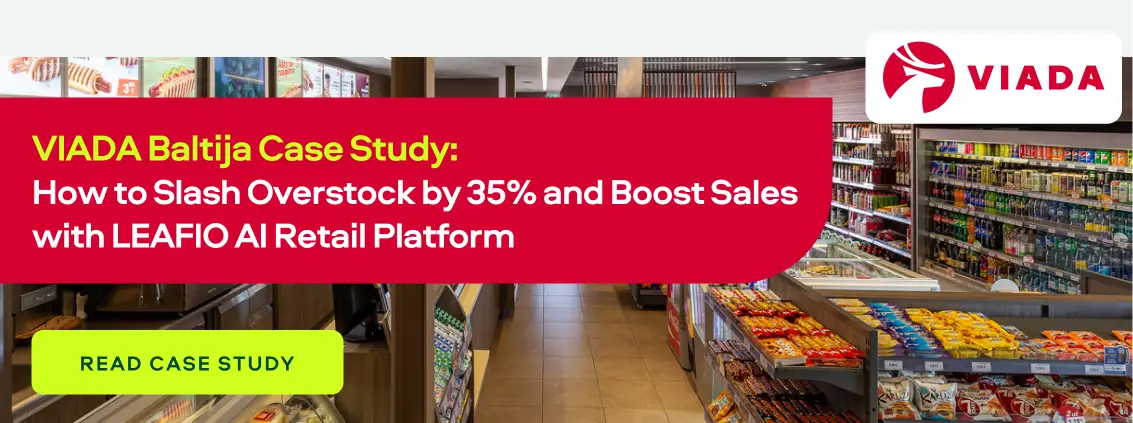
The impact of AI on these sensitive processes becomes evident almost immediately upon implementation, especially when compared to manual operations. Take Viada Baltija. After implementing the AI-powered platform across its convenience store network, the chain reduced overstock by 35% and decreased missed sales by 29%—all within just six months of implementation.
Theft and loss prevention
Preventing product spoilage and theft is equally critical. Spoilage is addressed through accurate forecasting and automated replenishment, while theft prevention is enhanced by computer vision and AI-driven detection of suspicious shopper behavior. In fact, AI is expected to identify new and evolving theft patterns, with blocked theft incidents to increase by up to 25% in 2025.
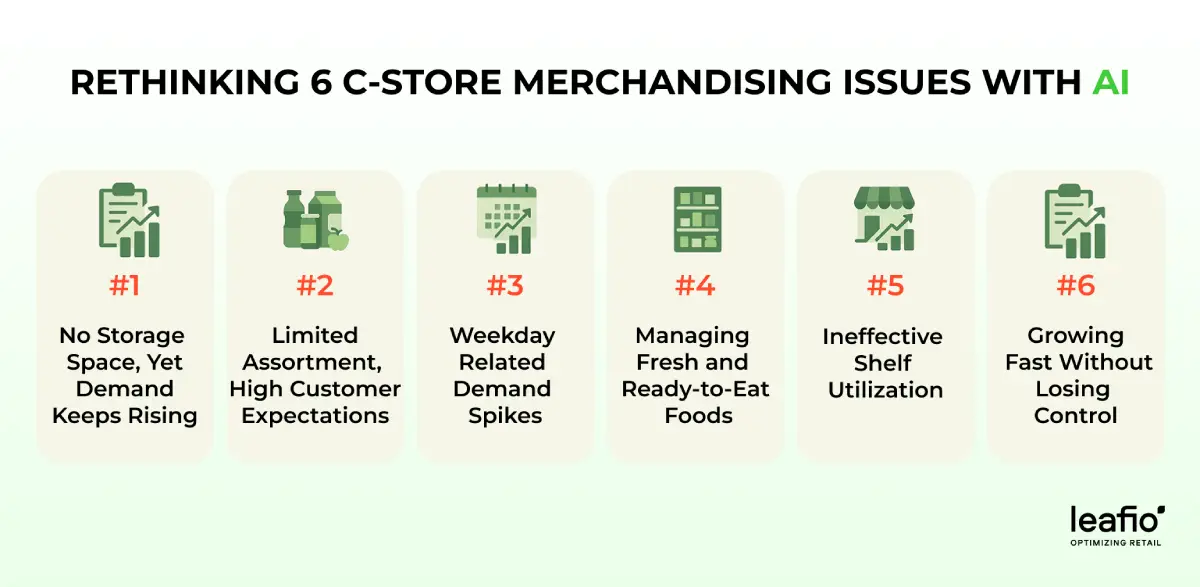
Rethinking 6 C-store Merchandising Issues with AI
Inventory, assortment, and shelf space are three tightly interwoven pain points for c-store operators. Let’s explore key merchandise-related challenges for convenience stores and how AI solves them.
#1: No Storage Space, Yet Demand Keeps Rising
Convenience stores operate within extremely limited square footage, which leaves little room for excess inventory. Yet customer expectations remain high—they always want their favorite products available. Striking a balance is difficult: ordering too much leads to spoilage and markdowns, while understocking risks empty shelves and lost revenue. AI tackles this dilemma with precision.
AI software enables retailers to work in an "empty warehouse" mode, where daily demand forecasting and automated replenishment minimize tied-up capital while ensuring high availability. Additionally, by building a multi-echelon supply chain and leveraging intelligent shelf planning tools, stores can maintain optimal stock levels, streamline product placement, and increase profitability per square meter.
#2: Limited Assortment, High Customer Expectations
Due to their compact size, convenience stores face inherent constraints in product assortment. Yet customers still expect variety and relevance. Failing to offer the right mix leads to either missed sales or overstocked items that waste valuable shelf space. In this delicate balancing act, AI helps retailers craft a highly optimized assortment.
Intelligent analytics allow stores to assess SKU performance across locations, identify top-performing items, and phase out underperformers with minimal risk. AI also supports forecasting for new product launches, ensuring that changes to the assortment are data-driven and aligned with customer demand.
Combined with real-time shelf analytics and margin data, these capabilities allow convenience stores to adapt planograms dynamically and maximize every inch of retail space, leading to higher profitability, more satisfied shoppers, and fewer costly inventory mistakes.
That’s why Quality Oil, a major gas station chain based in North Carolina, chose an AI-powered platform. With seamlessly integrated assortment and shelf management modules operating as a unified ecosystem, the company can now optimize its product mix and make the most of every valuable inch of store space.
#3: Weekday Related Demand Spikes
Customer demand in convenience stores isn’t just about location—it shifts dramatically depending on the day of the week, holidays, and even weather conditions. Trying to keep up with these patterns manually or with outdated systems can result in costly outcomes.
AI offers a smarter path forward. By automatically applying a demand variability index, factoring in existing stock, goods in transit, and supplier constraints, AI solutions enable retailers to fine-tune their order volumes for each delivery cycle. They can also filter out atypical spikes, like sudden holiday rushes, to avoid skewing future forecasts. As a result, convenience stores can maintain optimal stock levels, reduce waste, and better align inventory with actual customer behavior.
#4: Managing Fresh and Ready-to-Eat Foods
Managing fresh and ready-to-eat food in convenience stores is particularly complex due to short shelf lives, frequent deliveries, and fluctuating demand. Overestimating demand leads to spoilage and write-offs, while underestimating means empty shelves and lost sales. AI deals with these challenges by analyzing historical sales, factoring in expiration dates, supplier delivery windows, and weekly demand shifts to optimize replenishment.
By implementing AI in the order management system, Baltic Petroleum cut write-offs in the Sandwiches category from 11% to just 1.9% in two months. Meanwhile, a 50% reduction in overstocks and a boost in sales allowed the system to pay for itself in just three months.

#5: Ineffective Shelf Utilization
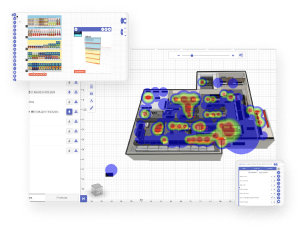
A convenience store needs to follow the correct merchandise placement to provide maximum convenience for the customer and increase sales for the chain. Given the small space, it is critical to monitor the effectiveness of different types of layouts quickly. AI-powered tools are transforming this process by enabling stores to build effective planograms not only through analysis of historical sales, but also by leveraging forecasted demand. This shifts visual merchandising from reactive to proactive, where shelf layouts are guided by future expectations rather than past performance alone.
In addition, AI provides on-shelf image recognition using photo reports or real-time camera feeds, identifying where stock is missing or not yet displayed. This allows retailers to quickly correct inefficiencies on the shop floor, ensuring shelves remain full and attractive to the customer.
#6: Growing Fast Without Losing Control
Expanding the network is critical for profitability in the convenience store sector. For instance, 7-Eleven plans to open 500 new stores between 2025 and 2027, with 125 scheduled for 2025 alone. However, scaling up brings up its own set of challenges. Without the right systems in place, opening new locations becomes a resource-intensive process, often requiring extensive manual planning, assortment curation, and planogram development.
This is where AI brings transformation. Modern platforms help unify and standardize key retail processes—from demand forecasting and replenishment planning to assortment strategy and shelf space optimization. When opening a new store, the system can generate accurate initial demand forecasts by referencing data from similar existing locations. It can also create adaptable format planograms in just a few clicks, ensuring a smooth and profitable rollout.
By eliminating guesswork and manual labor, AI empowers retailers to expand rapidly while maintaining high operational efficiency and consistency across the chain.
To Sum Up
The convenience store of the future is not just a place to shop—it’s a smart, adaptive, and hyper-efficient space. Multiple case studies demonstrate measurable improvements in stock accuracy, product availability, reduced waste, and increased profits. That is why AI is no longer just a nice thing to have; it has become a must-have tool for convenience retailers who want to stay ahead.


Have a question?

Jack Larson
Retail Optimization Expert


