
Baltic Petroleum, an 86-store gas-station convenience retail chain in Lithuania, increased sales by 62% and reduced overstock by 50% after deploying LEAFIO Inventory Optimization and LEAFIO Shelf Efficiency together on a single platform. The project reached payback within one month and delivered a 1,581% ROI in the first year, alongside a 13% inventory turnover improvement and a 9% reduction in lost sales. By centralizing ordering from 84 store managers to 4 head-office specialists and digitizing planogram management across ~2,500 SKUs, the chain eliminated manual Excel processes and gained full control over inventory and shelf execution.
Results at a Glance
Timeframe: first year post go-live; payback within 1 month; fresh improvement within 2 months.
| Metric | Result | Context / Period |
|---|---|---|
| Sales increase | +62% | Planogrammed categories, LFL comparison |
| Overstock reduction | −50% | Network-wide |
| Inventory turnover improvement | +13% | Network-wide |
| Product availability improvement | +8% | Network-wide |
| Lost sales decrease | −9% | Network-wide |
| ROI — first year | 1,581% | Net profit from sales growth & cost reduction |
| Payback period | 1 month | From go-live |
| Ordering headcount | 84 → 4 specialists | Store managers → head-office centralization |
| Manual ordering time eliminated | ~168 man-hours/cycle | ~2 hrs × 84 stores |
About the Client
Baltic Petroleum is a leading fuel and convenience retail operator in Lithuania, running a network of 86 gas-station convenience stores with approximately 2,500 SKUs. Its outlets offer locally prepared food, hot drinks, and packaged food and non-food items, combining the fuel-retail and c-store (convenience store) segments. The chain manages stock and merchandising centrally from its head office across the entire Baltic network.
The Challenge: Decentralized Ordering and Manual Merchandising Across 86 Gas Stations
Before LEAFIO AI, Baltic Petroleum had no centralized inventory or merchandising tools. Every gas station manager acted independently, and the head office had no real-time visibility into stock health or shelf execution.
| Decentralized ordering | 84 station managers placed manual orders (~2 hrs each = 168 man-hours/cycle), causing overstock, errors, and zero head-office visibility. |
| No inventory analytics | Internal focus was on sales/margin only. No operational visibility into surplus, lost sales, availability, or turnover. |
| Promotional stock gaps | Promo data was maintained in Excel, disconnected from ordering, causing overstock or shortages on promoted lines. |
| No assortment matrices | A single matrix applied to all store formats; managers often ordered far fewer SKUs than the active matrix allowed. |
| Zero merchandising process | No planograms across categories (except a basic beverages spreadsheet), no space standards, and no compliance tracking. |
| Fresh write-off inaccuracy | The monthly write-off cycle led to inaccurate inventory balances and unreliable fresh replenishment ordering. |
The Solution
Baltic Petroleum deployed the LEAFIO AI Retail Platform as a unified convenience store management software, running LEAFIO Inventory Optimization and LEAFIO Shelf Efficiency simultaneously on a shared data layer. This platform approach meant that replenishment decisions and planogram data stayed in sync from day one, giving the head office a single source of truth for both stock and shelf execution across all 86 gas-station convenience stores in Lithuania.
LEAFIO Inventory Optimization: Centralizing Replenishment
Ordering was centralized from 84 gas-station managers to 4 head-office specialists, eliminating approximately 168 man-hours of manual work per ordering cycle and removing the human errors that came with decentralized store-level decisions.
Dynamic assortment matrices replaced the single-matrix-for-all approach, giving category managers format-specific, data-driven tools to plan replenishment accurately across the entire 86-store network.
Fresh category management was overhauled by revising the write-off process in both field operations and the accounting system, replacing the previous monthly stocktake cycle with system-driven Fresh-algorithm ordering that reflects accurate real-time balances.
Promotional stock planning was integrated directly into the ordering system, eliminating the Excel-based process that had previously caused overstock and shortages on promoted lines.
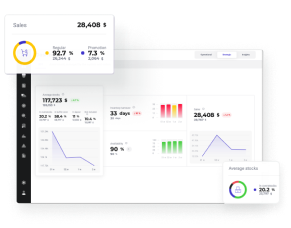
The team gained access to 40+ analytics reports, including Supplier Reliability and Phantom Inventories, alongside a visual inventory dashboard for real-time monitoring of surplus, availability, lost sales, and turnover.
LEAFIO Shelf Efficiency: Digitizing Planogram Management
A full planogram management lifecycle was introduced for the first time across all product categories, covering creation, distribution, implementation, and compliance control, replacing a process where individual stores made shelf placement decisions independently.
A dedicated head-office merchandiser role was created to own the merchandising function end-to-end, based on recommendations from the LEAFIO AI implementation team.
The analytics module gave Baltic Petroleum's team structured visibility into shelf performance through four core reports: the Assortment Report to verify category coverage, the LFL Report to track sales dynamics in pilot categories, the Layout Efficiency Report to measure planogram performance against peer stores, and the Task Dashboard to monitor execution progress.
Both solutions run on a unified data exchange platform, eliminating the silo between inventory and shelf teams and ensuring that replenishment decisions and planogram data stay in sync across the network.
What the Client Said
“Implementing LEAFIO Inventory Optimization has revolutionized our operations. The implementation period required a lot of our resources and some changes to our business logic, but after LEAFIO AI was implemented, it automated the order process, minimizing human involvement and ensuring meticulous control at every stage. By optimizing our personnel’s time, we’ve enhanced our focus on customer service and operational efficiency. The comprehensive analytical reporting further empowers our decision-making, making us more agile and responsive in managing our business.”
— Edvin Bachšijan, CEO, Baltic Petroleum
Operational Impact
The shift from decentralized, store-level decision-making to centralized, data-driven management transformed how the entire Baltic Petroleum network operates.
| Before LEAFIO | After LEAFIO |
|---|---|
| 84 station managers placing manual orders | 4 head-office specialists managing the entire network |
| ~168 man-hours consumed per ordering cycle | Fully automated — manual ordering time eliminated |
| No planograms (except 1 category in Excel) | Full planogram lifecycle across all categories, all 86 stores |
| No dedicated merchandising role | Head-office merchandiser position created |
| Sales/margin focus only — no inventory KPIs visible | 40+ reports + live dashboard: surplus, lost sales, availability, turnover |
Conclusion
Baltic Petroleum’s results show what is possible when inventory replenishment and shelf execution are managed on a single AI platform. Eliminating 168 man-hours of manual ordering per cycle, building format-specific assortment matrices, and introducing a full planogram lifecycle across 86 stations moved the chain from reactive store-level decisions to proactive, head-office-led operations, delivering 1,581% ROI in the first year.
Frequently Asked Questions
By deploying LEAFIO Inventory Optimization and LEAFIO Shelf Efficiency on a unified platform, Baltic Petroleum centralized ordering from 84 store managers to 4 head-office specialists, built dynamic assortment matrices, and digitized planogram management across all 86 stations. The result: overstock fell 50% while sales grew 62%.
Baltic Petroleum runs the LEAFIO AI Retail Platform—specifically LEAFIO Inventory Optimization for automated replenishment and demand-driven ordering and LEAFIO Shelf Efficiency for end-to-end planogram creation, execution, and compliance tracking.
The project reached payback in one month and delivered a 1,581% ROI in the first year, driven by 62% sales growth, 13% faster inventory turnover, reduced ordering headcount, and lower operational costs.
Ordering was fully decentralized: 84 gas-station managers placed manual orders using Excel schedules, consuming ~168 man-hours per ordering cycle and generating persistent overstock, errors, and no visibility into inventory KPIs.