

The term big data in retail gets thrown around so often, it’s easy to forget that not all data is big, and not all big data is useful. For many retailers, the path to data-driven decisions is littered with outdated history, inconsistent formats, and dashboards that tell them what they already know.
While big data holds the promise of revolutionizing everything from inventory to pricing, most retailers are still struggling to harness its real value because they’re swimming in information but starving for insight.
More Doesn’t Mean Better: The Trash Data Trap
Retailers often believe they are data-rich simply because they store terabytes of transactions, sales, and stock levels. But we always say: That's not big data—that’s flat data. Ten years of POS logs don’t explain why something happened. They just tell you that it did.
This is where the trash data problem begins. Huge databases:
- Lack contextual signals (e.g., promotions, holidays, weather)
- Don’t distinguish regular sales from markdowns or outliers
- Combine clean and corrupted entries without clear labels
When these datasets are fed into forecasting models, the results are misleading at best and costly at worst.
In fact, up to 80% of a data science team’s time is spent just on cleaning and organizing data, not even modeling it. In retail, this time sink is compounded by the scale and complexity of SKU portfolios, regional store behaviors, and frequent changes in assortment.
What Real Big Data Looks Like in Retail
True big data in retail isn’t defined by file size or server capacity. It’s about volume, variety, velocity, and value.
- Volume: Not just large—constantly expanding across channels and devices
- Variety: Structured (e.g., sales logs), semi-structured (e.g., loyalty card usage), and unstructured (e.g., online reviews, video feeds)
- Velocity: Real-time or near-real-time updates, not batch uploads from last week
- Value: Data that drives decisions, not just dashboards
Retailers with mature data ecosystems collect inputs from diverse sources: footfall counters, mobile apps, weather APIs, competitive price trackers, and planogram compliance tools. These inputs allow them to see correlations, predict future demand, and identify root causes instead of just symptoms.
The Hidden Cost of Dirty Retail Data
Picture a typical scenario: a retailer sees declining sales for a certain product. The data says it’s in stock. But what if it’s stuck in the backroom and never made it to the shelf? Or what if the price label is wrong?
This is known as the “out-of-shelf” vs. “out-of-stock” problem, and it illustrates how unverified data can easily mislead even the most advanced systems. Dirty data like this can lead to:
- False low-sales signals. They usually lead to a decrease in orders and the “consolidation” of this false signal in the system. Low sales will be the consequence of insufficient stock. This is a typical trap-mistake in retail.
- Broken forecasts. They fuel both overstocks/write-offs for some SKUs and revenue losses for others.
In one case cited during a strategic session, it was discovered that a high volume of products marked “in store” were actually unavailable to shoppers because they were not displayed on the shelf. These invisible errors cost thousands in lost sales. Yet, they were completely undetectable in raw sales data.
Predictive Analytics Without Clean Data is a Mirage
Retailers increasingly rely on predictive analytics to optimize assortment, pricing, and inventory. However, these models only work if the data foundation is solid. A model trained on blended sales data—without separating promotions, markdowns, or external campaign effects—will produce flawed forecasts.
For instance, one retailer observed vastly different promo outcomes across identical campaigns. They only later realized one was supported by a national advertising push—an event missing entirely from their dataset. Without that context, the model “averaged out” the effect, distorting future predictions.
Data cleaning isn’t just technical grunt work. It is a strategic capability.
It involves:
- Segmenting and labeling historical data properly (e.g., regular vs. promo sales)
- Removing outliers and noise caused by supply issues or external shocks
- Isolating causality from correlation through feature engineering
Why Most Retailers Still Struggle with Big Data
There are four key reasons:
- Operational Immaturity: Many retailers have not yet aligned IT, commercial, and marketing teams around a shared data strategy.
- Lack of Purpose: Data is collected but not linked to decision-making goals.
- Poor Storage Design: Data isn’t stored in the right format or structure for efficient analysis.
- Tech-Over-Hype: Overreliance on machine learning and AI as “silver bullets,” without solving the foundational data issues.

Unfortunately, retailers often invest in machine learning without realizing the machine has nothing meaningful to learn from.
So, What’s the Way Forward?
To unlock the true power of big data in retail, companies must go beyond volume and focus on readiness, quality, and applicability. This includes:
- Defining clear goals for what decisions the data should support (e.g., reducing waste, improving on-shelf availability, preventing stockouts)
- Designing data pipelines that continuously clean, validate, and structure inputs
- Adopting hybrid modeling approaches—combining machine learning with statistical methods where appropriate (e.g., Poisson models for slow movers)
- Embedding insight delivery into daily workflows, not just dashboards
According to McKinsey, retailers that successfully implement advanced analytics at scale can boost operating margins by up to 60%. However, that success hinges not on flashy AI but foundational data discipline.
Conclusion: From Buzzwords to Business Value
Big data in retail is not about how much you store. It's about how much you use wisely. A modern retail organization doesn’t just collect data; it questions it, cleans it, structures it, and puts it to work.
The future of competitive retail will belong to those who:
- Know the difference between raw data and ready data
- Clean before they model
- Focus on action, not accumulation
Because in the end, dirty data doesn’t just cloud your vision—it costs you money.
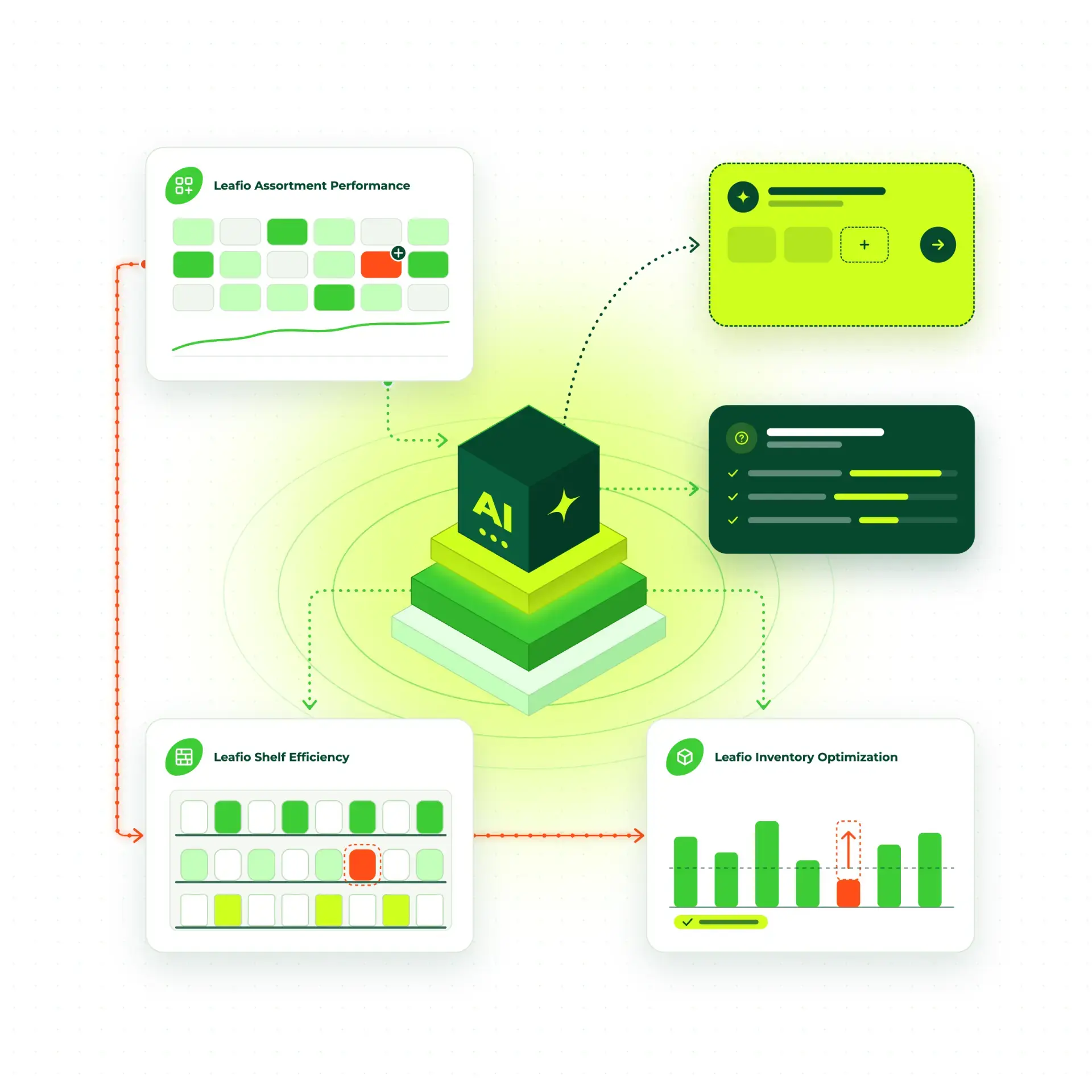
Ready to turn your data into decisions?LEAFIO AI helps retailers go beyond dashboards with clean, structured, and actionable insights. From demand forecasting to inventory optimization, our solutions are built to transform raw data into measurable performance.
👉 Discover how LEAFIO AI can upgrade your retail operations


Have a question?

Ben Starynskii
AI-driven retail transformation expert