
The pressure is on, challenges are mounting, and retailers must stay on their toes to keep their competitive edge. In-depth retail analytics has become integral to modern retailers' strategic planning and daily routine. It comes as no surprise, then, that the retail business intelligence solutions market is estimated to grow by 22%, according to the Retail Analytics Market Size and Share Forecast Report, potentially reaching $7.7B in 2029.
Retail intelligence software helps businesses collect data, analyze trends, and create smart data visualizations. Modern BI solutions help retail companies identify trends, optimize inventory and layouts, and enhance customer experiences.
In turn, a wide range of retail BI solutions is available as stand-alone tools or as part of specialized software. Thus, what is the best choice, and which tools are right for your business?
In this article, we'll explore tools, examples, and trends in business intelligence for retail. Be in the know and read until the end!
Key Takeaways
Retail BI turns data into strategy, driving smarter decisions across operations.
Uncovers sales & margin trends.
Links dashboards to team KPIs.
Tracks inventory vs demand.
Optimizes pricing & markdowns.
Predicts churn & loyalty drivers.
What is Retail Business Intelligence?
BI in the retail industry refers to the analytical software used to collect, process, and analyze vast business data from various sources. Their first goal is to extract actionable insights from vast amounts of retail data to support decision-making across multiple channels and different aspects of the retail operation.
Using BI software, retailers can make informed decisions that enhance operational efficiency, optimize stock and assortment, drive sales, and improve customer service.
Retail BI analytics traditionally encompasses data management, predictive analytics, data visualizations, and other technologies to help retailers run their businesses effectively.
How Would the Retail Industry Use Business Intelligence?
Retail companies widely use business intelligence software to understand current operational issues, customers' preferences, and growing market trends. These tools collect and analyze data from various sources, such as sales transactions, inventory levels, assortment performance, customer interactions, and external market data.
BI systems enable retailers to identify patterns and trends in consumer behavior, optimize inventory management, improve demand and sales forecasting, and personalize marketing efforts.
In a nutshell, business intelligence software for retail enables managers and sales teams to make strategic decisions for staying competitive in today's highly demanding market.
How to Use Business Analytics in Retail: Possible Options
BA tools enable retailers to optimize operations based on market trends and customer behavior. Let's see how this can be done.
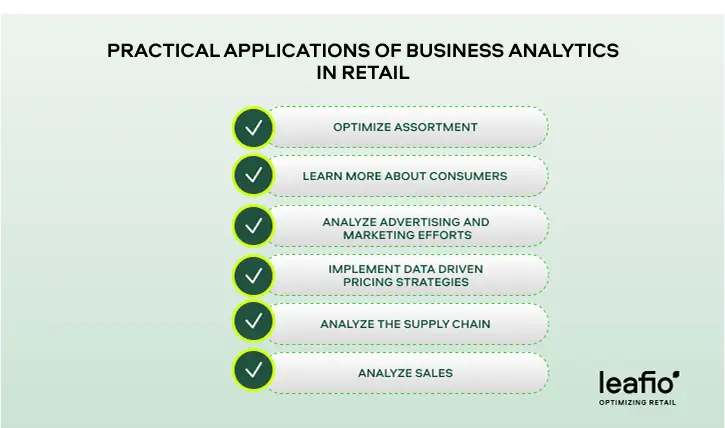
Optimize Assortment
Using BA, find out how to correctly select products for different customer segments or different store branches to reduce shortages and increase sales. Determine what sells poorly and what sells well. Monitor and analyze economic indicators, including gross profit and sales volume. Evaluate the performance of each stock-keeping unit and calculate the product penetration rate. Analyze logistics costs, waste rates, and other service costs. Plan your assortment from a single store to a chain.
Learn More About Consumers
Identify your customers' needs and analyze their behavioral patterns to improve customer experience, increase loyalty, and sales. The system can provide customer segmentation based on various indicators, interaction and experience analysis, as well as analysis of engagement, conversion, and satisfaction, or churn. Additionally, monitor customer profitability with LTV calculations.
Analyze Advertising and Marketing Efforts
Create cost-effective marketing strategies, optimize customer acquisition costs, and reduce churn rate. Track promo campaign results across multiple channels (offline and online), analyze the average basket content in each segment, and monitor customer sensitivity to promotions. Plan cross-sales and discounts, optimize loyalty programs, and model customer choice.
Implement Data Driven Pricing Strategies
Set and change prices according to market conditions, competitor offers, and demand indicators. Reduce dissatisfaction levels and increase profitability through demand analysis, price sensitivity monitoring, lost sales analytics, price benchmarking, as well as modeling initial, discount, and promotional pricing.
Analyze the Supply Chain
Make deliveries as transparent as possible and balance inventory according to demand while reducing transportation costs and minimizing risks. BI systems provide multi-channel inventory monitoring, tracking of inventory in a chain or multiple warehouses, analysis of average turnover ratio, shrinkage, profitability, storage costs, etc. Modern systems forecast optimal inventory levels and ensure automatic ordering, as well as model optimized supply chains.
Analyze Sales
Study indicators and forecast future sales to identify opportunities and reduce operating costs. Track KPIs for each channel, store, region, category, brand, and other indicators. Forecast sales volumes for a specific product category, stock-keeping unit, or brand. Analyze sales team performance and methods. Last but not least, study the consumer basket.
For CPG brands and distributors, retail execution software such as SimplyDepo captures store visits, shelf audits, photos and reorders in one place, helping managers review field activity alongside sales performance.

How to Implement and Scale BI in Retail: Current Challenges
Business analytics can truly transform retail processes. However, the path from investing in system implementation to seeing the first real benefits is long and complex.

Data Quality
Retailers who have not yet implemented modern systems often use the principle of self-service data preparation. Or, data is often stored separately in different sources: ERP, POS, supply chain management tools, etc. It is difficult to bring them together due to incompatibility and the lack of necessary tools.
Solution: Invest in BI tools that can clean, verify, and integrate data. There are platforms on the market that work well with different data sources and have ETL (Extract, Transform, Load) features to make the process better. It's a good idea to start by integrating key sources of info (like inventory data) and move forward slowly until you have one system.
Staff Resistance
Sometimes, the implementation of new software or an entire system is ineffective due to staff reluctance to work with new technologies. This is unfortunate because any program is only as effective as its users.
Solution: Choose partners (system developers) who offer staff training and demonstrate all the benefits not only to management but also to direct users. Invest in training programs for different user groups: from store managers to analysts at the central office. It is important to emphasize that software is not introduced to replace human intelligence but rather to expand and save it from routine work.
Problems With Setting and Evaluating Goals
Without clear, measurable goals, any BI initiatives would lose focus, and no understanding of how valuable they are would be gained.
Solution: Before implementing BI, set specific KPIs. These could be, for example, improving forecast accuracy by X% or reducing inventory shortages by Y%. Set a baseline to track progress. Monitor KPIs and adjust plans as necessary.
Choosing a Solution
Many developers send customer service requests to retailers—the choice of BI solutions is actually very large. Sometimes it is difficult to find a system that can truly meet current needs and scale with business growth.
Solution: Don't just evaluate features. Evaluate vendors. How do they understand your business processes? How do they work with customers? How do they continue to develop? Consider solutions that offer comprehensive capabilities: from integrating data from different sources to analyzing the effectiveness of planograms or marketing channel performance assessment.
Going Beyond Basic Analytics: the Next Stages of Retail BI Development
Although traditional BI systems are capable of providing real-time data, stiffer competition requires additional functionality, but what can the existing business intelligence systems do already?
Forecasting
It is time to implement solutions that can not only respond to historical sales data but also generate forecasts for the future. Predictive analytics is the modern standard. Retail BI is required to recommend specific solutions to achieve desired results, as well as to evaluate the impact of these solutions based on specific measurable indicators.
For example, imagine a system capable of signaling potential product stock depletion during a sale period and automatically placing orders with suppliers to prevent shortages. At the same time, the system can take into account the delivery times of specific suppliers, as well as potential disruptions in the supply chain or even the actions of competitors.
Such solutions, in essence, represent a transition from interpreting complex data to evaluating clear strategies put forward by the system. This greatly speeds up decision-making and reduces risks.
Hyper-personalization
Studying customer behavior and creating personalized offers based on expectations is a must for retail businesses. It is no longer enough to simply segment buyers into general groups. Therefore, with the help of artificial intelligence and machine learning, you can work with hyper-personalization without restrictions:
- manage offers and promotions in the store's mobile app based on individual purchasing patterns and browsing history,
- use mobile tools by salespeople to personalize offers and services,
- adapt the bonus and compensation system to the level of engagement and individual values of each customer.
ESG Achievements
Business users demand accountability from their partners for their impact on society and the environment. BI for retail helps manage such initiatives. This includes:
- Optimizing supply chains to reduce waste (both carbon footprint and packaging waste).
- Generating transparent reports for stakeholders.
- Gaining a clear picture of ESG strategy implementation and identifying areas for improvement.
Top Business Intelligence Tools for the Retail Industry in 2025
LEAFIO AI offers a range of BI tools to support extensive business growth and increased profits. Here are some of the retail management BI solutions and tools provided by LEAFIO AI Retail Platform.
BI Module for Inventory Optimization
LEAFIO Inventory Optimization's retail BI solution gives insights into your operational investments and their potential returns. LEAFIO's advanced BI diagnostic tool helps to meticulously assess your inventory management and supply chain processes through over 40 comprehensive reports and essential retail indicators (LFL, analysis by SKU, lost sales reasons, suppliers, promo, ABC(D) analysis)
In-depth Planogram Analytics
With the in-depth analytics module of the LEAFIO Shelf Efficiency, you can make the right decision regarding layout adjustments and assortment rotation. You can immediately access critical sales performance indicators and reports: LFL, assortment, balances, the layout structure, recommendations for changing facings, the returns ratio, and planogram efficiency calculation.
Assortment Management Analytics Insights
Created with machine learning, LEAFIO's assortment management analytics module constantly analyzes the changes made in the categories and their results. Based on this, LEAFIO assortment performance offers substantial qualitative improvements to help you work with the assortment more efficiently.
Customer Loyalty BI Analytics
LEAFIO’s Loyalty Management BI Analytics is the insight engine that converts raw data into valuable information. It empowers decision-making through detailed reports, such as loyalty program efficiency, customer basket analysis, RFM analysis, marketing activities analysis, email conversion, anti-fraud report, etc.
TMS Analytical Module
With the LEAFIO Rinkai TMS BI module, you can access comprehensive analytics covering the entire period, monitor key metrics, and craft personalized dashboards to suit your specific needs. Last mile logistics solutions allow for overseeing cost overruns, logistics expenses, load management, and customer satisfaction.
Moreover, last mile delivery software enables retailers to optimize drivers' performance and streamline branch operations with ease, ensuring efficient and timely delivery of products to customers' doorsteps while enhancing overall operational efficiency.
Transforming Retail through Business Intelligence Innovations from LEAFIO AI
The utility of business intelligence for retail companies goes much further than simple reports. The latest trends in retail business intelligence include:
- artificial intelligence and machine learning integration for predictive analytics,
- adopting real-time analysis from various data sources for swift decision-making,
- using cloud-based BI tools for scalability and enhanced data security.
As a prime example, LEAFIO AI uses ML as part of the retail business intelligence solution to predict the real effects of promotional campaigns. The tool considers critical retail metrics such as sales performance, product availability throughout the promotional period, the promotion's impact on sales growth, and the remaining product balances after the campaign.
Such in-depth analysis of sales data helps retailers refine their approaches to customer engagement, promotion planning, and executing promotional and marketing campaigns, ensuring they are strategically aligned with current business objectives.
3 Advantages of Business Intelligence in Retail Industry
Retail intelligence software provides the retail sector with the means to make informed decisions based on data-driven insights. Here are the three main benefits of harnessing retail business intelligence implementation:
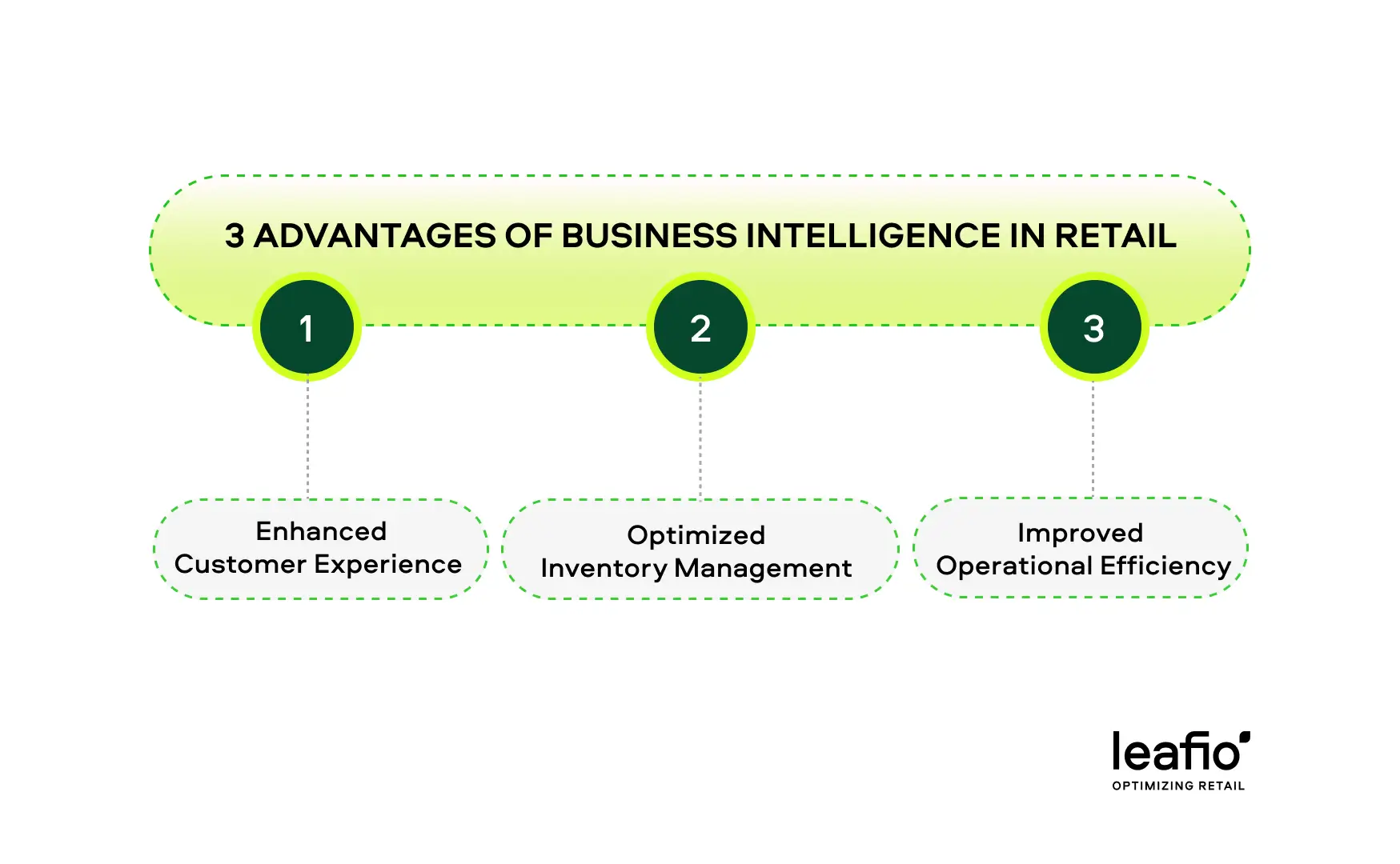
#1: Enhanced Customer Experience
BI tools analyze customer data, including purchasing habits, preferences, and feedback, to offer a tailored shopping experience across customer journeys.
Such a personalized approach enhances the shopping experience and fosters customer loyalty, thus encouraging positive word-of-mouth.
#2: Optimized Inventory Management
Through digital data integration, predictive retail analytics, and financial data analysis, a retail company can forecast supply and demand dynamics more accurately, ensuring the right products are available at the right time without overstocking or stockouts.
Optimization reduces carrying costs, improves cash flow, and maximizes sales opportunities. BI can also highlight trends in product performance, helping retail businesses adjust their inventory and pricing strategies to meet market demands and eliminate underperforming products.
#3: Improved Operational Efficiency
BI in the retail industry streamlines operations by identifying inefficiencies within the retail process, from supply chain logistics to customer relationship management to in-store operations.
How to Measure the Value of Retail Business Intelligence
As we've said already, investments in technology must pay off; this is a fundamental business rule. Business intelligence in retail is not just an operational cost but also a strategic decision to increase profits and gain an advantage over competitors. So let’s take a closer look at how to assess the financial impact of an implemented system.
Cost Reduction and Revenue Growth
BI is primarily seen as a solution for identifying low-efficiency operations: this helps save costs. For example, it refers to inventory optimization to reduce storage expenses and waste. However, BI should also be viewed as a strategic tool for increasing revenue.First and foremost, it’s about customer demand and offering personalization. You can quantitatively assess transactional data and see an increase in the average check or the number of sales per square meter of space.Moreover, the demand forecasting and assortment planning capabilities of BI reduce the need for planning a large number of discounts. As a result, the gross margin increases.
Gaining Strategic Benefits
The return on investment in BI should be evaluated beyond standard financial metrics, as the system encompasses several strategic advantages:
- Improving CLTV or customer lifetime value. By analyzing data and implementing appropriate solutions, you gain a deeper understanding of customers and increase loyalty. Repeat purchase rates and average spending over specific time periods play a key role.
- Faster product launch. BI helps analyze potential opportunities and risks, making it easier to make decisions on updating the product range.
- Increased agility and flexibility. In today’s market conditions, those who quickly adapt to changing consumer trends or new challenges gain the upper hand. Thanks to real-time dashboards and alerts, you can respond quickly based on data: seizing new opportunities or avoiding major losses due to risks.
Key Takeaways
In a highly competitive retail environment, business analytics helps with strategic planning and improving operational efficiency, optimizing assortment and inventory, and enhancing service quality.
BA tools help optimize assortment, study consumer behavior, and analyze everything: from sales to marketing.
Implementing BI involves several challenges that can be overcome by selecting quality tools, responsible data handling, staff training, and defining and tracking KPIs.
Business analytics continues to evolve, and its future lies in hyper-personalization and accurate demand forecasting.
Retail BI FAQ
What is a retail intelligence platform?
A retail intelligence platform is a data-driven technology that collects, analyzes, and interprets vast amounts of retail data to provide actionable insights. Business analytics and business intelligence solutions in retail help to understand market trends, customer behavior, and operational efficiency, enabling them to make informed decisions for optimizing inventory, supply chain management, marketing campaigns, and overall business performance.
What are intelligent systems in retail?
Intelligent systems in retail refer to advanced technological solutions that utilize data analytics, artificial intelligence (AI), and machine learning to optimize retail operations.
What does BI stand for in retail?
BI stands for analyzing retail data for valuable insights, enabling more informed business decisions. Retail business intelligence software helps assess store performance, optimize operations, enhance customer retention, predict and analyze sales performance, manage inventory effectively, and drive sales and profitability through strategic insights.


Have a question?

Mary Makarchuk
Retail Optimization Expert