



On a Tuesday morning, a supplier rep leaves one of your stores with an order for six cases of a drink the chain never listed. Centralizing store ordering keeps unlisted products out of the backroom. Store managers still need room to adjust orders when they know something the planner doesn't.
In practice, the split comes down to three rules:
- The central team owns the assortment matrix and the order calculation.
- The store can change an order within an approval threshold, and every store edit carries a reason.
- Once a month, someone reviews those reasons and turns the recurring ones into the plan.
Store managers stop spending their mornings on order spreadsheets.
Store-led ordering drifts long before it shows up in the numbers
Store-led ordering in a multi-store chain rarely fails in one dramatic week. It drifts a few cases at a time, and each case has a reasonable story behind it. Someone added one more pallet before the long weekend. Someone kept a slow item because a regular asks for it.
Limits loosen. A chain sets a maximum stock per category, then grants exceptions for a holiday, a new store, a supplier deal. A year later the exceptions are the rule, and nobody remembers which limit is real.
Suppliers push. A sales rep who visits a store every week has more time with the manager than the category team does. When the rep offers a free display or a bonus case, the manager says yes. An item outside the assortment matrix lands in the backroom. Multiply that by 40 or 80 stores and the chain carries a second, unofficial assortment.
Ordering eats the manager's time. In many chains, the store manager spends a few hours on every order day counting, guessing and typing. Each manager orders by a slightly different logic, so the central team cannot compare stores or tell a demand problem from an ordering habit. (If you are still deciding whether central ordering is right for your chain, this comparison of centrally led and store-led replenishment covers the trade-offs.)
What store teams see before planners do
Central ordering works from sales, stock and delivery data, and some of what drives demand never reaches those systems. The order does not know about a road closure that cuts store traffic for two weeks, or a school fair next Saturday. Nor does it know about a delivery that arrived three cases short and was never corrected in the system.
Stock records are the most common gap. A July 2025 GreyOrange survey of 500 US store managers measured how often stock shown as on hand can't be found. For 24% of them it happens at least once a day, and for 63% at least once a week. Take a store where the system believes 30 units sit in the backroom and the shelf is actually empty. Only the person standing in the aisle knows the order is wrong.
Before changing an order, ask what the store knows that the system doesn't. That means separating two kinds of store edits early:
- Edits with local facts behind them: an event, a closure, a shelf that holds less than the plan assumes.
- Edits without them: a rep's bonus case, extra stock "just in case", an item the manager personally likes.
The first kind is information the central team needs. The second is the drift that made centralization necessary. Short deliveries and damaged stock are a third case: they need a correction to the stock record, and then the order is recalculated.
A five-step rights model for central store ordering
A rights model puts the ordering rules of a multi-store chain on one page. It spells out who can change an order, by how much, who approves larger changes and how every store edit gets reviewed.
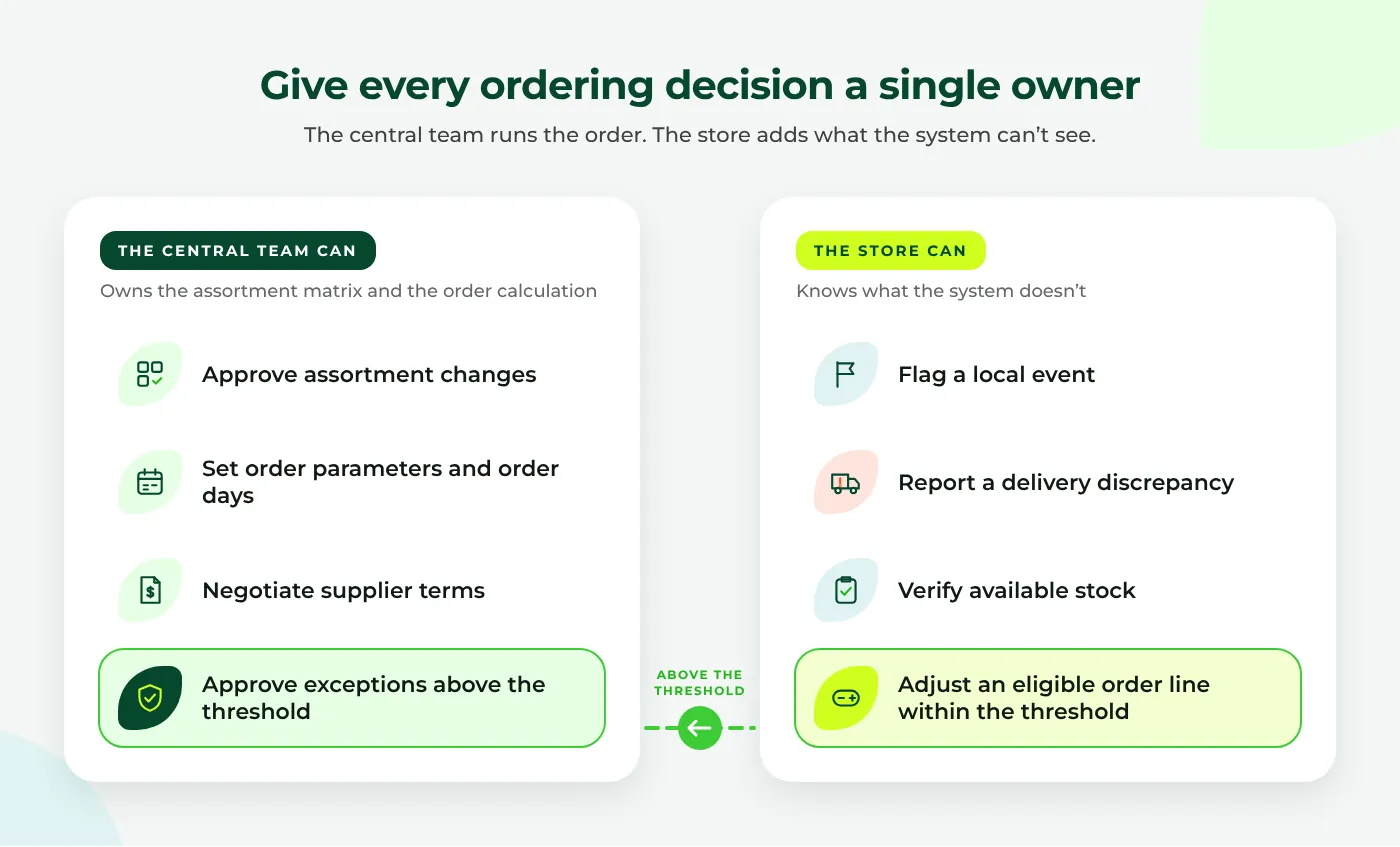
Step 1: Give every ordering decision a single owner
List the decisions hidden inside a store order and give each one an owner. Write the rights as actions, so the table works as a template:
| The central team can | The store can |
|---|---|
| Approve assortment changes | Flag a local event |
| Set order parameters and order days | Report a delivery discrepancy |
| Negotiate supplier terms | Verify available stock |
| Approve exceptions above the threshold | Adjust an eligible order line within the threshold |
Some categories deserve a wider store role. Seasonal goods and products with a very short shelf life change faster than any central review cycle. Promotions follow their own exit rules and need a separate plan.
Step 2: Lock the assortment matrix before you centralize anything
The assortment matrix decides what each store may carry, and central ordering only works when stores order inside it. An item outside the matrix reaches a store through the category manager, never through a sales rep at the back door. This one rule usually removes the supplier pressure from the store, because the manager no longer has the authority to say yes.
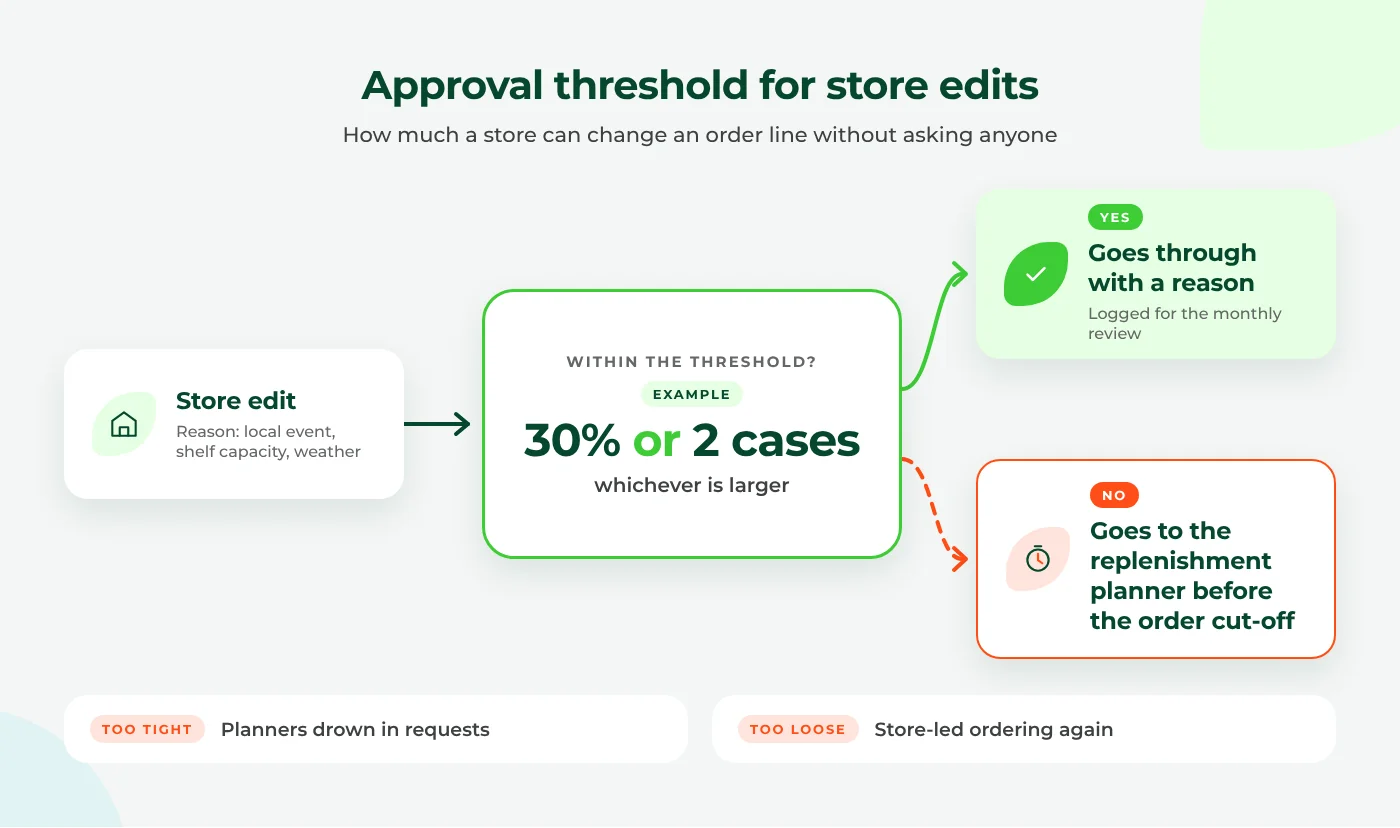
Step 3: Set an approval threshold for store edits
An approval threshold is the size of change a store can make without asking anyone. For example, a chain might let a store change any order line by up to 30% or two cases, whichever is larger. Anything above that goes to the replenishment planner before the order cut-off. Set the threshold too tight and planners drown in requests. Set it too loose and you have store-led ordering again under a new name.
Step 4: Make every store edit carry a reason
A store edit without a reason teaches the central team nothing. Give stores a short list of reasons. Start with local events, shelf capacity and weather, and keep the list to five or six options. Free text is the exception. Stock problems come first. If a stock count or a delivery discrepancy changes the available stock, correct the inventory record and recalculate the order. If the store still needs a different quantity after that, it logs the reason for the edit. A fixed list turns the review in Step 5 into a single report.
Step 5: Review store edits monthly and turn the recurring ones into the plan
The monthly review checks each edit against what would have happened without it. Sales alone cannot settle this, because a stockout hides part of the demand. For each edit, compare the stock the store would have had under the original recommendation with what it actually had after the change. Opening stock, receipts, sales and any stockout before the next delivery show the outcome. Each edit is then labeled as helped, hurt, made no material difference or inconclusive.
If the same local fact keeps driving useful edits, add it to the planning inputs. A store near a stadium gets game days in its event calendar, and the order includes them automatically. Edits that hurt get a conversation with the store, with the data on the table.
Progress shows up as fewer repeats. Stores stop making the same edit for the same reason, because the plan already covers it.
Two store edits in one week, and what each one costs
Take a 45-store grocery chain that orders centrally and uses the approval threshold from Step 3. In the same week, two stores want to change their orders.
Edit A: a home game. Store 17 sits a few blocks from a football stadium, and Saturday brings a rivalry game. The central order for one six-pack of beer is 6 cases of 8 packs each, 48 packs in all. The store manager asks for 6 more cases. That is a 100% change, well above the threshold (here 2 cases, since 30% of 6 cases is only 1.8). So the request goes to the replenishment planner with the reason "local event", and the planner approves it before the cut-off.
Assume the store had none of this beer left when the delivery arrived, and the next delivery comes after the weekend. The store receives 96 packs and sells 91 by Sunday evening. Without the edit, it could have sold 48 at most, so roughly 43 packs of demand would have gone unserved. At $9 a pack, that is $387 in sales the edit helped keep, from one store and one item.
Edit B: a rep's offer. The same week, a sales rep for a new energy drink visits stores on his route. The drink is not in the assortment matrix, so under Step 2 no store can order it. Without that rule, say 12 store managers each agreed to take six cases, with 24 cans per case at $1.10 a can. The table shows what the chain would have committed to.
| Edit A: home game | Edit B: rep's offer | |
|---|---|---|
| Stores involved | 1 | 12 |
| Extra stock | 6 cases (48 packs) | 144 cans per store, 1,728 in total |
| Extra stock at cost | $312 at $6.50 a pack; 43 of the 48 extra packs sold over the weekend | $158.40 per store, $1,900.80 in total |
| Left over | 5 packs after the weekend, sold the following week | about 84 cans per store after eight weeks, 1,008 in total ($1,108.80 at cost) |
| What the rights model does | approves it, logs the reason, adds game days to the store's plan | blocks it at Step 2 and sends the rep to the category manager |
The Edit B numbers assume each store sells about 60 cans in eight weeks, which is generous for an item nobody planned shelf space for. The leftover cans also take facings from listed items. And the cost does not stop at cash: the matrix now says one thing and twelve shelves say another.
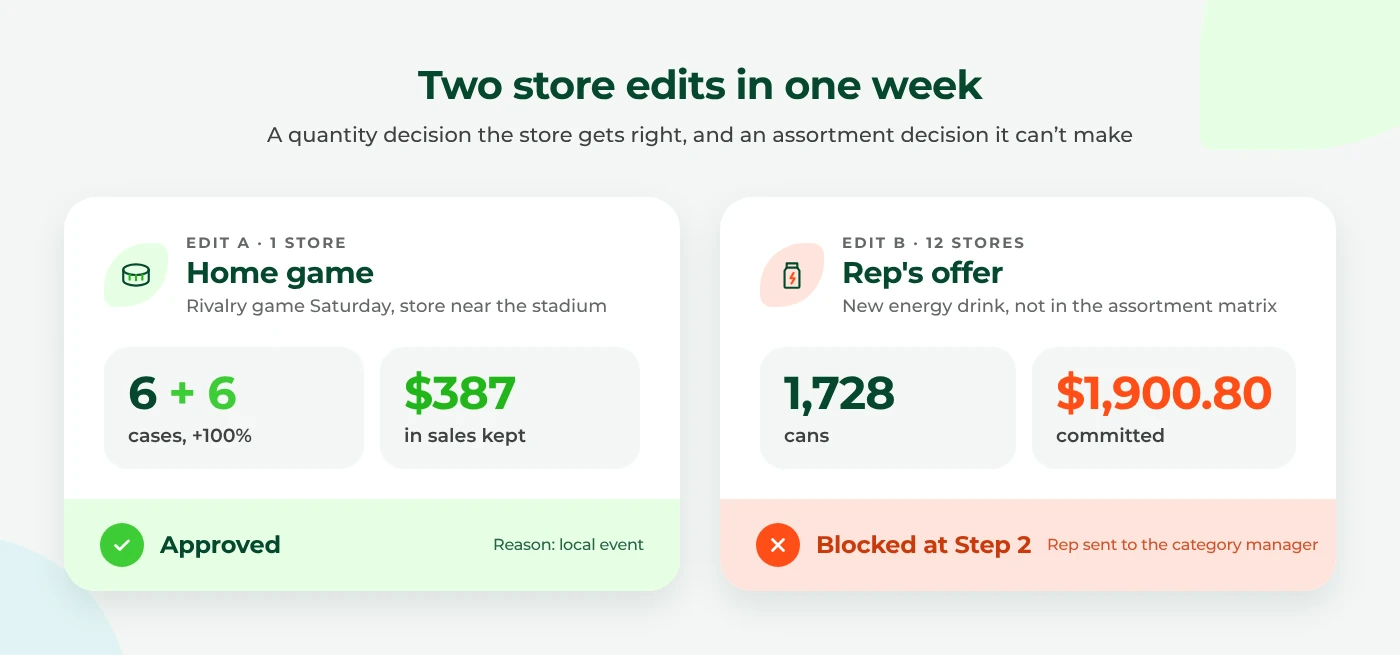
The stadium order needs a quantity decision, and the store is right to ask for it. The energy drink needs an assortment decision, which belongs to the category manager and never reaches the order. Steps 2 and 4 exist to keep those two apart.
How LEAFIO Inventory Optimization runs central orders while stores keep their say
LEAFIO Inventory Optimization uses its AI demand forecast, on-hand stock and incoming inventory to calculate how much of each SKU every store should order. Orders go to suppliers on their schedules, and the retailer's ERP stays in place.
The assortment matrix sets the boundary. The module orders the products that are active in each store's assortment. When a chain also uses LEAFIO Assortment Performance, status changes there reach replenishment automatically. A delisted item stops being reordered without anyone retyping the decision.
Stores keep a voice in the process:
- Orders can be reviewed and adjusted before they go to the supplier, and an edit can carry a reason from a list the chain defines.
- Each user works with the stores assigned to them, and the chain decides by role who can view, edit or send orders.
- Store managers see order history and stock performance for their store, so they can question the plan with numbers in hand.
On the central side, lost-sales analysis helps planners find orders where a manual cut may have left the shelf short, so they can check them. The approval threshold and the route to the planner are rules the chain sets in its own process.
Two published projects show what the move away from store-led ordering looked like:
Local Discounter, an 82-store supermarket chain in Eastern Europe, had all its store managers building orders, each spending 2 to 3 hours on order creation. After ordering moved to LEAFIO Inventory Optimization, store staff spent 80% less time on orders, availability rose 10% and inventory turnover improved 15%.
Daily, a 227-store grocery chain in the country of Georgia, had store managers adjusting ERP orders on their own judgment. After the rollout, 99.5% of its orders go out without a manager touching them, availability is up 8% and overstock is down 17%. The same rollout also brought the distribution center and promotion planning into the system, so these results belong to the whole project.
Neither case measures a rights model on its own. Once stores are working from a centrally calculated order, planners can start tracking what stores still change and why.
Where a central ordering model breaks down
Central store ordering with a rights model suits chains whose stores share one owner, one assortment logic and reasonably accurate stock records. Outside those conditions, parts of it stop working.
Franchised stores with their own P&L. A franchisee who pays for the stock will not accept a central order as final, and should not have to. Here the central order works better as a recommendation, with the approval threshold set wide.
Very small chains. In a chain of five or six stores, the store manager often is the planner. Adding a central team and a monthly review can cost more time than it saves.
Products that live for a day or two. For bread, ready meals and cut flowers, the store's same-day judgment about waste carries real weight. Many chains keep a wider store role for these categories even after the rest is centralized.
Inaccurate stock records. This one is the hardest. A central calculation multiplies whatever errors sit in the stock data across every store at once. If your counts drift, fix the data first.
None of this argues for keeping store-led ordering everywhere. It argues for deciding category by category, with the rights model written down, rather than letting each store manager decide alone.
FAQ
What happens if a store asks for an edit just before the order cut-off?
The request goes to the replenishment planner like any other edit above the threshold. Set a default for requests that are still pending at the order cut-off. If your policy is to release the original order, send it on schedule. The planner then checks whether a later delivery can still cover the event.
Should we centralize by store or by category?
By category is usually safer. Start with stable, fast-moving categories where store edits are rare, and write the rights model for them. Move to seasonal and short-life categories once the review in Step 5 runs smoothly.
How many store edits are normal?
There is no universal figure, and it depends on the category. The direction matters more than the level. If the monthly review turns recurring edits into the plan, the same edit for the same reason should come up less often.


Have a question?

Kristi Miller
Retail optimization expert