


Everyone knows that the difference between plans and actual results can be enormous. Often the reason for this is the insufficient organization of the processes of creating plans and monitoring at different levels. It is in these cases that the relationship between the principles of Sales and Operations Planning (S&OP) and Sales and Operations Execution (S&OE) gains importance in particular. Gartner experts say that S&OP is the single most important and critical cross-functional process that drives revenue and profitability.
Let's look at how each of these approaches helps business leaders improve efficiency and close the gap between the desired and actual results.
Key Takeaways:
S&OP ensures mid-to-long-term strategic planning by integrating demand, supply, and financial data across departments;
S&OE focuses on short-term execution, bridging daily operations with strategic plans and enabling quick adjustments;
Effective S&OP includes five steps: demand/supply analysis, financial review, cross-functional meetings, and executive approval;
Synchronization of S&OP and S&OE processes increases agility, operational consistency, and decision-making speed;
LEAFIO Inventory Optimization software automates demand forecasting and sales planning at all levels, improving visibility and strategic alignment.
Understanding retail S&OP (Sales and Operations Planning)
First things first, let's explain the difference between the three planning horizons that many companies are currently using to help you understand:
- Annual planning process focuses on decisions with a long lead time. This could be, for example, entering new markets.
- S&OP planning process (e.g., monthly) focuses on the product family level. Some organizations extend this framework even further into enterprise-wide financial planning (see our breakdown of IBP vs S&OP for how the two approaches differ in scope and governance.)
- S&OE – tactical planning (e.g., weekly), which focuses on the SKU level and aims to track the alignment of demand and supply with the plan.
What is S&OP?
In summary, a sales and operations plan (S&OP) is the process of bringing demand plans together with supply chain planning leaders and financial plans. The goal is to create an integrated business strategy for sales, finance, marketing, production, purchasing, demand planning, supply chains and inventory management, and inventory and material planning. It helps decision-makers determine what actions are needed to achieve their goals. Additionally, S&OP ensures team interaction within the company.
There are various options for the step-by-step implementation of S&OP. Let's look at the typical steps:
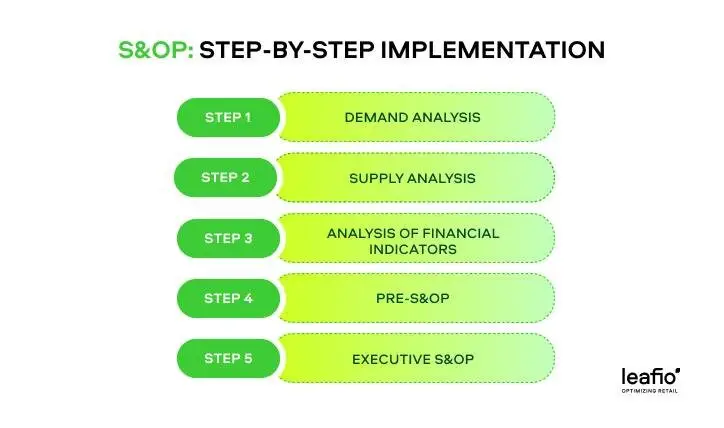
#1 Demand analysis
The purpose of this step is to create a consensus forecast or demand plan based on marketing data, consumer trends, product hierarchy, and other factors.
#2 Supply analysis
This analysis should be synchronized with the demand plan drawn up at the previous stage. A supply planning process steps are then developed based on it to bring customer demand and inventory into balance.
#3 Analysis of financial indicators for the previous month
This is the input data for calculating the current month's S&OP cycle. In the process, the team compares actual expenses with existing budgets and forecasts.
#4 Pre-S&OP
These are preliminary meetings with managers of different levels to build a link between demand, supply chain, financial performance, and expectations. The purpose of the meetings is to identify problems and create strategies for solving them.
#5 Executive S&OP
The final meeting includes a review of all the scenarios and decision options. The management accepts them and sets deadlines for implementation.
What are the expectations of an effective S&OP implementation?
There are always major business shifts like fluctuations in the supply chain and demand. Therefore, it is fundamentally important to build a clear link between the chosen strategy and its implementation. A clear plan helps to understand the overall strategy at all levels.
With the help of S&OP, you can get a grip on the business flow: the number of goods, customers, or other units that a business can process in a set period. The analysis allows you to determine this indicator and make use of it in further planning.
Planning sales and operations helps to establish RACI for each stage of the process: all performers will have their own boundaries of responsibility. Finally, S&OP provides measurability: you can analyze specific data, processes, and roles.
What is S&OE (Sales Operations Execution)?
Sales and Operations Execution is a weekly process that includes various additional processes and steps. They focus on the execution of the tactical plans defined in the S&OP process. These steps include demand analysis, gap reconciliation, inventory planning, etc. The S&OE process is conducted to:
- bridge the gap as this analysis is essentially a link between tactical-level plans and the day-to-day implementation of those plans;
- ensure continuity by effectively analyzing inventory and supply chain planning and minimizing disruptions.
The tactical horizon of the S&OE process is 0 weeks to a year, while that of S&OP is 3 to 18 months. With Sales and Operations Execution, you can make quick changes and adapt business processes to unplanned actions and conditions.
Key components of S&OE

The most important steps:
- Planning, which involves breaking down broad S&OP plans into more specific and detailed ones. Production processes, supply chain, inventory management, etc., are planned.
- Real-time tracking of indicators to determine the actual performance and compare it with planned data. This allows you to identify problems promptly and resolve them quickly.
- Establishing cooperation between sales, logistics, and supply chain planning to align priorities.
- Technological integration to automate processes, monitor performance, and establish internal communication.
The main goal of implementing S&OE is to increase the efficiency of processes and bring actual performance indicators closer to the planned ones.
Differences between S&OE and S&OP
As we have said before, S&OP focuses on the company's plans for the medium and long-term horizon. The purpose of planning is to identify ways to achieve the goals set out in the strategy. That is why the level of S&OP is high, and it deals with product families and ways to optimize the overall supply chain and demand factors. It includes planning the product life cycle and new product launches. That is why it is enough to hold S&OP meetings once a month only.
It is difficult to implement such plans without a clear S&OE process. Day-to-day operations are unstable and require timely monitoring and adjustment. The task of sales operations execution (S&OE) is to solve short-term problems such as delivery delays, unplanned shutdowns, etc., in the context of S&OP implementation. In that case, meeting once a week is perfectly appropriate to get agreement on relevant decisions.
Leveraging S&OP and S&OE effectively
The following strategies can be implemented to ensure the effective use of S&OP and S&OE:
- Alignment of plans and implementation stages. It is important that the S&OP plan is in line with the overall strategy, and that S&OE processes are in line with Sales and Operations Planning. All representatives of the organization, from top managers to executives, should work towards the same goals.
- Cooperation between departments. A common understanding of the company's priorities and potential risk factors is important.
- Modern technologies. Manual process management in the modern world is basically a losing strategy right from the start. It is worth integrating forecasting tools, supply chain automation platforms, and performance indicator tracking as soon as possible.
- Monitoring and improvement. These processes must be continuous, as they affect the productivity and efficiency of strategy implementation.
Introducing LEAFIO Inventory Optimization
According to a McKinsey study, 77% of businesses are investing in technology to create better supply chain visibility. They are already one step ahead in the competition. Therefore, it is important to choose the necessary digital solutions and implement them into routine business processes without delay.
LEAFIO AI S&OP software automates the main processes of demand forecasting. Thanks to this, retailers can work with detailed information on specific items based on forecasts from the company level and specific categories down to the SKU level.
The platform offers two main modes: demand planning solution and sales forecasting. Owing to this, it can provide results both in units and in monetary terms, which is important for financial planning. Users can view the data in different cuts: weekly, and monthly, create operational roadmaps, and see the actual results alongside forecasts.
With the help of its advanced forecasting algorithms, LEAFIO AI accurately predicts demand and sales, making it much easier to develop detailed sales plans and more accurate demand forecasts. As a result, an increase in the effectiveness of strategic and tactical decisions is sure to come. Additionally, the system automates routine tasks and saves time in making plans and forecasts. At the same time, it maintains consistency across different organizational levels.

Conclusion
If organized effectively, S&OP and S&OE separate processes will provide a significant competitive advantage: from increased efficiency in strategy implementation to faster and more effective responses to current challenges and customer satisfaction.
FAQ
What is the difference between S&OE and S&OP?
S&OP is planning that helps to execute the overall business strategy and focuses on the supply chain challenges, and the product category level. S&OE is a method of control and operational planning and response to current challenges that focuses on the SKU level.
What is the purpose of S&OE?
S&OE focuses on actual processes, so it helps to plan the production in detail as well as sales and supply chain planning of specific products.
What is S&OP software?
LEAFIO AI S&OP is a new planning solution that improves forecast accuracy and automates processes, establishing interaction between departments and increasing the efficiency of retail business.
What are the elements of S&OE?
The main ones are constant monitoring of actual supply chain and demand indicators by the S&OP, as well as detection and correlation of deviations from the plan. This may include changing the plan when needed.


Have a question?

Kristi Miller
Retail optimization expert


