One inaccurate forecast leads to another and before you know it, there is a whole chain reaction of negative consequences that continue to snowball to wreck the business. Everyone—retailers to manufacturers—will be affected. The bullwhip effect is the culprit here, but there are also effective strategies for reducing the impact of this phenomenon.
Key Takeaways
The bullwhip effect disrupts supply chains, but tech and closer collaboration mitigate it.
Small demand changes can cause big swings upstream.
Overordering increases holding costs.
Data sharing with suppliers helps stabilize.
AI can adjust orders dynamically.
Continuous monitoring reduces variability.
What is the Bullwhip Effect? A Simple Explanation
The bullwhip effect in the supply chain is a phenomenon where changes in consumer demand lead to significant fluctuations in inventories at the level of manufacturers and suppliers. Conventionally, this happens as follows:
- A retailer notices a slight change in consumer demand and adjusts its order accordingly.
- A wholesaler sees the change, predicts a possible increase in demand from other retailers, and adjusts its order as well.
- The manufacturer creates more goods than wholesalers or retailers can sell.
- Unsold inventory remains in the warehouse and causes losses due to excessive storage costs.
The ripple effect caused by a small change (hence the name) can end up looking like this:
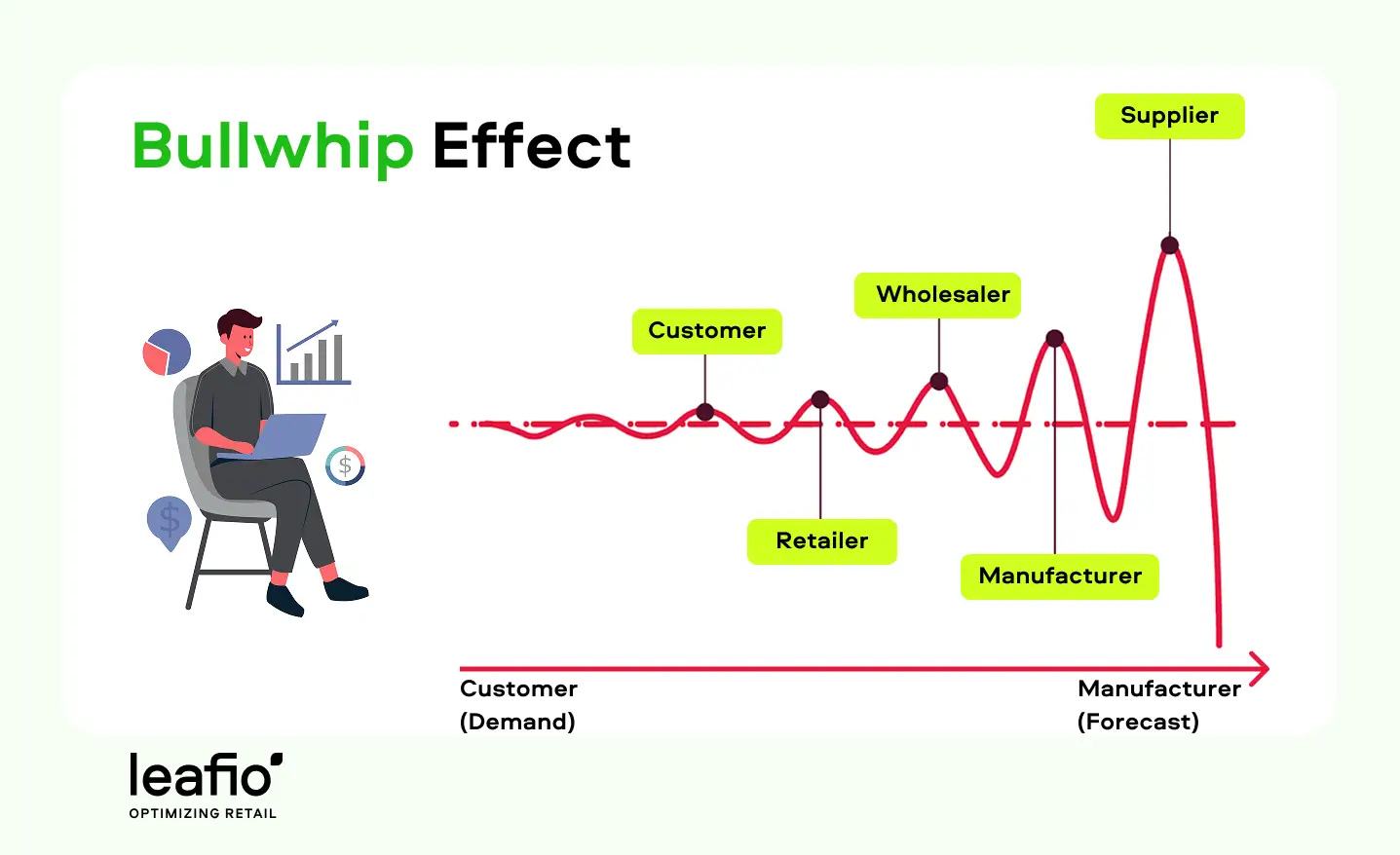
This analogy was first introduced by Jay Forrester in his studies of system dynamics. He noticed the feedback delay loops and excessive corrections inherent in complex power grids. Therefore, the other name for the phenomenon is the Forrester effect.
What is bullwhip effect in supply chain: an example
The best-known example of the bullwhip effect is Covid-19 and the panic demand for hygiene products. In the first weeks of the pandemic, retailers placed massive orders, and manufacturers increased production tenfold. However, the panic quickly subsided, and demand returned to normal levels, leaving supply chain participants with excessive inventory.
Why is the bullwhip effect so serious?
The Forrester effect disrupts the efficiency and stability of the supply chain in various ways:
- overestimation of demand leads to overproduction, excessive inventory and high warehouse costs (and vice versa, underestimation causes shortages and leads to customer dissatisfaction);
- fluctuations force producers to increase operating costs, as they need to adjust production, logistics, and labor distribution;
- the demand signal, moving through the entire supply chain, can be distorted, making accurate forecasting and decision-making impossible.
Real-World Examples of the Bullwhip Effect in Action
Interestingly, the bullwhip effect has been experienced not only by niche producers but also by large brands and world-class corporations. Here are a few examples.
Classics: Procter & Gamble and Pampers diapers
It is said that this case gave birth to the new term “bullwhip effect”. In 1992, the company increased diaper production in anticipation of the baby boom. This was the result of incorrect forecasting. Experts predicted that the new generation would have more children than their parents. However, no allowance was made for the new trend of responsible family planning. The expected jump in demand did not materialize, and the company was forced to buy back excess inventory, losing $30 million in the process.
Hewlett-Packard and DeskJet printers
When the manufacturer's specialists compared the sales of DeskJet printers from retailers with the volume of their orders, as well as their own orders for components, they noticed a classic bullwhip effect: retailers' orders were slightly excessive. Relying on this unverified data, the manufacturer was producing more models than the market demanded.
Volvo and green-colored cars
In the 1990s, Volvo's sales team was faced with a huge inventory of green cars. Obviously, to reduce it, they offered a discount. Demand increased significantly. However, due to ineffective communication between departments, the production department did not know that this was due to the discount! Therefore, the plants received a command: increase production of green models because demand is high. So instead of clearing out inventory, they increased production. This is a typical bullwhip effect.
What Causes the Bullwhip Effect?
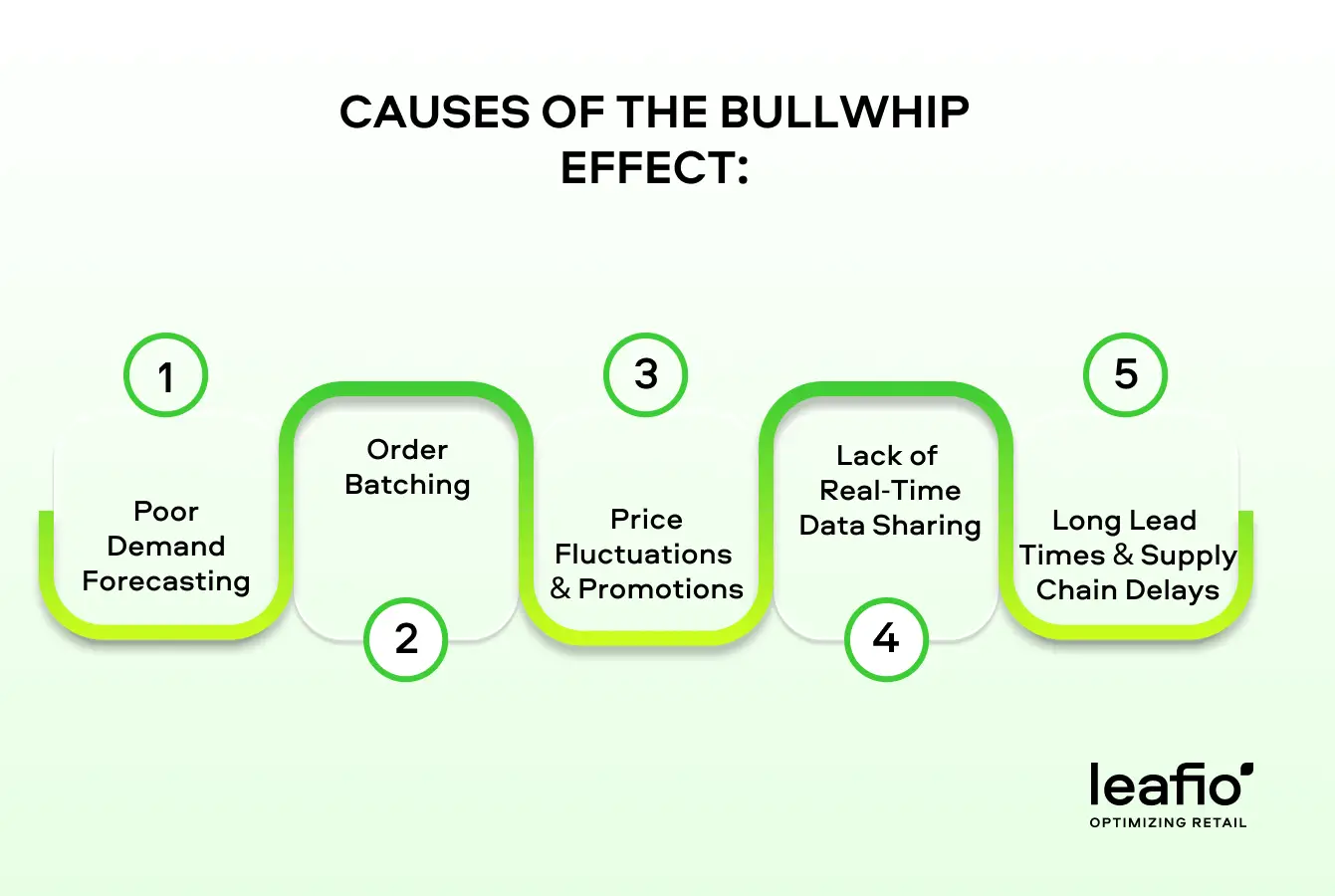
What are the root causes of the bullwhip effect? Let's analyze the factors that have the greatest impact.
1. Poor Demand Forecasting
The problem is based on the inability to accurately predict the final customer demand. The fact is that each participant in the supply chain makes its own forecasts based on the orders it receives. Often, they extrapolate these forecasts into the future without focusing on actual demand. That is, the retailer orders with a small surplus just to be sure, and the wholesale intermediary does the same – and so it continues all the way to the manufacturer. As a result, a slight fluctuation in demand turns into a large wave of inaccuracy through the supply chain.
2. Order Batching
The widespread practice of consolidating small orders into large batches is explained by the requirements for savings and optimization. Its downside is the irregular placement of orders or their accumulation until a certain volume is reached and suppliers may interpret these fluctuations in their own way. For example, they may believe that irregular but large orders are associated with demand spikes. These artificially created spikes are then passed on down the chain, causing data to be distorted.
3. Price Fluctuations & Promotions
The bullwhip effect in supply chain management can occur due to promotions, temporary discounts, and other marketing-related price fluctuations. Affordable prices in most cases influence buying behavior and lead to an increase in demand. Usually, after the promotion ends, the surge subsides and returns to a stable level. However, these sudden changes can be misinterpreted by suppliers. If they are not correctly informed about the retailer's marketing activities, they might interpret short-term fluctuations as steady changes in demand.
4. Lack of Real-Time Data Sharing
The previous problem is the root cause of the next problem. If there is no real-time data sharing between supply chain participants, critical errors occur. Each participant ends up making decisions based only on the actual data from their customers, without knowing the reasons for them. The lack of visibility into end demand leads to reactive actions: often, the reaction to fluctuations is excessive and leads to the accumulation of excess inventory and other consequences.
5. Long Lead Times & Supply Chain Delays
The longer the time between placing an order and receiving it, the higher the likelihood of demand changes during this period. A typical supply chain management principle in such cases is to try to compensate for the potential delay by placing more orders or holding safety stocks. However, this only increases demand fluctuations for suppliers. Delays due to transportation problems or production failures can also become triggers. Supply chain participants will have to react to this, and demand information will be temporarily distorted.
The Real Impact of the Bullwhip Effect on Supply Chains
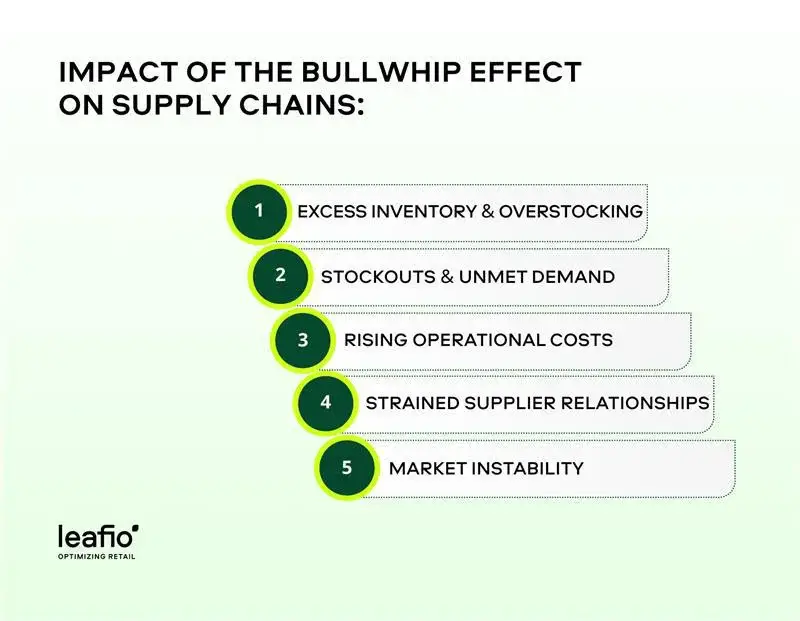
Understanding the cause of the bullwhip effect is the first step, but it is equally important to understand what the real consequences of this effect are for supply chain participants. It is worth saying that they are serious. Let's consider just the most important ones.
Excess Inventory & Overstocking
This is an obvious consequence. Due to the effect, excess inventory is accumulated at all levels of the supply chain. As a result, storage costs increase, and a significant portion of working capital is frozen. We have to cut back on investments, deal with the problem of spoilage, obsolescence, and disposal of goods. These are direct financial losses.
Stockouts & Unmet Demand
Interestingly, the bullwhip effect can also cause the opposite: a shortage of goods. This happens when sudden changes in demand are difficult to predict and pass on along the supply chain, and the manufacturer does not have time to increase production in a timely manner. The result is a loss of potential sales, customer disappointment, customers switching to competitors, and a drop in brand loyalty.
Rising operational costs
The consequence of unstable demand is the inefficient use of production capacity. Manufacturers often have to reorganize processes and change approaches from working overtime under pressure to having too much downtime. Transportation costs also rise as urgent deliveries are more expensive. Warehouse costs increase because of the need to store excess inventory, and because of the need to process orders quickly and move goods instantly in response to rapid changes in demand.
Strained Supplier Relationships
Unpredictable order patterns undermine retailers' relationships with suppliers and manufacturers. A sharp change in volume or an unexpected increase in supplies will force changes in plans and approaches to process management and they are factors that are difficult to respond to. An objective response to cooperation with such a customer is to refuse or increase the cost, but long-term relationships cannot be built like that, and they are very much needed in an environment saturated with competitors.
Market Instability
The bullwhip effect can manifest itself at the macroeconomic level: significant changes in supply and demand lead to price fluctuations for raw materials and finished products. In such cases, it is impossible to make accurate long-term forecasts and adopt strategic plans. The best example is the aforementioned supply chain crisis caused by the pandemic. No one was prepared for the demand for N95 medical masks to increase 100 times.
How to Minimize the Impact of the Bullwhip Effect (Best Solutions)

Let's look at the solutions that can be implemented to reduce the amplitude of demand fluctuations.
#1 Smarter Demand Forecasting
Basing your expectations on historical data is good, but more intelligent approaches to forecasting are needed. It is important to implement modern analytics tools that can take into account seasonality, the impact of marketing campaigns, economic indicators, and other factors. It is also necessary to introduce the practice of collaborative planning, forecasting, and replenishment (CPFR), which is based on the general exchange of data and joint forecasting between supply chain partners.
#2 Inventory Optimization: Finding the Right Balance
Move from reactive inventory management to the practice of optimizing inventory levels at every stage of the supply chain. To do this, you need to determine the right amount of safety stock based on demand data and lead times. Integration of an automatic replenishment system that will automatically respond to actual demand and minimize negative fluctuations during orders will also help.
#3 Pricing and Promotion Adjustments
Unpredictable or overly aggressive discounts distort data, as they lead to artificial increases in demand, followed by rapid declines. Your pricing strategies should be more balanced and avoid unexpected sales. If necessary, be sure to coordinate your actions with suppliers and take into account supply chain capabilities and brand capacity.
#4 Strengthening Supplier Collaboration
Make the entire supply chain transparent by establishing real-time data exchange. This includes demand forecasts, information on inventory levels, production plans, and delivery schedules. The more data is available to partners, the better informed your decisions will be during the demand ups and downs.
The Future of Supply Chains: How AI & Automation Are Reducing the Bullwhip Effect
The development of artificial intelligence and automation systems has opened up new opportunities to reduce the bullwhip effect in retail. For example, the LEAFIO AI Retail Platform offers innovative solutions to optimize supply chain management approaches.
- Traditional forecasting approaches cannot cope with modern market challenges, and inaccurate forecasts only exacerbate the bullwhip effect. Instead, software based on artificial intelligence and machine learning is able to analyze huge amounts of data: from historical sales to the impact of external factors. This significantly increases forecasting accuracy and allows supply chain participants to make informed decisions.
- One of the reasons for the bullwhip effect, as we have already found out, is the lack of transparency in the supply chain. Modern tools can provide end-to-end visibility and collect real-time data at all stages. This makes it impossible to make decisions based on incomplete or outdated information.
- In addition, modern intelligent solutions use predictive analytics to automatically adjust inventory levels at all stages. We are talking about modern smart supply chains that are able to adapt to changes in demand and ensure an optimal balance between storage costs and end customer satisfaction.
Key Takeaways: What You Must Do to Control the Bullwhip Effect
- The bullwhip effect is a phenomenon characterized by increasing fluctuations in demand as you move up the supply chain.
- This is usually caused by inaccurate demand forecasting, marketing activities, price fluctuations, and non-transparent cooperation between supply chain participants.
- The problem leads to the accumulation of excess inventory, the destruction of relationships with suppliers, increased operating costs, and other negative consequences.
- To minimize the effect, it is necessary to implement tools for intelligent demand forecasting, establish real-time data exchange with suppliers, adjust marketing activities and pricing, and integrate modern supply chain management software and other modern solutions for more accurate forecasting and intelligent inventory management.


Have a question?

Kristi Miller
Retail optimization expert