

Warehouse inventory management software is a system that tracks stock at the bin and rack levels, automates receiving and putaway, and provides operations teams with real-time visibility into what is on the shelf and where. It helps warehouses move beyond counting inventory to managing the full physical flow of goods from the dock door to the dispatch bay. The best systems go beyond basic tracking to integrate directly with ERP and business systems, keeping inventory levels accurate and labor and space utilization optimised at every stage.
This guide covers what this software does, how it differs from a basic inventory tracker or a full WMS, and how to choose the right option for retail warehouses of any scale.
Key Takeways
Warehouse inventory management software controls and tracks inventory as it moves through warehouse operations. It provides real-time visibility into stock locations, quantities, receipts, put away, picking, packing, transfers, and shipments.
Warehouse inventory management software and a WMS are closely related but not always identical. Inventory management focuses primarily on stock visibility and control, while a full warehouse management system (WMS) also orchestrates operational workflows such as receiving, put away, slotting, picking, packing, labor, and outbound fulfillment.
Core capabilities include real-time inventory tracking, barcode or RFID scanning, receiving and putaway, picking and packing, cycle counting, location management, replenishment, reporting, and ERP integration. Advanced systems may also support automation, mobile workflows, analytics, and multi-warehouse operations.
Real-time inventory accuracy is one of the main benefits of warehouse inventory management software. A centralized system reduces discrepancies between physical and recorded stock, improves order accuracy, helps prevent stockouts and overstock, and gives teams reliable data for operational decisions.
Integration is critical for effective warehouse inventory management. Bidirectional connections with ERP, order management, e-commerce, transportation, and other business systems allow inventory and order data to move consistently across the supply chain without manual reconciliation.
Choosing the right system depends on warehouse complexity, not just warehouse size. Businesses should evaluate inventory volume, number of SKUs and locations, order velocity, integration requirements, traceability needs, scalability, implementation effort, data security, and the level of process automation required.
The business value comes from connecting inventory visibility with warehouse execution. The right software can reduce manual work and errors, accelerate receiving and fulfillment, improve space and labor utilization, and provide more accurate inventory data across the organization.
What Is Warehouse Inventory Management Software?
In practice, this term can mean very different things. At the simple end sits basic warehouse management software that records quantities, sends reorder alerts, and produces basic reports. At the other end are full inventory management systems that handle every physical operation inside a distribution centre: receiving, putaway, picking, packing, and shipping, with inventory tracking built into every step and inventory levels kept accurate in real time.
These are genuinely different products. Basic warehouse management software answers one question: "How much do I have?" A warehouse inventory management system answers a harder one: where exactly is it, who touched it last, and what needs to happen next?
Most mid-market retail warehouses, those managing anywhere from 5,000 to 500,000+ SKUs, start looking for warehouse management software after outgrowing spreadsheets. Retail warehouses at this scale need more than a basic inventory tool, and most retail warehouses reach that point faster than expected. What they often discover is that standalone tools solve the counting problem but not the operations problem. A full inventory management system solves both, and inventory accuracy is a byproduct of managing the actual warehouse processes correctly, with continuous monitoring of inventory levels at every stage.
Core Features to Look For
Not all warehouse inventory tools are built the same. These eight capabilities separate a system that actually supports warehouse operations from one that just tracks numbers on a screen.
Real-time inventory visibility.
Every scan updates the record: receiving, picks, transfers, returns. No batch updates, no end-of-shift reconciliation. What’s on screen reflects what’s on the shelf, updated in real time.
Multi-location tracking.
Stock is tracked at bin, rack, and zone levels across multiple warehouses or DC sections. Moving an item from reserve to pick face is a recorded transaction, not an assumption left to memory.
For operations spread across multiple warehouses, facilities, or job sites, multi-location tracking should also provide a centralized view of inventory across every location. Visual inventory management platforms like CyberStockroom take this further by mapping inventory to the physical structure of each site, from buildings and rooms down to racks, shelves, and bins. This makes it easier for teams to locate stock, track transfers between locations, maintain an activity history, and work from the same up-to-date inventory information.
Receiving and putaway automation.
Goods are scanned on arrival and matched against the purchase order. The system assigns a storage location based on SKU rules: temperature zone, velocity, FEFO/FIFO rotation, and directs the operator there directly.
Picking accuracy tools.
Barcode scanning at the pick step means a picker cannot close out an order with the wrong item. Batch and wave picking reduce travel distance. Pick-to-light and voice options support high-velocity environments. Barcode scanning at receiving ensures every item is recorded correctly from the moment it enters the facility.
Reorder point alerts.
When a pick face drops below threshold, replenishment triggers automatically. No supervisor needs to notice the empty slot. The system already has.
ERP integration (bidirectional).
Purchase orders flow in from the ERP; goods receipts and stock updates flow back. SAP, Oracle, and Microsoft Dynamics are the most common integration targets for retail DCs.
As warehouse systems become increasingly connected with ERP, e-commerce, and other cloud-based platforms, protecting inventory data across these integrations becomes critical. Retailers need secure access controls, reliable data exchange, and cybersecurity practices that protect online inventory data from unauthorized access or manipulation without disrupting real-time warehouse operations.
Expiry date and FEFO tracking.
For grocery, pharmacy, and health and beauty, FEFO (First Expired, First Out) is a compliance requirement, not a preference. The system enforces rotation rules at the pick level, automatically, without relying on picker memory.
Reporting and audit trail.
Every stock movement is logged: who scanned what, where, and when, enabling real time inventory tracking at the movement level. That audit trail is what makes inventory control reliable. When a discrepancy appears, advanced analytics surface it immediately. Investigations that used to take hours take minutes.
Warehouse Inventory Management vs. Spreadsheets: Why Excel Fails at Scale
Most retail DCs start on spreadsheets. At 20 SKUs and one receiving dock, it works. At 5,000 SKUs, three picking zones, and two locations, the cracks show up fast.
| Symptom | Business Impact |
|---|---|
| Stock counts differ between manager spreadsheets | Wrong replenishment decisions, overstocking or stockouts |
| Picking team works from yesterday's data | 2–5% mis-pick rate, customer complaints |
| Returns and receipts entered with a delay | Ghost inventory, inaccurate on-hand figures |
| No audit trail when an error occurs | Can't trace the source, problem repeats |
| Opening a second DC doubles the complexity | Excel breaks down entirely, with no multi-location support |
The common thread is latency. Spreadsheets record what happened, not what’s happening. Inventory levels drift, inventory control breaks down, operational efficiency suffers, and customer satisfaction follows. In a warehouse processing hundreds of orders a day, that gap is operationally expensive.
Dedicated warehouse management software solves these issues by helping teams automate warehouse operations and streamline warehouse operations that previously relied on manual effort.
WMS vs. Standalone Inventory Software: What's the Difference?
Both manage inventory, but they do it at different levels of the operation. WMS solutions handle the physical work; basic inventory tools only record the result.
| Capability | Basic Inventory Software | Warehouse Management System (WMS) |
|---|---|---|
| Stock level tracking | ✅ | ✅ |
| Location-level tracking (bin/rack) | ❌ / limited | ✅ |
| Picking workflow management | ❌ | ✅ |
| Receiving & putaway automation | ❌ | ✅ |
| ERP integration (bidirectional) | Limited | ✅ |
| Multi-DC / multi-zone | ❌ | ✅ |
| Expiry / FEFO management | ❌ | ✅ |
| Labor productivity tracking | ❌ | ✅ |
For warehouses processing more than 200 orders per day or managing 3,000 or more SKUs across multiple zones, a standalone tool becomes a bottleneck. It tracks the numbers but doesn't direct the work. A WMS manages inventory as part of the full warehouse operation: every pick, transfer, and receipt updates the record automatically, because the system is running the task that created the movement.
The practical result: inventory accuracy in a well-implemented inventory management system is not something that requires periodic reconciliation. It's a continuous output of the daily operation, enabled by continuous monitoring and deep integration with existing business systems.
How LEAFIO WMS Handles Inventory in Real Time
Three scenarios come up repeatedly in mid-market retail DC evaluations. Here is how LEAFIO WMS addresses each one.
"We don't know where stock is until we physically count it."
LEAFIO WMS tracks every unit at the bin level from the moment it is scanned at receiving, maintaining accurate inventory levels across all zones. Stock location is a live field, not a periodic snapshot. Supervisors see current slot-level positions on a dashboard, with no manual count required. This warehouse inventory management system gives full visibility without interrupting daily operations.
"Our picking error rate is too high."
Barcode scanning is required at every pick step. A picker cannot confirm a pick with the wrong item or quantity, and the system flags it before the box closes. One auto parts distributor reduced customer complaints caused by shipping errors from 15% to 0.01% after implementing LEAFIO WMS, delivering a measurable improvement in customer satisfaction. That number did not improve because of training. It improved because the system made mis-picks structurally difficult.
"Our inventory system doesn't talk to our ERP."
LEAFIO WMS integrates with existing ERPs via bidirectional API, connecting seamlessly with existing business systems. Purchase orders, stock receipts, and dispatch confirmations flow between systems in real time across multiple sales channels, with no manual re-entry and no end-of-day sync.
Want to see how LEAFIO WMS handles inventory in a retail DC like yours? Book a 30-minute demo →
Real Results: What Retailers Achieve With WMS-Based Inventory Management
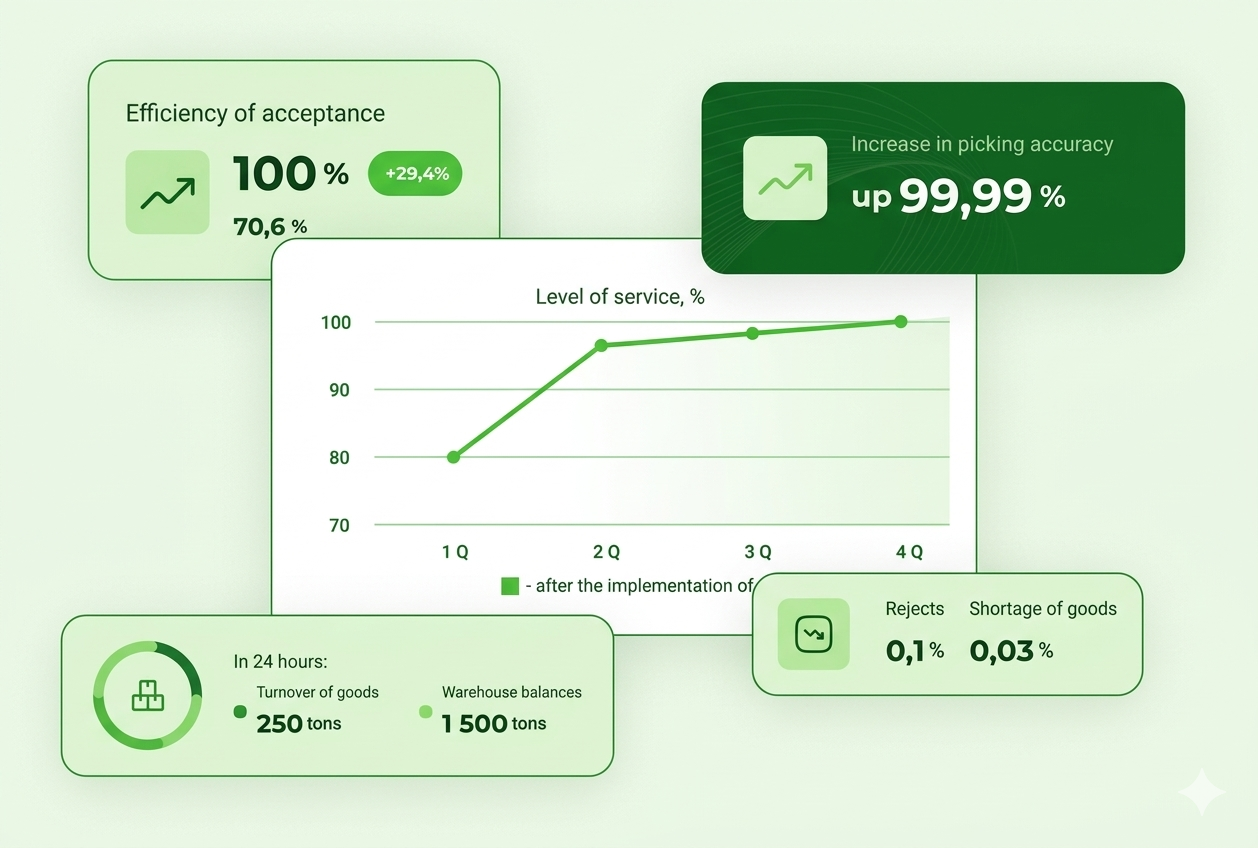
Numbers from live LEAFIO WMS implementations across retail and distribution:
40% – increase in labor productivity, Eastern European auto parts distributor after full warehouse automation
99.95% – picking accuracy, a medical device distribution company, after replacing manual processes
15% → 0.01% – customer complaints caused by shipping errors, auto parts distributor, documented in published case studies
Across retail DC implementations using cloud based wms solutions, the operational impact extends beyond picking accuracy. Order processing time drops by 35% as directed workflows eliminate idle time between tasks. Warehouse space utilisation improves by 20% through intelligent slotting and putaway rules. Inventory turnover increases by 25% as real-time stock visibility enables faster replenishment decisions aligned with future demand. Inventory control tightens at every stage, inventory levels stay accurate, and customer satisfaction improves as a direct result. Cloud based wms solutions consistently deliver these outcomes across retail and distribution verticals. These outcomes are not primarily technology stories. They are process stories. The WMS made the correct operation the path of least resistance, and accuracy followed.
How to Choose the Right Warehouse Inventory Management Software
Choosing the right system comes down to where the operation sits today and where it is heading. Six questions make that evaluation faster.
• Does it track inventory at the bin and rack level, or just total quantity? If location-level accuracy matters, and in any DC above 1,000 SKUs, it does, so basic inventory software will not be sufficient.
• Does it integrate with your existing ERP? One-way integrations create reconciliation work. Look for bidirectional, real-time data exchange with your specific ERP, not just a generic API.
• Can it handle your vertical requirements? Retail warehouses have specific needs: FEFO for pharmaceuticals or groceries, catch weight for food distribution, multi-temperature zone management for mixed ambient and chilled stock.
• What does implementation actually look like? Timeline, data migration scope, staff training. A cloud-based WMS, delivered as software as a service, typically goes live in 8–12 weeks for a mid-market retail DC.
• Is it built for your scale? Some enterprise WMS platforms are over-engineered for a 50-location retailer. Others are too light for 200 locations. Mid-market retail needs a system designed for that range.
• What is the total cost of ownership? License or subscription fees are visible. Implementation, integration, and ongoing support often cost as much again. Get a full picture before comparing vendors.
Most retail DCs achieve full ROI on a WMS implementation within 12 to 18 months, driven by reductions in picking errors, labor costs, and inventory write-offs. Gains in operational efficiency across shipping processes, inventory management, and supply chain visibility compound quickly. Cloud based wms solutions typically deliver measurable results within the first quarter after go-live. A system with strong warehouse management capabilities, advanced analytics, and analytics tools also gives planners the data they need to anticipate future demand and keep inventory levels optimised. If the operation ticks most of these boxes, including integration with customer relationship management and other business systems, it is likely ready for a WMS. Here is what LEAFIO WMS looks like in practice:
Frequently Asked Questions
What is the difference between a WMS and inventory management software?
Basic warehouse management software tracks stock quantities and locations. A modern warehouse management software platform, or full inventory management system, does that plus manages the physical operations that create those records: receiving, putaway, picking, packing, and shipping. In a WMS, inventory accuracy is a byproduct of running warehouse tasks correctly, with continuous monitoring at every step. In a standalone tool, accuracy depends on manual data entry.
How does warehouse inventory management software improve picking accuracy?
The most effective mechanism is barcode scanning at the point of pick, where the picker cannot complete the pick without scanning the correct item. Combined with directed picking routes and batch or wave planning, this eliminates the conditions that produce errors. WMS-based picking typically reduces error rates from 2–5% to under 0.5%, with a direct impact on customer satisfaction.
Can warehouse inventory management software integrate with ERP systems like SAP or Oracle?
Yes. LEAFIO WMS integrates with existing ERPs via API, keeping inventory and order data - purchase orders, goods receipts, and stock updates - consistent across systems in real time. Both options include full API access for ERP and e-commerce integrations.
How long does it take to implement warehouse inventory management software?
For a mid-market retail DC, cloud based wms solutions typically take 8–12 weeks to implement, covering data migration, configuration, ERP integration, and staff training. Simpler standalone inventory tools can go live faster, but they solve a narrower problem. The timeline depends heavily on ERP complexity and data readiness.
What are the most important features of warehouse inventory management software for retail?
For retail distribution, the non-negotiable features are: real-time location-level inventory tracking, FEFO/FIFO rotation enforcement, barcode-based picking confirmation, multi-temperature zone management, and bidirectional ERP integration. Multi-DC support and demand-triggered replenishment are important for operations managing 50 or more store locations.
Is warehouse inventory management software suitable for mid-size retailers?
Mid-size retailers, those managing 50 to 300 store locations with a dedicated distribution centre, are exactly the profile where wms solutions deliver the clearest ROI. At that scale, Excel and basic tools create visible operational costs: picking errors, slow replenishment, inability to scale across multiple sales channels without doubling headcount. Modern warehouse management software with analytics tools removes those constraints, giving planners visibility into future demand and keeping inventory levels accurate across all locations.
See LEAFIO WMS in real time, from receiving to dispatch. Book a 30-min demo →


Have a question?

Andrew Ivarsen
Logistics Optimization Expert