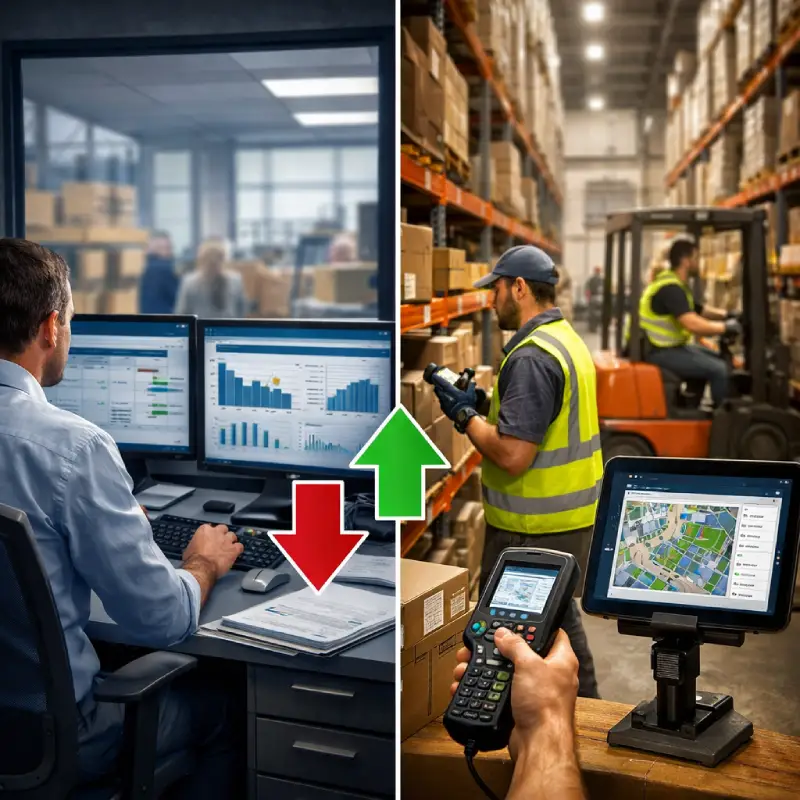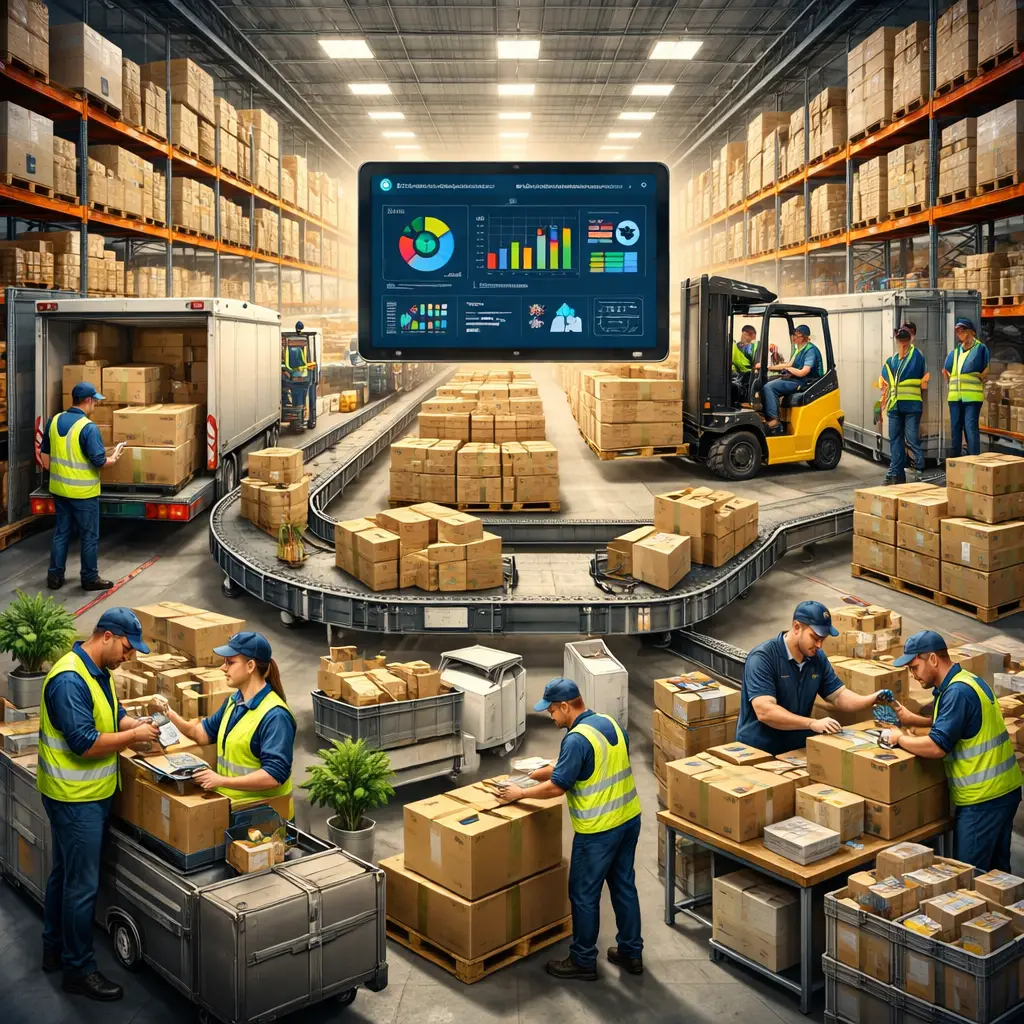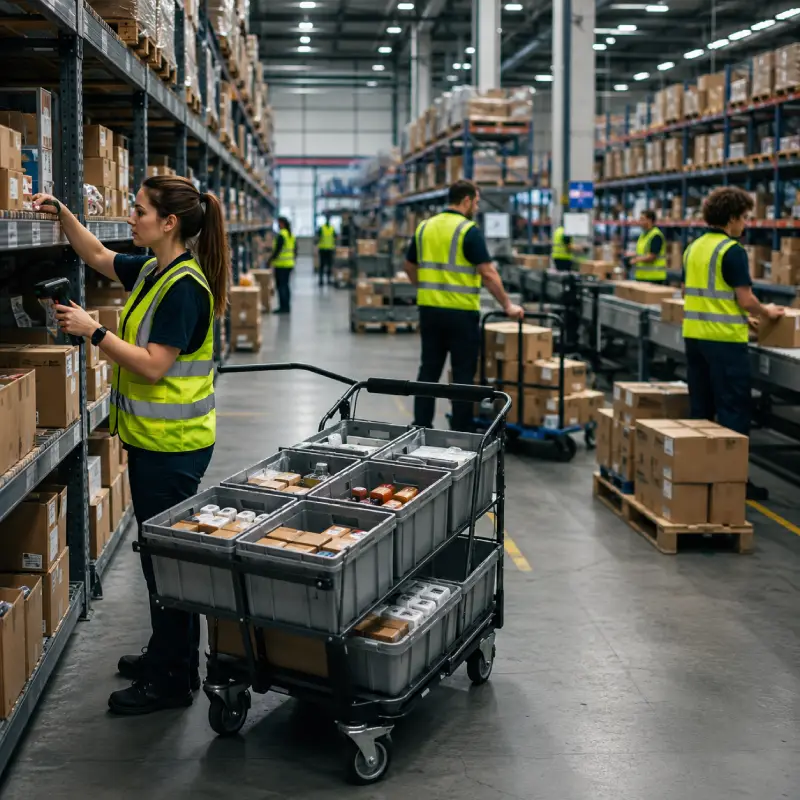


Order picking is the part of that chain where a list becomes a physical stack of goods, and where most decisions per minute happen: which aisle, which shelf, how much, into what container. Various picking methods exist because no single approach fits every warehouse; the right one depends on volume, layout, and how tightly warehouse operations need to sync with shipping. It's one of several capabilities covered in LEAFIO's guide to key features of a warehouse management system.
What Is Order Picking?
Order picking, in plain terms, is retrieving the items a warehouse order calls for so they can be packed and shipped: it sits between put-away and packing in the order fulfillment process, and it's where most of the manual decision-making happens on a given shift. Many warehouses gradually evolve their picking method as operations grow, rather than choosing one deliberately from the outset. Picking is also disproportionately labor-intensive: across a typical shift, roughly half of picking staff time goes to walking the warehouse and searching for storage locations, another fifth to preparing shipping documents, and only about a tenth to the actual act of picking goods off the shelf. Five patterns cover most of what actually happens across daily warehouse operations at a retail DC, and they're below roughly in the order a growing operation tends to run into them. Picking method selection is only one part of broader warehouse management, but it's the part that shows up fastest when it's wrong.
The Main Picking Methods
This is the one everyone starts with, whether they mean to or not: a picker works one order start to finish, then moves to the next. Nothing to sort afterward, no risk of mixing up two customers' orders, nothing to configure. The catch is distance. Once volume climbs, the same picker is walking the same three aisles ten separate times in a shift instead of once, and picking routes that once felt efficient start adding up faster than most people expect. This is usually the point where warehouses start looking at automated picking systems instead of relying on memory alone.
Instead of one order per trip, a picker works several at once, collecting for, say, eight orders in a single pass through the warehouse, then either sorting them at the end or dropping items straight into separate totes as they go. The whole point is to fulfill multiple orders simultaneously in one trip instead of retracing the same aisles order by order. Fewer trips, less walking per order. The part that trips people up is the sorting step. If it isn't built into the picking flow itself, it just moves the work, and the error risk, to a different table. (There's a longstanding argument in the industry about whether sorting belongs to picking or packing at all, not one this article is going to settle.)
Orders get released in scheduled groups rather than as they come in, timed to a shipping window or a truck's departure. If a DC ships on a fixed schedule, this is built for exactly that constraint, keeping warehouse operations aligned with transport. It requires more planning than the other methods, since something has to decide what goes into which wave and when it opens.
Split the warehouse into zones (by product type, temperature, physical layout, whatever fits the site) and assign pickers to specific zones instead of to orders. The zone picking method is sometimes run as pick and pass, where an order moves progressively from one zone to the next rather than being consolidated at the end. An order touching three zones gets picked in three pieces and consolidated before it ships. Pickers get to know one area well instead of the whole floor passably, which is usually a net win on speed. The consolidation step is the price of admission: those partial picks have to land back together correctly, every time.
Think of cluster picking as batch picking with real-time order separation. One picker still handles multiple orders simultaneously per trip, with each item going straight into its correct container in real time, using a multi-slot cart or a handheld that tells the picker exactly where each scanned item belongs. By handling orders simultaneously this way, cluster picking delivers speed close to batch picking while maintaining accuracy close to discrete picking. It needs a system that can track item-to-container assignment as it happens, though, or it quickly becomes difficult to manage accurately. For that reason, it shows up in warehouses with more mature processes rather than as a first step.

The Five Methods, Side by Side
None of the descriptions above translate perfectly into a single line each, but here's the rough shape of it. Zone picking, sometimes run as pick and pass, scales differently than the others. The order-volume column is a general guide, not a hard threshold: actual breakpoints depend on SKU count, average order size, and warehouse layout, and vary by operation.
| Method | Best For | Advantages | Limitations | Relative Order Volume |
|---|---|---|---|---|
| Discrete picking | Low volume, unique or high-value items | Simplest to run, lowest error risk | Slowest at scale | Low |
| Batch picking | High volume of small orders | Fewer trips through the warehouse | Requires a sorting step after picking | Medium |
| Wave picking | DCs with fixed shipping windows | Synchronizes picking with transport schedules | More complex planning and wave scheduling | Medium-high, cutoff-driven |
| Zone picking | Large warehouses with distinct storage zones | Pickers specialize by zone | Needs a consolidation step | Scales with warehouse size, not just order count |
| Cluster picking | High-SKU, e-commerce-style retail | Batch-level speed, closer to single-order accuracy | Complex to set up, depends on solid system support | High |
Figuring Out What Fits
Finding the right picking method for your operation usually comes down to a few questions, settled before anyone opens a software demo:
SKU count and daily order volume tend to matter most, since a small, stable assortment can run on discrete picking a lot longer than a high-SKU operation can, and order volume is usually the single biggest factor in whether batching pays off at all. Fixed departure windows point toward wave picking; multiple zones point toward zone picking; and if barcode-guided picking isn't in place yet, that's worth solving before layering on a more complex method, not after. Every warehouse order that moves through the wrong method costs a little warehouse efficiency, and those small losses compound across thousands of orders a month, which is exactly why picking method choice belongs in any serious warehouse management review.
Seasonality is worth a separate mention: a method that runs fine ten months a year can fall over during a peak, and it's rarely obvious in advance which one will. Past a certain size, most DCs stop running just one method anyway. Zone picking across the main floor with plain discrete picking for a small high-value cage off to the side is a fairly ordinary setup, not an exception. The picking method itself has little bearing on license or subscription pricing, but implementation complexity does.
How LEAFIO WMS Supports Each Method
People pick the orders, not the software. Barcode scanning runs at every step (cell, item, container), regardless of which method is in use, keeping order fulfillment operations consistent day to day. Good warehouse management depends on that consistency more than on any single method's theoretical strengths. It's also the mechanism behind the accuracy gains covered in LEAFIO's warehouse management system overview.
Pickers work through a handheld terminal one task at a time, and the system can prioritize which warehouse order comes next by urgency or shipping deadline. Because the terminal guides each task step by step and validates scans, new pickers can rely on system prompts instead of memorizing warehouse layouts and product locations.
The terminal assigns the next task automatically or lets a picker choose from a list, which keeps picking routes efficient batch to batch. LEAFIO also launches orders automatically as part of the standard picking and shipment workflow. Replenishment works the same way: once stock in a picking cell drops below a set threshold, the system automatically generates a movement task, which typically gets carried out at the end of the shift rather than waiting for a picker to notice an empty slot mid-batch.
Outbound orders queue against specific loading gates, with a shipment monitor tracking idle time and loading windows for each one, keeping order fulfillment operations synchronized with departure schedules. Warehouses with tighter constraints lean on that monitor more heavily.
Slotting runs off SKU velocity, using ABC-analysis, with specific zones reserved for the fastest-moving stock near the shipping zone. That's what makes pick and pass setups work: nobody covers extra distance for a slow-moving item by accident. LEAFIO also tracks weight and dimensional characteristics during receiving, which matters for planning cell and pallet capacity even where it isn't the direct driver of zone placement. High-velocity sites often add pick-to-light or voice-picking on top, though availability depends on the specific WMS implementation and hardware.
Every scan is checked against the task in front of it, so a picker juggling multiple orders gets flagged immediately if an item is headed for the wrong container. The platform doesn't bolt this on as a special case: cluster picking runs through the same task-assignment engine that handles every other method here, configured rather than custom-built for it. Where scanning alone isn't enough, LEAFIO adds weight checks, piece recounts, or a visual check before a pallet ships.
FIFO and FEFO rotation are built into the picking logic itself rather than depending on memory, and when a SKU ends up scattered across half-full cells, the system generates its own task to consolidate them rather than waiting for someone to notice on a walk-through.
Real Results
An auto parts distributor in Eastern Europe faced these problems at once before adopting LEAFIO WMS: staff carried the assortment and layout in their heads, nobody consolidated fragmented stock, and there was no single view of what was happening on the floor. The picking process itself hadn't kept pace with growth, and that's the gap LEAFIO closed.
Paper gave way to barcode-driven mobile data collection terminals (DCTs), with shortages and defects logged automatically instead of scribbled down. The result that mattered most: complaints tied to mispicks and shortages fell from 15% to 0.01% once every product had a reliable identifier, reducing customer complaints and improving picking accuracy. The warehouse could also run inventory counts without stopping operations, and the system began generating its own tasks to consolidate fragmented stock. This specific number reflects one warehouse's starting conditions, though the underlying gain in warehouse efficiency tends to hold, illustrating the operational improvements a warehouse management upgrade can produce. More on what drives picking accuracy is in LEAFIO's warehouse inventory management software overview.


Have a question?

Andrew Ivarsen
Logistics Optimization Expert