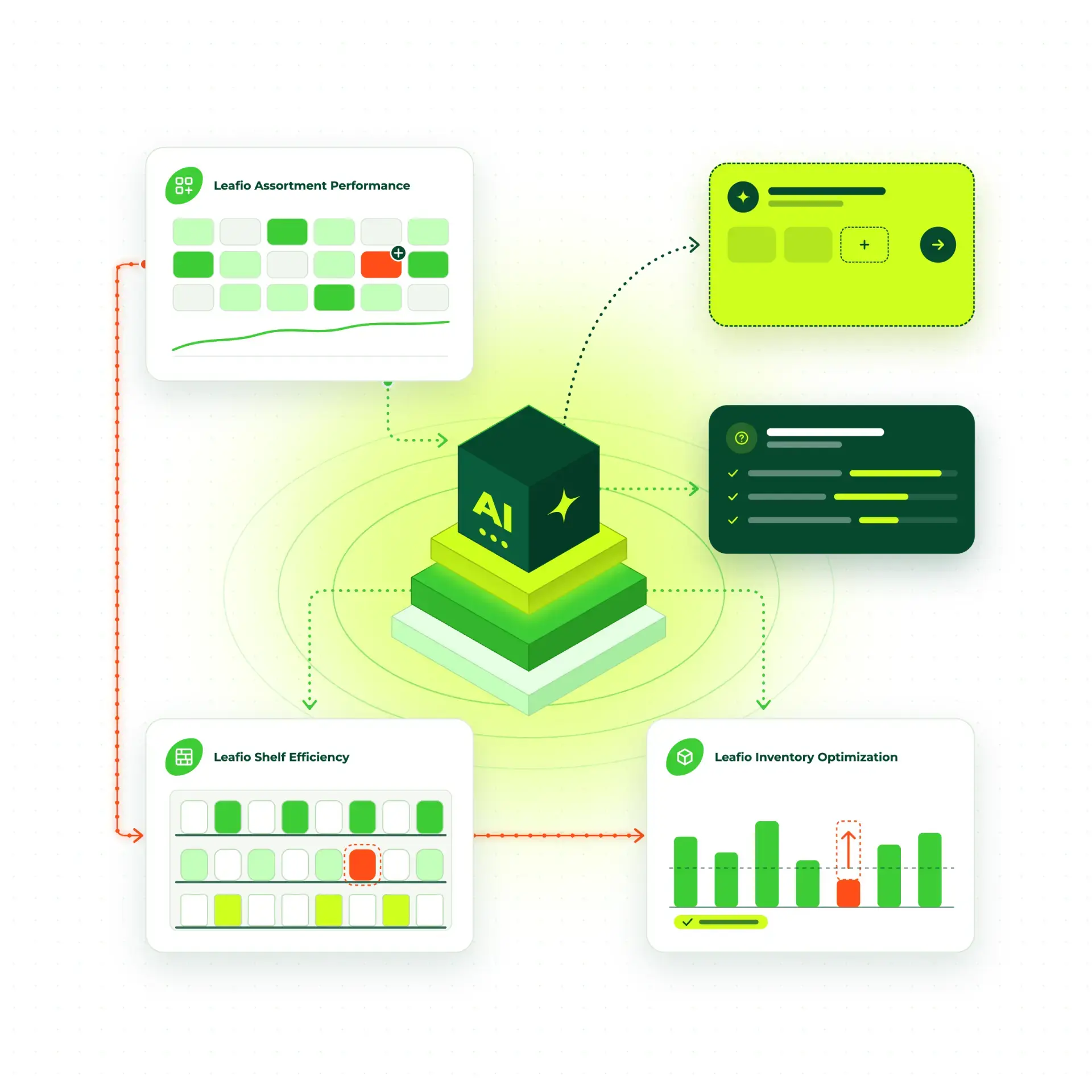
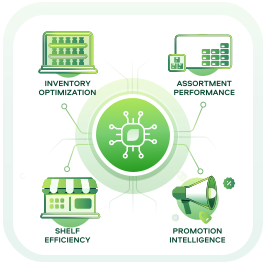
Since the May 2026 launch, KOLO’s category managers no longer track matrix changes manually inside their ERP. The system now applies routine delisting, rotation and replacement changes automatically, following rules set by the category team. Total inventory value fell 5.5% network-wide, and passive stock at the distribution center fell 59%. Assortment Performance runs alongside KOLO’s existing LEAFIO AI Retail Platform modules: Inventory Optimization, Shelf Efficiency, and Promotion Intelligence.
Results at a Glance
| Metric | Result |
|---|---|
| Non-matrix stock value | −31% |
| Passive stock at the distribution center | −59% |
| Total stock value (all statuses) | −5.5% |
| Assortment changes processed (SKU status level) | 67,000 |
| Of which fully automated by the system | ~28,000 (≈42%) |
Timeframe: first four months after go-live in May 2026.
About KOLO
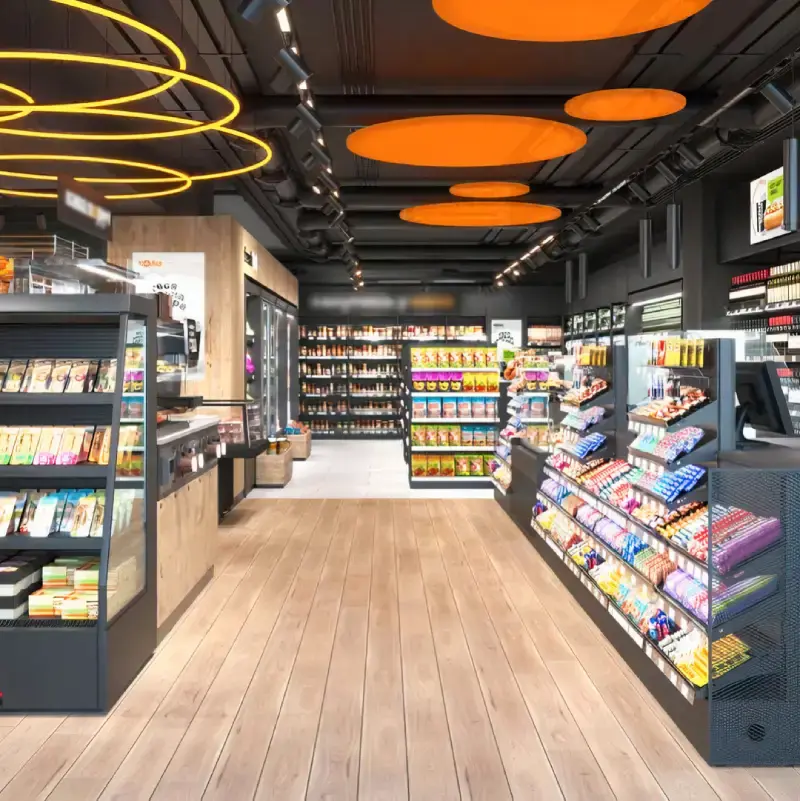
KOLO is a chain of neighborhood convenience stores in Eastern Europe. It operates 250+ locations and carries 3,500+ active SKUs. Founded in 2017, the chain runs one central distribution center and six store formats. Before Assortment Performance, KOLO already ran Inventory Optimization, Shelf Efficiency, and Promotion Intelligence of the LEAFIO AI Retail Platform. Inventory Optimization alone cut KOLO’s overstock by 43% in its first quarter after go-live, compared with the previous system.
The Challenge
Keeping the matrix stable through an ERP migration
KOLO was moving to a new ERP system and wanted to keep full control of its assortment matrix during the transition. The matrix lived inside the previous ERP, tied to equipment-SKU sets and store-equipment mappings.
Limited visibility into matrix changes
The previous system did not keep a history of matrix changes, so it was difficult to tell who made a change and whether it was correct. With several people editing the matrix, accountability was hard to establish.
A multi-step delisting process
Delisting took the most time. Introducing a new SKU first required removing a set number of existing ones through a controlled, multi-step approval. For a fast-moving convenience format, this slowed down assortment updates.
Common assortment challenges
Like many convenience retailers, KOLO also worked on tail SKUs, duplicate or cannibalizing items, and gaps in must-stock coverage. Removing an SKU from the matrix often left stock behind.
The Solution
Extending a platform already in place
Because KOLO already ran other LEAFIO modules, adding Assortment Performance meant extending the platform rather than starting from zero. The rollout kicked off in October 2025. It paused briefly for the holidays, restarted at the end of January 2026, and went live on 11 May 2026.
Integration: reconnecting existing data exchanges
No new integration had to be built from scratch. The team adjusted field mappings and delimiters. It then reconnected KOLO's existing data exchanges to the new format.
Network-wide launch built on store clusters
The assortment matrices already existed inside the old ERP, so there was no separate pilot phase. The main scaling task was building equipment-based store clusters across the whole network. The LEAFIO development and project management team helped design them.
Every department involved from day one
Assortment touches both planogramming and ordering, so every relevant department joined from day one. The hardest part was not the software. It was coordinating communication and responsibilities across teams during the transition.
Operational Impact
42% of assortment changes run automatically
Since go-live, LEAFIO Assortment Performance has processed 67,000 assortment changes for KOLO. The system zeroed out more than 10,000 of them automatically the moment stock hit zero. It rotated or replaced more than 18,000 without any human involvement. Together, close to 42% of all assortment changes now run automatically, following rules set by KOLO’s category managers.
Rotation and replacement as the main lever on leftovers
Non-matrix stock covers items in passive, sellout, delisting, archive or removed status. It dropped 31% between May and August 2026. Passive stock at the distribution center fell 59%, and total stock value across the network fell 5.5% over the same period. The rotation-and-replacement module has become KOLO's main lever for cutting non-matrix leftovers.
Direct link from assortment report to planogram
A new reporting link lets category managers jump straight from an Assortment report into Shelf Efficiency to check the current planogram. This removes a step that used to require a separate conversation with the planogramming team.
Conclusion
KOLO needed to keep control of its assortment matrix through an ERP migration. In the first four months after go-live, LEAFIO Assortment Performance cut non-matrix stock by 31% and automated 42% of assortment changes. Because KOLO already ran other LEAFIO modules, the team extended its existing integration instead of building a new one.
FAQ
What results did KOLO see after implementing LEAFIO Assortment Performance?
In the first four months after go-live, KOLO cut non-matrix stock by 31% and passive stock at its distribution center by 59%. Total inventory value dropped 5.5%, and roughly 42% of 67,000 assortment changes were automated.
How long did the LEAFIO Assortment Performance rollout take at KOLO?
Roughly three and a half months of active work. The project started in October 2025, paused briefly for the holidays, restarted at the end of January 2026 and went live on 11 May 2026.
Did KOLO need to build a new integration for Assortment Performance?
No. KOLO already ran other LEAFIO modules, so the team adjusted field mappings and delimiters in the existing data exchange. It did not build a new integration from scratch.
How does LEAFIO Assortment Performance work with KOLO's other LEAFIO modules?
Assortment Performance manages product statuses on the same platform as Inventory Optimization and Shelf Efficiency. With data exchange set up, a new SKU moves from the matrix to the planogram and into ordering, and delisting and rotation decisions reach replenishment. Category managers can already jump from an assortment report to the current planogram in Shelf Efficiency.
What was the hardest part of the transition for KOLO?
The process rather than the software. The biggest shift was aligning the commercial and planogramming teams on a single source of truth for the assortment matrix, and clarifying who owned which step.