

Enterprise Resource Planning systems such as Microsoft Dynamics 365 have long served as the operational backbone of retail organizations. They ensure transactional accuracy, financial control, and process consistency across departments.
However, as retail environments become more volatile due to expanding assortments, frequent promotions, multi-location networks, and unpredictable demand shifts, inventory management increasingly affects margins, service levels, and working capital.
In this context, many retailers recognize that visibility and control are no longer sufficient. They begin by adding specialized inventory optimization systems—not to replace ERP—but to introduce a complementary decision intelligence layer that continuously recalculates optimal inventory decisions.
To understand why this shift is occurring, let’s clarify a fundamental distinction: ERP systems and inventory optimization systems serve different purposes.
ERP and Inventory Optimization Serve Different Purposes
ERP systems are designed to ensure operational stability. Their primary mission is to record transactions, synchronize departments, and maintain financial and procedural consistency.
Systems such as Microsoft Dynamics 365 provide structured inventory visibility, reporting, and predefined replenishment rules that support operational control.
Inventory optimization systems, by contrast, are designed to continuously improve decision quality under changing conditions. Their focus is not transactional execution, but dynamic recalculation of what should happen next: how much to order, where to position stock, and how to balance service level with working capital.
Answers: "What do we have? What has happened?"
- Records transactions accurately
- Synchronizes departments
- Maintains financial consistency
- Rule-based replenishment triggers
Answers: "What should we do next?"
- Continuously recalculates decisions
- Adapts to demand variability
- Optimizes stock positioning
- Scales without manual effort
Difference in Purpose and Design Philosophy
| Area | Microsoft Dynamics 365 | Inventory Optimization |
|---|---|---|
| Core mission | Transactional backbone | Continuous decision optimization |
| Inventory role | One of many modules | Primary focus |
| Main question | What do we have? What has happened? | What should we do next? |
| System orientation | Stability and compliance | Adaptability and performance |
| Decision logic | Rule-based execution | Dynamic recalculation |
Microsoft Dynamics 365 — A Strong ERP Foundation
Microsoft Dynamics 365 is a widely adopted ERP platform in retail, providing structured data management, financial control, and operational consistency across procurement, warehousing, sales, and accounting processes.
In relatively stable demand environments with moderate SKU counts, predictable seasonality, and straightforward supply chains, ERP-based inventory management can be sufficient. Predefined replenishment rules, historical reporting, and centralized visibility support operational control and process discipline.
ERP systems excel at transactional reliability: recording orders accurately, tracking stock movements, and aligning operational activity with financial reporting.
However, ERP systems were not designed to continuously recalculate optimal inventory decisions under high volatility. Their logic typically relies on static parameters, i.e., reorder points, safety stock levels, and rule-based triggers, that require manual review as conditions change.
As complexity increases, maintaining these parameters becomes progressively more demanding.
Why Inventory Decisions Break Under Volatility
Retail demand rarely follows a stable pattern. Promotions, local events, supplier variability, assortment changes, and substitution effects continuously reshape sales dynamics across locations.
Under such conditions, inventory decisions cannot rely solely on predefined rules or historical averages. Parameters such as reorder points and safety stock levels quickly become outdated as demand variability increases.
When volatility rises, static inventory logic creates two common outcomes: excess stock in some locations and stockouts in others. Teams respond by manually adjusting parameters, reviewing exceptions, and recalibrating forecasts, often under time pressure.
Volatility quietly turns automation into manual control.
Over time, this manual intervention becomes the norm rather than the exception. The system still functions, but decision quality increasingly depends on human effort rather than continuous recalculation.
The result is not system failure, but decision fatigue. Maintaining acceptable performance requires growing operational involvement.
Forecasting — From Planning Support to Decision Engine
Forecasting plays a central role in inventory management, but its purpose depends on system design.
In ERP environments, forecasting primarily supports planning and reporting. Historical sales data is used to identify trends and seasonality, helping teams estimate demand and configure replenishment parameters.
On the other hand, in volatile retail environments, forecasting cannot remain a static planning reference. It must directly influence operational decisions.
In specialized inventory optimization systems, forecasting is integrated into the execution logic. It dynamically drives replenishment quantities, stock positioning, and allocation decisions across locations while continuously recalculating optimal actions as demand conditions change.
ERP forecasting supports human planning.Inventory optimization forecasting drives automated decisions.
That difference defines whether forecasting remains advisory or becomes operational.
Forecasting Approach and Decision Logic
| Aspect | ERP-Based Logic | Inventory Optimization |
|---|---|---|
| Forecasting purpose | Planning support | Direct decision driver |
| Data foundation | Historical trends | AI/ML adaptive models |
| Reaction to demand shifts | Manual parameter adjustment | Built-in recalculation |
| Promotion handling | Rule-based configuration | Model-driven promotion logic |
| Model evolution | Manual configuration required | Continuous learning |
| Operational impact | Supports decisions | Drives automated decisions |
Research Insights — Why Generic Forecasting Breaks at Retail Scale
Practical retail implementations reveal recurring structural limitations as SKU counts grow and demand volatility increases.
-
1Limited demand awareness
Models primarily based on historical sales signals often struggle to capture promotional uplift, substitution effects, or localized demand shifts at scale. Forecasts may remain statistically sound while becoming operationally misaligned.
-
2Manual tuning dependency
Higher forecast accuracy frequently requires parameter fine-tuning and ongoing recalibration. As complexity grows, maintaining model performance increasingly depends on human intervention.
-
3Decision scalability bottlenecks
Even when models perform well individually, recalculating and validating forecasts across thousands of SKUs becomes operationally heavy. The challenge is not model accuracy — it is scaling decisions continuously across the network.
Automation — Rules vs. Continuous Decision-Making
Automation exists in both ERP systems and specialized inventory optimization platforms, but the underlying logic is different.
In ERP environments, automation is rule-based. Reorder points, safety stock levels, and replenishment thresholds are predefined and executed consistently. This ensures process discipline and transactional control.
As demand shifts, automation increasingly relies on manual recalibration.
Specialized inventory optimization systems follow a different model. Instead of executing predefined thresholds, they continuously recalculate optimal replenishment and allocation decisions based on updated forecasts and current demand signals.
In this approach, automation is embedded in ongoing decision recalculation. Human involvement shifts from rule maintenance to supervisory oversight and strategic exception management.
Automation Logic Comparison
| Area | Microsoft Dynamics 365 | Inventory Optimization |
|---|---|---|
| Replenishment logic | Static rules | Dynamic, demand-driven recalculation |
| Reaction speed | Depends on manual review | Continuous recalculation |
| Human involvement | Parameter tuning required | Supervisory role |
| Error sensitivity | High as parameters become outdated | Reduced through recalibration |
| Primary outcome | Inventory control | Inventory performance |
ERP automates process execution. Inventory optimization automates decision-making under uncertainty.
Scaling Inventory Complexity Without Scaling Manual Effort
As retailers expand, inventory complexity grows faster than transaction volume. More SKUs, more locations, and shorter product lifecycles increase decision pressure across the network.
ERP systems can technically scale to support this growth. However, the effort required to configure, validate, and adjust inventory logic increases proportionally.
Scalability and Operational Complexity
| Dimension | ERP Inventory Module | Inventory Optimization |
|---|---|---|
| SKU growth | Configuration-heavy | Designed for scale |
| Multi-location networks | Structurally supported | Mathematically optimized |
| Multi-echelon logic | Limited | Native |
| Fresh & short-life goods | Manual rule management | Model-driven logic |
| Adaptation speed | Parameter-based | Continuous recalculation |
ERP scales infrastructure. As SKU counts grow, parameter monitoring and exception handling expand rapidly.
Inventory optimization scales decision quality. Specialized systems scale decision logic itself — enabling complexity without proportional manual effort.
How LEAFIO Inventory Optimization Complements Microsoft Dynamics
Microsoft Dynamics 365 provides the transactional backbone that ensures financial control, process integrity, and cross-departmental alignment. For most retailers, it remains the central system of record.
LEAFIO Inventory Optimization does not replace this foundation. It operates as a decision intelligence layer on top of ERP that continuously recalculates replenishment quantities, safety stock levels, and stock positioning across the network based on real demand variability.
- Executes transactions
- Records stock movements
- Maintains financial consistency
- Cross-departmental alignment
- What should be ordered
- In what quantity
- Where inventory should be positioned
- How to balance service level vs. working capital
This architectural separation enables retailers to introduce advanced optimization without destabilizing their ERP environment. The ERP remains responsible for execution and control, while LEAFIO focuses on continuous decision improvement under complexity.
ERP remains the system of execution.
LEAFIO becomes the system of optimization.
By separating transactional control from decision intelligence, retailers preserve ERP governance while gaining scalable, mathematically driven inventory performance.
Real-World Impact — From Visibility to Performance
Retailers who introduce specialized inventory optimization on top of ERP often move from inventory visibility to measurable performance.
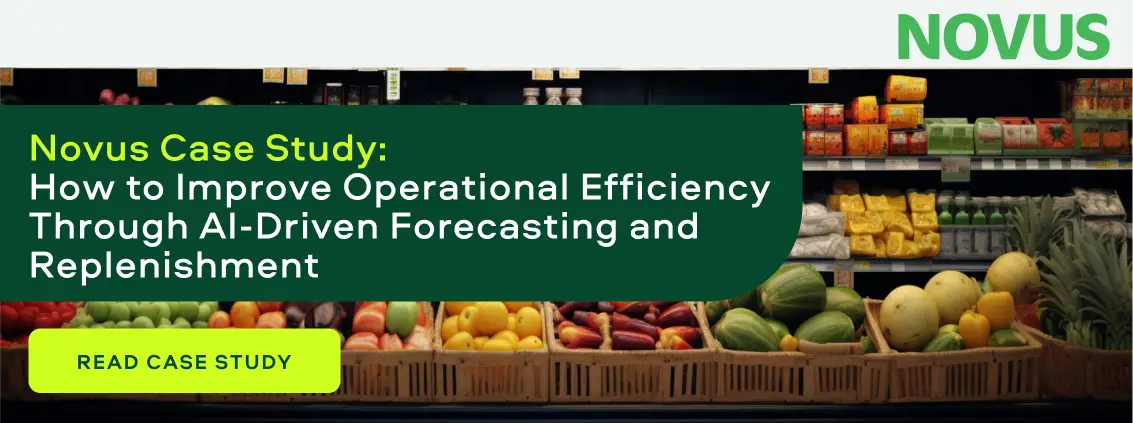
After implementing LEAFIO Inventory Optimization alongside its existing systems, Novus—one of the largest supermarket chains in Eastern Europe—achieved:
These results were not driven by replacing their ERP but by enhancing it with a continuous decision intelligence layer.
ERP systems like Microsoft Dynamics 365 remain essential. They provide stability, compliance, and a reliable transactional backbone.
Modern retail demands more than control. It demands continuous optimization. Inventory challenges at scale do not arise because forecasting tools are inaccurate. They arise because traditional systems were not designed for continuous, network-wide decision-making.
Specialized inventory optimization systems are not alternatives to ERP. They are strategic extensions that transform inventory from static records into a dynamic, performance-driving capability.
For retailers navigating volatility and growth, the winning strategy is not choosing between ERP and optimization — the secret lies in making them work together.


Have a question?

Kristi Miller
Retail optimization expert