
Did you know that it is only a particular product or group of products that generates the majority of your revenue? Studies show that just 18% of the assortment can generate 78% of the total profit. ABC analysis helps to discover the actual ratio in your store. Let's talk about what the ABC method is, its application, advantages, and limitations.
Key Takeaways
ABC analysis prioritizes resources for most impactful SKUs.
A-items drive most revenue.
B & C managed for efficiency.
Helps tailor safety stock.
Informs staff focus & shelf space.
Reviewed quarterly or seasonally.
What is ABC Analysis?
ABC analysis is an inventory management principle that helps determine the value of inventory based on its importance to business processes. ABC classification is primarily concerned with ranking goods by customer demand and cost, which allows managers to divide them into classes according to their importance. The distribution is based on the potential profit each class of goods can bring.
In essence, ABC analysis helps to apply the Pareto principle to the management of goods in retail based on the principle of their priority.
How ABC inventory analysis is related to the 20/80 principle
At the beginning of the 20th century, an Italian economist and sociologist, Vilfredo Pareto, noticed a pattern: approximately 20% of the components of a particular system determine 80% of its result. Initially, this applied to the distribution of land: 80% of the plots in Italy belonged to 20% of the population. Then it turned out that the principle works in other areas as well.
That leads to the retail ratio of 20% of goods generating 80% of revenue. Of course, the figures are conditional (the ratio can be, for example, 25% to 75%), but generally, the principle works as in the graph below, where product A accounts for 70% of total sales.
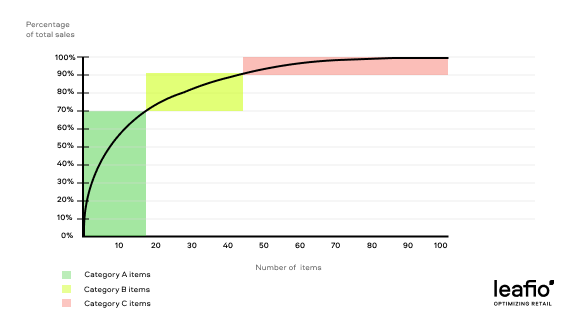
ABC inventory analysis categorizes inventory by priority based on known criteria. Its goal is to reduce business costs (for example, for purchasing and storing inefficient goods), free up working capital, and increase sales of the most important products (those that generate 80% of profits).
ABC classification principle
The classic result of ABC analysis in inventory is the division of all products into three main categories:
- A – the most essential products that generate the most revenue (up to 80%) and therefore require particularly tight control.
- B – less essential products. These, however, also require medium-level control and management as they generate up to 20% of revenue.
- C – less important products that require minimal control. They generate up to 5% of revenue.
In practice, the number of categories can be higher: it depends on the specifics of each retailer.
Benefits of ABC Analysis in Inventory Management
Let's explore how ABC analysis is used and why it helps organize business processes in retail.
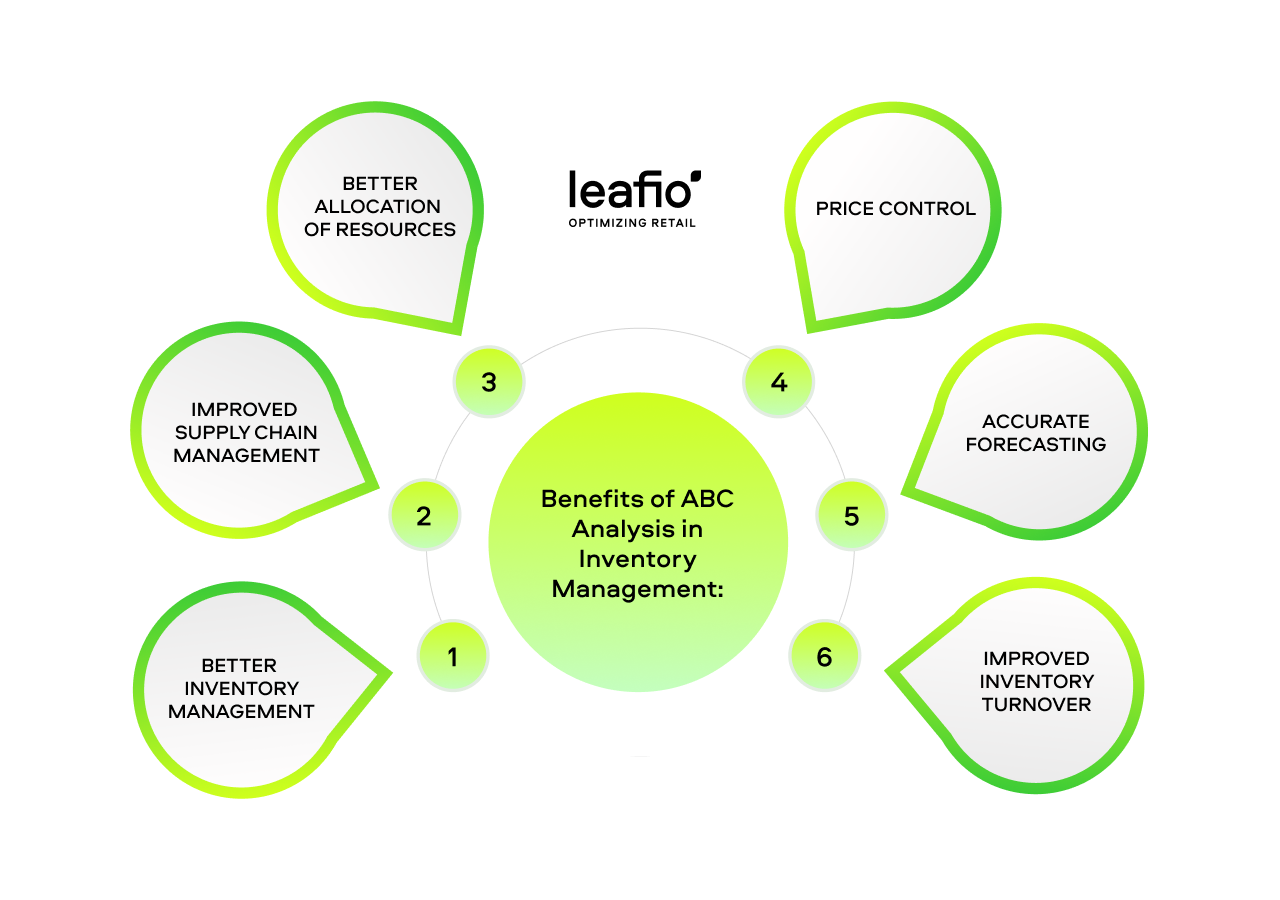
Better inventory management
ABC analysis helps to identify products with the highest, medium, and low demand. With this information, you can reasonably optimize warehouse space and allocate enough space to store category-A goods. This will allow you to keep their quantity at the right level. The space for category B and C goods can also be optimized according to sales figures and avoid situations where a product that generates little or no profitability takes up a large area.
Improved supply chain management
ABC inventory analysis shows you what decisions you need to make to improve the supply of goods. With its help, you will determine which products and in what quantities you need, and as a result, you can:
- find suppliers that offer the broadest range of goods for the product you are interested in;
- for category A goods, find one supplier and negotiate special terms of cooperation with them (e.g., discounts, priority order fulfillment, free delivery, etc.);
- for category C goods, sign a contract with the supplier offering the lowest prices;
- reduce procurement, administration, and logistics costs. Simplify operations by reducing the number of contracts and simplifying quality control.
Better allocation of resources
By identifying category A products using ABC analysis, retailers can ensure they receive the proper attention: concentrate marketing resources, organize the best shelf space, and order new shipments before stocks run out.
Price control
ABC inventory analysis helps to identify a sharp increase in demand for a certain category of goods and increase the price. Obviously, this increases the store's profitability.
Accurate forecasting
With the help of ABC inventory classification, an understanding of which products are the basis of sales is created. The results of the calculations can be used to predict purchases and future trends, as well as for strategic promotion planning.
Improved inventory turnover
ABC analysis in inventory management prioritizes products, which allows you to improve inventory turnover. For example, by regularly replenishing category A products and managing category B and C products, you can ensure that your inventory is up-to-date and meets customer needs. Additionally, the risk of shortages for high-demand products is reduced, and low-priority products are not overstocked.
Challenges and Limitations of ABC Analysis
ABC analysis in inventory is an effective but not universal method. Let's talk about the factors that limit it.
Not always accurate
The analysis focuses on the cost of an item rather than its strategic importance to the business. The logic of ABC is clear: cheap goods are not important. However, in real life, they may be necessary to retain customers. A good example is bread in a grocery store, which is inexpensive and has low margins, which puts it in the B or even C category because its impact on overall revenue is low. At the same time, it:
- serves as an attraction for customers;
- is an essential reputational product;
- attracts a steady stream of customers who buy bread every day.
ABC inventory analysis is time-consuming
Performing calculations for each product (regarding traditional methods) requires a lot of resources. Suppose a retailer has tens of thousands of SKUs. In that case, it will either have to hire separate specialists for ABC analysis or implement special solutions for inventory control and calculations based on the principles of ABC categorization.
An additional challenge is the volatility of demand for some categories. That's why you need to conduct ABC inventory analysis regularly, spending time and part of your profits on it.
Does not take into account seasonal changes
A typical ABC analysis example: in summer, demand for sunscreen increases. It is likely to move to category A during this period. If you ignore seasonality and base your analysis only on summer sales, you may mistakenly predict similar demand throughout the year. The result is the risk of not selling all the stock out at the end of the holiday season, the accumulation of illiquidity, decreased profitability, and the problem of disposing of expired creams.
It does not take into account dynamic factors
The standard ABC classification system focuses on static indicators. What happens if a new product is added to the assortment? It will be classified as a low-priority product because it has no sales history. At the same time, the product can be very promising if adequately promoted. So, if you follow the ABC principle alone, you risk missing opportunities.
There is a risk of subjective judgment
If the retailer has not established clear criteria for ABC classification of inventory, the employees responsible for the analysis will distribute goods based on basic calculations and their own judgment.
Not enough data to make decisions
ABC inventory analysis provides a high-level view but is insufficient to justify specific decisions. Therefore, additional data is needed, at least on the reliability of supply chain management or lead time.
It needs standardization and does not work with some systems
ABC analysis in inventory management will only be successful if all components are standardized in terms of storage, naming, and regularity of evaluation. And if you use a GAAP system, it will be incompatible with ABC analysis and its results.
It does not apply to identical products
If a retailer sells standardized products (say, candy), ABC analysis will be ineffective. It works only when there is a clear difference between the products: some are more expensive, some are cheaper, some are bought more often, others less frequently. In this example, all the types of candy are in the same group, so you need to apply other analysis methods to them.
How to Perform ABC Analysis (Step-by-Step Guide)
If you have decided to allocate resources using the ABC analysis method, here is a clear guide on how to do it.
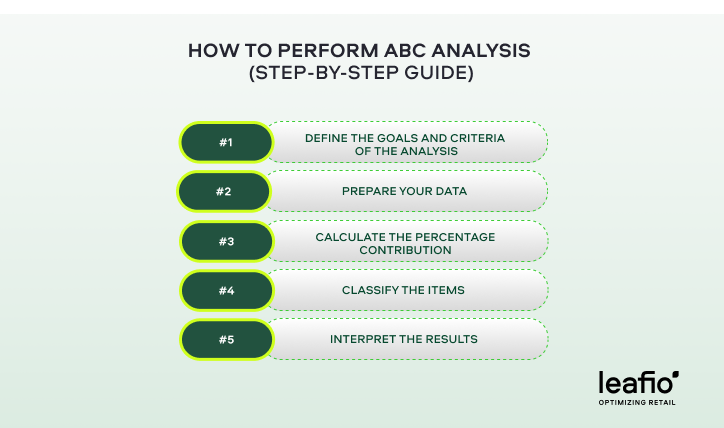
#1. Define the goals and criteria of the analysis
Start by looking at the reasons for performing an inventory management ABC analysis: optimize inventory, manage inventory items more thoughtfully, reduce warehouse costs, or understand which products are most valuable. After that, determine the criteria by which you will divide your products into categories: for example, sales volume or revenue.
Let's say your goal is to find the products that generate the most revenue for you so that you can establish stricter inventory control.
#2. Prepare your data
Gather complete and accurate information about inventory and sales for a given period. You will need the following data: product names, number of units sold, price per unit, and total revenue generated.
Let's return to our task: you want to do an ABC analysis and have six months of data. Let's see what you can do with it.
#3. Calculate the percentage contribution
For each product, you need to calculate its percentage contribution to total revenue (or another indicator you chose in the first step).
Example:
You received $50,000 in total revenue in six months.
Product A brought you $25,000, product B – $15000.
Let's do the math:
Product A: $25,000 / $50,000 * 100 = 50%.
Product B: $15,000 / $50,000 * 100 = 30%.
#4. Classify the items
With the information about the percentage contribution, you can assign products to three categories based on predefined thresholds. The principle may be as follows:
- Category A – 70-80% of revenue.
- Category B – 10-20%.
- C items – 5–10%.
Thresholds for categories vary depending on the specifics of a particular business.
#5. Interpret the results
Based on the results of the inventory management ABC analysis, formulate appropriate decisions. For example:
For category A, maintain optimal inventory levels, a high replenishment frequency, increased control, and optimized conditions. For example, set a weekly order schedule and negotiate a discount with the supplier.
For category B, control the inventory level and monitor the order schedule. For example, analyze sales volume and place orders monthly.
For category C, reduce warehouse costs and analyze the assortment to remove or add certain types of goods. Also, stimulate sales of outdated stock by creating stock clearance discounts.
Best Practices for ABC Analysis
The importance of ABC analysis increases if you create conditions for consistent application and regularly change the assortment based on the results.
The classification should be simple
The higher the turnover, the greater the risk of shortages. However, gross profit or cost can also serve as primary indicators. In such a case, the most expensive goods are assigned to category A, and the cheapest to category C.
Avoid spinning your wheels
Organize your ABC analysis so that the cost of resources correlates with profit. For example, if managers spend 50 hours analyzing class C products, it may not pay off due to low sales and low margins. Spending the same amount of time on Class A products makes much more sense. That's why the number of counting cycles for products that generate the most profits should also be higher.
Stay flexible
Be ready to change your decisions just as conditions change. New trends, products, different purchasing habits of new customers, changing seasons—any of these factors can necessitate an inventory reclassification. Therefore, decisions that are set in stone don't sit well with the ABC analysis.
Make a connection between inventory and sales
If sales increase, inventory turnover does, too. Then, the replenishment schedule needs to be changed. The same thing happens if sales fall due to external or internal factors. Track this relationship, draw conclusions, and change advertising strategies and prices for each product class.
Use Accurate and Up-to-Date Data
The results of ABC analysis are only as good as the data used to inform it. Therefore, use only accurate, up-to-date, and complete information for a specific billing period.
Automate ABC Analysis and Inventory Management
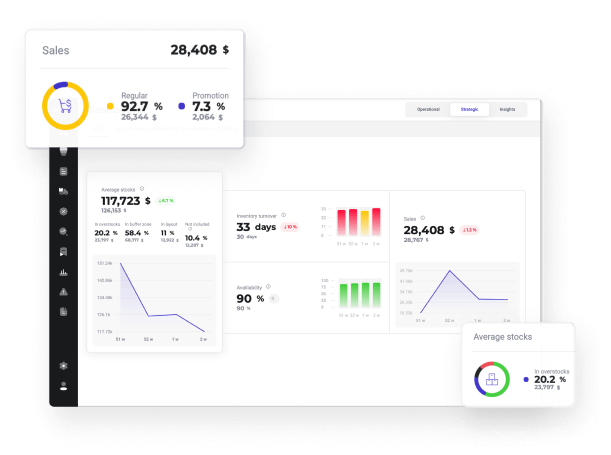
Manual ABC analysis is the best opportunity for mistakes and wasted time. It is incredibly daunting for large retailers because the analysis cost will be enormously prohibitive. Fortunately, there are automated inventory management solutions and software. These will help you track all changes in turnover, classify goods, and receive accurate reports without wasting precious time. Modern programs can easily be synchronized with ERP and set up uninterrupted data retrieval.
Combine ABC Analysis with XYZ Analysis
While ABC analysis allocates products based on their contribution to cost, ZYZ analysis is based on the variability of demand. By combining these two approaches, you can more accurately manage inventory, forecast demand, and allocate products.
Increase the efficiency of your analysis with LEAFIO AI
LEAFIO Retail Business Intelligence Software provides comprehensive analytics for product management within the assortment matrix. One of the features is ABC(D) and XYZ analysis. The report obtained from this analysis helps to:
- identify low-turnover products in advance;
- identify the most profitable and popular products;
- classify products by demand fluctuations and sales stability.
The program generates a report in which products are divided into four groups according to their contribution to sales or profit margin. Products are grouped by the share of the selected indicator, and thresholds can be customized independently.
As we mentioned above, XYZ analysis helps to assess the predictability of demand and the stability of sales. You can determine what quantities of each product should be ordered or, for example, identify the types of products that must be disposed of promptly.
Combining the two types of analysis helps you optimize inventory in a more balanced way, predict demand, and reduce waste.
Conclusion
Any decent inventory management system should rest on proven analysis methods that provide the basis for managerial conclusions. The ABC analysis is a well-known method of classifying goods that helps to improve the supply chain, establish inventory management, and understand what share of profit each product brings. However, the method has its limitations as well. It must be combined with other methods like XYZ to deliver a more complete view of the situation. Use modern software solutions that will perform this analysis automatically and save time and money.
ABC analysis FAQ
What is ABC analysis?
This is a method that optimizes the inventory management process. It helps to categorize products based on their importance to the business. This way, you can focus resources on the most valuable items.
What are the criteria for ABC inventory?
It can be sales volume, revenue, or profitability. The specific criteria depend on your business goals.
How often should I conduct an ABC analysis?
Focus on the intensity of your business processes. Try a quarterly analysis as a starting point, but if your inventory turnover is high, you'll need to do it more often.
Can ABC Analysis work for small businesses?
This analysis helps any company prioritize ABC inventory management. The size of the business does not matter.
What are common mistakes to avoid in ABC Analysis?
Don't base your conclusions on the results of just one analysis. Remember that the data needs to be updated regularly, and market trends and changing seasons must be considered.


Have a question?

Kristi Miller
Retail optimization expert