
Every retail business hopes to attract as many new customers as possible, retain the existing ones, and boost overall sales. The best way to reach these goals is to drive customer loyalty, keep the competitive edge, and foster growth through impactful promotional campaigns. In fact, according to McKinsey, effective promotions can boost sales volumes by 10-20% and improve customer acquisition by up to 30% .
However, planning and executing promotions is complex and fraught with challenges. Retailers must navigate logistical hurdles, including coordinating departments, managing inventory, and accurately forecasting demand. Automation tools—specialized solutions for retail based on artificial intelligence—will help to perfect the process.
In this detailed guide, we explore the difficulties that retailers encounter when planning and implementing promotional campaigns and offer solutions to overcome them. We will also discuss how to use the power of promotional forecasting with the correct data and AI technology.
Key Takeaways
AI promo tools predict, personalize & protect margins.
Identifies best promo SKUs.
Tests price elasticities.
Cuts ineffective discounts.
Matches promos to inventory.
Learns from past campaigns.
Common challenges in trade promotion management
Managing several promotions is quite challenging. Especially when major holiday sales come around and you are running multiple promotional campaigns at the same time, numerous challenges can pop up in trade promotions management in retail.
#1 Lack of coordination
Retailers sometimes struggle to align promotions with overall marketing strategies or consider factors like seasonality, consumer demand, and competition. Coordinating promotions across multiple locations and channels requires efficient logistics for consistent and timely implementation.
#2 Data management difficulties
Promotions generate vast amounts of data, including sales figures, pricing information, and consumer behavior. Retailers often find it challenging to collect, consolidate, and analyze this data to gain actionable insights. Integrating data from various sources and ensuring its accuracy are persistent issues.
#3 Insufficient analytics tools
Measuring the ROI of trade promotions is a complex task. Retailers must isolate incremental sales attributable to specific promotions while accounting for cannibalization and baseline sales fluctuations. Advanced analytics tools are essential to assess promotion effectiveness accurately and make informed adjustments.
#4 Budget constraints
Retailers must negotiate with manufacturers or suppliers and align promotional expenses with expected returns. Limited budgets and competing priorities demand strategic decisions on which promotions to invest in and how to optimize spending for maximum profitability.
#5 Supplier and manufacturer communication
As in the case of budgets, collaborating with manufacturers makes trade promotion management successful. The key is open and transparent communication, shared data and insights, and a common understanding of goals and expectations. Otherwise, differing objectives, communication gaps, and conflicting interests will cause problems.
#6 Consumer fatigue
Continuous promotions can lead to consumer fatigue, reducing responsiveness. Retailers need to manage the frequency and timing of promotions to maintain engagement and avoid diluting their value. Understanding consumer behavior and preferences is critical for effective targeting.
#7 Market pressure
Competitive markets pressure retailers to churn out standout promotions quickly. Retailers must monitor market trends and competitors’ activities, finding innovative ways to differentiate their promotions while maintaining profitability.
Retailers increasingly adopt integrated solutions and platforms combining technology and expertise to keep their offers fresh and innovative.
Boosting trade promotion effectiveness with AI
Artificial intelligence (AI) is revolutionizing trade promotion management as we speak by providing precise demand forecasts and automating critical processes. By integrating AI-driven solutions, retailers enhance the effectiveness of their promotional campaigns in several key areas:
Accurate trade promotion forecasting
AI-driven tools excel in predicting demand for promotional campaigns. Using historical data and advanced machine learning algorithms, these tools provide highly accurate forecasts. It allows retailers to anticipate customer needs better, ensuring the right products are available in the right quantities at the right time. Accurate forecasting reduces the risks of overstocking and stockouts, optimizing inventory levels and improving overall promotion performance.
Automation of stock replenishment and order creation
AI automates the complex processes of stock replenishment and order creation. Retailers can use AI to generate orders automatically based on real-time data and predictive analytics. This reduces manual effort, minimizes human error, and ensures timely stock availability. Automated systems can also dynamically adjust order quantities based on ongoing sales performance, optimizing inventory management during promotional periods.
LEAFIO AI promotion management solution
LEAFIO AI offers specialized AI-driven solutions designed to enhance trade promotion management. LEAFIO Inventory Optimization helps retailers automate stock replenishment across the entire supply chain, from central warehouses to individual stores. The system uses machine learning algorithms to generate precise forecasts, considering various factors influencing demand.
LEAFIO AI's promotion planning software also provides comprehensive analytics to assess the performance of promotional activities. It helps retailers identify successful strategies and areas for improvement, leading to more effective future campaigns.
Incorporating AI and automation into retail operations boosts the accuracy of promotion forecasting and enhances efficiency in stock management and promotional execution. Retailers who adopt these advanced technologies can expect significant improvements in their promotional effectiveness, which will lead to sustained business growth.

Promotion forecasting process
There are several essential steps to building an effective promotion forecasting process:
1. Data preparation and cleaning
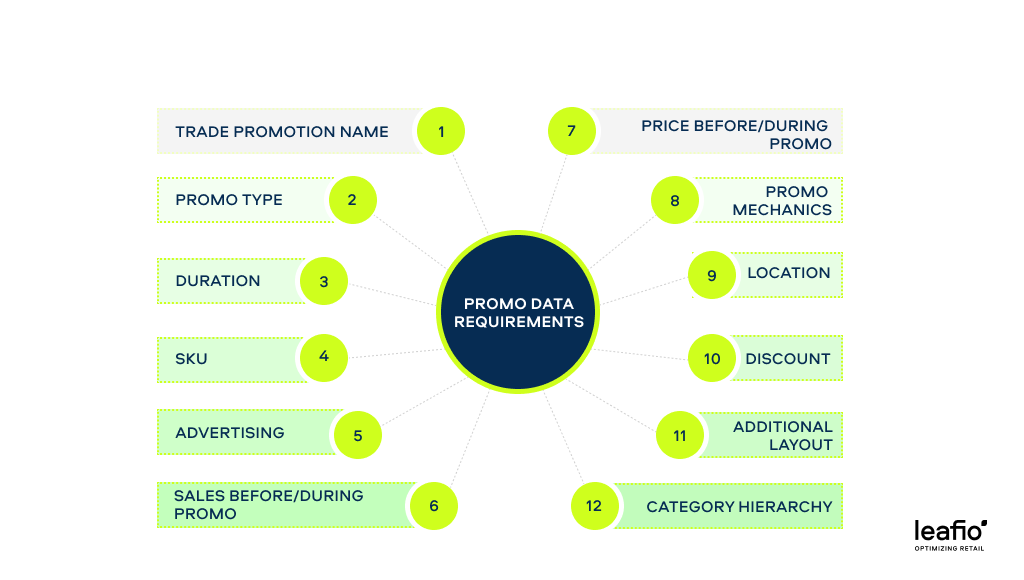
Accurate trade promotions forecasts rely on high-quality data. Retailers should filter out any unnecessary data that could affect forecast accuracy, such as random demand spikes on out-of-stock days. It's also essential to separate promotional and regular sales into two databases. After it is cleaned, the database is loaded into the model for training.
2. Identifying demand-influencing factors
To improve the accuracy of trade promotion forecasting, retailers need to consider various factors that influence demand fluctuations. These factors may include seasonality, market share conditions, regional variations, and external events. Analyzing historical data helps recognize patterns affecting sales volume during promotions, leading to more precise forecasts.
3. Model training and cross-validation
Naturally, training the forecasting model with historical data is irreplaceable. The model learns from past sales patterns and adjusts for identified influencing factors. Cross-validation tests the model with different data subsets to ensure it performs well under various scenarios. Refining the model involves incorporating additional data and adjusting parameters to enhance predictive accuracy. The final validation test confirms the forecast's accuracy and reliability, providing a solid basis for planning promotional activities.
4. Choosing the suitable forecasting model
Various AI-based models predict promotions, including Simple Moving Averages, Life Cycle Modeling, Adaptive Smoothing, Random Forest, and LightGBM. These models range from time series forecasting with linear dependencies to decision tree algorithms. Multiple models are often combined to determine the most effective approach for each case.
Choosing the suitable model depends on several things:
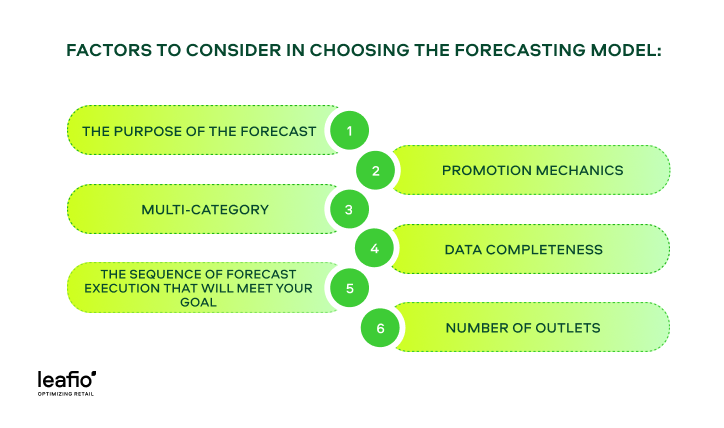
- Purpose of the promotional forecast: When using forecasting models, it's essential first to define a specific goal, such as predicting store occupancy during a promotion or financial planning, and align the model with the forecast’s purpose.
- Multi-category forecasting: Consider the number of product categories involved. The chosen model should handle diverse impacts of demand growth factors across categories.
- Sequence of forecast execution: For demand forecasting and order replenishment, the system might forecast specific SKUs at individual stores and then aggregate them for all locations. For financial planning, the sequence might start from the category level.
- Promotion mechanics: The nature of the promotion affects model selection. One model might best predict regular discounts, while complex deals like "buy one, get one free" may require another.
- Data completeness: Complex models need extensive historical data, while simpler ones can work with limited datasets. Could you match the model to the available data?
- Number of outlets: Decide if the promotion will be network-wide or limited to specific stores, impacting the forecasting approach.
LEAFIO AI uses LightGBM and other advanced AI models to provide accurate trade promotion forecasting tailored to clients' needs, helping retailers improve the planning and execution of promotional campaigns.
Measuring trade promotion effectiveness
There are three main steps to evaluate the results of a promotional campaign.
1. Using metrics of trade promotion forecasting accuracy
Commonly used metrics include MAE (Mean Absolute Error), MAPE (Mean Absolute Percentage Error), WAPE (Weighted Average Percentage Error), WMAPE (Weighted Mean Absolute Percentage Error), BIAS, and RMSE (Root Mean Square Error).
At the SKU evaluation level, LEAFIO AI specialists use the WMAPE metric. Calculating WMAPE helps indicate different indicators' role in the forecast and their effect on the results. For example, a mistake in forecasting demand for expensive SKUs causes more significant business losses than an error in forecasting low-value products.
2. Financial metrics assess the economic outcomes of promotions:
- Sales uplift: Measures specific sales targets increase during the promotion.
- Return on investment (ROI): Calculates promotional profitability.
- Inventory turnover: Assesses the speed of selling promotional inventory.
- Gross margin return on investment (GMROI): Evaluates profitability of inventory investment.
These metrics clearly show a trade promotion’s effectiveness in driving sales and profitability.
Methods for measuring trade promotion effectiveness include:
- Comparison of forecasted and actual sales: identifying discrepancies.
- Analysis of inventory levels: stock monitoring throughout the promotion.
- Customer feedback and surveys: gathering consumer insights.
- Promotional analytics: advanced tools analyze performance.
It is worth remembering that even with the most accurate promotional forecast, a retailer can always encounter unforeseen problems, such as problems related to logistics or store operations. These factors can reduce the overall promotional effectiveness and lead to a loss of sales. Expert data analysis and the use of the listed performance evaluation metrics will help you get the most comprehensive retail promotion analytics and learn information that might come in handy in the future.
The economic impact of trade promotion automation and AI-powered promotion forecasting
Automating trade promotions and AI-powered forecasting tools can significantly improve a retailer's economic performance.
A striking example of the implementation effect that the LEAFIO AI solution can have is the case of Novus, a grocery chain with about 90 supermarkets. Novus successfully manages 30,000 SKUs and runs promotions on 40% of its assortment. After implementing LEAFIO’s AI-driven promotion planning solution, Novus achieved notable results: improved promotional product availability and significantly reduced excess inventory.
The automated promotion management process offers several key advantages:
- Resource optimization: Automation reduces the need for manual intervention, saving time and labor costs.
- Accuracy and efficiency: AI algorithms provide precise demand forecasts, ensuring optimal stock levels and reducing the likelihood of stockouts or overstock situations.
- Enhanced decision-making: Comprehensive analytics and real-time data allow retailers to make informed decisions quickly and efficiently, adapting to market changes and consumer behavior.
- Centralized management: Automation centralizes the management of promotional activities, maintaining a consistent approach across all stores and simplifying the coordination process.
Retailers using LEAFIO’s AI-powered solutions have seen significant improvements, such as a 20% increase in product availability, a 50% reduction in overstock, and a 15% increase in promotional forecast accuracy, leading to increased sales and more efficient resource use.
Practical tips for retailers
Promotional forecast accuracy is essential, but financial results matter even more. Forecasts are crucial when planning promotions and placing orders. However, once actual promotional data comes in, use this accurate data to guide your future decisions. Incorporating promotion analytics capabilities ensures that trade promotion forecasting is part of the overall campaign plan.
Here are some practical tips to enhance trade promotions:
- Remember to focus on actual promotional sales, not forecasted sales. While we rely on promotional forecasts when planning promotions and placing orders, it's important to shift focus to actual revenue data once the promotional campaign is executed.
- It is essential to check the promotion effectiveness of each promotional activity and compare the goals with the results, considering all relevant factors.
- Trade promotion forecasting is part of the process and should be included in the overall campaign planning.
- Ending the trade promotions at the right time is just as important as the right start, as the retailer's goal is to prevent the formation of excess inventory at the end of the campaign.
Conclusion
Taking advantage of technology to automate promotional campaigns and accurately forecast promotions using machine learning algorithms followed by robust promotion analytics capabilities is a must in today’s retail. Successful implementation heavily depends on precise data processing and balanced result assessment. Retailers must prioritize maintaining data quality, consistently updating datasets, and analyzing incremental volume, promotional costs, and past promotions effectiveness to drive continuous improvement.
AI-driven tools optimize promotional costs by reducing manual work and improving forecast accuracy. These tools enhance promotion effectiveness through precise demand forecasting and automated stock replenishment. By evaluating forecasts against real-world outcomes, retailers can refine strategies and achieve better results.
Join the growing number of satisfied LEAFIO AI customers and discover how to boost the effectiveness of your promotions today!
FAQ
Why is trade promotion important?
Trade promotions drive customer loyalty, maintain a competitive edge, and foster business growth. Effective promotions attract new customers, retain existing ones, and increase overall sales, boosting trade promotion effectiveness and contributing to long-term success.
What are the common challenges in retail promotion planning?
Common challenges in retail promotion planning include coordinating across departments, managing inventory, accurately forecasting demand, and ensuring data accuracy. These promotion challenges often complicate the promotion management process and require robust trade promotion analytics.
How do we measure promotion effectiveness?
Measuring promotion effectiveness involves comparing forecasted sales with actual sales, analyzing inventory levels, and gathering customer feedback. Critical metrics for measuring trade promotion effectiveness include incremental volume, ROI, and sales uplift, which provide insights into promotional performance.
What are the KPIs for promotion effectiveness?
Key performance indicators (KPIs) for promotion effectiveness include sales uplift, return on investment (ROI), gross margin return on investment (GMROI), and inventory turnover. These metrics help evaluate the success of promotional activities and guide future strategies.
How can detailed sales data help gauge the effectiveness of a sales promotion?
Detailed sales data allows retailers to analyze consumer behavior, identify trends, and measure the impact of promotions on sales. The data supports promotion analytics, enabling more accurate promotion forecasting and improving promotional effectiveness by refining strategies based on real-world performance.
How do you ensure data accuracy in promotion forecasting?
Ensuring data accuracy in promotion forecasting involves regularly updating and cleaning datasets, eliminating irrelevant or erroneous information, and using high-quality, well-prepared data.
What are the benefits of trade promotion automation?
Trade promotion automation enhances efficiency by reducing manual effort, improving forecast accuracy, and optimizing stock replenishment. Automated trade promotion systems streamline the promotion management process, improving promotion efficiency, reducing costs, and increasing promotional effectiveness.


Have a question?

Kristi Miller
Retail optimization expert