Trade promotion management and optimization are essential business processes requiring accuracy, involvement, interaction of various departments, and in-depth analytics. That is why successful retailers use specialized promotion planning software. The whole global trend and area are promising as the trade promotion management software market is estimated to have a CAGR of 9.7% between 2022 and 2030. This is a global trend and a promising area. And even more advanced retailers choose promotion software solutions based on artificial intelligence.
In this article, we will explore what AI-based solutions, in particular, can do to bring promotion processes and promo campaigns' efficiency in the retail industry to another level.
Key Takeaways
Optimized trade promos protect margins and grow category sales.
Base on clear volume & margin goals.
Avoid cannibalizing regular sales.
Use AI for lift prediction.
Coordinate with inventory plans.
Post-event analysis improves next round.
Benefits of AI in trade promotion optimization
Artificial intelligence significantly increases the effectiveness of promotion optimization. What are the main advantages of such a solution?
Enhanced forecasting and analytics
One of the main advantages of using AI for trade promotion optimization (TPO) is the ability of the system to analyze vast amounts of information to predict demand accurately. Machine learning forecasting algorithms based on high-quality data can easily spot patterns and trends. This helps managers make decisions based on practical conclusions rather than mere intuition. The effectiveness of retail promotion optimization only increases as a result.
Moreover, AI can sift through complex data sets and identify trends and patterns hidden at first glance, even by an experienced specialist. This creates the conditions for developing innovative trade promotion optimization solutions for product placement, campaign duration, and promotional pricing.
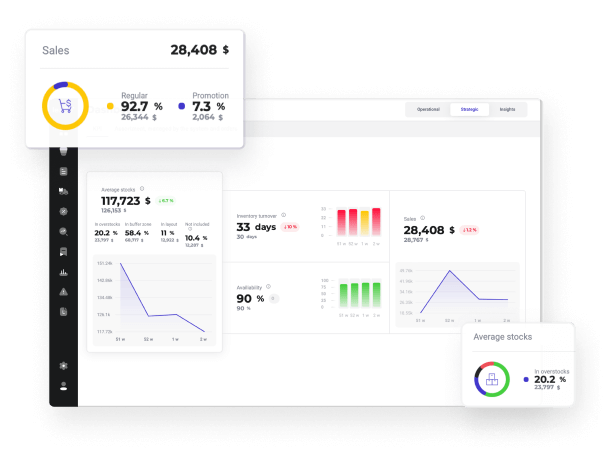
Improved promotion planning
The AI-powered system takes all the hard work out by automating routine tasks: demand planning, replenishment order formation, and sending. It sets the staff free to focus on strategic areas. At the same time, you can establish cooperation between locations and departments and ensure the whole team is working on the same tasks.
Effective trade promotion execution
Artificial intelligence provides real-time data on the effectiveness of retail promotion optimization, creating conditions for making quick adjustments. Moreover, it is possible to automate promotions based on real-time information. This helps to prevent overstocking or understocking issues, reduces waste, and ensures that products are available whenever and wherever customers need them.
Critical components of AI-driven promotion planning
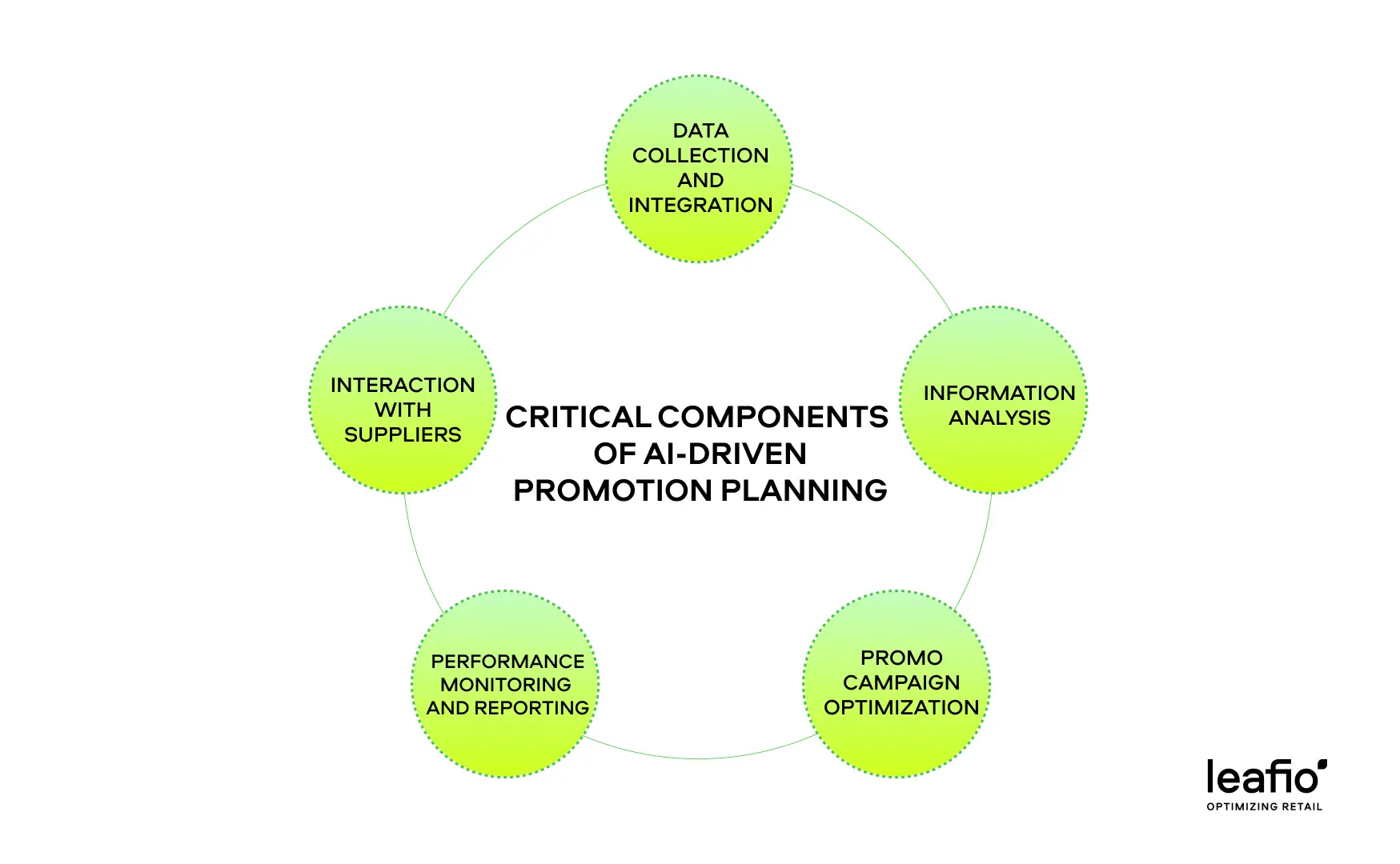
A whole market of different promotion optimization solutions based on artificial intelligence exists. Still, it is worth noting that these solutions have to consider many factors to allow you to maximize their potential.
#1 Data collection and integration
Artificial intelligence needs high-quality data from various sources: CRM, sales data, industry benchmarks, etc. Users should look for an AI solution flexible enough to integrate with existing systems. Within the network, you can incorporate the tools typically used by retailers, e.g., BI, ERP, and others.
#2 Information analysis
The solution must wield advanced algorithms based on machine learning that can analyze vast amounts of various data, including historical sales, pricing policies of promotions, promotion mechanisms, demand generation factors, and other aspects. This will allow you to create an accurate forecast of demand for promotions. In addition, it will become possible to develop predictive models to predict future customer behavior, market trends, and promotional campaign results.
#3 Promo campaign optimization
Retail promotions are optimized by tracking their progress, responding quickly to changes in demand, and adjusting inventory levels in different stores. This helps distribute products between stores more efficiently, avoid product shortages during promotions, and prevent excessive accumulation of goods after the promotion. The software should also allow you to see current promotions and make more informed decisions about the dates and selection of products.
#4 Performance monitoring and reporting
One of the capabilities of an AI-based system for promotion optimization in retail is real-time campaign performance tracking, which significantly improves decision-making efficiency. After the promotion, the system provides post-promotion analytics that helps you improve future promotions. You can evaluate the effectiveness of the promotion by analyzing plan/fact numbers, balances, turnover, product availability, and lost sales during the campaign. Ready-made ROI calculations for each campaign or channel are also available.
#5 Interaction with suppliers
Effective promotion planning involves interaction between retailers and suppliers. AI can significantly improve this process. In particular, analyzing information about the supply chain, stock levels, and target market demand makes it possible to create the most effective campaigns. The system should also consider the supplier order requirement (e.g., MOQ), lead time, and delivery schedules and analyze supplier reliability to ensure all promotional products are delivered before the promotion starts.
This ensures that supplies support promotions well, minimizing the risk of shortages or surplus accumulation. More accurate demand forecasting will allow suppliers to plan distribution more efficiently. In short, AI is about increasing efficiency and building strong business relationships and long-term strategic partnerships.
The role of promotional pricing in trade promotion optimization
Promotional pricing performs an essential function in optimization: sales and customer acquisition depend on it. What does this mean? It is a strategy of offering products at a reduced price for a limited time to stimulate demand, expand the target audience, or release warehouse stocks.
Steps in a promotional pricing strategy can look like this:
- Analysis of audience preferences, buying behavior, and price sensitivity.
- Segmentation of the audience based on the analysis and grouped data.
- Competitor analysis, pricing strategies, and advertising campaigns.
- Cost calculation of goods sold. Considering marketing costs, it is essential to ensure that promotional pricing achieves the desired profit margin.
- Dynamic pricing models can change prices in real-time based on market conditions. AI and machine learning tools can also help optimize promotional pricing.
- A/B testing of different pricing strategies and selection of the most effective one.
- Tracking promotion pricing strategies and making adjustments in real-time.
Correct pricing increases margins, retains customers, and helps promote the brand. It can be used to manage inventory efficiently, for example, by speeding up the sale of slow-moving goods. A well-calculated price increases customer loyalty and promotes repeat purchases. Ultimately, promotional pricing helps you stand out from the competition and attract more customers.
3 tips for achieving retail promotion optimization
There are several styles of trade promotion optimization. Let's consider the three most important ones.
1. Automated promotion efficiency analysis
By automating the retail promotion optimization process, you can eliminate human errors, save time, and get high-quality, accurate data. The tools can collect and analyze large amounts of information from various sources, conjuring a comprehensive picture of promotion efficiency. This is what retailers need to make decisions and quickly adjust promotion strategies in real-time. Using the right tools, you can:
- identify low-performing promotions and adjust them to improve results;
- accurately forecast and make decisions that will make the promotion planning process effective;
- reduce the routine workload on staff, allowing them to focus on strategic tasks rather than manual data processing.
2. Centralized promotion planning
In the promotion planning process, you can combine all the promotion details to create a holistic view and coordinate the work of all departments, from marketers to those who work directly on the sales floor. This way, teams will achieve common goals.
Unified planning is, first of all, the coherence of all promotional activities, regardless of location or sales channel. This is important for maintaining brand integrity and improving customer experience.
In addition, centralized planning helps to properly allocate resources, ensuring the efficient use of budgets, inventory, and people.
3. Testing different promotion scenarios
In the process of promotion optimization in retail, it is important to study different promotion strategies and determine the most effective ones. This includes testing different pricing models, discount options and levels, and advertising channels. Thanks to this, retailers:
- reduce risks, as they can identify them at the planning stage and mitigate them before full implementation;
- optimize strategies to achieve their goals quickly;
- better understand customer behavior and preferences, which will help plan future promotions.
Tools and technology for optimizing retail promotion planning
Facebook, Amazon, Google, and Alibaba have all learned how to analyze massive amounts of data and use the results for improved efficiency. Medium-sized retailers can respond just like them.
In an ideal world, big data would come from similar sources, making artificial intelligence and machine learning a simple process. However, unstructured data comes from different files: email, spreadsheets, documents, etc. We must determine the quality of the data type needed and merge it from these diverse sources.
Having high-quality data does not immediately solve the problem. AI models need to learn to predict outcomes, which happens only with high-quality big data. Marketers can do five things to optimize their retail promotions to reach this efficiency level.
- Strategize. Gather data for each stage of the process.
- Plan. Coordinate with marketing and logistics to negotiate parameters and conditions.
- Preparation. The company that uses this application can analyze performance.
- Execution. Put the plan into action and collect data.
- Exit. When the promo ends, review the survey results and adjust the program for the next promo.

You’ll need at least six months to do all of that and 12 months more to go through the annual cycle and analyze all trade promotions.
An end-to-end AI software plus a promotion planning solution improves a company’s ability to coordinate processes. Internal flow ensures multi-level, multi-step processes for upcoming promos. Every participant in the process completes tasks at the right time.
The AI models will predict current promo efficiency and reduce time spent on forecast generation. With AI, you’ll be done guessing and no longer rely on partial data and hunches.
The more trade promotions you have, the faster the models learn and improve. Ultimately, the data becomes more accurate, resulting in better promotion management results.
How LEAFIO AI improves trade promotion planning
LEAFIO AI Promotion Software optimizes planning processes with accurate forecasting and reconciliation of inventory levels and actual sales. The system provides comprehensive analytical data so you can accurately assess process effectiveness and make the right strategic decisions.
Among the benefits of the solution are:
- accurate forecasting, which helps to create a promotion plan and achieve inventory balance;
- storage and organization of data to train the model and improve the quality of forecasts
- significant reduction in staff workload;
- accurate assessment of the effectiveness of the current campaign to quickly respond to changes and customize the interaction between performers.
All information about promotions is available in one place: historical data, current promotions, and planned promotions. Thus, you can analyze performance without manual calculations and unnecessary detail.
FAQ
Why is promotional planning important?
Proper promotion planning increases sales and revenue, promotes customer loyalty and company awareness, efficiently allocates funds, inventory, and staff efforts, and reduces potential risks. Additionally, analyzing data from past promotional campaigns helps create more effective strategies.
What is retail promotion optimization?
It is about the use of analytical data, the implementation of promotional activities and their adjustment to achieve profitability and increase profits. In general, trade promotions involve studying past experience, implementing automation tools, testing various options, and creating promotion strategies to increase sales and attract customers.
What two questions must be answered for the development of the promotional program?
The first question is: what is the purpose of the campaign? To answer this, you need to identify specific goals, such as increasing sales. The second question is: who is the target audience? To answer this question, you need to analyze your customers and divide them into segments based on their preferences and behavior.


Have a question?

Jane Medwin
LEAFIO Co-Founder, Retail Optimization Expert