



INSTORE 2024 survey results—which involved more than 700 owners and managers of American jewelry stores—tell us that 4 out of 10 retailers are not familiar with GMROI. These retailers are letting an indicator that can reveal inventory problems slip through their fingers. Inventory problems are most likely holding their retail company back from generating higher profits. GMROI is really one of the best tools for measuring and managing the performance of inventory investments, providing powerful information for better informed decision-making.
In this guide, we will go through the benefits of a GMROI analysis, its correct calculation, and how you can improve it to drive business growth.
Key Takeaways
GMROI helps retailers understand if inventory is truly profitable.
Measures how inventory turns generate gross margin.
Helps spot underperforming SKUs.
Can guide markdown or promotion strategy.
Essential for planning seasonal inventory.
Drives smarter cash allocation.
What is GMROI in Retail?
GMROI (Gross Margin Return on Inventory Investment), also referred to as gross margin return on investment, is a retail KPI that measures how much gross profit a retailer earns for every dollar invested in inventory. It is calculated as: GMROI = Gross Margin ()÷AverageInventoryCost() ÷ Average Inventory Cost ( )÷AverageInventoryCost(). A GMROI above 1.0 means the inventory generates more profit than it costs to hold.
Between 70% to 80% of a retailer's assets are tied to inventory. Therefore, it is logical that every retailer should be making sure that they are profitable. GMROI (Gross Margin Return on Inventory Investment) shows how much gross profit you get for every dollar invested in inventory during the year.
Inventory investment includes the costs of transportation and storage of inventory, as well as the fulfillment of customer orders. If these inventory costs are higher than what you get from selling products, you should reconsider your strategy immediately.
The importance of GMROI in retail industry
GMROI is an essential tool that allows you to study and analyze the performance of each store to date and create more accurate forecasts. By analyzing this indicator, the profitability of products and the suitability of suppliers can be understood better.
Unfortunately, many retailers spend money on products that do not generate healthy profits. Once you analyze the gross margin return on investment, you can make better decisions about your inventory and optimize your company's operational processes.
How to calculate GMROI?
The standard GMROI formula is:
GMROI = Gross Margin / Average Inventory Cost
Where Gross Margin % = ([Revenue – CoGS] / Revenue) * 100
And Average inventory cost = (Current inventory + Previous inventory) / Number of periods
However, GMROI (Gross Margin Return on Inventory Investment) can be calculated by retailers in slightly different ways, depending on what types of expenses are taken into account. For example, real estate, storage, marketing, etc. The costs taken into account will vary greatly depending on your goal.
GMROI example: which store is the most productive?
Let's take a look at this theoretical example of 4 stores' performance and find out the most profitable one using the GMROI formula.
| Sales | Gross margin | Average Inventory Cost |
|
|---|---|---|---|
| Store A | $318,800 | 45% | $104,300 |
| Store B | $230,099 | 40% | $55,100 |
| Store C | $209,600 | 49% | $83,200 |
| Store D | $186,400 | 42% | $34,700 |
Store A has the highest sales. B and C have similar sales, but store C has the highest gross margin. So which one is doing better? To get an answer, you need to calculate GMROI for each store.
| Sales | Gross margin | Average Inventory Cost |
GMROI | |
|---|---|---|---|---|
| Store A | $318,800 | 45% | $104,300 | $1.37 |
| Store B | $230,099 | 40% | $55,100 | $1.67 |
| Store C | $209,600 | 49% | $83,200 | $1.23 |
| Store D | $186,400 | 42% | $34,700 | $2.25 |
Store D has the highest GMROI, indicating it generates the most gross margin dollars per dollar of average inventory cost. This means Store D generates $2.26 in gross margin for every $1 invested in inventory, making it the most inventory-efficient store.
How to interpret results of GMROI analysis?
One of the recent study results published in the INSTORE 2024 survey showed that better-performing jewelry stores receive a higher return on their inventory investment: 51% of thriving companies achieved GMROI above $1.00.
So, in general, a GMROI higher than $1.00 means that the retailer is making a profit on inventory. It means that the higher the GMROI indicator the better. A GMROI below $1.00 indicates that the retailer is not generating enough gross profit to cover inventory costs. The reasons may include excess inventory, incorrect pricing, poor product quality, etc. In any case, a low GMROI is a reason for an in-depth process analysis.
However, determining a perfect GMROI for any retail business is difficult. It tends to vary by geography, vertical, and market segment. Every retailer must have its own benchmarks for optimal GMROI based on the company's individual business strategy.
Measure GMROI against other metrics
For effective analysis, it's also important to compare GMROI with other key indicators.
For example, a high GMROI with a low inventory turnover may indicate that the products are profitable but sell slowly. In this situation, you should use promotions or discounts to speed up inventory turnover.
A low GMROI with high inventory turnover, on the other hand, may indicate that goods are sold quickly, but the gross margin is too low. You need to adjust prices or cut costs to increase profitability.
Problems that can arise with GMROI analysis
Here are some of the challenges you may face during the gross margin return on investment analysis:
- Incorrect data. GMROI calculations will be inaccurate if a retailer has problems with inventory management. This is often the result of using an old accounting system, as well as the human error factor.
- Seasonal goods. GMROI may vary depending on seasonal demand. For example, categories of goods that are actively sold during the Christmas holidays may show an inflated GMROI.
- Gross margin return isn't an end-all answer. The basic formula only shows how efficiently you spend money on inventory. Therefore, even with a high GMROI, the profitability may stay low because the problem hides under other investments: marketing, transportation, labor, etc.
- Specificity of certain categories. Different product categories may have different expectations for gross margin return on investment based on margins and turnover rates, making direct comparisons difficult.
- Long life cycle of goods. Products with a long shelf life (or those that sell slowly) may have a low GMROI. This often misleads retailers, but such products can be profitable over time.
Steps a retailer can take to improve on GMROI
If you are not satisfied with the results of your GMROI analysis, apply the following tips.
1. Improve inventory management
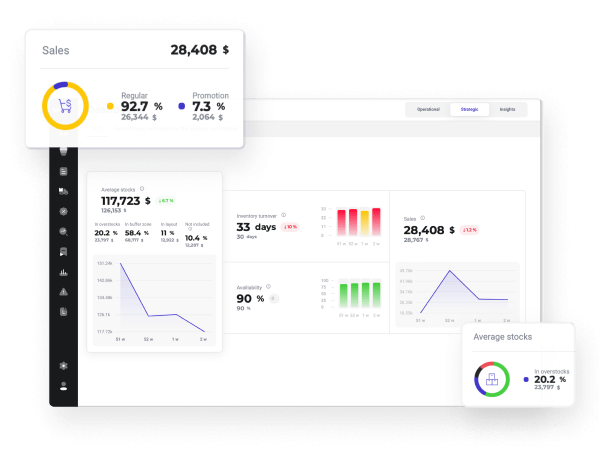
Optimize GMROI through better inventory management: increase inventory turnover, minimize overstocking and SLOB inventory to reduce inventory carrying costs. Modern retailers use AI-powered self-regulating technologies to strike a balance between high product availability and minimal write-offs to increase inventory turnover, reduce lost sales, and overstocks.
For example, using LEAFIO Inventory Optimization software, retailers have seen an increase in inventory turnover of up to 30%. The replenishment optimization system was developed to manage inventory at all levels of the supply chain. The solution has an automatic ordering system that allows retailers to generate and send orders to external suppliers or to the warehouse without any intervention, preventing human factor errors. Also, the promotional excellence functional block allows retailers to adapt warehouse stocks to current promotional sales.
2. Optimize pricing strategy
Let's say you have a large amount of overstock goods that are taking up space on your shelves. This inventory does not generate any revenue and is thus a net expense. If you reduce the price of these products, for example, through promotions and discounts, you will get these products off the shelves faster and improve your GMROI.
But if you push the prices too low, the total amount of sales will drop and the GMROI will also be accordingly unsatisfactory. Instead of randomly raising or lowering prices, you should consider optimizing your pricing based on your data and setting prices at the maximum GMROI per SKU/store.
Specialized software helps to optimize pricing based on the collected information, taking into account a variety of factors, such as sales velocity, seasonal trends, customer demand, competitor pricing, and product shelf life. This approach ensures that your prices are not only competitive but also maximize profitability by balancing turnover rates and profit margins.
3. Use data for smarter demand forecasting
If a retail business accurately predicts future demand, it can make better purchasing decisions and get a better return on its inventory investment. An accurate demand forecast based on sales data enables you to understand how many units of each SKU to allocate to each location and channel.
LEAFIO's AI-powered demand planning software allows retailers to calculate the future demand for each product. The software considers various factors, including seasonality, current sales, promotions, and more, to generate accurate forecasts.
In fact, thanks to AI-based inventory forecasting and replenishment with LEAFIO AI, the Novus supermarket chain managed to achieve the following results: 10% more sales, 15% better inventory turnover, and 11% higher average stock reduction.

Key takeaways:
- GMROI shows how much gross profit you get for every dollar spent on inventory.
- Understanding GMROI can (gross margin return on investment) allow retailers to make better decisions about inventory and optimize the company's operational processes.
- Calculate GMROI using the standard formula: GMROI = Gross Margin / Average Inventory Cost
- To improve GMROI, implement automated inventory management systems to enable smarter forecasting and manage inventory levels more effectively.
- Set your own benchmarks for optimal GMROI based on the company's business strategy.
FAQ GMROI in Retail
What is GMROI?
GMROI (Gross Margin Return on Inventory Investment) is a retail metric that shows how much gross profit is generated per dollar of inventory investment. Formula: GMROI = Gross Margin ÷ Average Inventory Cost.
What is a good GMROI?
A GMROI of 1.0 or higher is generally considered the break-even point. Most healthy retail businesses target a GMROI of 3.0+, though benchmarks vary significantly by category—grocery typically runs lower (1.5–2.5), while apparel can exceed 3.5.
What is a good GMROI in retail specifically?
In retail, a GMROI above 2.0 is commonly cited as a solid performance benchmark. High-margin categories like jewelry or accessories often target 5.0+, while fast-moving grocery categories may operate profitably at 1.5–2.0.
What is the difference between GMROI and ROI?
ROI measures return on any investment, while GMROI is specific to inventory — it focuses on gross margin efficiency rather than net profit. GMROI is more useful for buyers and category managers comparing SKU performance.
What is gross margin return on inventory investment (GMROI)?
It is the full name of GMROI. It quantifies how efficiently a retailer converts inventory investment into gross profit, making it a core KPI for inventory and category management.


Have a question?

Kristi Miller
Retail optimization expert