

The best convenience store inventory management software gives multi-site operators AI-driven demand forecasting and automated replenishment, not just a POS terminal with low-stock alerts.
I tested and researched the top 10 picks for 2026, including LEAFIO AI, Petrosoft, and PDI Technologies, plus where niche back-office tools fall short for growing chains.
The convenience store software market is crowded. Most tools that show up in search fall into two buckets: point-of-sale software built for the register and back-office ERP platforms built for fuel and lottery compliance. Niche c-store vendors like Petrosoft, PDI Technologies, LOC Software, and SSCS handle fuel, lottery, and tobacco compliance well. None of them forecast demand with AI. A few tools, like Paytronix, rank for “inventory management” searches even though they're loyalty platforms, not inventory tools at all.
Convenience store technology has come a long way from paper logs, but I found the same pain points across G2 and Capterra reviews no matter which vendor I looked at: manual min/max thresholds that ignore seasonality; POS and inventory data sitting in separate systems; and chains that grow into grocery, pharmacy, or fashion outgrowing single-format tools fast. This article breaks down all 10 options, with an honest comparison table, pros and cons for each, and a switching guide if you're ready to move off a niche tool.
What Is Convenience Store Inventory Management Software?
Convenience store inventory management software tracks stock across the register, the back room, and, for fuel retailers, the tank, then tells an operator what to reorder and when. Basic tools apply fixed min/max thresholds per SKU. More advanced platforms use AI demand forecasting to account for seasonality, promotions, and store-level trends, then connect that forecast directly to automated replenishment and planogram decisions.
Why Convenience Store Inventory Management Software Matters
Running inventory well matters more in convenience retail than the format's small footprint suggests.
According to IHL Group's 2025 retail inventory research, the global retail industry loses $1.73 trillion a year to inventory distortion, equal to 6.5% of total sales, and thin-margin c-store operators feel that gap fastest.
NACS reports that 63% of U.S. convenience stores are run by operators with 10 or fewer locations, which means most chains are managing inventory without a dedicated planning team.
Without dedicated convenience store inventory management software, most operators run into the same problems:
- Manual min/max thresholds miss seasonality, so a summer beverage spike or a holiday snack rush goes uncaught until a shelf is empty
- POS, back-office, and fuel data live in separate systems, so nobody has one view of what's actually on the shelf
- Purchasing stays store-by-store even as a chain grows, so the tenth location doesn't buy any smarter than the first
- Slow movers pile up in the same category where fast movers go out of stock
- Chains expanding into grocery, pharmacy, or fashion outgrow single-format c-store tools within a year or two
LEAFIO AI helps multi-format convenience chains achieve centralized purchasing through AI demand forecasting that scales beyond a single vertical, which is the gap most niche C-store tools leave open.
How I Picked the Best Convenience Store Inventory Management Software
I built this list from G2, Capterra, and Gartner Peer Insights reviews; vendor documentation; and Ahrefs SERP data covering “convenience store software,” “convenience store POS system,” and related C-store searches. I weighted each tool on how well it solves inventory problems specifically, not just how often it shows up in search results.
Here's what I checked for each solution:
- Accuracy of AI demand forecasting (seasonality, trend, promotions) against static min/max thresholds
- Centralized inventory visibility across multi-location chains
- Depth of c-store-specific features (fuel pricing, lottery, tobacco compliance) where a chain actually needs them
- Planogram and shelf-space optimization capabilities
- Pricing transparency and whether a free trial or demo is available
- Verified reviews on G2, Capterra, or Gartner, not vendor marketing claims alone
- Scalability beyond a single retail vertical for chains that are growing
Quick Comparison: Best Convenience Store Inventory Management Software at a Glance
Here's a snapshot of all 10 tools before the in-depth reviews. LEAFIO AI is the only one built around real AI demand forecasting rather than manual rules.
| Tool | Best For | Price Range | Free Trial? | AI Demand Forecasting? |
|---|---|---|---|---|
| LEAFIO AI | Growing multi-site & multi-format chains (10+ locations) | Custom (subscription) | Yes (demo) | Yes, full AI forecasting + replenishment |
| Petrosoft | 1–20 location independents/small chains | From $149/mo | No | Rule-based only |
| PDI Technologies | Regional/national fuel+c-store networks | Custom (enterprise) | No | No |
| LOC Software | Independent/regional chains up to ~50–100 locations | Custom (quote) | No | No |
| SSCS | Small/mid single-site operators | ~$995 one-time/user | No | No |
| Shopventory | 1–10 locations on Square/Clover/Shopify | $49–229/mo | Yes, 14 days | Static thresholds only |
| Datascan | 500+ location networks (physical counting service) | Custom (quote) | No | Not applicable, counting service only |
| NRS Plus | 1–5 independent locations | $19.95–79.95/mo + hardware | No | No |
| Square | 1–few locations, budget-conscious | Free–$149/mo + fees | Yes, 30 days | Low-stock alerts only |
| Paytronix | Loyalty/guest engagement, not inventory | Enterprise quote | No | Not applicable, not an inventory tool |
10 Best Convenience Store Inventory Management Software: In-Depth Reviews
This list moves from the tools built closest to real inventory management down to POS systems with basic stock tracking. It ends with a loyalty platform that shouldn't rank for this search at all but does.
1. LEAFIO AI: Best AI-Native Inventory Management for Growing Convenience Chains
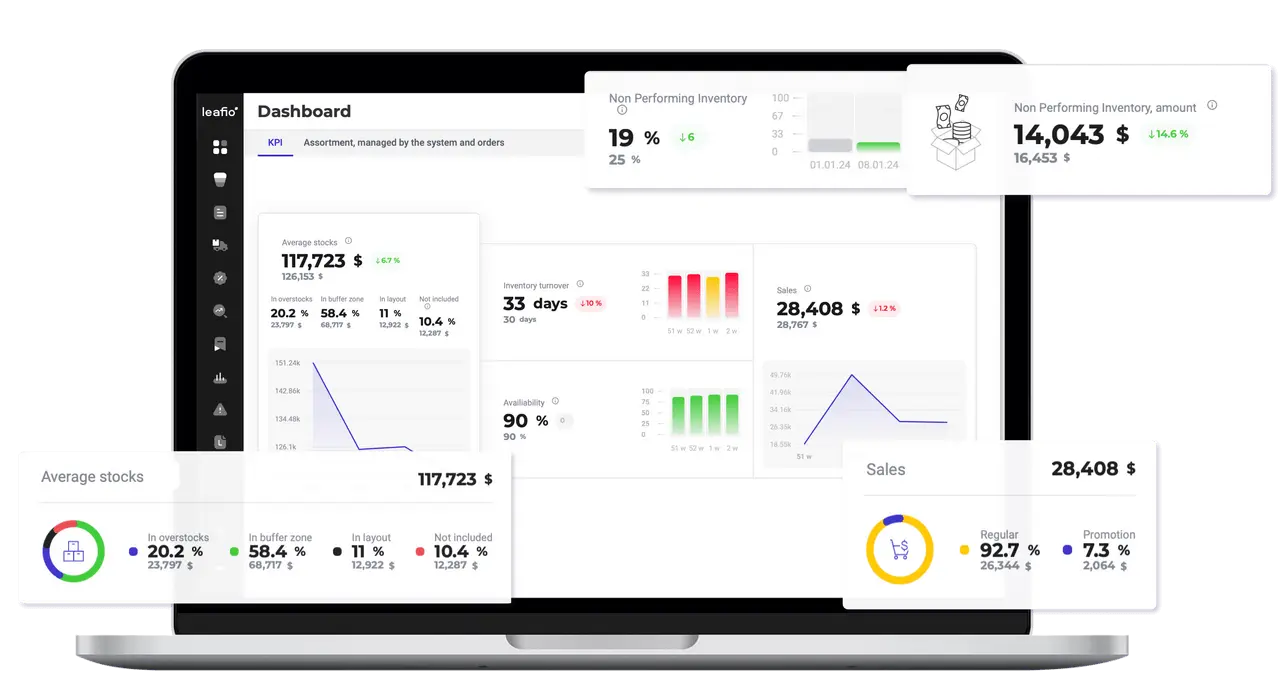
LEAFIO AI is a retail AI platform covering inventory optimization, demand planning, automated replenishment, planogram management, and merchandising in a single system. It runs at 250+ retailers across 40+ countries and 30,000+ stores, and G2 rates it 5.0/5 across 31 reviews with a Leader badge. Among the 10 tools on this list, it's the only one built around real AI demand forecasting rather than manual rules and the only one that connects convenience store inventory management to shelf planning and multi-format retail growth in the same platform.
Key features:
- AI demand forecasting that factors in seasonality, trend, and promotions, not static min/max thresholds
- Automated replenishment across an entire chain at once, from a handful of stores to hundreds
- Planogram and merchandising optimization inside the same platform, not a bolt-on module
- Multi-tier supply chain management from distribution centers down to individual stores, accounting for demand variability at each site
- Automated forecasting for new store openings, based on data from similar existing locations
- Scalability across grocery, pharmacy, fashion, and convenience formats inside a single platform
Pros and cons:
| Pros | Cons |
|---|---|
| True AI demand forecasting with seasonality, trend, and promo modeling | No built-in fuel pricing, lottery, or tobacco rebate compliance |
| Automated network-wide replenishment, not per-store rules | No native POS; works alongside your existing POS system |
| Planogram and merchandising in one platform | Enterprise sales process with a demo, not instant self-serve |
| G2 5.0/5 across 31 reviews, with a Leader badge | Best fit starts around 10+ locations, not a single independent store |
Real-world results back this up: at Baltic Petroleum, an 86-location fuel-and-convenience network in Lithuania, LEAFIO AI lifted sales 62% in planned categories, cut overstock in half, and took ordering from 84 store managers down to 4 head-office specialists, paying back in one month with 1,581% first-year ROI.
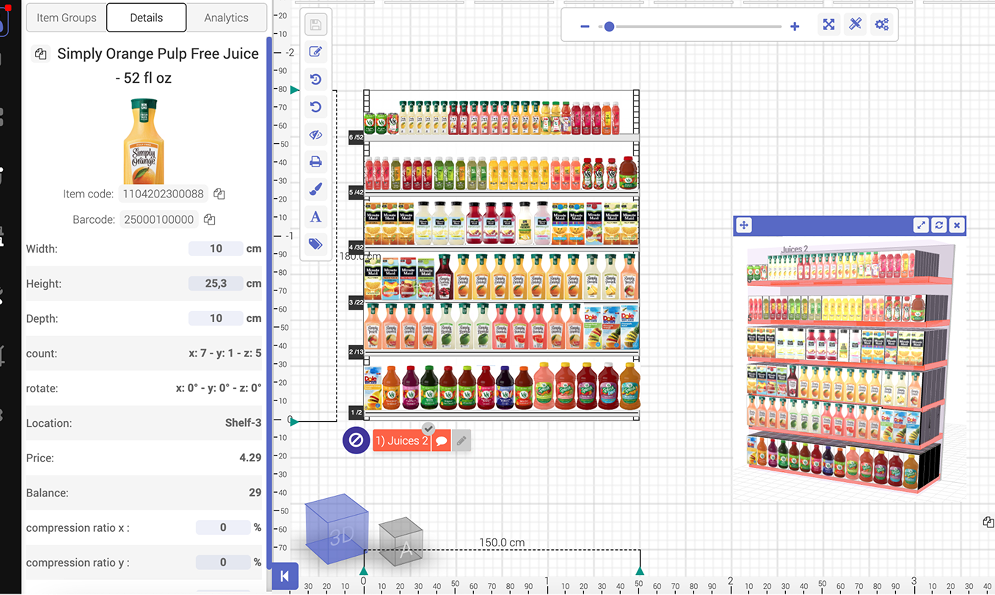
Pricing: Custom pricing based on chain size and module selection. Request a free demo at leafio.ai/solution-for-convenience-stores to see current terms for your network.
Best for: Multi-site and multi-format chains with 10+ locations, especially fuel-and-convenience combos that need AI demand planning instead of manual thresholds. LEAFIO AI's convenience store inventory management solution is built specifically for this segment.
Bottom line: If your chain has outgrown static thresholds and spreadsheets, LEAFIO AI pairs AI forecasting with automated replenishment and planogram management in one place. LEAFIO AI helps fuel-and-convenience networks achieve fewer stockouts and less overstock through automated, store-level replenishment. Learn more about the inventory optimization module and planogram software that powered the Baltic Petroleum results. The full product suite is at leafio.ai.
Ready to see LEAFIO AI in action? If manual thresholds and disconnected systems are costing you sales, a short demo shows how AI forecasting and automated replenishment would work across your chain. No lengthy sales process required to find out. Book a free demo →
2. Petrosoft: Best for Independent Fuel and C-Store Operators (1–20 Locations)
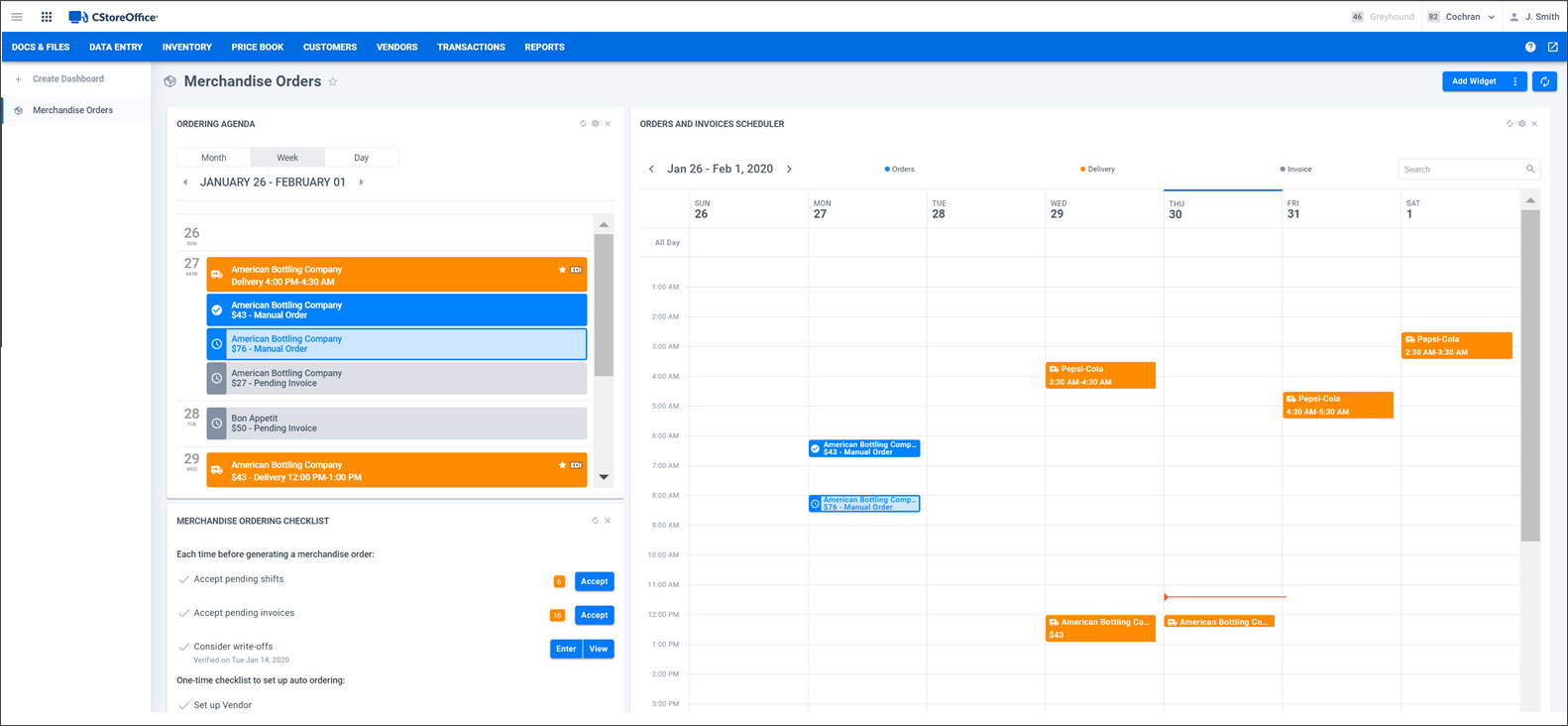
Petrosoft built its C-Store Office platform around the real operational needs of a fuel and convenience store owner. It's back-office, POS, inventory, and fuel management software aimed squarely at independent operators and small chains, mostly in the 1–20 location range. G2 rates it 4.3/5 from 2 reviews, and Capterra rates it 3.8/5 from 33 reviews. Reviewers praise its support team, its interface, and its cloud-based inventory module.
Key features:
- Cloud-based inventory tracking built for fuel and convenience formats
- Fuel management and tank reconciliation
- Lottery and tobacco rebate tracking
- Mobile app for cost and VIN entry at the pump
- UPC-based item lookup and pricebook management
Pros and cons:
| Pros | Cons |
|---|---|
| Responsive customer support | Complex cost/VIN setup in the mobile app |
| Easy-to-use interface | Confusing UPC linking process |
| Cloud-based inventory module | Steep learning curve for new staff |
Pricing: From $149/month, billed per store. See petrosoftinc.com for current tier details.
Best for: An independent owner or small chain (1–20 locations) running a US c-store or gas station that doesn't need AI forecasting yet.
Bottom line: Petrosoft is a solid convenience store back-office pick if fuel and lottery tracking matter more to you than demand planning: it beats LEAFIO AI on narrow, out-of-the-box fuel and lottery specialization and setup speed for a single store, but it runs on rule-based automation, not AI demand forecasting, and has no planogram module. One customer, LPT Retail Management Services, cut manager paperwork by 75% and trained new staff 75% faster after switching.
3. PDI Technologies: Best for Regional and National Fuel-and-C-Store Networks
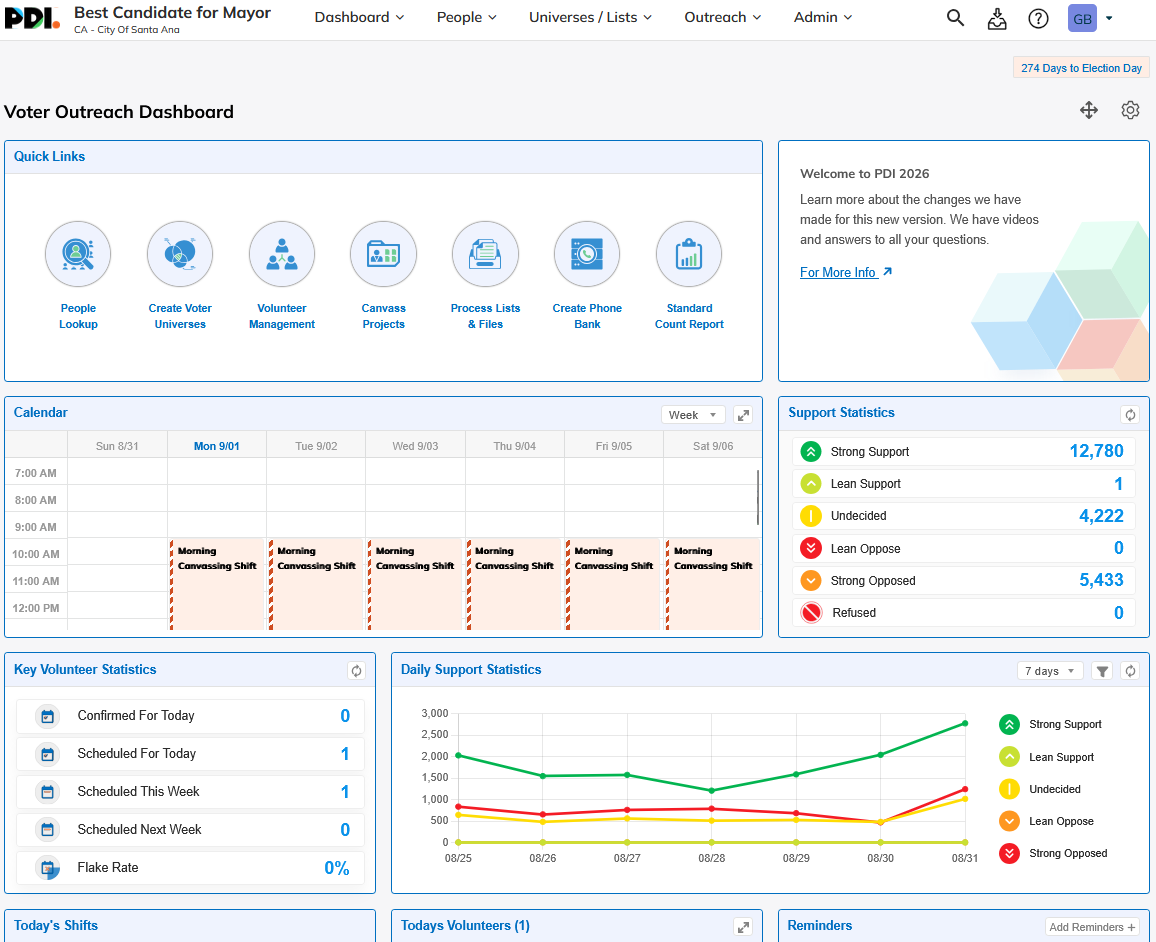
PDI Technologies has run ERP software for fuel and convenience retailers for more than 40 years, with a footprint across 200,000+ locations. Its retail suite bundles POS, inventory, fuel pricing, loyalty, analytics, and managed cybersecurity under one brand. It serves everyone from single operators to large regional and national networks. G2 rates it 4.3/5 from 2 reviews, while Capterra shows a lower 2.0/5 from just 3 reviews.
Key features:
- Unified ERP hub for POS, inventory, and fuel pricing
- Centralized pricebook management across locations
- Foodservice management tools
- Managed cybersecurity services
- POS integrations with UI shortcuts for faster checkout
Pros and cons:
| Pros | Cons |
|---|---|
| Deep POS integrations | Slow performance at high transaction volumes |
| Centralized pricebook | Cluttered, dated interface |
| 40+ years of fuel and c-store specialization | Inconsistent inventory accuracy per reviewers |
Pricing: Custom enterprise pricing. Contact PDI directly for a quote scoped to network size.
Best for: Regional or national fuel-and-c-store networks that want one ERP vendor covering POS, fuel pricing, and cybersecurity under a single contract.
Bottom line: PDI is a capable back-office system for convenience store operations at scale, with deep niche specialization in fuel pricing and foodservice that LEAFIO AI doesn't attempt, but it isn't built to forecast demand or optimize shelf space, and its review base is thin and inconsistent. FastBreak Convenience Stores, a 30-location chain, used it to centralize pricebook management and improve item-level inventory accuracy.
4. LOC Software: Best All-in-One POS and Back Office for Regional Chains
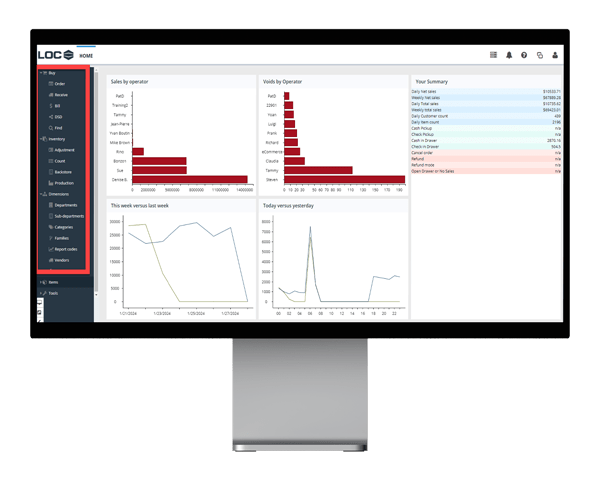
LOC Software has sold POS and back-office retail management systems across North America for 35+ years, serving convenience stores, grocery, natural food, and pharmacy retailers. It targets independent and regional chains up to roughly 50–100 locations that want one system covering POS, back office, fuel, and loyalty. G2 rates it 4.0/5 from a single review.
Key features:
- Combined POS and back-office platform
- Order management using historical sales data
- Fuel and forecourt integration
- Loyalty program management
- Detailed reporting across categories and stores
Pros and cons:
| Pros | Cons |
|---|---|
| Order system built on historical data | Steep learning curve |
| Detailed reporting and support | High cost for small operators |
| 35+ years of vertical integration | Dated interface |
Pricing: Custom quote based on store count and modules. Contact LOC Software for pricing.
Best for: Independent or regional convenience chains up to ~50–100 locations that want an all-in-one POS, back-office, fuel, and loyalty system.
Bottom line: LOC Software fits chains that already know they want a single vendor for POS and fuel operations: it has decades of niche experience LEAFIO AI can't match, but it has no AI demand forecasting, no planogram optimization, and only one public G2 review to judge it by.
5. SSCS: Best Budget Back Office for Single-Site Gas Stations
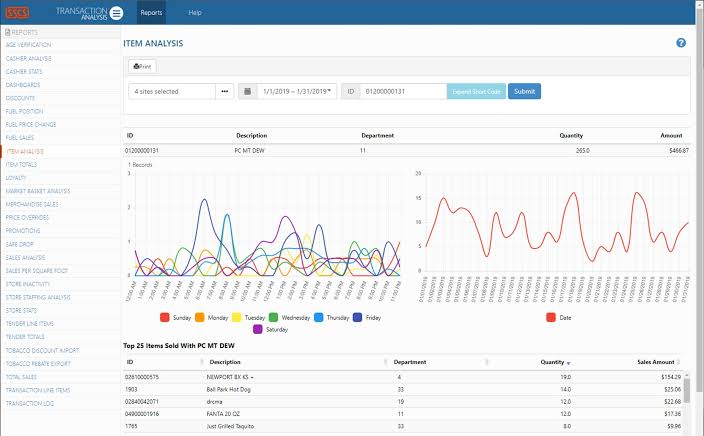
SSCS has sold back-office software to gas station and convenience store operators since 1981, when it launched its flagship Computerized Daily Book product. It works partly as accounting software, covering bookkeeping, fuel management, and POS integration alongside inventory. It's aimed mostly at small and mid-size single-site operators, with a handful of enterprise oil company clients. Capterra rates it 4.0/5 from 2 reviews.
Key features:
- Daily bookkeeping and accounting integration
- Item-level inventory tracking
- Fuel and tank management
- POS system integration
- Lottery and tobacco rebate reporting
Pros and cons:
| Pros | Cons |
|---|---|
| Simple for store managers to run | Customer service quality varies |
| Accurate item-level reporting | Very small review sample size |
| Affordable one-time license |
Pricing: Roughly $995 one-time per user. See sscs.com for current licensing terms.
Best for: A small or mid-size single-site gas station or convenience store operator who wants simple, affordable back-office software.
Bottom line: SSCS is one of the more affordable back-office options here, with deep single-site fuel and lottery specialization at a low one-time cost, but it has no AI forecasting, no replenishment automation, and almost no public review base to check before you sign.
6. Shopventory: Best Inventory Add-On for Square, Clover, and Shopify Stores
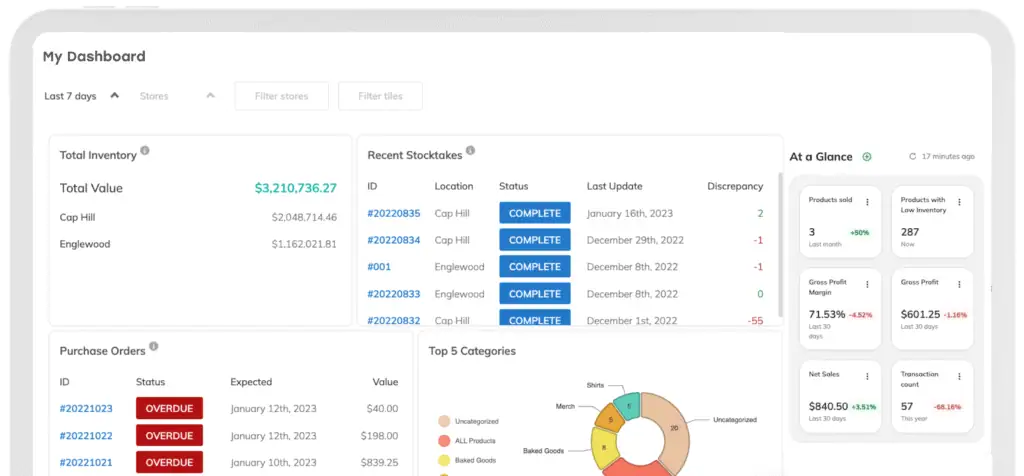
Shopventory is an inventory management add-on that plugs into POS platforms like Square, Clover, and Shopify. It isn't a standalone ERP or AI planning platform; it's a layer that sits on top of a POS a store already uses. It fits best for 1–2 convenience stores, or a small chain up to roughly 5–10 locations. G2 rates it 4.2/5 from 12 reviews, and Capterra rates it 4.8/5 from 117 reviews, among the strongest review counts on this list.
Key features:
- Direct integration with Square, Clover, and Shopify POS
- Low-stock alerts with manual reorder thresholds
- Multi-location reporting
- Purchase order management
Pros and cons:
| Pros | Cons |
|---|---|
| Strong support and simple setup | Reporting can feel cumbersome |
| Reliable POS integrations | Premium features cost extra |
| 14-day free trial | Limited access permissions for multi-location teams |
Pricing: From $49 to $229/month depending on tier. A 14-day free trial is available at shopventory.com.
Best for: A convenience store or small chain already running Square, Clover, or Shopify that needs basic inventory tracking without a full platform switch.
Bottom line: Shopventory is a well-reviewed, low-cost way to get inventory visibility fast if you're already on Square or Clover, but it still runs on static min/max thresholds with no AI forecasting, so it hits a ceiling once a chain grows past a handful of stores.
7. Datascan: Best Physical Inventory Counting Service for Large Networks
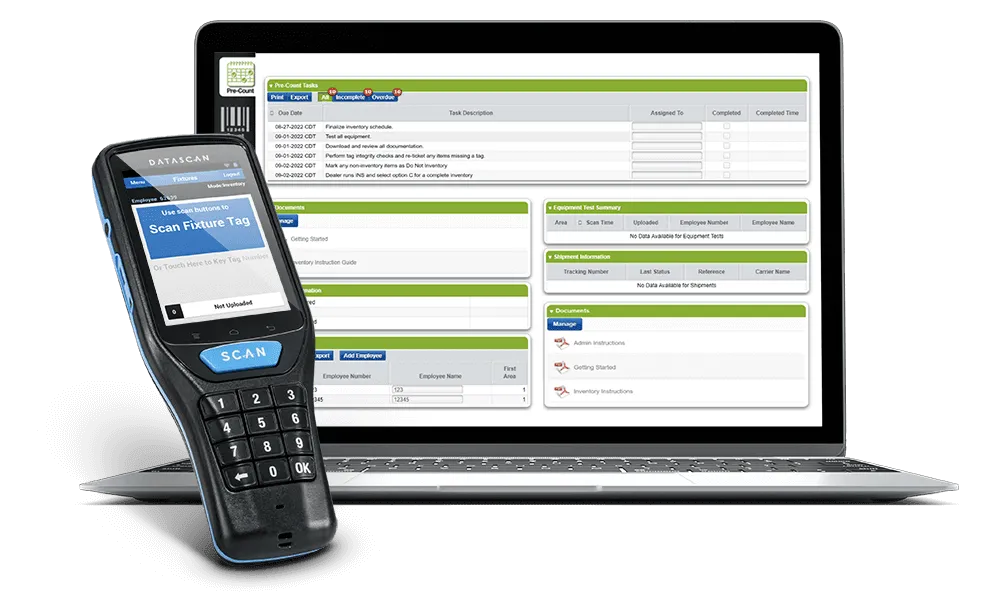
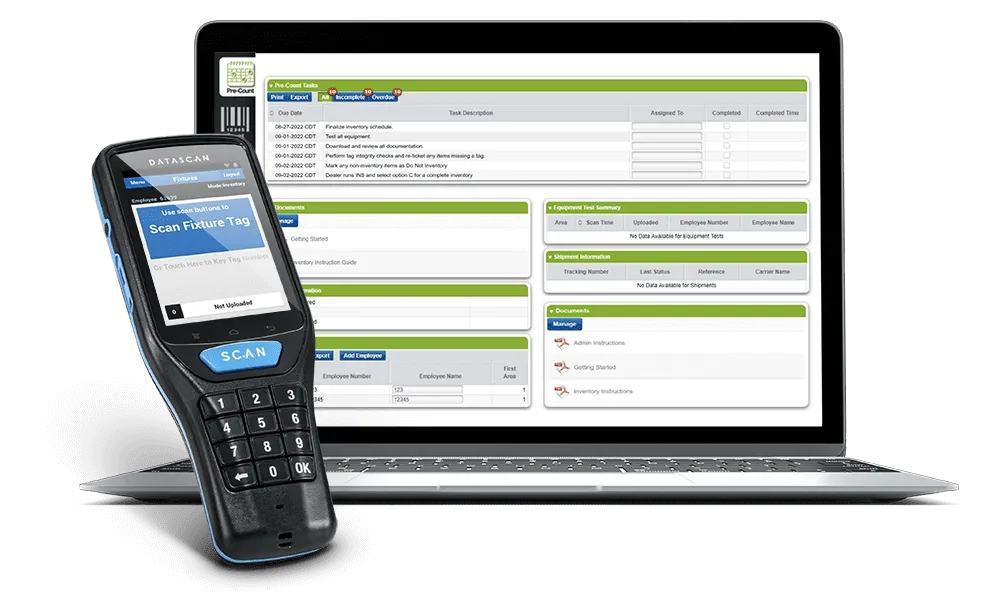
Datascan isn't a SaaS planning platform; it's a physical inventory counting service, built around handheld scanners, RFID hardware, and its DART software. It's been in business since 1970 and operates in 50+ countries, with case studies from chains running 500 to 2,000+ locations. Gartner Peer Insights rates it 4.0/5 from 5 reviews.
Key features:
- Handheld scanner and RFID hardware rental
- DART inventory counting software
- Pre-configured scanners requiring minimal training
- Scalable counting logistics for large networks
Pros and cons:
| Pros | Cons |
|---|---|
| Pre-configured, easy-to-use scanners | Unintuitive integration with other systems |
| Minimal training required | Limited customization |
| Scales to very large networks | Slow support response times |
Pricing: Custom quote based on store count and count frequency. Contact Datascan for a scoped price.
Best for: Large retail or convenience chains (500+ locations) that need periodic physical stock counts, not ongoing demand planning software.
Bottom line: Datascan solves a real problem, accurate physical counts at scale, backed by more than 50 years of stocktaking experience, but it counts what's on the shelf rather than telling you what or when to order, so it isn't a substitute for a forecasting platform like LEAFIO AI.
8. NRS Plus: Best All-in-One POS for Independent Convenience Stores
NRS Plus is an all-in-one POS system with payment processing and basic inventory and loyalty features, launched in 2015 as a subsidiary of IDT Corporation. It has more than 35,000 installed POS systems, mostly among owners of 1–5 independent convenience stores, gas stations, or liquor stores. A recent SERP check shows it ranking near the top for "best convenience store software," even though it's a POS product first. On POSUSA it scores 7/10, with roughly 75% five-star reviews against 18% one-star reviews.
Key features:
- All-in-one POS and payment processing
- Age verification for tobacco and alcohol sales
- EBT and eWIC payment support
- Fuel dispenser integration
- Basic loyalty program tools
Pros and cons:
| Pros | Cons |
|---|---|
| Transparent pricing | Hidden processing fees reported by users |
| Easy setup | Limited customer support |
| Built-in c-store features (age check, EBT, fuel) | Reports of technical outages |
Pricing: From $19.95 to $79.95/month plus hardware and processing fees. See nrsplus.com for current tiers.
Best for: An owner of 1–5 independent convenience stores or gas stations who wants a simple all-in-one POS system with c-store features built in.
Bottom line: NRS Plus bundles POS, payment processing, and loyalty at an affordable entry price, which LEAFIO AI doesn't try to compete on, but it has no AI demand forecasting, no planogram optimization, and no path to managing inventory across a growing multi-store network.
9. Square (Square for Retail): Best Budget POS for a First Convenience Store
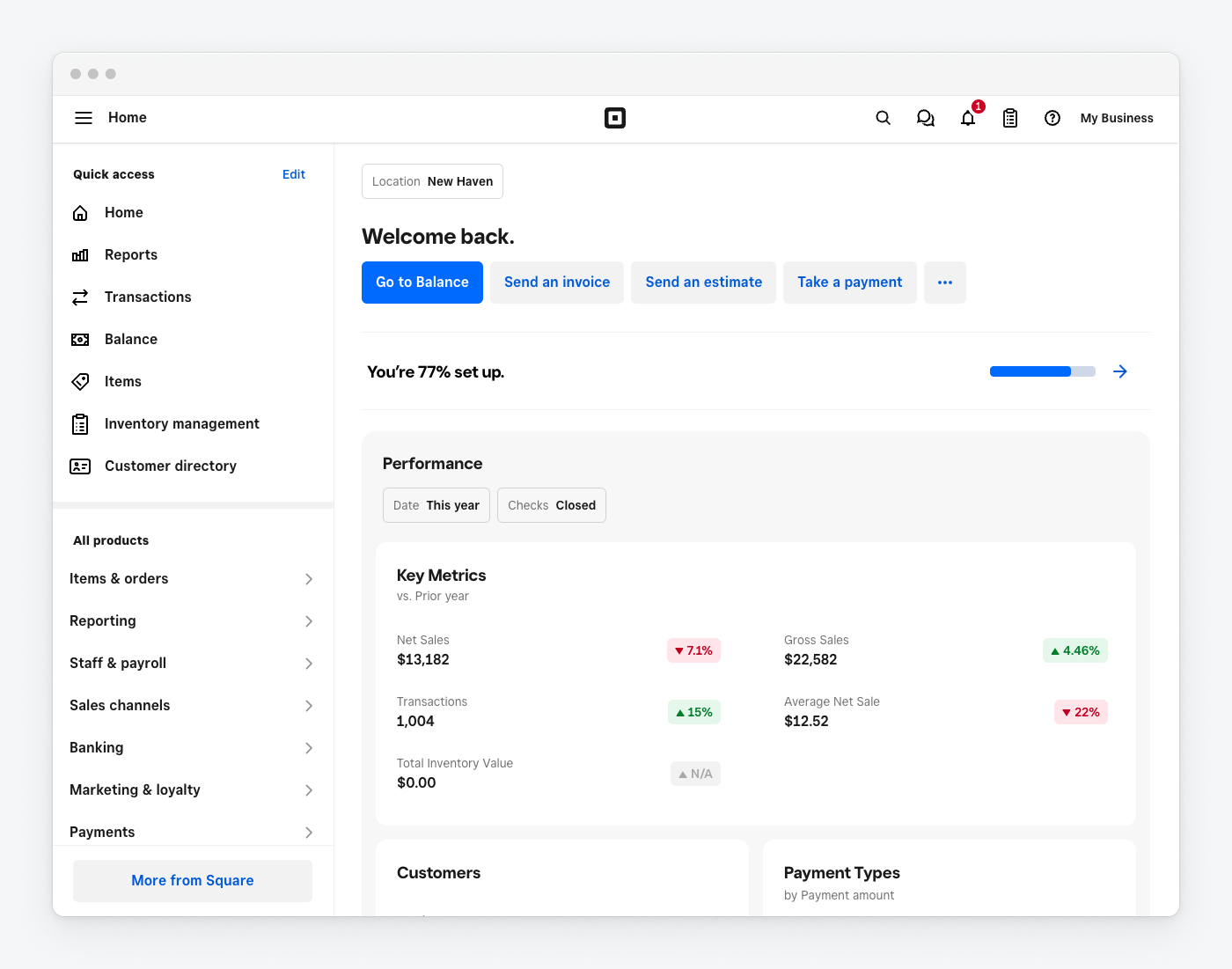
Square for Retail is a mass-market, self-serve POS builder with basic inventory management, launched in 2009 under parent company Block Inc. (NYSE: XYZ). It fits best for a small owner running one or a few convenience store locations on a tight budget. It carries strong brand recognition and a large review base: G2 rates it 4.6/5 from 1,183 reviews, and Capterra rates it 4.7/5 from 493 reviews.
Key features:
- Self-serve setup with no sales call required
- Built-in payment processing
- Low-stock alerts and basic inventory counts
- Multi-location reporting on paid tiers
- Free tier available for single-location stores
Pros and cons:
| Pros | Cons |
|---|---|
| Simple, fast setup | Inventory count discrepancies reported |
| Consolidated payments, inventory, and reporting | High processing fees (2.4–3.3%) |
| Recognizable, trusted brand | Support issues reported by some users |
Pricing: Free for a single location, up to $149/month on paid plans, plus processing fees.
Best for: A budget-conscious owner running one or a few convenience store locations who wants a recognizable, self-serve POS system with basic stock tracking.
Bottom line: Square wins on entry price, setup speed, and brand trust for a first-time operator, none of which LEAFIO AI is built to compete on, but it offers low-stock alerts rather than demand forecasting and locks multi-location reporting behind paid tiers.
10. Paytronix: A Loyalty Platform That Ranks for Inventory Searches It Shouldn't
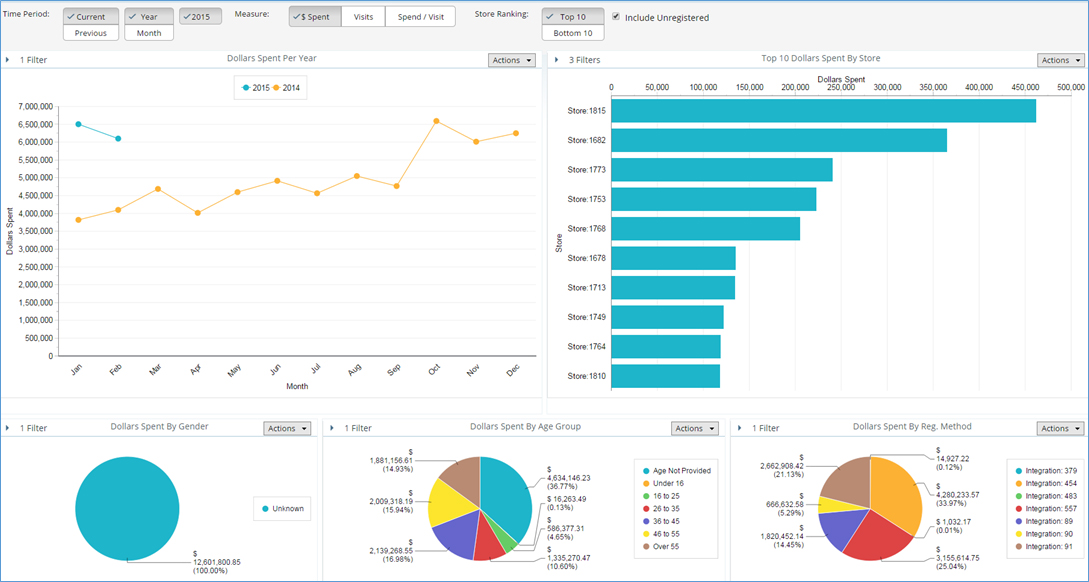
Paytronix is a guest engagement and loyalty platform. It handles loyalty programs, online ordering, and CRM for convenience store and restaurant chains, from small operators up to enterprise networks. It's worth including here for one reason: it ranks in search results for "convenience store inventory management," despite having no inventory functionality at all. G2 rates it 2.8/5 from 3 reviews, while Capterra rates it higher, at 4.1/5 from 12 reviews.
If you keep landing on Paytronix while searching for inventory software, that's a sign this category's search results are genuinely confusing. It's not a sign that Paytronix does something it doesn't.
Key features:
- Loyalty program management across multiple card programs
- Mobile and online ordering
- Guest CRM and marketing analytics
- Tobacco compliance reporting
Pros and cons:
| Pros | Cons |
|---|---|
| Flexible loyalty program design | High fees reported by users |
| Consolidated card program management | Limited support |
| Strong marketing analytics | Complex onboarding |
Pricing: Enterprise quote only. Contact Paytronix for pricing scoped to your loyalty program size.
Best for: Convenience store or restaurant chains that need loyalty and mobile ordering, not operators searching for an inventory management system.
Bottom line: Paytronix reportedly drove 18–30% higher visit frequency and spend after adding mobile ordering, according to vendor-reported figures I'd treat with some caution since they aren't independently verified. Either way, it's a loyalty tool with no inventory functionality whatsoever, a fundamentally different category of product than LEAFIO AI or any other tool on this list.
How to Choose the Right Convenience Store Inventory Management Software
Not every convenience store inventory management tool fits every chain. The right pick depends on how many locations you run today and where you want to be in two years. Work through these questions before you commit to a vendor.
- How many locations does your chain run, and do you need centralized inventory visibility across all of them?
- Are static min/max thresholds good enough, or do you need AI demand forecasting?
- How critical is fuel, lottery, or tobacco compliance functionality to your daily operations?
- What POS system do you already run, and do you need a replacement or a tool that works alongside it?
- Is your chain planning to expand into other retail formats or verticals? If you're weighing options across grocery and convenience at once, LEAFIO AI's inventory optimization software and our Leafio vs RELEX comparison may help.
- What's your budget, and do you need a self-serve trial before you commit to a purchase?
- How important is planogram and shelf-space optimization to your merchandising strategy?
AI Features Comparison: Which Tools Are Actually AI-Native
Every vendor in this category uses the word “AI” somewhere in its marketing, but the label covers very different technology depending on the tool. A genuinely AI-native platform learns from sales history, seasonality, and promotions to predict demand and adjust automatically. A tool with “AI insights” bolted onto rule-based automation still runs on a fixed threshold; the AI label just describes the dashboard, not the ordering logic.
On this list, LEAFIO AI is the only platform where AI sits in the forecasting and replenishment engine itself, not just in reporting. Shopventory and Square use static min/max or low-stock alerts branded as smart features. Petrosoft, PDI Technologies, LOC Software, and SSCS run on rule-based automation with no forecasting layer at all. Datascan is a counting service, not a planning tool, and Paytronix's AI, where it exists, powers loyalty personalization, not inventory decisions.
LEAFIO AI helps convenience retailers achieve shelf-level accuracy through planogram and replenishment logic that runs off the same forecast, which is the practical difference between an AI label and AI that actually changes what gets ordered.
If you're comparing AI-native platforms outside the convenience niche too, our Best Inventory Optimization Software guide covers the same distinction for grocery and general retail chains.
How AI Enhances Convenience Store Inventory Management Software
Traditional c-store back-office tools apply fixed rules: set a threshold and alert when it's crossed. AI changes the model by learning from sales history, seasonality, and promotions to predict what a store will actually need, not just flag when it's already low. In practice that means faster purchase recommendations, forecasts that adjust automatically for a beverage aisle's summer spike or a lottery ticket's weekly cycle, and accurate demand estimates for a brand-new store based on similar existing locations. Most tools on this list still rely on manual rules dressed up with AI language in the marketing copy. Platforms built around machine learning from the start, like LEAFIO AI, are the exception rather than the norm. LEAFIO AI helps growing c-store chains achieve accurate new-store forecasts through demand models trained on similar existing locations.
How to Launch a Convenience Store Inventory Management Solution That Scales
Moving off a niche back-office tool doesn't require ripping out your existing POS system. Here's the sequence that works across most of the tools on this list.
- Export your item master, pricebook, and at least two years of sales history from your current back-office or POS system.
- Map the integration between LEAFIO AI and your existing POS so sales data flows into forecasting; LEAFIO AI works alongside your POS rather than replacing it.
- Keep fuel, lottery, and tobacco compliance on your existing back-office system, since LEAFIO AI doesn't cover that layer.
- Run AI demand forecasting in parallel with your old manual thresholds for a few weeks and compare the two side by side before switching over fully.
- Onboard the planogram and merchandising module if you're coming from a POS-only tool; this is usually a net-new capability, not a migration.
- Pilot the full setup at 1–2 stores before rolling it out chain-wide, the way VIADA Baltija phased its rollout across a 93-station gas-and-convenience network in Latvia, cutting overstock by 35% and lost sales by 29%.
Switching software always carries some risk, but a phased pilot limits how much of that risk hits your whole network at once. Chains that upgrade their convenience store inventory management software typically do it because manual thresholds and disconnected systems have already started costing them sales.
Switching doesn't have to be painful. Our team has run this migration alongside POS systems like Petrosoft, Square, and PDI. We can walk you through what a pilot would look like for your stores. Talk to our team →
FAQ
What software do convenience stores use for inventory management?
Convenience stores use a mix of back-office ERP systems (Petrosoft, PDI Technologies, LOC Software, SSCS), POS inventory add-ons (Shopventory), and AI-driven platforms like LEAFIO AI. The right fit depends on how many locations a chain runs and whether it needs demand forecasting. Single-location stores often rely on the inventory features already bundled into their POS system.
What is the best POS system for a convenience store?
NRS Plus and Square for Retail are two of the most widely used POS systems for convenience stores. Both offer payment processing plus basic inventory tracking. Neither includes AI demand forecasting, so growing chains typically pair their POS with a dedicated inventory platform once they pass a handful of locations.
How do convenience stores manage inventory?
Most independent convenience stores manage inventory through manual counts and min/max thresholds set inside their POS system. Larger and multi-location chains use dedicated back-office or AI-driven platforms that centralize inventory visibility, automate reordering, and forecast demand by category and location.
What features should convenience store inventory software have?
Look for accurate demand forecasting that accounts for seasonality and promotions, centralized visibility across all locations, automated replenishment, and integration with your existing POS system. If fuel, lottery, or tobacco compliance matter to your business, confirm the software handles those categories specifically.
Is there free convenience store POS or inventory software?
Square for Retail offers a free tier for single-location stores with basic inventory tracking, though it charges processing fees on transactions. Most dedicated back-office and AI platforms, including LEAFIO AI, use subscription or enterprise pricing instead of a free tier. They typically offer a demo or trial period instead.
What's the difference between convenience store back-office software and a full POS system?
A POS system handles transactions at the register: ringing up sales, processing payments, and applying discounts. Back-office software manages what happens behind the counter, including inventory counts, purchasing, pricebook management, and reporting. Many convenience store chains run both together, with the back-office system feeding data to or from the POS.
Is there an AI-driven option for multi-format or fast-growing convenience store chains?
LEAFIO AI is the option on this list built specifically for that scenario. It combines AI demand forecasting, automated replenishment, and planogram optimization in one platform. It also scales across grocery, pharmacy, fashion, and convenience formats, instead of staying locked into one vertical.


Have a question?

Jack Larson
Retail Optimization Expert


