The total losses that US and Canadian retailers incur in a year amount to over $349 billion due to out-of-stock and overstock according to IHL Group research. An effective stock replenishment system goes a long way in the retail business due to its role in optimizing inventory levels, reducing overstock and stockouts, moving inventory, and ensuring that popular items are consistently available. As competition intensifies between sales channels and consumer expectations of immediate availability rise, efficient stock management becomes essential for maintaining customer satisfaction.
In this article we will touch on the main aspects of how to replenish stock effectively, covering the basic elements and methods to the critical points when replenishment is needed.
Key Takeaways
Smart replenishment keeps shelves full without wasting capital.
Links to demand forecasts.
Uses vendor-managed options.
Automates based on sell-through.
Considers seasonality.
Reviews supplier lead times.
What is replenishment?
Replenishment of stock is the process of ordering and inventory allocation to replace products missing on shelves. The point of replenishing stock is to keep an optimal inventory level that maximizes the sales potential while minimizing excess stock and storage costs, thereby ensuring that businesses can continue to meet consumer demand without interruption.
Auto stock replenishment systems are used for monitoring stock levels and automatically reordering products when they fall below a predefined threshold to maintain optimal inventory and prevent stockouts.
Why is effective stock replenishment important?
Effective stock replenishment is important because it prevents stockouts, minimizing lost sales and keeping customers satisfied. It also avoids overstock, reducing the risk of tying up capital and product obsolescence. Additionally, it lowers shipping costs by reducing the need for last-minute deliveries. Efficient replenishment ensures optimal inventory levels, enhancing overall business efficiency and profitability.
Benefits of Stock Replenishment
| Benefit | Description |
|---|---|
| Stock-out Prevention | Effective periodic replenishment helps prevent stockouts, leading to lost sales. Keeping customers satisfied through an effective replenishment process is crucial. |
| Minimize Overstock | Inefficient replenishment leads to overstocking, tying up working capital and risking obsolescence. Products may become unsellable if stored too long. |
| Reduce Shipping Costs | Optimized inventory replenishment avoids last-minute deliveries, reducing delivery mistakes and saving money by minimizing the number of deliveries. |
How does stock replenishment work? (Best practices)
Replenishment of stock is a complex process usually including four key elements vital for success.
Monitoring inventory levels
Modern systems use real-time tracking technologies like RFID or IoT sensors that provide instant data on stock levels, dramatically improving accuracy over manual tracking.
Forecasting demand
AI and machine learning forecasting play a significant role in modern replenishment systems. They analyze past sales data, current market trends, and even external factors such as economic indicators or weather patterns to accurately forecast future demand.
Ordering process
Once the stock level hits or falls below the minimum threshold, the system either automatically places an order with pre-approved suppliers or alerts managers to do so manually. This automation speeds up the inventory replenishment process, reduces human error, and optimizes costs by choosing the best suppliers to fulfill customer orders based on price, quality, and delivery times.
Lead times consideration
Understanding supply chain lead times is crucial to timing orders so that in on-demand replenishment new stock arrives just as inventory is about to be depleted but before it runs out. Efficient inventory management of lead times helps avoid both stockouts and excess inventory.
What are the two inventory replenishment strategies?
When it comes to stock replenishment methods, the choice is simple: Push or Pull.
#1: The Push method
It means using a statistical forecast of future demand to plan how best to push inventory throughout the main distribution centers, regional warehouses, and local branches. The push system is also ultimately only as effective as the forecasts on which it’s based.
#2: The Pull method
The method uses demand data to anticipate customers’ behavior at the lowest point of the supply planning, so it focuses on the immediate and short-term needs of your customers. It can handle nuances of individual customer requirements more flexibly than a push system, so you become better positioned to replenish a specific item in a specific location.
Though, it's hard to optimize. If you focus on the requirements of each location, you may lose sight of the bigger picture.
What is the time to replenish stock?
The time to replenish your stock is the time it takes for an order for new stock to be received and ready for sale from the moment it is placed. This time includes the processing of the order, production or procurement of too much stock or too little stock by the supplier, shipping, and receiving and handling inefficient replenishment of stock back at the store or warehouse.
There are multiple factors and variables to calculate the reorder point. For example:
- packaging and shipping time,
- processing time at the warehouse,
- customer order fulfillment,
- allocations,
- promotions,
- manufacturing time etc.
Taking into account all the factors, you can calculate the optimal time to replenish your stocks. However, for retailers with multiple sales channels and locations, it is very important to have a specific replenishment system that can always send orders out promptly.
Enhance the efficiency of stock replenishment with LEAFIO AI Automated Inventory Replenishment Software

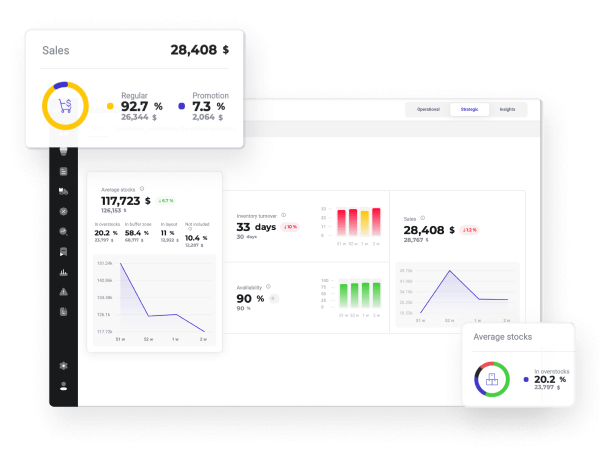
Now that we have seen how important it is, it should be said that an efficient stock replenishment process is impossible without implementing an automated ordering system such as LEAFIO AI Automated Inventory Replenishment Software.
The key features of inventory management software
#1 Automatic calculation of quantity requirements per order
On the order day, product demand is calculated for each SKU at each POS. After assessing current demand, stock levels, and incoming orders, the final order quantity is determined, considering the supplier's order requirements.
#2 Automatic order generation
Orders are generated daily based on the assortment matrix and schedules, right after demand calculation. This process occurs even before managers start their workday.
#3 Automatic order dispatch
Generated orders are automatically sent to the client's accounting system and the supplier via email or EDI.
#4 Automatic submitted orders editing
After a supplier receives an order, they can provide feedback on available stock. Any differences in delivery quantities are automatically updated in the dispatched orders form.
#5 Order execution control
Automated systems track the order delivery times and notify managers of unfulfilled orders. Information about late or unfulfilled orders is recorded in a supplier reliability report.
LEAFIO's solution is the optimal way to replenish your stock effectively by accurately forecasting demand and automating order processes. Using the specific system reduces stockouts and overstock situations.
Replenish Stock FAQ
What is replenishment stock?
Stock replenishment meaning is the inventory buffer stock that is ordered or produced to refill existing stock levels on high demand for replenishment, ensuring that there is enough supply on hand to meet ongoing customer demand without interruption of safety stock itself.
What is replenishing inventory?
Replenishing stock meaning refers to the process of replenishing inventory by adding enough stock to existing inventory to maintain sufficient levels for smooth operations and sales, preventing stockouts while optimizing storage costs.
What is a replenished inventory called?
A replenished inventory is commonly referred to as "stock on hand" inventory flowing or simply "restocked inventory," representing the items raw materials that have been added back into the inventory system to maintain adequate supply levels, which is replenish stock meaning.
What is the method for replenishing inventory?
Inventory replenishment methods typically involve monitoring inventory levels, forecasting customer demand, restocking inventory, and reordering products based on predetermined thresholds or at regular intervals, ensuring continuous availability of goods.


Have a question?

Kristi Miller
Retail optimization expert