


Inventory availability is the subject of much debate because on the one hand, you need to make sure that goods are available, but on the other hand, you also need to push down the costs of storing them. What 72% of retailers want is a balance between the two.
In this article, we will tell you how to manage stock availability and look at its connection to the supply chain and demand forecasting. Last but not least, we will also offer some advice on optimization using modern technological solutions.
Key Takeaways
Keeping shelves stocked boosts sales and protects long-term loyalty.
Avoids lost sales from stockouts.
Reduces emergency replenishment costs.
Builds brand trust.
Requires tight forecast & supply alignment.
Monitored by fill rate & availability KPIs.
Understanding product availability
What is stock availability? In simple terms, product availability is about products being available in the right place and at the right time. The goal is clear: higher sales and customer satisfaction.
With that goal in mind, how is it that 43% of small businesses do not track their inventory and 21% report that they have "no inventory"?
However, it would be too simplistic to talk only about inventory. After all, stock availability is not just stock replenishment. It is also about aligning this process with the preferences and buying habits of your target audience. This may involve buying more of certain products during the high season, temporarily offering exclusive products, or even limiting availability to emphasize the urgency of the promotion. It's much more than just a routine inventory purchase.
Why do you need product availability
Three pillars support inventory availability:
- Clear and highly accurate forecasting
- Proper inventory management
- Timely delivery of goods
Additionally, it is the balance between demand and stock that retailers typically seek to increase conversion rates and outperform on key performance indicators. It can be achieved by putting the following processes in place:
- ensuring the stock availability of the goods customers need;
- improving customer expectations;
- strengthening loyalty to your brand;
- gaining an advantage over competitors.
Well-established inventory availability is the basis for effective management decisions because the process is based on data analysis: demand and market trends, purchases now and in the past, customer behavior, and other indicators. Managing it means that you can not only manage your inventory but also adapt it to your marketing campaigns.
Why is keeping enough inventory essential?
Inventory plays a vital role in ensuring smooth operations and meeting customer demand. Which of the following is a reason for keeping a supply of inventory?
- Fluctuations in supply availability
- Supplier limitations, such as minimum order quantities
- The chosen stocking approach or strategy
- Obligations outlined in customer service level agreements
- Opportunities for cost savings through bulk purchasing
- Efforts to reduce delivery expenses
- The service quality and speed customers expect
Actually, each of these factors highlights the importance of keeping a supply of inventory to balance demand and operational efficiency.
Common challenges causing product availability issues

As we've seen, stock availability is key when you are trying to meet customer expectations and better business performance. However, until the processes are in place, there are always factors that can upset the balance. These are the main ones.
Supply chain bottleneck
This is one of the main reasons for the shortages. A problem can pop up at any link in the supply chain: for example, at the procurement or delivery stage. If the products don't get to the warehouse and shelves on time, your customers will be disappointed, and there’s nothing you can do about it. That's why getting this process right matters.
Poor forecasting
You are taking a risk if you still keep records in conventional spreadsheets and forecast demand based only on past sales data. It's quite possible that these rather limited forecasts won't match the real situation. This can result in excess inventory and additional costs for maintaining it, or shortages and loss of sales. You need to have enough data to make a forecast, as well as modern analytical tools to process the information.
Supplier reliability
The other problem that could arise in your supply chain has to do with suppliers. They are the ones who make sure your goods are available, but how do we define a reliable supplier?
- The level of order fulfillment. The higher it is, the greater the guarantee that you will receive the ordered products with minimal stock discrepancies and delays.
- Adherence to agreed schedules. On-time deliveries are crucial to maintaining predictable cycles and protecting against product shortages.
- Adaptability to the retailer's needs. A good supplier can adjust to the changing business needs of the retailer, which are expressed in order frequency and MOQ.
Volatile demand
Stable demand exists only in economics textbooks. In reality, there can be predictable and sometimes completely unexpected drops or spikes in demand for certain groups of goods. You can anticipate most of them, but not all of them. If you want to keep your customers loyal, you need to be prepared, including by setting up flexible supply strategies.
Data inaccuracies
Perhaps you have noticed that not one of the problems outlined so far stands alone. All of these issues are interconnected. As we have said before, effective forecasting requires complete and high-quality data. Inaccurate information causes problems with inventory availability. Such data can only be obtained through regular audits, well-established management processes, and the use of modern AI and machine learning inventory management tools.
6 Tips to improve product availability
We have listed the main problems with stock availability, and now it's time to focus on solutions. Here are some practical tips.

#1 Implement a reliable inventory management system
This is the natural starting point because it is firstly inventory management that helps you achieve a balance: enough stock to meet customer demand but not too much.
Don't forget about inventory turnover. This is a metric that shows how long it takes to sell your inventory and replace it with new stock availability. If the turnover rate is high, it means that you have efficient management and good sales. And vice versa: a low rate signals sales problems or excess inventory.
You will need a modern inventory management system to provide real-time inventory data and, if necessary, make simple decisions for you. It all depends on the settings: for example, you can automate the process of ordering goods from a supplier once you are already low on stock availability.
What does the integration of a specialized tool bring? You will reduce human error, improve accuracy, and automate routine processes to save time for more valuable tasks.
These systems also provide valuable insights through detailed reports and analytics, helping companies make informed decisions about replenishment and order volumes. High-quality analytics and comprehensive reports provide information about the success or alert you to problems promptly.
#2 Accurate demand forecasting
To achieve the desired results, you need to forecast demand correctly. To do this, use market research and sales data and rely on specialized tools. A manager's intuition is a great thing, but it needs to be backed up by some high-quality calculations.
A good forecast is an assumption based on various data: past sales, market trends, economic and political conditions, seasonality, etc. At the same time, the forecast needs to be adapted to the business model, industry specifics, and characteristics of the target audience. A human being is not able to account for dozens of factors and come up with an accurate result. That's why it's a good idea to enlist the help of an AI-based tool.
#3 Supplier relationship management
Constant communication, performance tracking, and possibly joint demand planning are the most important factors in the success of supplier relationships. You depend on each other, and your success should be shared. To do this, set clear performance criteria: this will help your partners understand your needs and adjust to them. And don't forget to distribute your supplier base so that the sudden withdrawal of one of them does not become critical. Interruptions happen, so you need to have options.
#4 Inventory optimization techniques
There are various approaches, but we suggest considering the following:
Safety stock availability is your buffer in case of a sharp fluctuation in actual demand or, for example, a delivery delay. Therefore, you need to calculate how much inventory, taking into account the underlying fluctuations in demand, lead time variability, and the established service level. Maintain the necessary inventory, but don't forget to periodically review and adjust it.
Inventory reorder points
Identify the right reorder points to ensure stock availability is replenished promptly. Each "point" is an inventory level at which a new order must be placed to get a new product before the old one runs out. We said above that this process can be automated: the automatic replenishment system will monitor the indicator and generate orders. It calculates the indicator based on lead time, safety stock level, demand, and average daily usage.
ABC(D) analysis
The ABC analysis in inventory management allows retailers to tailor the classification to their specific needs. Instead of relying solely on the sales value, retailers can choose the criterion that best suits their business goals: for example, sales amounts, margins, etc. After selecting the criterion, products are divided into four groups:
- Category A – These products, which usually make up 50% of the selected criterion, are the most important for the business. They generate the most revenue, profit, or sales frequency and require the strictest inventory control to ensure their availability.
- Category B – Covering 30% of the criterion, Category B items are moderately important. They deserve close attention, but may not require the same level of control as Category A items.
- Category C – These products, representing 15% of the criterion, are relatively less important. They may have lower sales volumes, profit margins, or frequency of sales, but still contribute to overall revenue. Inventory control for these products may be less strict.
- Category D – Products that make up the remaining 5% of the criterion are the least important. They may have low sales, low margins, or infrequent sales. Inventory control for these items may be minimal.
#5 Distribute inventory across multiple locations
By strategically distributing inventory across multiple locations, you can respond to customer demand faster and reduce logistics costs. An additional benefit is protection against local disruptions. To implement the strategy:
- Study demand patterns and customer demographics
- Segment products (you can use the ABC principle)
- Think about locations for warehouses
- Integrate an inventory management system
- Develop a replenishment strategy for each warehouse
- If you have a large network: create a hub and a chain of small regional warehouses
- Achieve a balance in stock availability and forecast demand
- For high-demand products, use the principle of cross-docking
#6 Define your target service levels
This will allow you to balance stock availability and product losses, which is especially important for perishable goods. The level of satisfaction can be used to predict the likelihood of meeting customer demand without the risk of a sudden shortage of goods. The higher the planned level of service, the more affordable the products are, but it is also more expensive to maintain a large amount of inventory (not to mention the risks of spoilage or loss of relevance).
To determine your target service levels:
- research what your customers expect
- study historical data
- consider the characteristics of the product
- calculate how much inventory you spend on storage
- make calculations
Don't forget: different product categories require separate levels. The ABC classification will help you with this:
- The optimal level for category "A" goods can start at 95%
- "B" at 90%
- "C" at 80%
Optimized inventory: how to achieve it
Stock availability and stock optimization have a common goal: to ensure that there is enough product to meet customer demand and reduce storage costs. By optimizing stock availability, retailers can find a balance between the two eternal problems of "not enough products” and "too many products".
This is what Daily, a regional chain of stores in Georgia, has achieved. Integrating the LEAFIO Inventory Optimization solution has helped to improve inventory turnover from 30 to 24 days (i.e., 16% reduction) and average stock availability went up by 8%. The system generates and dispatches an impressive 99.5% of orders automatically, without the need for human intervention while excess inventory has decreased by 17%. All of this helped the chain increase sales by 23% and expand the number of stores from 170 to 227.
Ensure Product Availability With LEAFIO AI
What can LEAFIO AI offer your business? The benefits are obvious:
- Automated orders based on highly accurate forecasts, taking into account historical data, demand fluctuations, seasonality, and many other factors.
- Centralized inventory management for smart distribution of goods between warehouses and outlets according to actual needs.
- Controlling the level of reliability of suppliers by analyzing the completeness and timeliness of completed orders. This helps to select the best suppliers and establish effective communication.
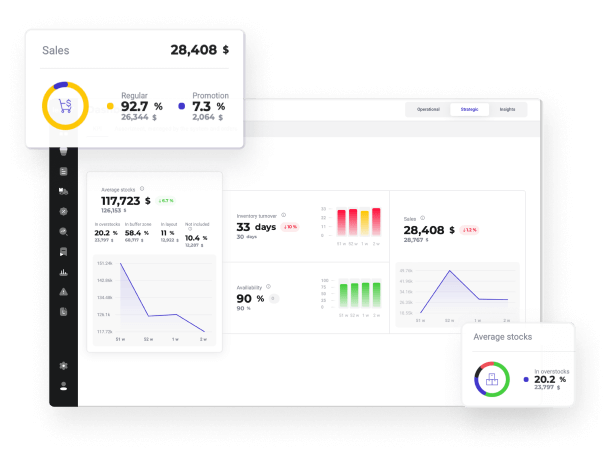
- Using detailed reports of the Retail Business Intelligence module, which works on the principle of drill-down. This helps to instantly find stock availability problems, and identify and eliminate their root causes.
Conclusion
Inventory management tools are a must-have if you are planning to meet customer demand, streamline your supply chain, and avoid the negative effects of overstocking. Implement modern solutions and get real-time information about your inventory, avoid delays in replenishment, and make effective decisions now. Inventory management in a highly competitive environment means constantly looking for ways to optimize and automate routine processes, so don’t let the benefits slip through your fingers.
Stock Availability FAQs
What should retailers do to ensure adequate levels of product availability in stores?
The basis of inventory availability is inventory management. At the same time, you need to monitor historical and current sales data to predict demand. Establishing relationships with suppliers, maintaining safety stock, and automating processes are also important.
How does product availability affect a retailer?
In short: well-established processes in the supply chain, inventory management, and forecasting lead to increased sales, improved reputation, and satisfaction of customer expectations.
How is stock availability measured?
Various metrics are used for this: shortage and filling ratios, delivery days, inventory turnover ratio, etc.
What is meant by product availability?
Product availability refers to the ability of a retailer to have the right products in stock, at the right time, and in the right quantities, ensuring customers can purchase what they need without delays. It's a critical metric impacting customer satisfaction, sales performance, and inventory management efficiency.


Have a question?

Jack Larson
Retail Optimization Expert
