

A grocery chain can automate every replenishment order it sends and still have someone sign off on each one by hand. That gap between what a system can already do and what an organization lets it do is where the real work happens now.
Progressive Grocer recently asked me to weigh in on where grocery replenishment is headed, for a piece published this month. It covered a lot of that gap, but not all of it. Here is a closer look at the economics, the framework, and the operating changes behind it.
You can read the original Progressive Grocer feature here: Making the Most of Replenishment
Where the bottleneck actually sits
Most grocery chains we work with have already automated the basics. Orders generate on their own, and forecasts run quietly in the background. What is slower to change is the workflow wrapped around those recommendations, built for a world before AI. That is usually the actual bottleneck, not the model itself.
Once that bottleneck clears, the payoff shows up quickly. At Local Discounter, our replenishment automation cut store-level ordering workload by 80%. At Daily Supermarkets, automation now generates 99.5% of orders without a manual step. Those gains run in both directions. Protecting availability matters, but so does avoiding the excess inventory that quietly ties up working capital and creates waste.
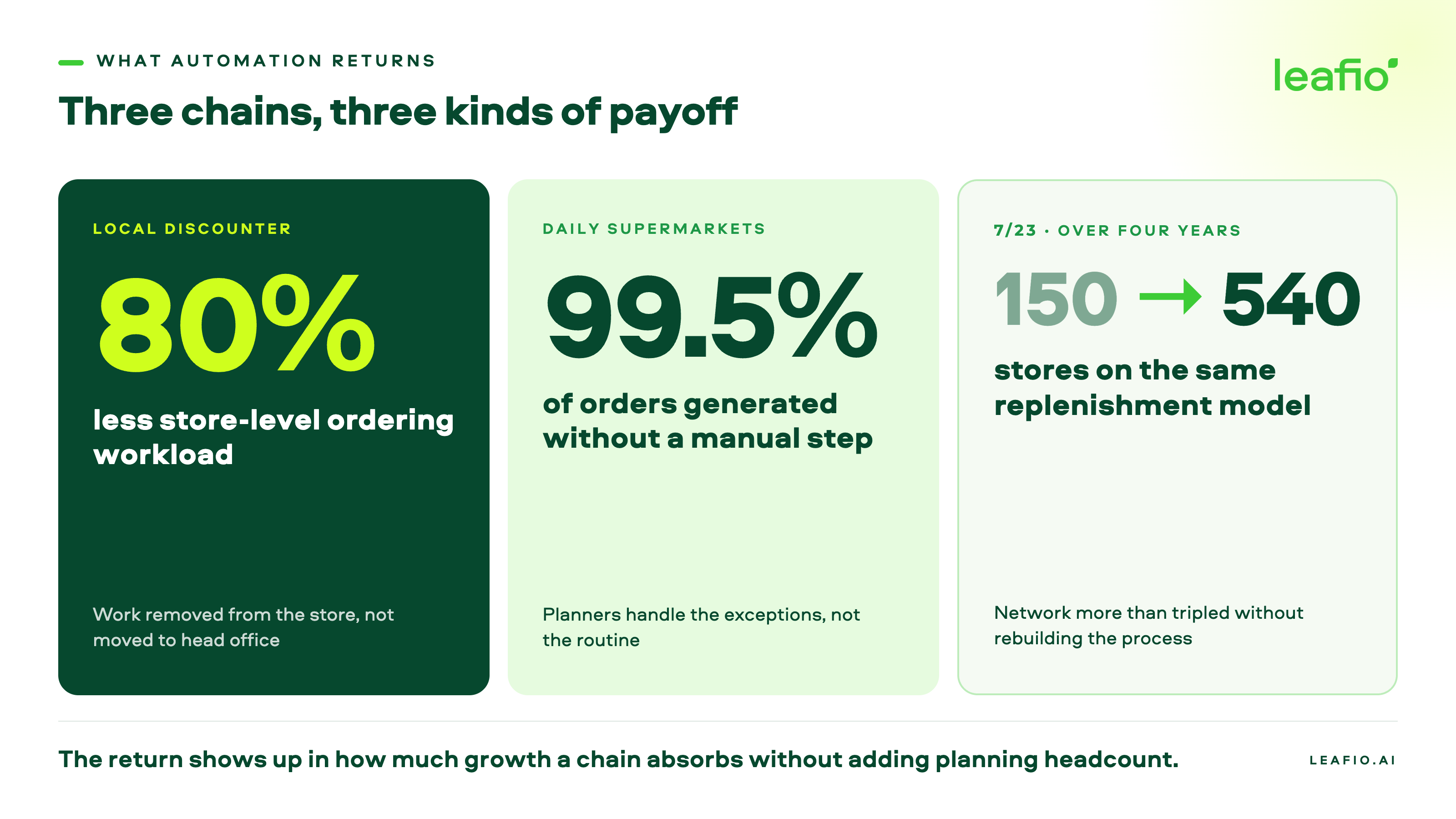
The bigger payoff shows up over time, as a retailer grows. Operational complexity does not have to grow at the same rate as the store network. Autonomous decision-making lets a chain support more stores without adding planning headcount at the same pace. 7/23, one of our longtime retail partners, grew from around 150 stores to more than 540 over four years. Throughout that growth, it operated on the same replenishment model the whole way through. The network scaled more than three times over without the process being rebuilt at every stage.
Replenishment’s real return shows up in how much growth an organization can absorb without a proportional increase in operational complexity. It is not just what shows up on an inventory report.
The four questions that determine where autonomy belongs
Technically, routine replenishment is already highly automatable. Systems can forecast demand, generate orders, and send them to suppliers without human intervention. The harder question is where that autonomy should stop.
Deciding which decisions an AI system can make on its own comes down to a specific framework I use with clients.
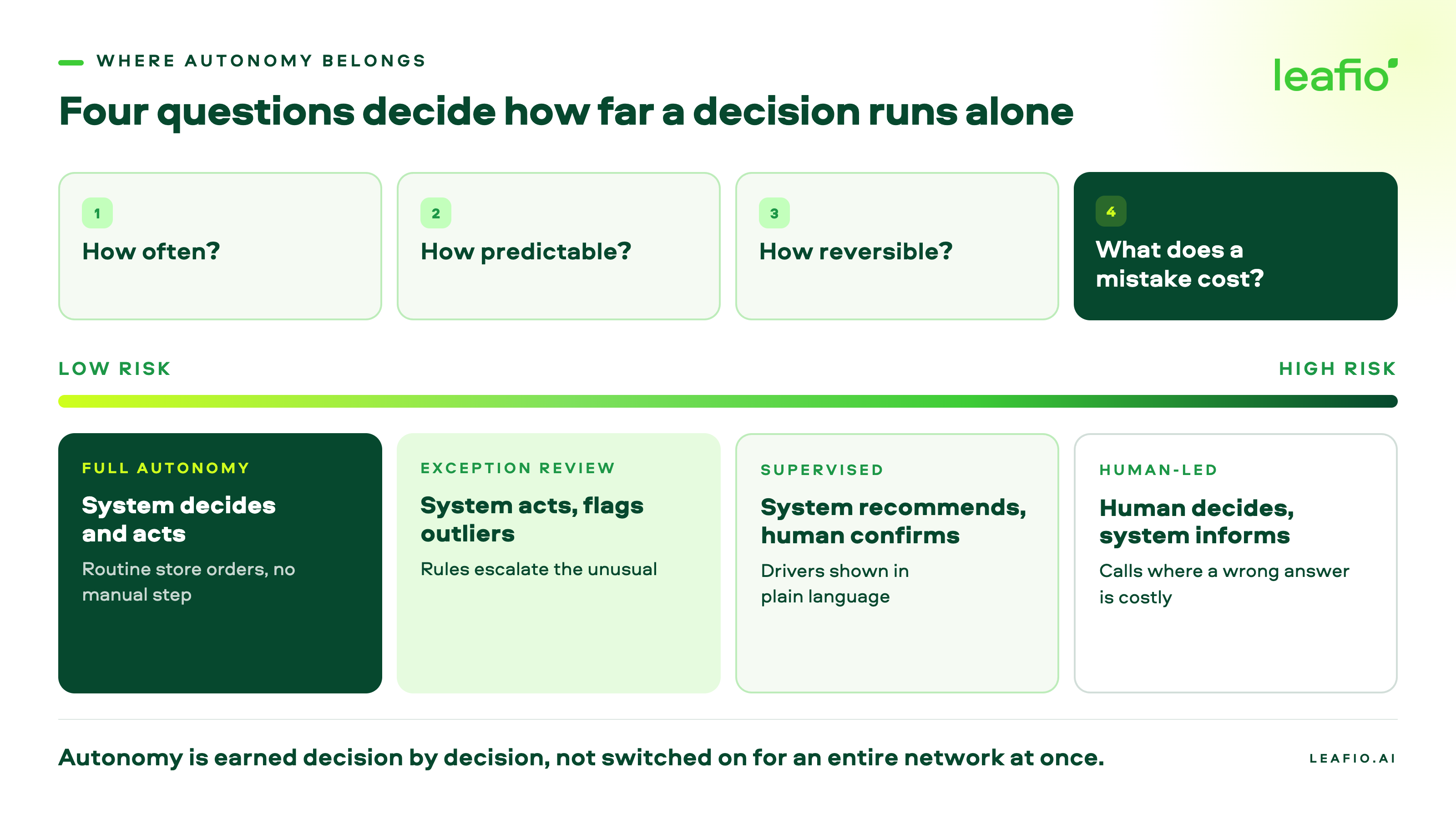
Four questions decide where autonomy belongs:
- How often does the decision happen?
- How predictable is the outcome?
- How easy is it to reverse if the system gets it wrong?
- What does a wrong decision actually cost?
As risk, unpredictability, or the cost of error rises, human supervision becomes more important. Autonomy should be earned decision by decision, not switched on for an entire network at once.
How retailers actually build trust in autonomous decisions
Accountability is the real barrier to AI-driven planning. When an automated order goes wrong, someone still has to answer for it, and most organizations have not clearly assigned that ownership. I’ve watched planners quietly keep double-checking an AI system that has been right for months. Nobody has told them it is safe to stop.
The more useful question is how organizations actually close that gap. The answer is sequencing, not a mandate. Start with routine, predictable decisions where the risk of error is low. Show planners which factors drove each specific recommendation, in plain business language. Only expand scope once results hold up against the metrics the team already trusts, with clear rules for escalating anything unusual. Skip that order, and roll out full automation before anyone has agreed on ownership, and the project usually stalls. That failure is rarely about the model. It is almost always about how the rollout was managed.
The skill set of the planner is changing
As more routine decisions move into the system, the planner’s job changes with them. I told Progressive Grocer that the planner of the future will manage a decision system, not a spreadsheet. The more specific shift is in what expertise actually becomes valuable.
Today, a planner’s value often comes from knowing individual SKUs by feel. Over the next several years, the more valuable skill becomes understanding why a model behaves the way it does. It also means translating shifting business goals into constraints the system can act on. The planners who do this well read the system correctly: when it has enough context to decide alone and when it doesn’t. That judgment call is worth more than constant overriding or blind acceptance.
From automated replenishment to an autonomous decision-making platform
A better forecast only gets a retailer so far. The larger opportunity is connecting that signal to the operational decisions that follow from it across inventory, assortment, and shelf execution.
Put together, these shifts point to something bigger than replenishment automation. Retailers are changing not only which decisions AI can make but also how those decisions connect and how autonomy expands.
That is the direction we are building toward at LEAFIO AI: an autonomous decision-making platform where retail decisions gain autonomy piece by piece. Demand, inventory, assortment, and shelf execution inform one another, so each decision has context from the rest of the operation. Autonomy also depends on feedback. A decision has to be measured against what actually happened, so the next one starts with more context than the last.


Have a question?

Jane Medwin
LEAFIO Co-Founder, Retail Optimization Expert