



Whether you are enjoying the spring flowers or suffering from pollen allergies, 2025 is underway and machine learning in demand forecasting stands as a transformative force, driving actionable insights, efficiency, and unprecedented accuracy.
ML in demand forecasting innovation continues to expand, offering powerful tools to navigate market complexities. According to McKinsey, integrating AI-driven predictive analytics in supply chain management typically results in error reduction ranging from 20% to 50%.
In this comprehensive guide, we explore the pivotal role of machine learning in demand forecasting, and the advancements poised to revolutionize retail strategies and customer behavior. Find out what we mean by ML demand forecasting and whether your retail business really needs it.
Key Takeaways
Machine learning delivers adaptive, self-improving forecasts that outpace traditional models.
Learns from evolving demand patterns.
Handles seasonality & trends dynamically.
Cuts forecast error rates.
Frees planners for strategic tasks.
Connects seamlessly to ERP & WMS.
Introduction: The New Era of Retail Demand Forecasting
The retail landscape is evolving rapidly, and the ability to anticipate demand has never been more critical. Traditional forecasting methods, which primarily rely on historical sales data and basic statistical models, are struggling to keep pace with the complexities of today’s increasingly volatile markets. As consumer preferences shift and external influences become more unpredictable, retailers are seeking more robust solutions to optimize inventory levels and respond swiftly to market changes. Enter machine learning and artificial intelligence—technologies that are redefining demand forecasting by uncovering complex patterns in sales data and enabling businesses to make smarter, data-driven decisions. In this new era, retailers who embrace advanced forecasting methods are better equipped to anticipate demand, minimize stockouts, and maintain a competitive edge.
What is machine learning in demand forecasting?
Often referred to as ML in demand forecasting, it is a data-driven approach rooted in data engineering and the application of machine learning algorithms to predict future outcomes based on historical data patterns. It leverages advanced statistical techniques and computer power to analyze vast datasets of historical sales data and trends, such as seasonality.
AI demand forecasting is increasingly adopted across industries for its effectiveness in predicting market demands, adapting to seasonal variations, and integrating with existing systems to improve operational decision-making.
For brick-and-mortar retailers, machine learning is a powerful tool for predicting demand, optimizing inventory, and fine-tuning marketing strategies. By forecasting product demand, retailers can adjust pricing and streamline the supply chain to meet customer needs more efficiently. This technology is also widely used by e-commerce businesses and even financial companies to forecast risks, market trends, and respond quickly to shifting market conditions, helping companies stay agile and competitive.
Traditional forecasting methods versus machine learning demand forecasting
Unlike traditional forecasting methods, ML demand forecasting dynamically adapts to changing patterns. Conventional methods, such as time series analysis and econometric models, have historically been used for demand forecasting but are limited in adaptability and accuracy. ML demand forecasting incorporates many variables including external data, enhancing the forecast accuracy and robustness. Using machine learning for forecasting demand empowers businesses to make informed decisions, optimize operations, and anticipate market dynamics with unprecedented precision.
Contrarily, traditional methods rely heavily on historical data and assumptions about linear relationships between variables. Traditional statistical methods often struggle to handle complex seasonality patterns, whereas ML driven demand forecasting leverages advanced algorithms to identify intricate, overlapping trends in diverse datasets, providing superior accuracy. They require manual intervention and are prone to human biases. Consequently, businesses relying solely on data gathering may face challenges of forecasting in adapting to dynamic markets and miss out on valuable insights for inventory management and strategic decision-making.
How is machine learning used for demand forecasting?
Machine learning demand forecasting models play a crucial role by applying historical data and various predictive machine learning algorithms, leveraging data analytics to forecast demand and anticipate future consumer demand. Initially, forecasting systems ingest large data volumes, that can include past sales records, market trends, seasonality, demographics, and external data and factors.
Most importantly, machine learning in demand forecasting further analysis holds the edge over other forecasting systems thanks to its ability to adapt and learn from new data. Predicting demand based on seasonality patterns and external factors is essential for accurate planning and optimizing supply chain decisions. This adaptability allows businesses to respond swiftly to changes in consumer behavior or other outer circumstances.
Which machine learning algorithm is best for forecasting?
| Algorithm | Description | Use Case |
|---|---|---|
| Clustering Analysis | aid in understanding and prediction. Data scientists often use clustering to improve the performance of an ML model by identifying relevant segments. | Useful for segmenting data to identify patterns and similarities. |
| Descriptive Analysis | Examines past events to predict future occurrences, guiding operational improvements and identifying opportunities. Data scientists analyze large datasets to extract meaningful insights for demand forecasting. | Helps in understanding trends and making informed decisions. |
| Outlier Analysis | Identifies anomalies to refine predictions, further process data, and isolate impacts. Outlier detection is crucial for maintaining the accuracy of ML models. | Essential for detecting and addressing data irregularities. |
| Factor Analysis | Reveals relationships between variables to anticipate future outcomes. Understanding these relationships helps data scientists improve ML model accuracy. | Helps in identifying influential factors and their interactions. |
| Time Series Analysis | Forecasts future patterns based on previous data and historical trends. This technique is widely used in ML models for demand forecasting, especially when considering seasonality and external influences. | Ideal for predicting trends over time in financial data etc. |
| Regression Analysis | Predicts continuous variables based on relationships with other factors. Regression is a foundational ML model approach for forecasting demand. | Useful for forecasting numerical outcomes like sales or costs. |
When push comes to shove, every one of these forecasting techniques can enhance your understanding of your data mining and forecasting capabilities to predict future demand.
How to apply machine learning in demand forecasting to my business?
Starting an ML demand forecasting project begins with a thorough data review and exploration to align with business goals and identify solutions that meet market needs.
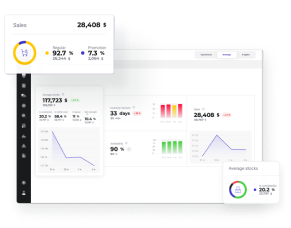
Realizing the need for demand forecasting with machine learning was the first step. Now, you should find a provider that can respond to your needs the best. LEAFIO 's AI-Powered Demand Planning Software provides you with a readily available machine learning demand forecast as it calculates the future demand for every single product based on its own sales data, history, and seasonal factors or promotions.
Our software will allow you to create a direct multi-step forecast strategy that builds separate models for each period and uses all incoming data to project for each subsequent period. Demand planners benefit from these machine learning tools, as they help manage complex variables like external factors, weather, local events, and inventory, improving forecast accuracy and operational efficiency.
Demand forecasting with machine learning with LEAFIO AI means being able to respond to both internal and external factors while eliminating human error. The forecasting algorithms of our demand planning software take into account all variables, facilitating the work of managers. This capability enables businesses to make faster, more informed decisions. Such cooperation always leads to data-driven strategic decisions that are the backbone of increased sales and happy customers.
The LEAFIO AI solution's impact is vividly illustrated by Novus, a grocery chain boasting around 90 supermarkets. They effectively manage 30,000 SKUs, with 40% of their assortment dedicated to promotions. Employing our ML-based Promotion Intelligence solution led to a 2% surge in promotional product availability, reaching an already impressive initial rate of 97.1%. Moreover, the retailer achieved a twofold reduction in excess inventory post-promotion, optimizing inventory management as a key outcome.
Precondition in demand forecasting for using machine learning
Preconditions in forecasting for utilizing machine learning encompass several critical factors. Firstly, a comprehensive dataset containing historical sales records, market trends, and relevant variables is imperative.
Secondly, data quality and consistency are paramount to ensure accurate model training. Additionally, domain expertise is essential for selecting appropriate algorithms and interpreting results effectively.
Lastly, organizational readiness, including stakeholder buy-in and investment in training and integration, is crucial for successful implementation.
ML in demand forecasting best practices, tools and software
Achieving accurate and efficient ML-powered demand forecasting requires a strategic approach grounded in best practices. Start by thoroughly analyzing historical sales data and incorporating relevant external factors to capture the full picture of market demand. Employ machine learning models that can adapt to new trends and refine their predictions over time. Regularly review and update your forecasting models to ensure they remain aligned with current market conditions and business objectives. Additionally, optimize inventory levels to balance supply with anticipated demand, and leverage human expertise to interpret model outputs and guide decision-making. By following these best practices, retailers can reduce forecast errors, improve forecasting accuracy, and stay agile in a rapidly changing retail environment.
Modern demand forecasting machine learning relies on a variety of sophisticated tools and software designed to enhance forecasting accuracy and efficiency. These solutions utilize machine learning algorithms to process historical sales data and integrate external factors such as weather patterns, economic indicators, and social media sentiment. Options range from traditional statistical modeling software to advanced machine learning platforms and cloud-based forecasting solutions. When evaluating demand forecasting tools, it’s essential to consider the quality of your sales data, the tool’s ability to handle diverse input data, and the overall forecasting accuracy. The right software can empower retailers to make data-driven decisions, respond to market fluctuations, and maintain optimal inventory levels.
What is the best machine learning model for demand forecasting?
Commonly used models include linear regression for simple linear relationships, ARIMA for time series data, and more advanced techniques such as random forests or gradient boosting for capturing nonlinear patterns. Additionally, deep learning models like recurrent neural networks (RNNs) or long short-term memory networks (LSTMs) excel in handling sequential data. Ultimately, the most effective machine learning forecasting model is one that aligns with the characteristics of the dataset and objectives.
Final thoughts
Machine learning for forecasting in retail for 2025 is bound to bring unprecedented insights and efficiency, addressing market complexities with innovative ML forecasting tools.
Having the best forecasting model empowers businesses to make informed decisions, optimize operations, and anticipate market dynamics. Leveraging machine learning in business forecasting holds immense potential for enhancing accuracy and driving strategic decision-making.
With reliable partnerships and robust infrastructure, businesses can harness the power of machine learning to stay agile, responsive, and competitive in the ever-evolving retail industry.
Machine Learning in Demand Forecasting FAQ
How accurate is machine learning demand forecasting?
Machine learning demand forecasting methods' accuracy varies depending on data quality, model complexity, and domain expertise. While ML models can offer high accuracy in many cases, they're not infallible and can be impacted by factors like data noise or unforeseen events. Having more data means more training data and higher forecast model accuracy too.
Can machine learning make predictions?
Yes, machine learning can make predictions by analyzing recent data patterns. Through various algorithms and techniques, such as linear regression, time series data analysis, and deep learning, machine learning models can make predictions with varying degrees of accuracy across different domains.
How is AI used in forecasting?
AI is employed in the machine learning forecasting process to analyze data and identify patterns, and consumer behavior. AI systems adapt to changing conditions, incorporate numerous variables, and generate more accurate forecasts across diverse domains such as sales forecasting, finance, and weather prediction.
