


Key Takeaways
AI transforms inventory management by increasing accuracy and automating complex decisions.
AI reduces human errors.
Predicts demand with higher precision.
Helps cut overstock and stockouts.
Automates replenishment.
Frees up capital tied in inventory.
Inventory management is undergoing a transformation with Artificial Intelligence (AI) replacing traditional reliance on spreadsheets and intuition. The Economist’s report highlights the rising complexity of supply chains and the burgeoning adoption of warehouse automation. It also indicates that enterprises will derive between $1.3 trillion and $2 trillion annually in economic value from using AI in supply chains and manufacturing. This trend has been pushing businesses of all sizes to adopt AI for inventory management to optimize resources and boost profits.
Logistics is currently experiencing a revolution fuelled by AI. Imagine intelligent systems managing self-driving trucks and automated warehouses. This is not science fiction anymore as Amazon already utilizes 200,000 robots in its warehouses, and FedEx uses machine learning algorithms to forecast demand and plan shipments.
The good news is that AI is no longer just the plaything of tech giants! Businesses of all sizes can benefit from integrating AI into their inventory management practices to maximize efficiency because it is becoming increasingly more affordable and accessible. As a case study for AI in inventory management, LEAFIO AI stands out as a leading provider of retail inventory optimization with AI, showcasing the advanced capabilities of this transformative technology.
AI Inventory Management: What It Is and How It Works
AI Inventory Management is like having a super-powered stockroom strategist. It brings big benefits: sharper logistics, fewer errors, faster orders, and smarter planning based on robust data analysis. AI in inventory management uses advanced algorithms to analyze mountains of data, handle inventory forecasting for your products, and optimize stock levels. This means no more running out of popular items or overloading shelves with slow sellers.
Unlike traditional methods that rely on spreadsheets and guesswork, AI in inventory management has managed to automate routine inventory tasks and provides real-time insights, ensuring a smoother, more accurate flow of goods.
Artificial intelligence inventory management can dramatically reduce overstocking and outages, improving overall supply chain efficiency. Companies like Amazon use AI inventory to manage customer demand patterns in real-time across warehouse networks, and retailers like Walmart employ AI driven predictive analytics to fine-tune their inventory levels.
By integrating artificial intelligence, businesses can shift from reactive to proactive inventory management, enhancing their retail business's responsiveness and operational efficiency.
AI for Intelligent Inventory Management — How to Use It
Optimizing inventory management processes can significantly enhance business efficiency, inventory accuracy, and decision-making.
How does AI help in inventory management? Here’s a concise guide to integrating AI into your business:
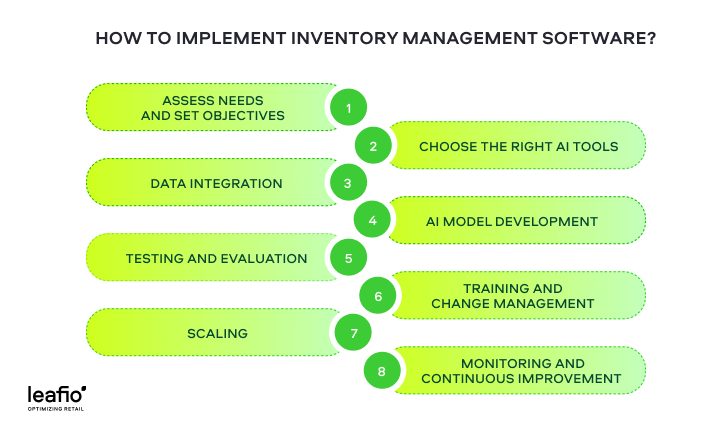
Step 1: Assess needs and set objectives
Identify which business processes could benefit from AI and define your goals, such as optimizing inventory management, reducing operational costs, and improving customer satisfaction.
Step 2: Choose the right AI tools
Select AI tools for inventory management that align with your objectives, considering scalability and ease of integration. They must include demand forecasting and automated replenishment features.
Step 3: Data integration
Incorporate analyzing historical data and third-party data into the AI system, focusing on data quality for successful AI applications. Deploy AI tools, ensuring they integrate smoothly with existing supply chain management systems like ERP or CRM.
Step 4: AI model development
Develop and tailor AI in inventory management to your business needs, using platforms that support custom model development.
Step 5: Testing and evaluation
Test AI models to evaluate their performance on small product ranges or several pilot stores and adjust based on feedback.
Step 6: Training and change management
Train employees on the new inventory optimization AI tools and control any change resistance effectively.
Step 7: Scaling
Based on the results of the pilot, the system is being scaled to the entire network.
Step 8: Monitoring and continuous improvement
Continuously monitor inventory level management processes and update the models to adapt to new data and business changes, leveraging AI driven insights for continuous improvement.
Businesses can unlock a new era of intelligent supply chain operations, demand forecasting, and informed decision-making, by following these steps and continuously learning from AI data.
AI-Powered Inventory Management: Top 5 Benefits
AI integration is a revolutionary advancement in inventory management systems, shifting the focus from a reactive approach to a proactive one. LEAFIO AI is one of the leading providers of such technology and offers a suite of artificial intelligence-based inventory management tools to optimize all aspects of the inventory process.
Integrating LEAFIO AI into your inventory planning strategy brings numerous benefits, such as maintaining high availability, enabling seamless KPI inventory tracking, and accurate demand forecasts.
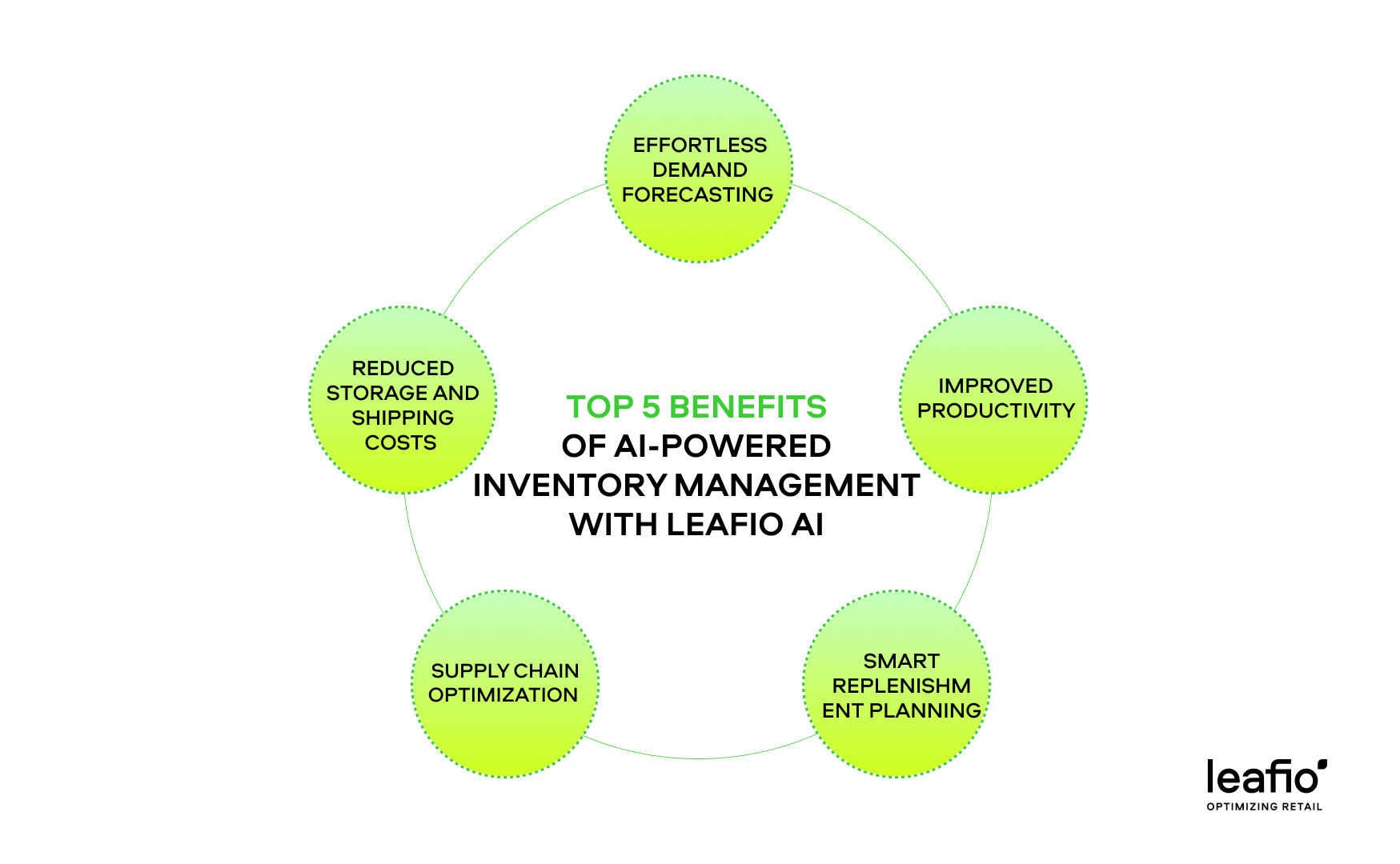
#5: Effortless demand forecasting
LEAFIO AI's demand forecasting module stands out by offering precise short-, medium-, and long-term sales predictions, enabling businesses to accurately plan up to a year in advance.
LEAFIO AI's demand forecasting tool analyzes historical sales data, demand variability, current stock levels, and seasonal demand, which allows companies to proactively adjust their inventory to meet anticipated demand. Enhanced forecasting accuracy ensures businesses are well-prepared for market changes, seasonal peaks, and promotional events, reducing the risk of stockouts and excess inventory.
#4: Improved productivity through AI algorithms
LEAFIO AI significantly enhances productivity by automating routine tasks in inventory management processes, including calculating and analyzing key performance indicators (KPIs). This automation streamlines operations and provides consistent data-driven insights, leading to improved decision-making.
As a result, companies experience measurable benefits, such as an 8% increase in sales, a 15% reduction in waste, and more efficient use of managerial and operational resources. These improvements collectively contribute to a leaner, more profitable business model.
#3: Smart replenishment planning and optimal stock levels
LEAFIO AI’s advanced multi-echelon replenishment inventory management systems meticulously manage inventory via all supply chain levels, ensuring optimal stock levels from retail fronts to central warehouses.
By accurately calculating reorder points based on inventory data and predictive analytics, LEAFIO AI effectively minimizes overstocks by 50% and boosts product turnover by 30%. This strategic control over inventory prevents understocking and ensures that capital is not unnecessarily tied up in surplus stock, thus enhancing overall business growth and responsiveness to market demand trends..
#2: Supply chain optimization
LEAFIO AI optimizes the entire supply chain by seamlessly balancing high availability and low write-offs. It addresses the unique demands of different product categories, particularly perishable goods, with its tailored AI algorithms that consider factors such as shelf life, delivery frequencies, and changing demand patterns.
This approach minimizes delays, reduces bottlenecks, and ensures a smooth flow of goods and information. The system’s capability to adapt to real-time changes in the supply chain enhances operational agility and effectiveness, ensuring that businesses can meet their delivery commitments reliably.
#1: Reduced storage and shipping costs
LEAFIO AI inventory management systems reduce storage and shipping costs by optimizing logistics through advanced AI-driven planning tools. By managing resource allocation and scheduling, LEAFIO AI reduces excess inventory that overloads warehouses and aligns orders with delivery schedules efficiently.
By avoiding additional urgent supplies, LEAFIO Inventory Optimization also cuts down on logistical expenses and enhances service delivery. The system ensures products are available wherever and whenever needed.
Through powerful analytics, LEAFIO AI provides deep insights into inventory trends, allowing businesses to make informed decisions that further streamline operations and reduce costs, thereby supporting sustainable and profitable business practices.
AI Inventory Management: Why LEAFIO AI Is the Best Choice
LEAFIO AI stands out as the premier AI-driven inventory optimization software in 2026 due to its innovative features and proven results that distinctly set it apart from competitors.
- Unified retail ecosystem. Inventory Optimization connects with promo, shelf, and assortment modules within the LEAFIO AI Retail Platform. One integration unlocks all modules.
- Flexible SaaS model. Subscription-based access with secure use of AI in inventory management from any location or device.
- Fast implementation. Integrates with both global ERPs and niche on-premise systems, enhancing existing workflows with advanced analytics.
- Rapid ROI. Most retailers see payback within the first year, with ROI reaching 300–400% in years two and three.
- Retail expertise. 200+ implementations across diverse global retail environments.
- Industry recognition. 25 G2 2026 awards, including Best Usability, Best Support, and Best Estimated ROI.
- Training and consulting. Dedicated onboarding helps teams quickly adopt AI-driven processes.
To see how LEAFIO AI can transform inventory management, schedule a demo and explore the platform in action.
“We are satisfied with LEAFIO Inventory Optimization, as it met our critical needs for inventory management and provided excellent debugging methodology and high-standard functionality. We appreciate the LEAFIO expert team's deep understanding of our inventory processes, both during implementation and through ongoing support," notes the Head of the General Construction Department of Maxibuild.
AI Inventory Management: Major Challenges
AI undoubtedly offers many advantages in inventory management, but it can also cause several potential problems. Let's look at the main challenges:
- Data issues. The performance of AI directly depends on the quality of the information processed by the system. If you provide inaccurate (or incomplete or outdated) data, the forecasts and decisions will also be incorrect. Another problem may be the fragmentation of data, as it is stored on different systems in different formats. To overcome this challenge, you need to organize the information, the methods of obtaining it, and its systematization and storage.
- Human resistance. Surprisingly, people often resist systems that make their routine work easier. Effective training, communication, and management can help here.
- Large investment. The cost of implementing AI-based technologies can be high, as you need to invest in technology, training, and integration. In most cases, this is not affordable for small businesses.
- Security issues. The greater the dependence on data, the more complex the issues of its secure storage become. It is important to synchronize these processes with the requirements of local legislation and international industry standards.
The impact of AI on inventory management: key takeaways
The rise of AI in the retail industry is revolutionizing inventory management, transforming it from a reactive to a proactive strategy. AI analyzes massive datasets to provide data-driven insights, optimizing stock levels, anticipating demand fluctuations, and minimizing costly errors. It automates tedious tasks like order placement and replenishment, freeing up valuable human resources for strategic planning. Additionally, AI connects and balances inventory management across end-to-end supply chains, handling unique product categories and adapting to real-time changes.
Looking to the future, AI will leverage machine learning for even more accurate demand forecasting, considering external factors like weather patterns and social media trends. AI will work seamlessly with robotic systems for tasks like picking and packing, with usage expected to expand into areas such as delivery. Furthermore, AI will personalize inventory management based on historical sales data and customer behavior, ensuring the right products are stocked at the right place and time.
The future of inventory management is intelligent, automated, and data-driven. Are you ready to unlock its potential with LEAFIO AI? Request a free demo now!
AI inventory management FAQ
How is AI utilized in inventory management?
AI analyzes massive datasets on sales history, product trends, and market conditions. This allows businesses to predict future demand fluctuations, ensuring optimal inventory levels and preventing stockouts or overstocking. Additionally, it automates repetitive tasks like order placement and reordering, freeing up human resources for strategic planning.
What is intelligent inventory management?
Intelligent inventory management goes beyond basic automation. It utilizes AI to analyze demand patterns, consumer demand, market trends, and forecast future needs, ensuring the right products are available at the right time to meet customer demand. This AI tool also optimizes stock levels, minimizing storage costs and preventing stockouts.
Can inventory management be automated?
Yes, AI enhances inventory management by automating various tasks. This includes automatic order placement based on established parameters, historical sales data, demand patterns, and current stock levels. Additionally, AI automates historical data analysis, eliminating the need for manual processes and enabling businesses to identify trends and predict future consumer demand with greater accuracy.


Have a question?

Kristi Miller
Retail optimization expert


