


A DIY retailer orders a full pallet of a discontinued paint line because the supplier's minimum order quantity leaves no other option. Eighteen months later, half that pallet is still on the shelf, the color has been replaced twice over, and the only way out is a 70% markdown. That single decision, repeated across thousands of SKUs a year, is what obsolescence management exists to prevent.
Obsolescence management is the set of practices retailers use to spot declining products early, stop over-buying them, and clear existing stock before it loses all its value. Done well, it protects working capital, shelf space, and margin across the retail supply chain. Done poorly, it shows up months later as a write-off nobody budgeted for.
This guide covers the full cycle: what obsolescence management means, what causes it, and how to measure it with concrete KPIs. It also covers how risk changes across the product lifecycle, how to liquidate stock that is already obsolete, and how to account for it correctly. The final section looks at where AI changes the economics of prevention. Throughout the guide, retail examples show how these decisions affect overstock, inventory turnover, assortment performance, working capital, and margin in practice.
What Is Obsolescence Management?
Obsolescence management is the process of identifying inventory that is losing market relevance and adjusting procurement before more of it accumulates. It also covers recovering as much value as possible from what already sits on the shelf or in the warehouse. The practice combines demand signals, product lifecycle stage, and financial exposure into a single decision: keep buying, slow down, or liquidate.
The practice sits at the intersection of merchandising, supply chain planning, and finance. A category manager decides what stays in the assortment. A planner decides how much to buy and when to stop. Finance decides when a slow mover becomes a write-off. Inventory obsolescence management is what connects those three decisions so none of them happen too late.
Obsolescence vs. Excess Inventory: What's the Difference?
Excess and obsolete inventory are often grouped together under E&O, but operationally they represent two different problems. The distinction matters because each requires a different inventory response.
Excess inventory still has demand behind it. You simply have more of it than you need for the coverage period you are planning against. Obsolete inventory has no demand left at all or demand so thin that normal sell-through will never clear it before the product is discontinued.
| Lifecycle status | What it means | The automated rule LEAFIO applies |
|---|---|---|
| Insertion | The SKU is newly added to the assortment matrix, with no sales history yet | Forecasting runs on analogs and category benchmarks; a temporary space allocation helps the item establish itself |
| New Product | The SKU is confirmed active and gaining sales | Replenishment and buffer targets adjust upward to match rising, still-uncertain demand |
| Extraction | The SKU is flagged for removal from the matrix, often with a planned exit date | Ordering tightens automatically, and stock winds down ahead of the exit date instead of after it |
| Passive Status | The SKU is fully phased out | Replenishment stops cleanly and the SKU drops out of active matrix reporting |
Getting this distinction wrong costs money in both directions. Treat excess as obsolete, and you discount stock that would have sold at full price. Treat obsolete as excess, and you keep reordering safety stock for something nobody wants anymore.
What Causes Inventory Obsolescence?
Most obsolescence traces back to a handful of recurring failures, and they compound. A forecasting miss on a product nobody is tracking through its lifecycle stage becomes a much bigger write-off than either problem alone. Understanding these root causes is the real starting point for how to prevent obsolete stock, since slow-moving inventory rarely turns obsolete overnight.
Inaccurate Demand Forecasting
A flat, one-size-fits-all forecast doesn't account for a product decelerating toward the end of its life. If the forecast still assumes steady-state demand while actual sell-through is dropping 15% week over week, every replenishment order compounds the surplus instead of shrinking it.
Poor Product Lifecycle Management
Products don't carry a single, unchanging demand pattern from launch to delisting. A reference that gets the same reorder logic in month one and month thirty will accumulate stock during decline. Nothing in the system flags that its risk profile has changed.
Supplier MOQ and Lead Time Constraints
A supplier's minimum order quantity does not care what stage of its lifecycle a product is in. If the MOQ for a slowing SKU is six months of cover, and lead time adds another six weeks, a single order can outlive the product's demand entirely.
Market and Consumer Preference Shifts
New entrants, ingredient reformulations, or a shift in what a category's shoppers actually want can make an otherwise healthy SKU irrelevant within a single season. Categories with fast innovation cycles, such as health and beauty or consumer electronics, see this more often than staples.
Seasonal and Promotional Misalignment
Ordering for a promotion based on last year's uplift, without adjusting for a category that has cooled since, is one of the most common causes of obsolescence. The stock that doesn't clear during the promotion window rarely clears at full price afterward.
Over-Provisioning and Safety Stock Miscalculation
A static safety stock buffer, set once and left alone, becomes a liability as soon as demand for that SKU starts declining. The buffer that protected against stockouts during growth is the same buffer that fills a warehouse during decline.
The Real Cost of Obsolete Inventory
Obsolete inventory is not a rounding error. According to IHL Group's research, cited by Chain Store Age, global retail loses $1.73 trillion annually to inventory distortion, the combined cost of out-of-stocks and overstocks. That figure is now equal to 6.5% of global retail sales. Overstocks, spoilage, and forced markdowns make up a substantial share of that figure, and obsolescence is where overstock stops being a temporary imbalance and becomes a permanent loss.
The cost shows up in three places at once. Working capital gets locked into stock that isn't generating revenue, adding to carrying costs that compound every month it sits. Warehouse and shelf space that could hold a productive SKU instead holds a dying one. And the eventual exit, whether markdown, liquidation, or write-off, almost always recovers less than the original cost, sometimes far less. This is exactly where obsolescence risk management earns its budget: catching the problem months before it turns into a write-off nobody planned for.
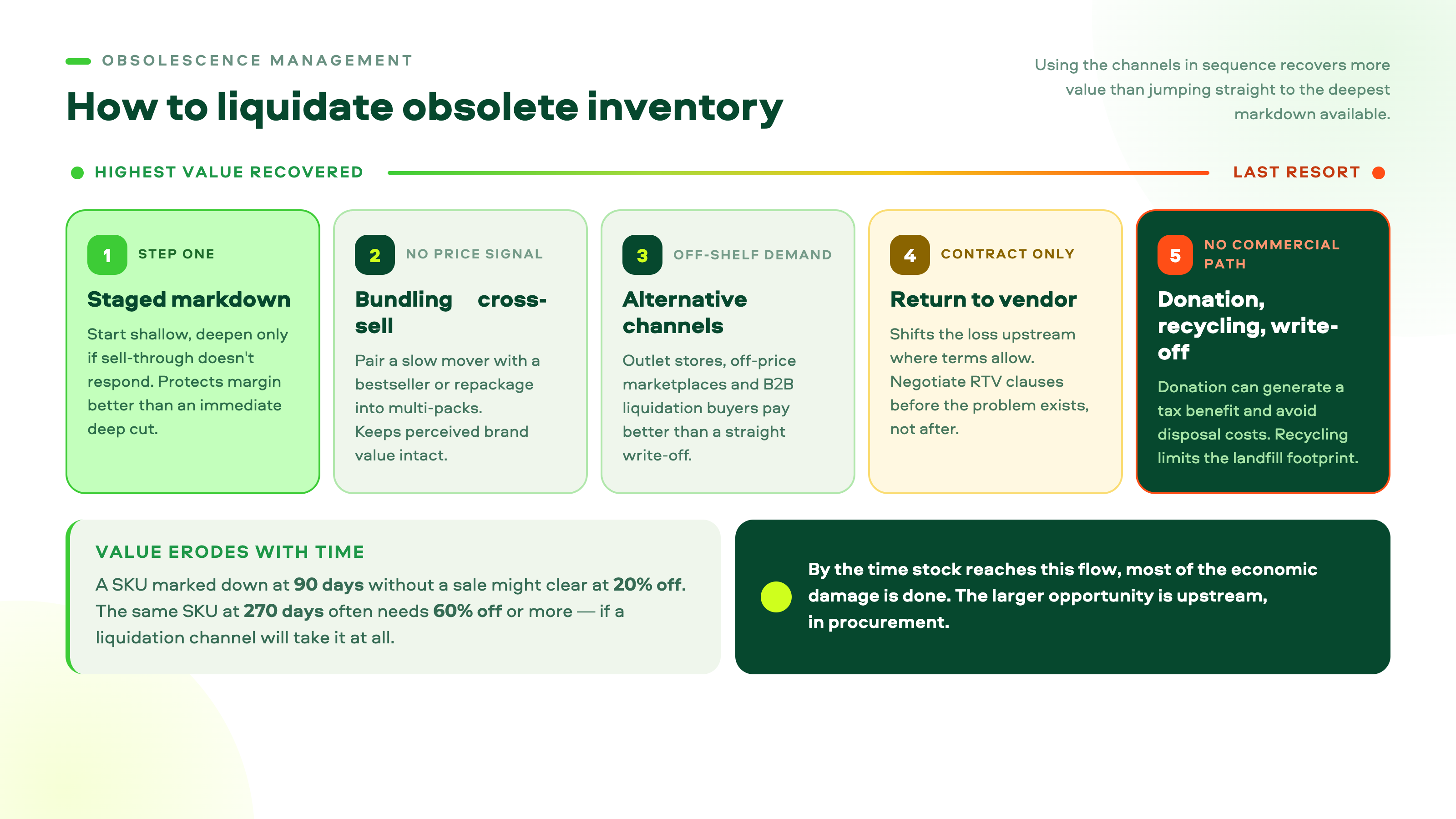
There is a compounding effect worth calling out directly: the longer obsolete stock sits, the worse the eventual recovery rate gets. A SKU marked down at 90 days without a sale might clear at 20% off. The same SKU at 270 days often needs 60% off or more, assuming a liquidation channel will take it at all.
For a closer look at calculating this exposure as a percentage of total inventory value, see our guide to SLOB inventory.
How to Identify Obsolete Inventory: Key KPIs and Metrics
Waiting for a category review to catch a dying SKU is too slow. The retailers that manage obsolescence well track a small set of leading indicators, weekly, at the SKU level.
Days on Hand (DoH) and Days Without a Sale
"Days on hand" tells you how long current stock would last at the recent sales rate. “Days without a sale” tell you something different and more urgent. It shows how long it has been since a customer bought the item at all, regardless of how much stock remains.
Excess Coverage Ratio
This measures stock on hand against a defined coverage target, typically two coverage periods plus safety stock. Anything meaningfully above that ratio, sustained over several weeks rather than a one-off spike, is a signal worth investigating.
Inventory Aging Reports
An aging report buckets stock by how long it has sat: 0-90 days, 90-180 days, 180+ days, and so on. The shape of that distribution across a category tells a planner more in five minutes than a single average turnover figure ever will.
Demand Loss Rate Week-over-Week
Tracking the percentage decline in units sold from one week to the next catches declines earlier than watching absolute sales volume. This matters most for SKUs with naturally low velocity, where a raw sales number barely moves even as the trend worsens.
ABC + XYZ Analysis for Obsolescence Risk Segmentation
Combining ABC analysis (value contribution) with XYZ (demand variability) segments the assortment into groups that deserve very different obsolescence scrutiny. A high-value, high-variability CZ item needs far tighter monitoring than a low-value, stable AX item, even if both show the same raw days on hand. This segmentation also feeds SKU rationalization decisions when a category review comes around, and it works alongside a standard inventory turnover ratio rather than replacing it.
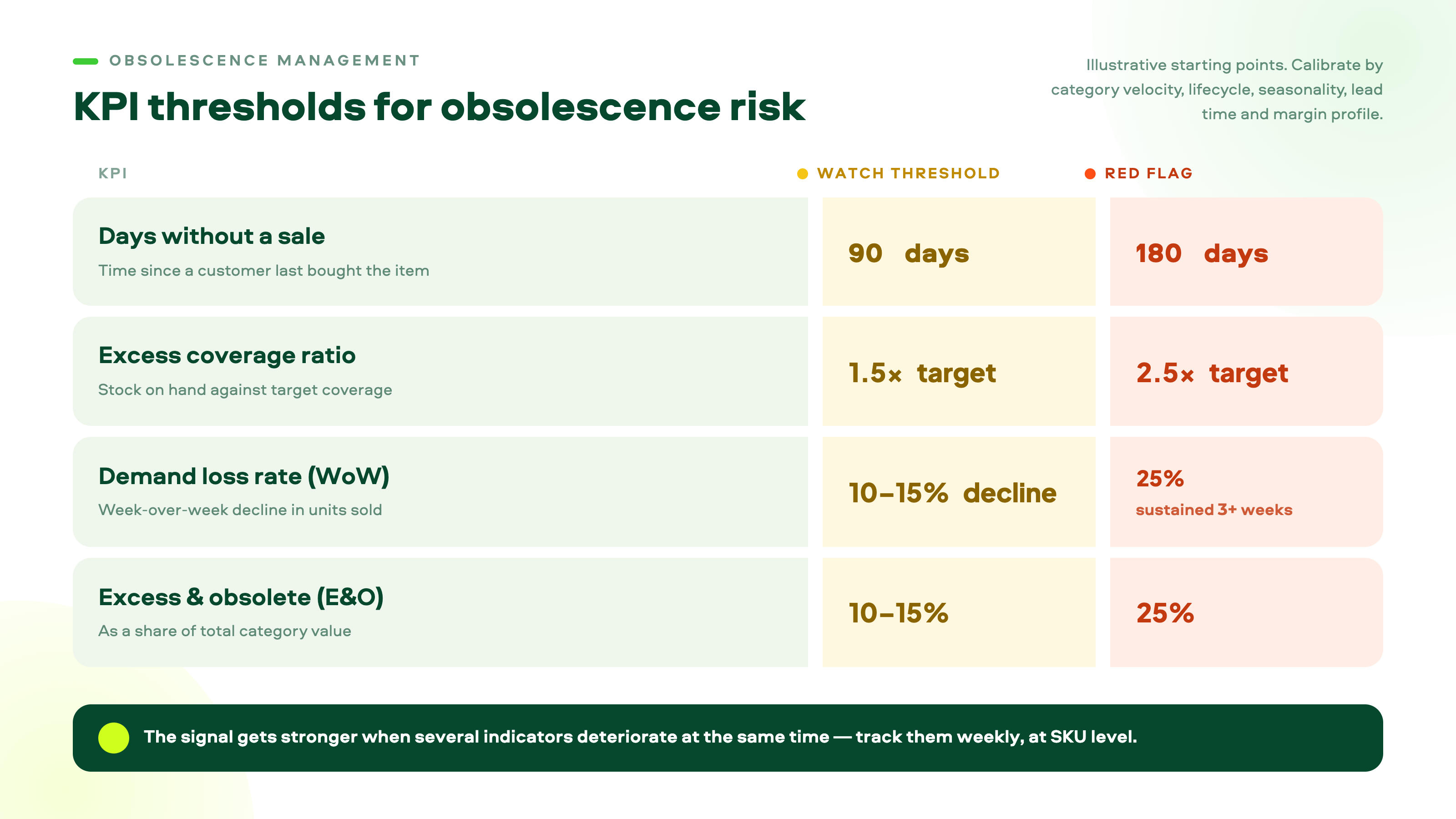
Used together, these indicators provide a practical early-warning framework for obsolescence risk. The thresholds below are illustrative starting points rather than universal benchmarks: retailers should calibrate them by category velocity, product lifecycle, seasonality, supplier lead time, and margin profile.
| Excess Inventory | Obsolete Inventory | |
|---|---|---|
| Demand | Present, just lower than stock on hand | Effectively zero |
| Root cause | Over-ordering, forecast miss, promo pull-forward | End of lifecycle, discontinued line, superseded SKU |
| Typical fix | Slow down replenishment and redistribute across stores | Markdown, liquidation channel, write-off |
| Financial treatment | Usually stays on the books at cost | Often needs a reserve or write-down |
| Time sensitivity | Moderate, normal sell-through will clear it | High, value keeps eroding the longer it sits |
The signal becomes more meaningful when several indicators deteriorate at the same time. For example, 180 days without a sale may be normal for a low-velocity specialty item but a serious warning for a fast-moving category; combined with rising excess coverage and declining demand, however, it becomes a much stronger case for intervention.
Obsolescence Risk Across the Product Lifecycle
The risk of obsolescence is not constant. It rises and falls with where a product sits in its lifecycle, and the procurement rules that make sense at one stage actively create risk at another.
Introduction Stage: Managing Risk When Data Is Scarce
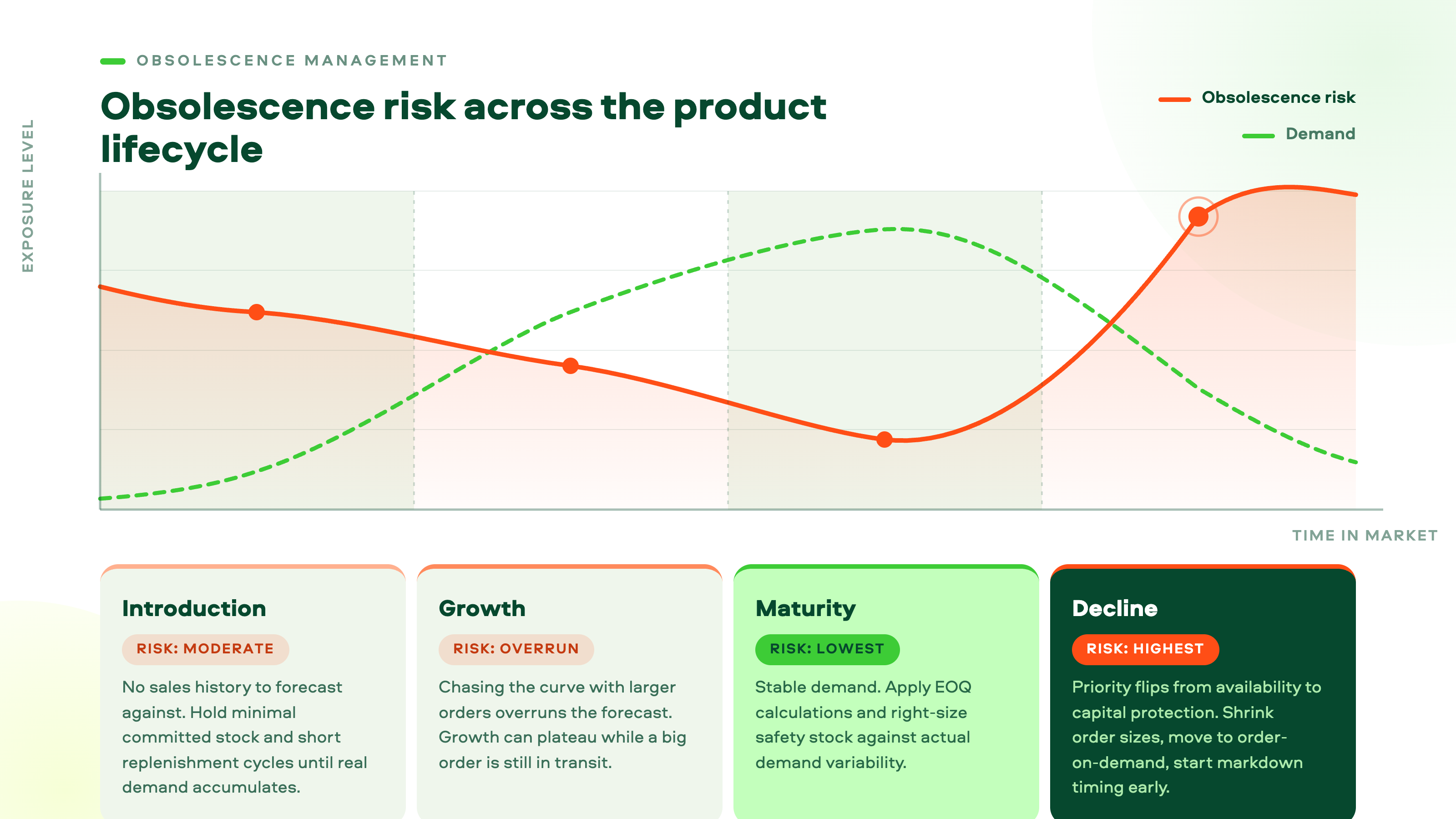
New items have no sales history to forecast against, so the safest posture is minimal committed stock and short replenishment cycles until real demand data accumulates. Ordering aggressively before proof of demand is one of the most common ways a product goes obsolete before it ever gets a fair chance on the shelf.
Growth Stage: Watching for Forecast Overrun
Once a product shows traction, the temptation is to chase the curve with larger orders. The risk here is overrunning the forecast on the way up, then discovering the growth trend has plateaued while a large order is already in transit.
Maturity Stage: Optimizing EOQ and Safety Stock
Stable, well-understood demand is where classic optimization tools do the most good. This is the stage to apply economic order quantity calculations and right-size safety stock against actual demand variability. Inventory control methods like EOQ and reorder point work best as the backbone of ordering decisions here.
Decline Stage: Slowing Procurement and Protecting Margin
As demand trends down, the priority flips from availability to capital protection. Order sizes should shrink, and order-on-demand should replace stock-and-forecast wherever supplier terms allow. The conversation with merchandising about markdown timing should start well before the shelf looks empty.
The retailers with the least obsolescence exposure treat this as a status change, not a judgment call made once a quarter. LEAFIO Assortment Performance's “Product Lifecycle” feature tracks SKUs through defined statuses, including a dedicated “passive status" for products being phased out. It automates the reordering, inventory, and merchandising rules tied to each stage. An SKU that moves into “passive status" stops generating standard replenishment orders automatically, instead of relying on a planner to remember to intervene manually across thousands of references.
Procurement Principles to Prevent Obsolescence
Obsolescence management in the supply chain starts at the purchase order, not at the markdown rack. Three procurement questions determine most of a retailer's obsolescence exposure before a single unit is ordered.
- What to stock against forecast versus what to manage on demand only.
- How much buffer to hold, given that buffer is what turns a demand miss into a pile of obsolete stock rather than a missed sale?
- And when to stop ordering entirely, which requires the discipline to treat a declining trend as a decision point rather than noise to wait out.
These three questions, asked consistently, are the obsolescence management best practices that separate categories with chronic write-offs from ones that don't have the problem.
Getting the third question right is usually the hardest. It means accepting a small risk of stockout on a declining item to avoid a much larger risk of write-off. Retailers that wait for absolute proof a product is dead before cutting orders are, by definition, waiting too long.
How to Manage and Liquidate Existing Obsolete Stock
Once stock is already obsolete, the goal shifts from prevention to recovery. This is where you manage obsolete inventory as dead stock management. Several channels exist, and using them in sequence generally recovers more value than jumping straight to the deepest markdown strategy available.
Markdown and Promotional Discounts
The most familiar lever and the right first move for stock that still has some retail appeal. Staged markdowns, starting shallow and deepening only if sell-through doesn't respond, protect margin better than an immediate deep cut.
Alternative Sales Channels (Outlet, B2B, Wholesale)
Outlet stores, off-price marketplaces, and B2B liquidation buyers will often take stock a regular shelf can't move at a price better than a straight write-off.
Bundling, Repackaging and Cross-Sell Tactics
Pairing a slow mover with a bestseller, or repackaging into a multi-pack, can move units without the price signal of a visible markdown. That matters for categories sensitive to perceived brand value.
Return-to-Vendor (RTV) Agreements
Where supplier contracts allow it, returning unsold stock shifts the loss upstream. This depends entirely on what was negotiated at the time of purchase. That is a good argument for building RTV terms into contracts before the obsolescence problem exists, not after.
Donation, Recycling and Responsible Disposal
For stock with no viable commercial path left, donation can generate a tax benefit and avoid disposal costs. Recycling limits the environmental footprint of items that would otherwise go to landfill.
Obsolete Inventory Accounting: Write-Offs and Provisions
The accounting side of obsolete stock management gets far less attention in most retail guides than it deserves, even though it directly affects reported margin.
Accounting treatment for obsolete inventory depends on the applicable reporting framework and inventory valuation method. Under IFRS, inventory is measured at the lower of cost and net realizable value (NRV), while US GAAP requirements vary depending on the inventory costing method used. When expected recoverable value falls below the carrying amount, retailers need to recognize the loss rather than leave inventory on the books at an overstated value.
For large assortments, retailers may use documented reserve or allowance methodologies to estimate expected losses from slow-moving and obsolete inventory. These estimates are typically informed by factors such as inventory age, recent sales activity, expected recoverability, markdown plans, and historical disposition patterns. The methodology should be applied consistently and reviewed as conditions change.
Whatever methodology finance applies, documentation matters. A consistent approach tied to defined aging, demand, and recoverability criteria is easier to support and audit than ad hoc write-down decisions made category by category.
Liquidation and accounting determine how much value a retailer can recover once inventory has already become obsolete. But by that point, most of the economic damage has already been done. The larger opportunity is upstream: detecting the combination of declining demand, excess coverage, and lifecycle change early enough to alter procurement and replenishment decisions before the stock requires a markdown, reserve, or write-off. This is where automation and AI change the economics of obsolescence management.
How AI Transforms Obsolescence Management
AI inventory management is where obsolescence prevention stops depending on any one planner's memory. The core challenge with obsolescence is scale. A single planner can watch a handful of SKUs closely, but not the demand trend, coverage ratio, and lifecycle stage of every SKU in a large assortment at once. That is exactly the gap that demand forecasting software and replenishment automation are built to close.
AI-Powered Demand Sensing and Trend Detection
Machine learning models can detect demand inflection points earlier than static forecasting methods by continuously incorporating recent demand signals and distinguishing persistent shifts from short-term noise. According to McKinsey, embedding AI in distribution and inventory operations can reduce inventory levels by 20 to 30 percent through capabilities such as dynamic segmentation and machine-learning-based forecasting. For obsolescence management, these capabilities are particularly valuable at the slow-moving and declining end of the assortment, where demand shifts can be difficult to capture with static forecasting and replenishment rules.
Gartner predicts 70% of large-scale organizations will adopt AI-based forecasting to predict future demand by 2030. Retailers still relying on static reorder rules for lifecycle-stage decisions are increasingly the exception, not the norm.
Automated Replenishment Adjustments by Lifecycle Stage
This is where lifecycle-aware automation earns its keep. Instead of a planner manually downgrading order frequency and quantity as an SKU ages, a system built around explicit lifecycle statuses adjusts the rules the moment status changes. That is the same shift described above for “Passive Status." The transition from active replenishment to wind-down happens the moment the data supports it, not at the next scheduled review.
Predictive Obsolescence Risk Alerts
Rather than waiting for an aging report to flag a problem after the fact, predictive models can score obsolescence risk at the SKU level before stock accumulates. The score blends demand trend, coverage, lifecycle stage, and category-level seasonality. A planner sees the risk rising while there is still time to cut an order, rather than after it has already landed.
MasterZoo, a European pet retail chain operating 200+ stores with over 6,000 active SKUs, struggled with a fixed clustering system. Outdated seasonal and promotional SKUs kept lingering outside active store assortments. After implementing LEAFIO Assortment Performance, MasterZoo cut out-of-matrix items by 25%, sped up matrix updates by 150%, and reduced manual assortment labor by roughly 50%. Planned SKU deactivation dates now let category managers retire outdated items before they turn into dead stock, instead of finding them during the next cycle count.
How LEAFIO AI Helps You Prevent Obsolete Inventory
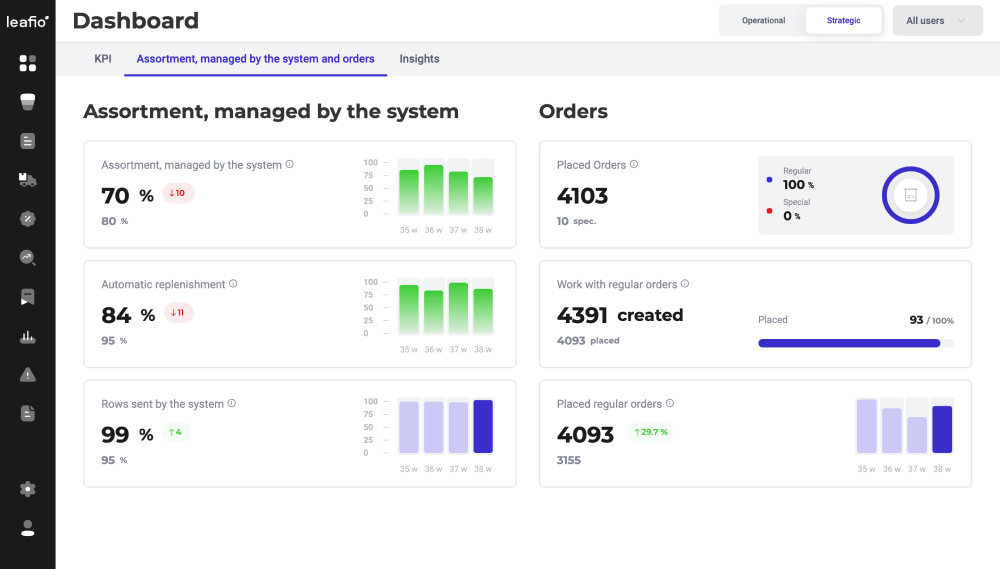
Preventing obsolescence at scale requires three things to happen continuously: detect the risk, decide how inventory policy should change, and act before more stock accumulates.
LEAFIO AI connects these steps in one planning process. It detects early warning signals such as declining demand, aging inventory, and excess coverage; translates lifecycle changes into appropriate inventory policies; and automatically adjusts replenishment as an SKU moves toward phase-out.
For discontinued items, the Product Lifecycle feature's “passive status” stops standard automated replenishment and applies the rules required to wind inventory down rather than continuing to build it. The result is a shift from discovering obsolete stock after the fact to managing obsolescence risk while there is still time to protect working capital and margin.
OMA, one of Eastern Europe's largest DIY retail chains with 38 sales facilities, was managing inventory manually across a min-max system. It didn't account for order packs, supplier minimums, or store-level safety stock. Within 12 weeks of rolling out LEAFIO Inventory Optimization on pilot product groups, overstock dropped by 10% while sales increased and missed sales fell in parallel. Over the following two years, inventory turnover improved 18%, or six days, and sales rose 32%.
If your assortment is carrying more slow movers than your last category review comfortably explained, a conversation about lifecycle-aware replenishment for your specific categories is a reasonable next step.
FAQ
What is the difference between excess and obsolete inventory?
Excess inventory still has demand behind it, just more stock than the current coverage period needs. Obsolete inventory has no meaningful demand left at all, usually because the product has reached the end of its lifecycle or been superseded. Excess is a timing problem; obsolete is a value problem.
What are the main causes of inventory obsolescence?
The most common causes are inaccurate demand forecasting, lifecycle stages that don't get reflected in ordering rules, supplier MOQ and lead time constraints, and shifting consumer preferences. Promotional misalignment and static safety stock that doesn't adjust as demand declines add to the problem.
How do you calculate obsolescence risk by product lifecycle stage?
Risk generally tracks lifecycle position. Introduction carries forecasting uncertainty, and growth carries overrun risk if orders chase a curve that plateaus. Maturity is the lowest-risk stage for well-optimized SKUs, while decline carries the highest risk if procurement lags falling demand. Segmenting the assortment by lifecycle stage, alongside ABC/XYZ value and variability, gives a practical risk score.
How can retailers reduce excess and obsolete inventory?
Knowing how to reduce excess and obsolete inventory starts with tighter demand forecasts and dynamic safety stock instead of static buffers. Monitoring days without a sale and excess coverage weekly, rather than quarterly, and automating replenishment rule changes by lifecycle stage both reduce the rate at which new obsolescence accumulates.
How do you liquidate obsolete inventory?
Common channels, roughly in order of value recovered, are staged markdowns, bundling or cross-sell tactics, and outlet, off-price, or B2B liquidation channels. Return-to-vendor agreements work where contract terms allow, with donation or recycling as a last resort.
What KPIs matter most for obsolescence management?
Days without a sale, excess coverage ratio against target coverage periods, inventory aging distribution, and week-over-week demand loss rate matter most. Together with excess-and-obsolete value as a percentage of category value, they give an early warning that a single turnover metric can't.
How AI helps prevent inventory obsolescence
AI improves demand sensing so declining trends get caught earlier, and it automates replenishment rule changes as a product's lifecycle stage shifts. It also scores obsolescence risk at the SKU level before stock accumulates, rather than after an aging report flags it.
How should obsolete inventory be treated for accounting purposes?
Accounting treatment depends on the applicable reporting framework and inventory valuation method. Under IFRS, inventory is measured at the lower of cost and net realizable value, while US GAAP requirements vary by costing method. Retailers may also use documented reserves or allowances for expected losses from slow-moving and obsolete inventory, based on factors such as aging, recent sales, recoverability, and markdown plans.


Have a question?

Kristi Miller
Retail optimization expert