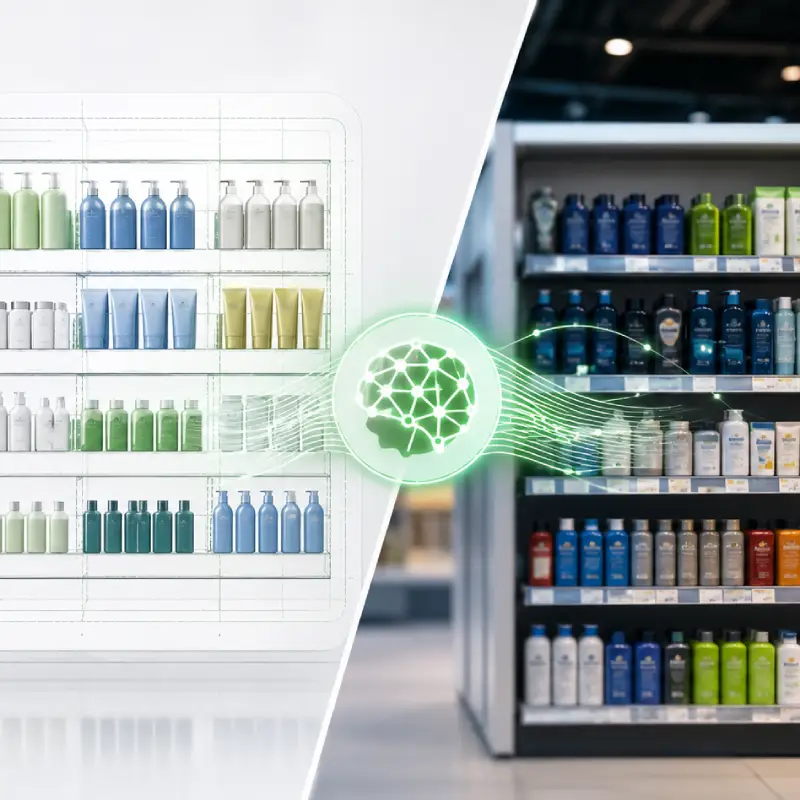


Walk into any store the week after a category reset and you will usually find two different shelves. One exists in the planning software, dimensioned to the centimeter, signed off by category management. The other exists in the actual store, rearranged by three different associates who never saw the plan. A vendor added an endcap. A Tuesday truck arrived short two SKUs. The gap between those two shelves is where a meaningful share of retail revenue quietly disappears.
That gap has a name on each side. The plan is the planogram. The shelf as it actually sits, right now, in front of a shopper, is the realogram. Planogram or realogram, whichever term shows up in your team's vocabulary, the two are meant to describe the same shelf at different points in time. The difference between realogram and planogram data is exactly where retail execution problems hide. Confusing the two, or worse, assuming planogram and realogram data always match, is one of the more expensive mistakes a merchandising team can make.
What is a Planogram?
A planogram is a schematic that specifies exactly where each product belongs on a fixture: which shelf, how many facings, and what order. It often includes pricing or promotional signage too. For a deeper look at how retail planograms get built across a chain, category managers start from sales velocity, margin targets, supplier agreements, and shopper behavior data, then distribute the result to stores as the standard every location is expected to follow.
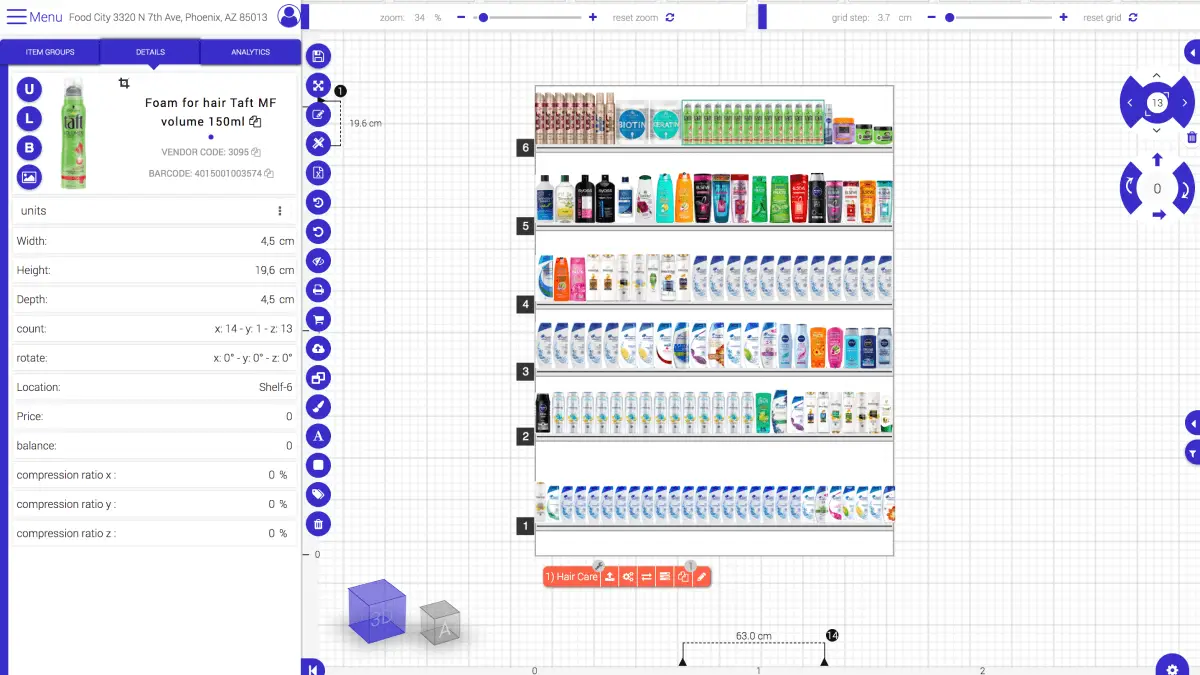
A planogram's real job is product placement and on-shelf availability decided in advance, down to two details that get contested most often during execution:
- Eye-level placement for priority items
- Promotional and seasonal display zones
What is a Realogram?
A realogram is the opposite of a plan. It is a record of the shelf as it exists right now, in a specific store, with all the accumulated drift of daily operations baked in. Where a planogram is designed, a realogram is captured, usually through a photo, a scan, or an AI-driven image recognition pass over the shelf.
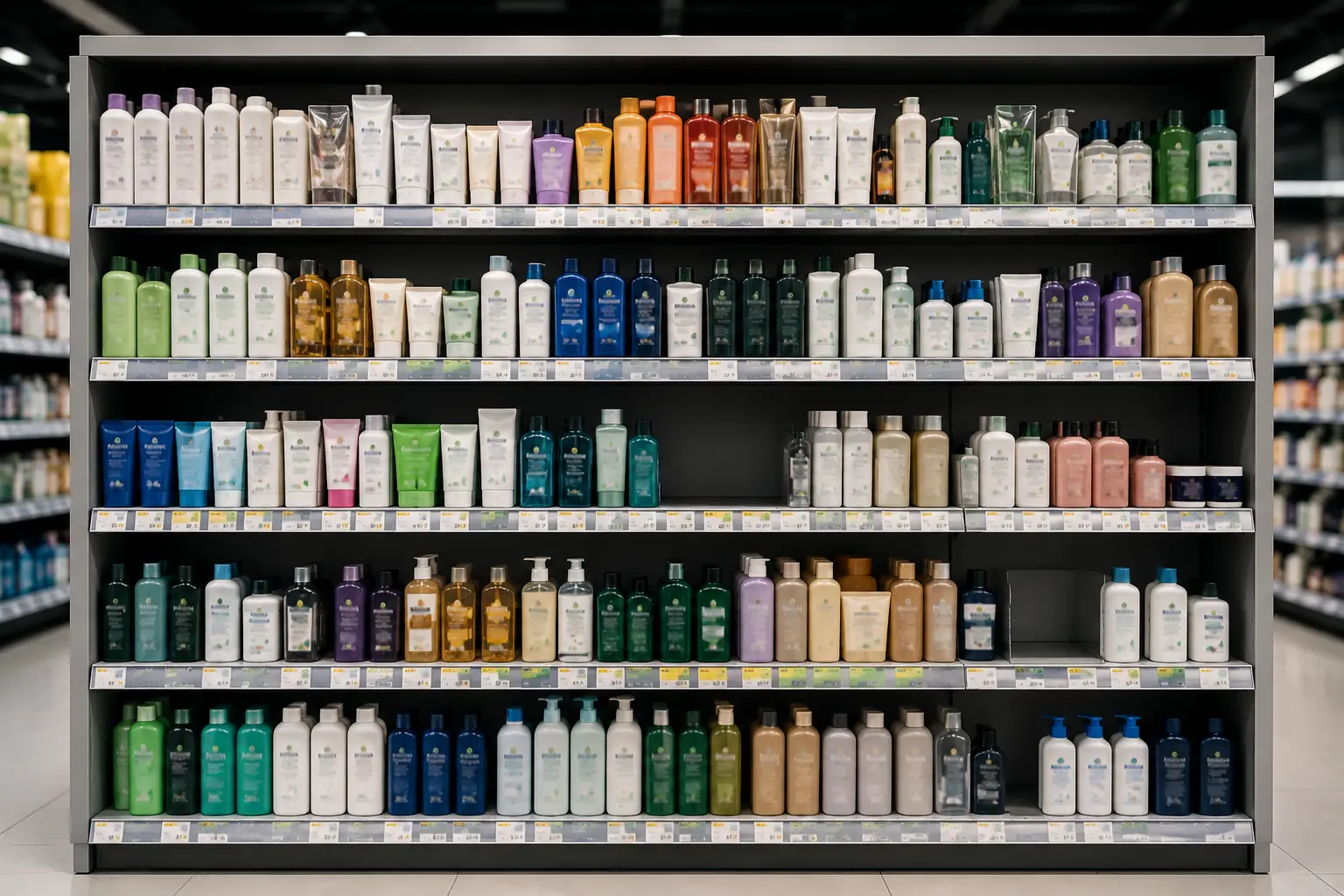
A realogram will show you the version of the shelf a shopper actually sees, including the parts nobody planned for. A product shifted left when someone grabbed the last unit behind it. A shelf facing got swapped by a merchandiser rushing to finish a route. An out-of-stock gap has gone unreported for days.
A realogram also catches what a quick glance at the shelf won't: unauthorized additions like a vendor-placed secondary display. It carries a timestamp and store identifier too, so drift gets tracked over time rather than caught once and forgotten.
On its own, a realogram is just a snapshot. Its value comes from what happens next: comparing it against the planogram to see where reality has diverged from the plan.
Planogram vs. Realogram: Key Differences at a Glance
| Planogram | Realogram | |
|---|---|---|
| Purpose | Defines the ideal shelf layout | Captures the actual shelf layout |
| Created by | Category managers, merchandising teams | Store associates, field reps, or AI image recognition |
| When it's used | Before a reset, launch, or seasonal change | After execution, to verify compliance |
| What it measures | Intended facings, adjacency, placement | Actual facings, gaps, misplacement |
| Format | Design file, diagram, or planning software output | Photo, scan, or digitized shelf image |
| Changes over time? | Static until the next revision | Changes constantly as stores operate |
The two documents are meant to converge. In practice, realogram and planogram differences show up constantly without deliberate effort to close them, which is exactly why the gap between them deserves its own name. Retailers that treat planogram compliance retail-wide as a single ongoing process, rather than a one-time reset event, are the ones that actually keep the two in sync.
What is the Execution Gap, and Why Does It Happen?
The execution gap is simply the distance between what the planogram says should be on the shelf and what the realogram shows is actually there. Every retailer has one. The question is how large it is and how quickly anyone finds out.
Common Causes of Planogram Non-Compliance
Non-compliance rarely comes from one dramatic failure. It accumulates from small, ordinary events that happen constantly across hundreds of stores:
- Understaffed resets. A store reset built for a two-hour window gets compressed into forty-five minutes on a busy Saturday, and shortcuts get taken, including on eye-level shelf placement for priority SKUs.
- Supplier interference. Field merchandising reps for CPG vendors adjust facings or add secondary displays without informing the retailer's merchandising team.
- Product substitutions. A distribution center runs short on an item, a store manager fills the gap with whatever is available, and nobody updates the plan.
- Fast-moving assortment changes. Perishables, seasonal SKUs, and promotional items rotate faster than most audit cycles can keep up with.
- Multiple store formats. A single planogram rarely fits every fixture variation across a chain, so store teams improvise to make it work locally.
- No feedback loop. Associates who deviate from a planogram rarely hear back about it, so there is no correction mechanism between resets.
The supplier-interference item on that list is solvable without shutting vendors out entirely. LEAFIO added a dedicated supplier role to Shelf Efficiency in 2026 that limits a vendor's rep to their own SKUs and a running photo log. That lets a brand confirm its own shelf placement without ever seeing a competitor's planogram.
An out-of-stock (OOS) gap is usually the visible tip of a bigger merchandising compliance problem. If one facing drifted, the whole row probably did too, which is exactly why in-store execution needs continuous checking rather than one-off spot fixes.
None of these causes are unusual or negligent. They are what happens by default in any retail environment with real people, real trucks, and real customers. That is exactly why closing the gap requires a system rather than good intentions.
The Business Cost of the Execution Gap
The dollar figures involved are large enough that "we'll catch it at the next audit" stops being an acceptable answer. Globally, out-of-stocks and overstocks (inventory distortion, closely tied to poor shelf execution) cost retailers an estimated $1.77 trillion in 2023. Out-of-stocks alone accounted for roughly $1.2 trillion of that figure, according to IHL Group. Not every dollar in that number traces back to a shelf that drifted from its plan, but a meaningful share does. A product sitting behind another product, or missing from its assigned facing entirely, is invisible to a shopper regardless of what the inventory system says is in stock.
The cost also shows up as lost supplier trust. CPG vendors negotiate shelf space and pay for premium positioning under the assumption that the agreed planogram will actually be executed. When it isn't, brands lose visibility they paid for, and retailers risk the relationship at renewal time.
There is a reason CPG leaders are moving fast on this. A 2024 McKinsey survey found 71% of CPG leaders had adopted AI in at least one business function, up from just 42% a year earlier. Shelf execution is one of the functions where that investment shows up first. It is one of the few places brand and retailer incentives point in exactly the same direction.
Why Traditional Shelf Audits Can't Close the Gap
If the execution gap is this expensive, the obvious fix looks like more auditing. Send someone to the store more often, take more photos, and fill in more spreadsheets. In practice, this approach runs into two structural limits that no amount of extra effort solves.
Manual Audits: Time-Consuming and Prone to Error
A human auditor walking a category with a clipboard, or more realistically a phone and a spreadsheet app, has to count facings, cross-reference a planogram, and note every discrepancy by hand. For a single mid-size category, that can take twenty to thirty minutes per store. Multiply that across a chain of two hundred or five hundred stores, and the labor cost alone becomes prohibitive. That is exactly why most retailers only audit a sample of stores, and only occasionally.
Manual counting also has its own error rate, and paper-based reporting means results reach headquarters days or weeks after the shelf has already changed again.
The Frequency Problem: Stores Change Faster Than Audits Run
Even a well-run manual audit program typically checks a given planogram once a month or once a quarter. Shelves do not wait that long to drift. A candy aisle can be substantially rearranged within a single week of restocking. A promotional display can go up and come down entirely between two scheduled audit visits.
This creates a strange situation. A retailer's compliance report can say a category "passed" its last audit, while the shelf, in the weeks since, has quietly drifted well away from plan. The report is accurate for the day it was taken and largely meaningless for every other day. Closing that frequency gap without an unaffordable increase in headcount is the real problem AI-powered shelf monitoring is built to solve.
How AI Closes the Planogram-Realogram Gap
AI does not remove the need for planograms or realograms. It changes how fast a realogram can be produced and how quickly the comparison against the planogram gets acted on.
Realogram capture built into execution, not bolted on as an audit
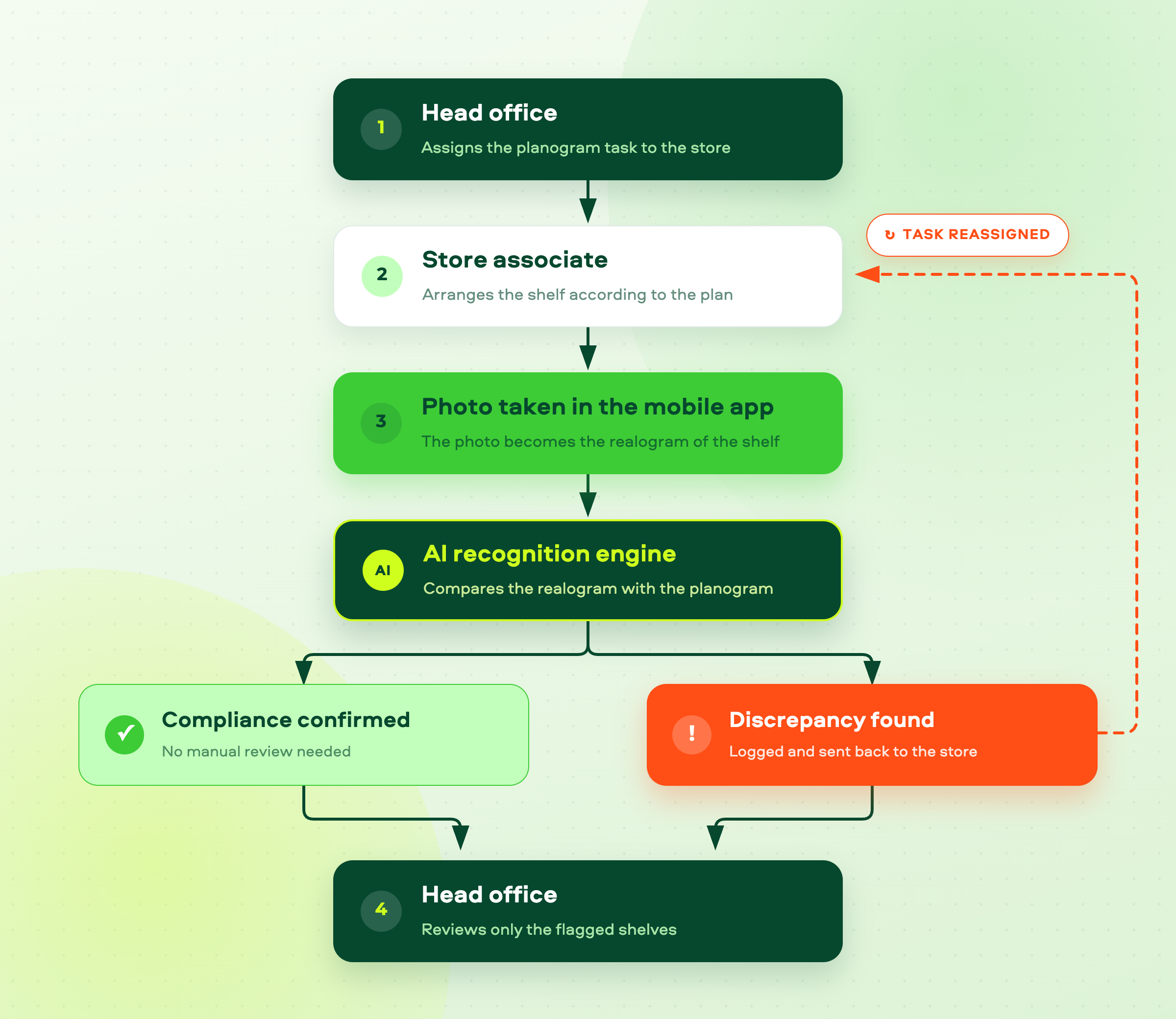
The task. The associate doesn't set out to audit the shelf. They open the merchandising app because a task arrived from the head office, and the task carries its own context: which planogram, which fixture, and which zone of the floor. Color coding shows what to change (green to add, red to remove), and a QR scan jumps straight to the fixture in question.
The photo. They execute the layout, photograph the finished shelf, and attach that photo to close the task. That photo is the realogram.
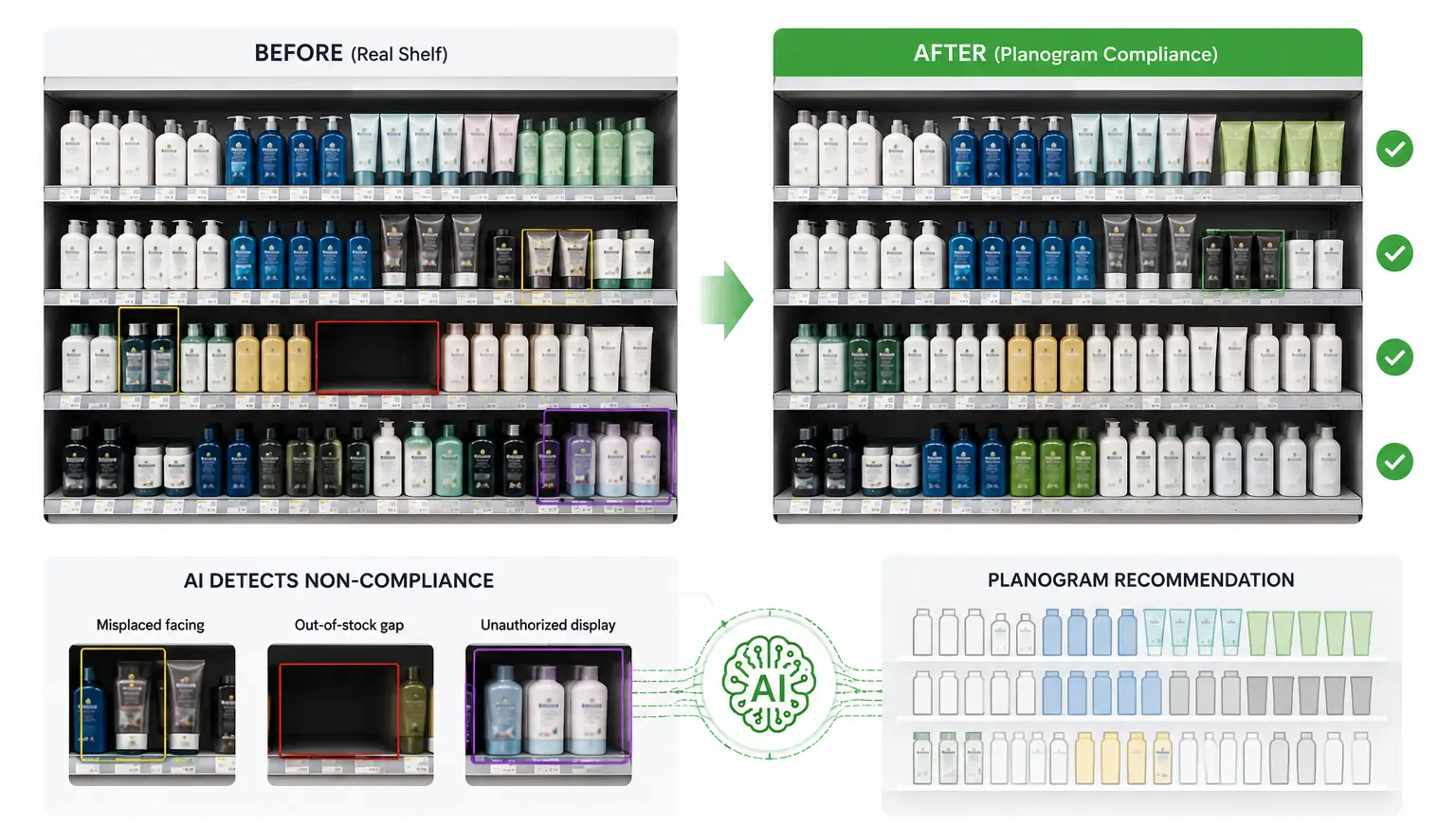
The check. The planogram image recognition engine takes it from there, comparing the capture against the approved planogram in seconds. It returns an accuracy score and marks the specific failures on the image itself:
- A wrong product
- An incorrect facing
- A missing item
- A shelf gap
Non-compliant tasks are reopened and reassigned automatically, so the fix lands back on the phone of the person already standing at that fixture.
The cause. The associate also records why the standard wasn't met:
- Stock never arrived
- On-hand quantity was too low
- The price tag was wrong
That turns a failed check into a diagnosable cause instead of another photo in a group chat.
The payoff. The head office never has to open most of these images. It gets a compliance score per store and a floor-plan overlay marking every problem location and reviews only the shelves where the system actually found something. That is the difference between a chain photographing its shelves and a chain that knows which photographs matter.
A team building this kind of system today does not start from scratch. The underlying detection models have matured quickly. A December 2025 study in Scientific Reports describing a computer vision system deployed across more than 7,000 7-Eleven stores in Taiwan reported shelf-detection precision above 99%, roughly the accuracy ceiling a well-trained store associate would need to hit doing the same count by hand, minus the fatigue.
Some platforms take this further. They estimate lost-sales impact per store per day and track shelf share by SKU over time, so a compliance score becomes a dollar figure a category manager can act on, not just a flag.
Two outcomes: confirmed compliance, or a task that finds its way back
From here the result branches. If the shelf matches the plan, it simply closes clean; one of the shelves headquarters never needs to open.
If a discrepancy is found, the reassigned task comes with a specific fix: move this SKU two facings left, restock this gap, and remove this unauthorized display. LEAFIO reports up to 80% less labor cost on execution and compliance tasks for retailers using this loop. Either way, headquarters gets a real-time view of compliance and revenue per shelf across every location, instead of a monthly snapshot of a handful of stores.
Business Benefits of AI-Powered Planogram Compliance
Three effects compound once compliance checks run daily instead of monthly:
- Revenue. A misplaced or out-of-stock product stops costing sales the same day it's caught, rather than weeks later.
- Associate time. Automated scoring replaces manual counting and spreadsheet reconciliation, freeing associates and district managers for customer-facing work.
- Visibility. Headquarters sees compliance across every store, not an extrapolation from the twenty locations someone had time to visit last quarter.
How LEAFIO AI Bridges the Planogram-Realogram Gap
LEAFIO Shelf Efficiency builds the planogram side of this equation with AI-driven planogram software that generates store-specific layouts from real sales data. It then closes the loop with photo-based compliance verification on the realogram side. The plan a category manager approves and the shelf a shopper actually sees stay in sync.
The results show up in real deployments. Eco Shop, a 250-store household goods retailer in Malaysia, was managing its entire planogram library through Excel spreadsheets. There was no direct link between the merchandising team and the stores executing the plans. After moving to LEAFIO Shelf Efficiency, a pilot across three categories delivered sales-per-meter gains of up to 32.4%. The first new store was built entirely on LEAFIO-generated planograms from day one.
Plum Market, a top-10 US regional grocer with more than 25 locations across the Midwest, faced a different problem: new store openings that took two weeks to fully stock and merchandise. After automating planogram generation and rollout with LEAFIO AI, the company cut store opening time from 14 days to 4.5 days. Sales grew 11.4% and profit increased 12.3% over two years.
If you manage merchandising across more than a handful of locations, the practical question is not whether a planogram-realogram gap exists. It does. The real question is how quickly you find out about it and how directly that finding turns into a corrected shelf. That is the real difference between retail planogram software built for drawing shelves and retail AI built for closing the loop between plan and execution.
FAQ
What is the difference between a planogram and a realogram?
A planogram is the intended shelf layout designed by category management, specifying facings, placement, and adjacency. A realogram is a captured record of the actual shelf as it exists right now in a specific store. The planogram is a plan; the realogram is a snapshot of reality.
How does AI check planogram compliance?
AI image recognition analyzes a photo of the shelf, identifies each product and its position, and compares that data against the approved planogram. It flags missing, misplaced, or incorrect products and produces a compliance score within seconds, instead of requiring a manual facing count.
Why does planogram compliance matter for retail sales?
A product that is out of position or out of stock is effectively invisible to a shopper, no matter what the plan intended. Poor execution directly erodes the sales and category performance the original planogram was designed to capture. That is part of why inventory distortion linked to shelf issues runs into the trillions of dollars globally each year.
How do you align a realogram with a planogram?
Alignment starts by capturing an accurate realogram, whether through manual audit or AI image recognition, then comparing it facing by facing against the planogram to identify deviations. The corrective step, routing specific fixes back to store associates, is what actually closes the gap rather than just documenting it.
What causes planogram non-compliance in stores?
Common causes include rushed or understaffed resets, supplier reps adjusting displays without informing the retailer, product substitutions during stockouts, fast-moving seasonal or promotional assortments, and store formats that do not perfectly match the planned fixture dimensions.
How does image recognition improve shelf execution?
Image recognition turns realogram creation from a slow, error-prone manual count into something that can happen daily across every store without added headcount, which closes the detection-frequency gap that made traditional audits unreliable.
What is a realogram shelf audit?
A realogram shelf audit is the process of photographing or scanning a shelf to capture its current state, then comparing that capture against the approved planogram to measure compliance. Modern versions of this audit use AI image recognition instead of manual counting.
How often should planogram compliance be checked?
Manual audits typically run monthly or quarterly at best, which leaves long windows where a shelf can drift unnoticed. AI-powered compliance checks can run daily or even continuously, since a photo takes seconds and the comparison happens automatically.


Have a question?

Jack Larson
Retail Optimization Expert