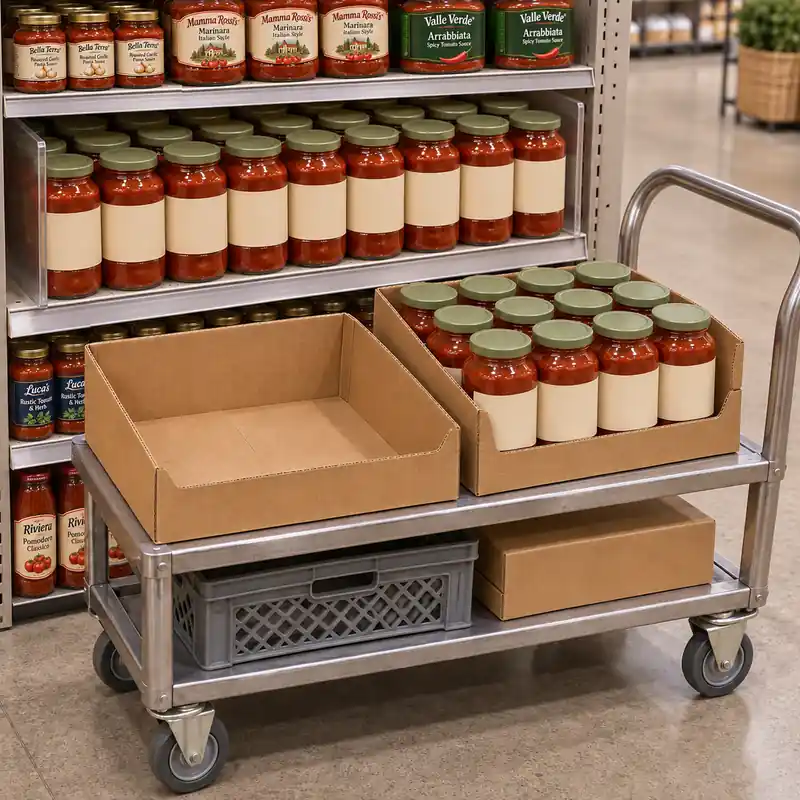


Take a store that sells six jars of pasta sauce a day, with a delivery every three days. The shelf holds 18 jars. The next delivery brings 24 because the order rounds up to full cases, and with six still on the shelf, 12 go to the backroom.
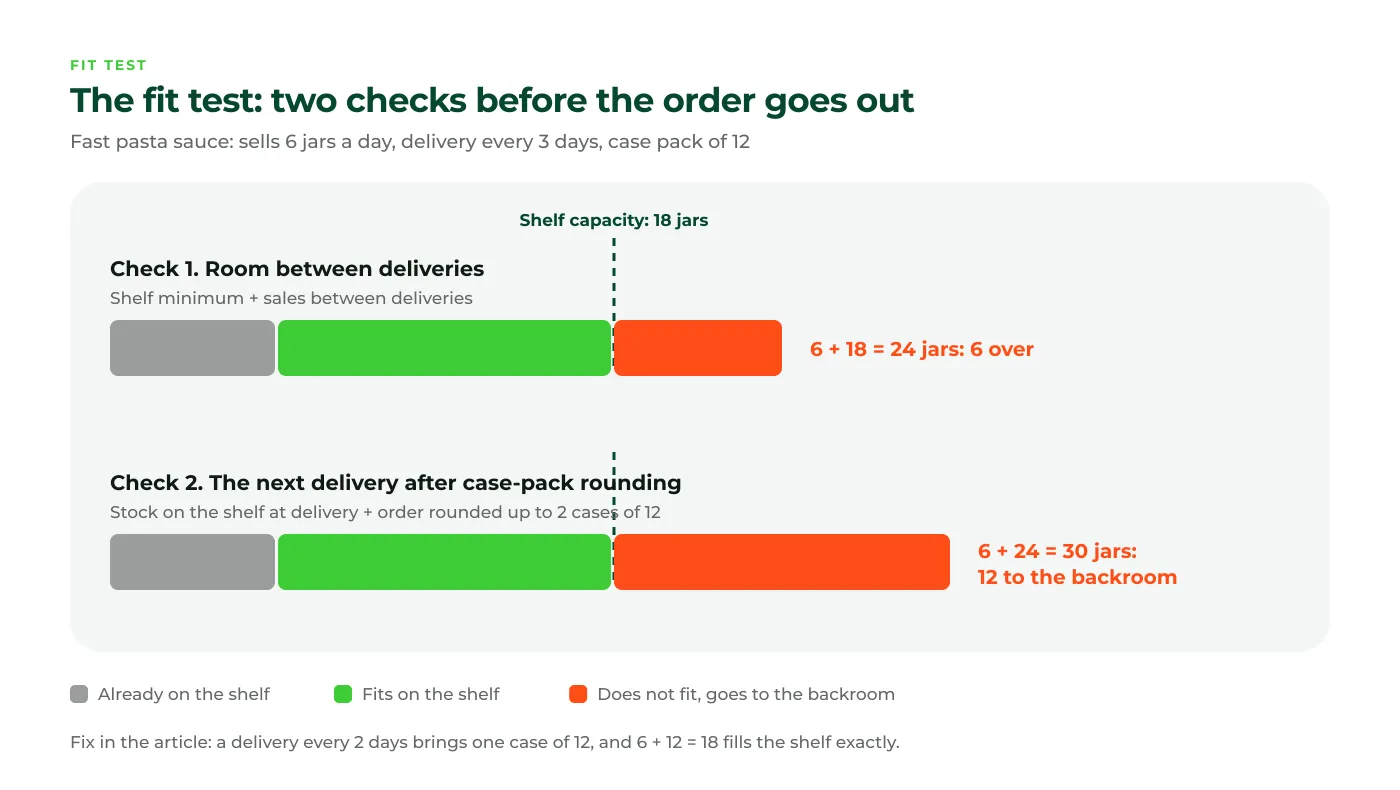
An order fits the shelf when it passes two checks before it goes out. First, shelf capacity covers the shelf minimum plus sales between deliveries. Second, the next delivery still fits once the order is rounded up to full cases. Overflowing backrooms and half-empty shelves usually start when one of the inputs behind those checks changes and the others stay put. This guide calls the two checks together the fit test and walks through it in six steps, with two SKUs worked out in full.
The backroom fills up when one number changes and the others do not
Shelf capacity and order size are set by different teams in most retail chains. The category manager decides facings in the planogram. Replenishment runs on sales, delivery days and case packs. Each side can be right on its own terms, and the two numbers still never meet.
Fast items overflow and slow items look half-empty
Picture a planner on a Monday morning. The overstock report flags the pasta sauce, so she cuts the next order. By Thursday the shelf has gaps. The "overstock" was a half-opened case on a backroom pallet, and nobody had brought it out.
What happens to the stock itself is dull and expensive. Cases that do not fit go to the back, get moved twice and sometimes get damaged on the way. The system counts them as available, so the record shows plenty while the shelf shows an out-of-stock.
Slow items fail the other way. The order matches sales, yet the shelf looks half-empty. Shoppers can read the gap as a product the store has stopped carrying, even though the item is in stock and counts toward on-shelf availability.
IHL Group's 2026 Inventory Distortion Study puts the cost of out-of-stocks and overstocks at $1.7 trillion a year, or 6.2% of global retail sales.
The fit test starts from four numbers per SKU and store
The fit test starts from four numbers per SKU and store: shelf capacity, the shelf minimum, sales between deliveries and the case pack. Most chains already hold all four. They just sit in different systems, owned by different people.
Step 1: Take shelf capacity from the published planogram
Shelf capacity is the number of units the shelf holds for one SKU: facings across, times units deep, times units high. Take it from the planogram the store actually runs. Last season's version, or one still in draft, gives a number the store cannot use.
Check product dimensions while you are there. If the item master says a jar is 7 cm deep and it is really 9, the planogram promises units that never fit.
Step 2: Set the shelf minimum and read it in days of sales
The shelf minimum, often called presentation stock, is the quantity that stays on the shelf so it never looks empty. Many chains derive it from facings, for example two units behind every facing.
Then convert it into days of sales. Two units behind each of three facings is six jars, one day of sales for a fast item. The same rule on a slow item can mean two weeks of stock that exists mostly for looks.
Step 3: Check that the shelf has room between deliveries
The first check is plain arithmetic. When a delivery arrives, the shelf should still hold its minimum, and the delivery should cover sales until the next one arrives. So shelf capacity has to be at least the shelf minimum plus sales between deliveries.
Use the time between deliveries here, not the ordering schedule. A store can order on Monday for a Wednesday delivery, and the two calendars do not always match.
If the shelf comes up short, it cannot hold enough stock to cover sales between deliveries and keep its minimum. Where a store keeps safety stock on the shelf as well, it belongs in the same sum.
Step 4: Check that the next delivery fits after case-pack rounding
The second check looks at the actual delivery and needs one more figure: the stock you expect on the shelf when the truck arrives. That stock, plus incoming units after rounding up to full cases, has to fit within shelf capacity. An order for 18 units in cases of 12 becomes 24, and the six extra units need somewhere to go.
Count the backroom too. Subtract any backroom stock available for the shelf when you work out how many units to order. Then round to full cases and check the result against the shelf space you expect when the delivery arrives. Skip the backroom, and an order that rounds up every time keeps adding to the pile.
Grocery has a long-standing heuristic for this. The Food Marketing Institute recommends the pack-and-a-half rule: shelf space for an SKU should hold at least one and a half case packs (Journal of Business Logistics). Treat it as a floor. It weighs the case pack against the shelf but ignores how fast the item sells and how often it arrives.
Step 5: Change the number that is out of line
Four levers can close the gap, and each one has a cost. Pick the cheapest for this item and this store.
More facings means taking space from a neighbor, so it is a shelf space decision as much as a stock one. More frequent deliveries cost transport and store labor. A smaller case pack needs a supplier who agrees to it. A lower shelf minimum is the cheapest lever and the most abused one, because it is easy to keep cutting until the shelf looks bare.
Step 6: Run the test again when the planogram changes
Every reset, new listing or delisting changes shelf capacity for the items around it. An order built on last month's facings can start overflowing the day the new planogram goes live. Rerun the test for every SKU that gained or lost space, before its next order goes out.
Two sauces on one shelf go wrong in opposite directions
The fast pasta sauce from the opening and a slow specialty sauce two bays down show two ways the shelf and the order drift apart. Here are their numbers before any fix.
| Fast sauce | Slow sauce | |
|---|---|---|
| Sales per day | 6 units | 0.5 units |
| Time between deliveries | 3 days | 7 days |
| Facings × depth | 3 × 6 | 4 × 5 |
| Shelf capacity | 18 units | 20 units |
| Shelf minimum | 6 units (1 day of sales) | 8 units (16 days of sales) |
| Sales between deliveries | 18 units | 3.5 units |
| Case pack | 12 units | 6 units |
The fast sauce passes the pack-and-a-half rule and still overflows
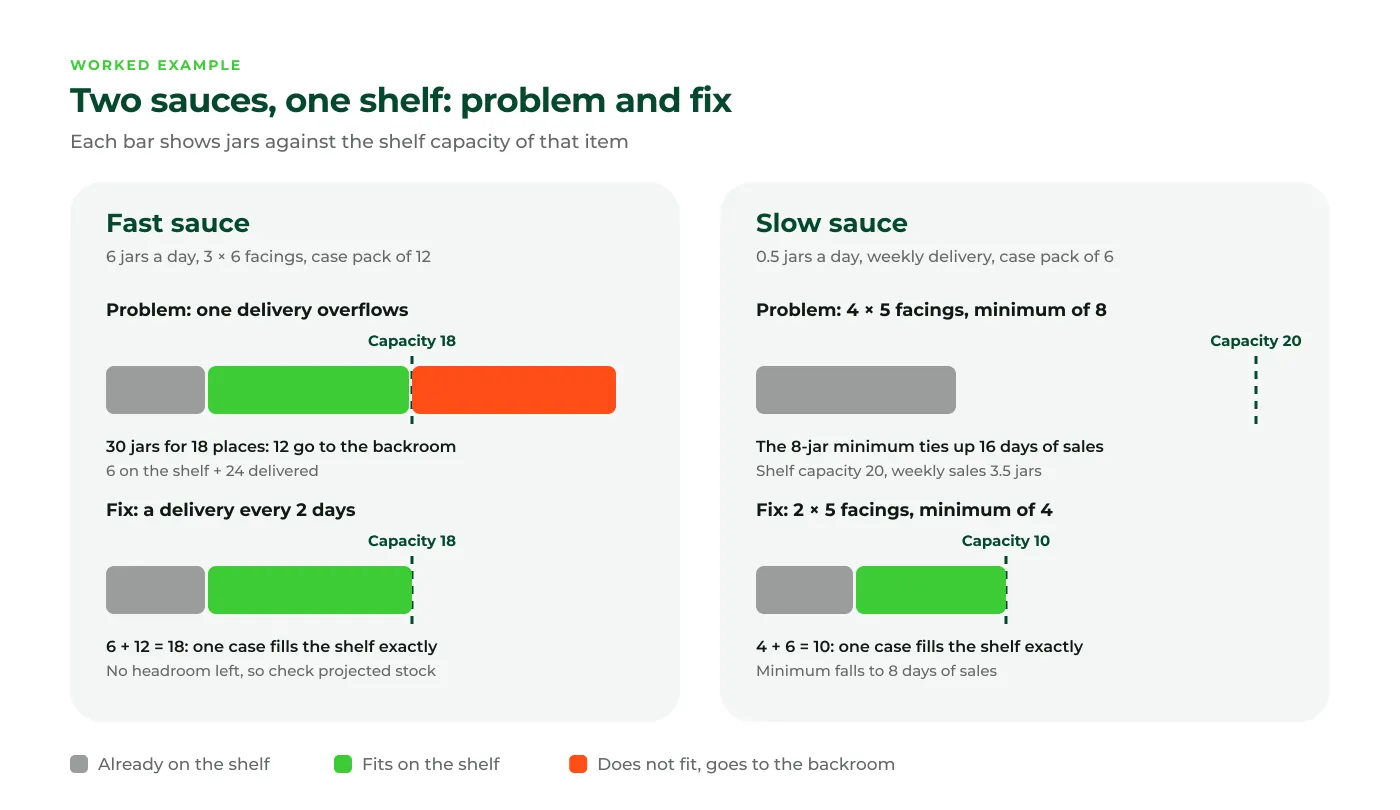
The fast sauce fails the first check before the case pack even enters. A shelf minimum of 6 plus 18 jars of sales between deliveries needs room for 24, and the shelf holds 18. The second check makes it worse. The 18-jar order rounds up to two cases, and with 6 jars still on the shelf, the store has 30 jars for 18 places. On that delivery, 12 jars go to the backroom. Those 12 jars should shrink the next order, or the pile grows with every delivery.
Note that this shelf passes the pack-and-a-half rule (1.5 × 12 = 18). It overflows anyway, because the rule never asks how fast the sauce sells.
The fix here is delivery frequency. With a delivery every two days, sales between deliveries drop to 12 jars, exactly one case. The shelf takes 6 plus 12, which is 18. There is no headroom left, so a slow day before a delivery can still leave a few jars in the back.
The slow sauce fits the shelf but ties up 16 days of stock
The slow sauce passes the first check easily. A shelf minimum of 8 plus 3.5 jars of weekly sales needs room for 11.5, and the shelf holds 20. The problem is how much stock the display requires. Its eight-jar shelf minimum ties up 16 days of sales.
Cutting the minimum without touching the facings trades one problem for another. Four facings with a few jars behind them look like a line the store is about to drop.
Here the fix is facings. At 2 facings × 5 deep, shelf capacity is 10 and the shelf minimum falls to 4 jars, or 8 days of sales. If four jars are expected to remain when the next delivery arrives, one case of 6 fills the shelf exactly. With weekly deliveries, the case still forces a choice. Ten jars minus a week of sales leaves 6.5, too many for another case. Skip that delivery, and a week later the shelf holds 3 jars, below its minimum. So check projected stock before every delivery instead of following a fixed rule. The two freed facings can go to an item that sells faster.
Backroom stock is not always an ordering mistake
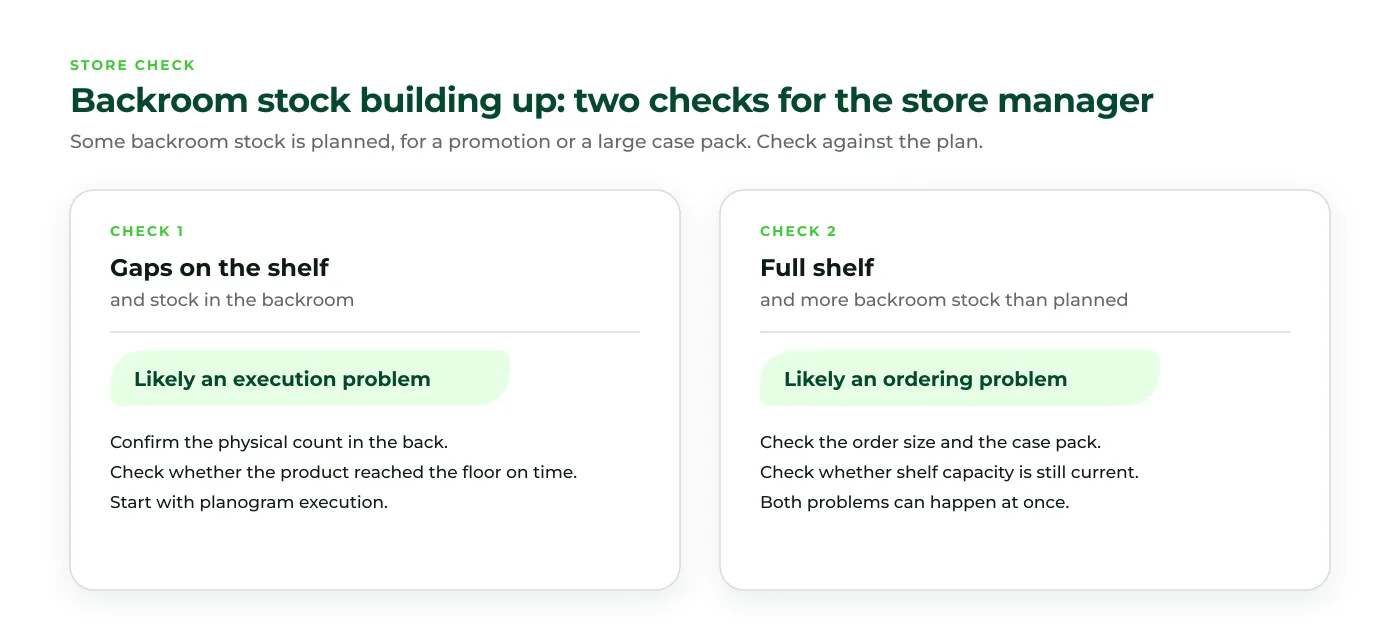
A full backroom can come from the order, from shelf work or from both at once. Some backroom stock is planned, too, for a promotion or a large case pack. A store manager can sort the worst items in a few minutes with two checks.
- Gaps on the shelf, stock in the backroom: confirm the physical count in the back, then check whether the product reached the floor on time. That is an execution problem, and planogram execution is where the fix starts.
- Full shelf, stock in the backroom: compare what sits in the back with the stock planned there. If it regularly exceeds the plan after deliveries, check the order size, the case pack and whether shelf capacity is still current.
Getting the diagnosis right decides who acts. Cutting orders to solve an execution problem creates exactly the stockout the planner was trying to prevent. And pushing stores to work harder on an order that cannot fit wastes labor on a number that was wrong at the source.
LEAFIO AI connects the planogram to the store order
LEAFIO Inventory Optimization can draw on facings and shelf capacity from the published planogram when retailers connect it with LEAFIO Shelf Efficiency. Both are modules of the LEAFIO AI Retail Platform, and each can also run on its own. With the two connected, the replenishment model uses facings and capacity in store orders and the shelf minimum. The order then reflects the shelf the store actually runs.
The machine-learning forecast behind each order knows demand but not the fixture, and shelf capacity fills that gap. Planners also see the shelf minimum in days of sales. A slow item's "three rows on the shelf" then shows up as the two weeks of stock it really is.
VIADA Baltija, a network of 93 fuel stations in Latvia, sets the shelf minimum once, on the planogram in LEAFIO Shelf Efficiency, and replenishment in LEAFIO Inventory Optimization picks it up automatically. All 93 stations moved to automatic orders, with overstock down 35%, lost sales down 29% and availability up 17%. The same project introduced standard planograms and replaced ordering by station managers, so these results belong to both modules and the process change around them.
Changing facings or delivery days is still a commercial call that involves the category team and the supplier. What the shared data changes is how quickly everyone can see which of the four numbers is out of line.
The fit test does not pay off on every shelf
The fit test assumes a stable home shelf, and some shelves are anything but stable. Promotional displays, end caps and second placements have their own capacity, which changes with every campaign. Test only the home shelf, and a planned promo delivery will look like overflow.
Large case packs on slow items are another exception. If a supplier ships only in cases of 24 and the item sells two a week, some backroom stock is the cheaper option. Accept it, and keep that backroom quantity visible so nobody mistakes it for a forecast error.
The test is also only as good as execution. A store that does not follow the planogram has one shelf capacity on paper and another on the fixture. Fix compliance first (or at least for the worst categories), or the arithmetic will be correct and still useless.
An order fits the shelf when the shelf has room between deliveries and the next delivery still fits after rounding to full cases. When the planogram changes, so do both answers, and the checks have to run again before the next order goes out.
FAQ
What is presentation stock in retail?
Presentation stock is the minimum quantity kept on the shelf so it looks full, usually set from the number of facings. It is separate from safety stock, which covers swings in demand. Converting it into days of sales shows whether it makes sense for slow items.
What is the pack-and-a-half rule?
The pack-and-a-half rule says shelf space for an item should hold at least one and a half case packs. That way a full case fits once part of the previous one has sold. It is a useful minimum, but it ignores sales speed and delivery frequency, so a shelf can pass it and still overflow.
Should shelf capacity cap the order quantity?
Not as a hard rule. For most regular items, a delivery should not bring more than the shelf can take on arrival. But an order capped at shelf capacity can run out before the next delivery when demand between deliveries is higher than the shelf holds. For such an item, change the delivery frequency or the facings, or plan stock in the backroom.


Have a question?

Jack Larson
Retail Optimization Expert