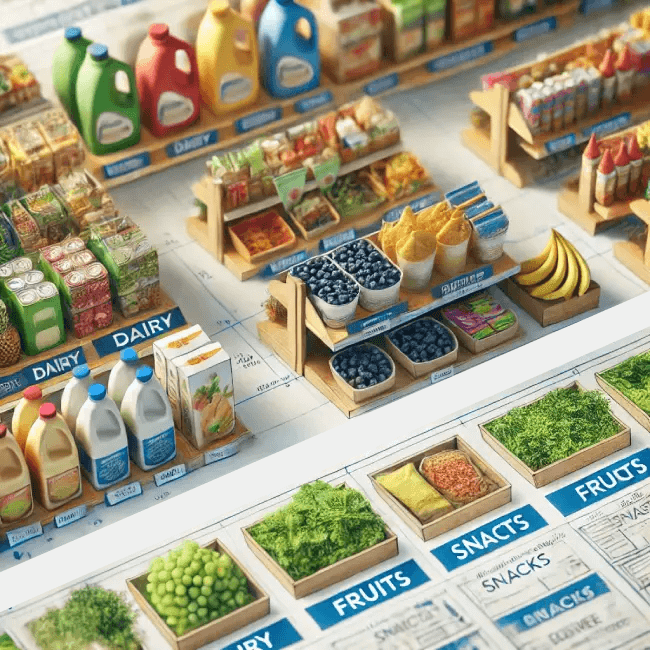

Let's start at the beginning: What is on-shelf availability (OSA)? In simple terms, OSA is a store’s ability to always keep products adequately stocked on store shelves. Good OSA is critical because sales will be lost if customers can’t find the right products on the shelf when needed.
According to on-shelf availability studies, when customers can't find what they are looking for, 70% will buy different brands, and 30% will go to another store. Luckily, there are strategies and technologies retailers can use to improve their OSA and prevent such losses.
Key Takeaways
Keeping shelves stocked builds sales and brand reputation.
Monitor OSA with sensors or audits.
Link inventory to shelf checks.
Use auto-replenishment.
Balance safety vs holding costs.
Analyze OSA KPIs by category.
Importance of on-shelf availability in retailing
Ignoring on-shelf availability will cost everyone dearly since both customers and retailers lose out. In an environment where meeting customer satisfaction is becoming the standard expectation, shoppers want to see the products they want on the shelves all the time. Apple, Amazon, and other industry leaders have shown them that such high-quality service is possible, so the bar is set high.
According to IHL’s research, when Amazon Prime members face empty shelves, they are 52% more likely than other consumers to buy the product they want online. The study also shows that upwards of 24% of Amazon’s current retail revenue comes from customers who first tried and failed to buy the product in a store.
Poor OSA creates low customer loyalty and long-term damage to your brand. On the other hand, high availability on store shelves improves customer satisfaction and loyalty and reduces lost sales and revenue.
Common challenges in maintaining on-shelf availability
Maintaining on-shelf availability is a balancing act between increasing profits and the high service costs required to reach a certain level. Retailers must understand the problem areas clearly and provide the right strategies. So, let's look at some of the most common causes of poor on-shelf availability.

Strategies for improving on-shelf availability
Let's take a closer look at how to improve on-shelf availability in stores.
#1 Using data-driven accurate forecasting
Part of every successful retailer's strategy is making accurate and high-quality demand forecasts, which are the basis for further calculations and ordering. The demand forecast must be based on precise sales data, considering seasonality, trends, and other factors. AI and machine learning technologies can achieve the maximum accuracy of forecasts.
#2 Streamlining supply chain processes
Every failure in the supply chain can lead to stock-outs and, as a result, empty shelves. That's why it's vital to build an effective supply chain and strong relationships with suppliers by establishing communication and providing accurate delivery schedules and deadlines to help suppliers plan their logistics.
#4 Monitoring store operations
The ways products are received, stocked, and displayed are essential to on-shelf availability. Efficient store operations ensure that SKUs quickly move from the backroom to the shelves. Regularly monitoring and optimizing these processes will help retailers to maintain high availability rates.
To control store operations, you can use the LEAFIO Visual Merchandising App, a handy tool for sending tasks to the store staff in real-time. The main office can check the execution of tasks through photos taken by employees after the products are displayed.
#5 Training staff
Well-trained employees are a crucial factor in retail shelf control. Staff should be aware of the best practices for stocking shelves. Conduct regular training sessions to help staff learn the skills needed to keep shelves in good condition—that is one of the best practices for maximizing on-shelf availability.
Future trends in on-shelf availability
The scope for on-shelf availability solutions has expanded substantially over the last few years. The global market is registering a CAGR of 9.1% from 2024 to 2034. AI-based technologies have enabled retailers to receive real-time information about product availability, automate replenishment processes, and optimize merchandising strategies.
Here are some innovative solutions that can help retailers to improve on-shelf availability.

LEAFIO AI empty shelf recognition technology
LEAFIO Shelf Efficiency software, a modern planogram optimization and merchandising automation solution, has introduced an empty shelf recognition module that uses AI algorithms to detect imperfections and empty places on planogram pictures. It automatically alerts staff about flaws and assigns tasks to complete the planogram. The system forms a report showing retail on-shelf availability issues in table sheet reports and directly on floor plans, highlighting planograms with empty spaces.
LEAFIO Empty Shelf Recognition technology ensures 100% controlled and automated on-shelf availability, protecting retailers and suppliers from lost sales and providing an in-store positive shopping experience for customers.
LEAFIO Inventory Management Solution
The effect of using the empty shelf recognition technology becomes clearer when used together with the LEAFIO Inventory Management Solution. It provides retailers with accurate data and the ability to generate and send orders automatically to external suppliers or your warehouse, maintain adequate stock levels, and keep every level of the supply chain running smoothly.
For example, NOVUS, one of the largest supermarket chains in Eastern Europe, has been using the powerful analytical module of the LEAFIO Inventory Optimization system to identify the causes of any instances of overstock or understock, point out problematic suppliers, and find delayed orders in supply chains within a few minutes. As a result, sales have risen by 10%, and NOVUS improved OSA by 98%.
If you're ready to transform your retail strategy and use innovation to increase sales, try LEAFIO Shelf Efficiency and its advanced empty-shelf recognition technology. Request a demo right now to experience the solution in your business.


Have a question?

Jack Larson
Retail Optimization Expert