

Whether you’re running a cozy neighborhood shop or a vast omnichannel powerhouse, one pesky question may plague your sleep: how will your business stay ahead? With technology advancing at breakneck speed, constantly shifting customer expectations, and industry standards for efficiency reaching new heights, the grounds for fear of falling behind are real.
According to the Total Retail survey, 76% of respondents expect their company's overall technology budget to grow over the next year, while only 18% foresee a reduction in tech spending. This trend reflects a strong industry-wide focus on technological advancement. That’s why spotting the key retail technology trends for 2025 is essential—it’s not just about keeping up. It’s about remaining indispensable in a world where adaptability is everything.
This article looks at five retail tech trends projected for 2025 to highlight the ways these innovations will continue to shape the future of smart retailing from the perspective of the LEAFIO AI teams' expertise and compelling industry research.
Key Takeaways
Key tech trends like AI, cloud & personalization shape retail’s future.
AI personalizes & predicts.
Cloud enables real-time data use.
Mobile-first engagement grows.
IoT connects shelf to system.
Unified platforms replace patchworks.
What Is Retail Technology?
Retail technology encompasses a broad spectrum of digital solutions and tools designed to enhance every facet of the retail experience. From inventory management systems and supply chain optimization to personalized customer interactions, retail technology is transforming the way businesses operate and engage with consumers.
Key recent innovations that have redefined the retail sector include:
- Artificial intelligence and machine learning;
- Robotics and warehouse automation;
- Unmanned in-store technology;
- Virtual and augmented reality;
- Computer vision and image recognition;
- Voice commerce;
- Data-driven marketing.
At its core, innovation in retail harnesses digital advancements to overhaul traditional approaches, crafting a more integrated, efficient, and customer-centered shopping ecosystem. The adoption and implementation of these technologies will depend on factors like industry, company size, and regional needs. Recognizing which tools align best with specific business challenges is essential for a successful technological transformation.
TOP 5 Retail Technology Trends in 2025
These are the top 5 retail technology trends relevant for the entire retail industry in 2025:
#1 AI technology is gaining importance
A study by Gartner indicates that 91% of retail IT leaders are prioritizing AI investments by 2026. AI and ML have shifted from being experimental technologies to essential components of competitive retail strategies.
AI-driven assortment management
Globalization has sparked fascinating and unexpected trends in the food industry, as highlighted in Food Report 2025. A rising interest in local cuisines is driving unique flavor combinations, leading to an evolving and diverse array of food products in supermarkets. Tracking the performance of these products—deciding when to expand or discontinue items—has become a task ideally suited for artificial intelligence. As a result, more retailers are adopting automated assortment planning software powered by smart algorithms. This technology enables them to keep pace with fast-changing trends, reducing the risk of financial losses and overstocks.
Demand planning and inventory optimization
AI and ML are game-changers in demand planning tool, helping retailers better predict sales trends, optimize stock levels, and reduce both overstock and stockouts. By analyzing historical sales data, seasonality, and even external factors like weather or economic conditions, AI-powered demand forecasting models provide accurate, dynamic predictions. This allows retail businesses to maintain lean inventories, improve cash flow, and ensure the right products are always available at the right time, minimizing lost sales opportunities.
Personalization and customer insights
By analyzing vast amounts of customer data—from browsing history to purchase patterns—AI models can predict what a customer might want next, creating a unique shopping experience that enhances customer loyalty. Machine learning algorithms further refine these recommendations in real time, learning from each customer interaction to improve the accuracy and relevance of offers. This level of personalization fosters a deep connection with consumers and can significantly increase conversion rates.
Pricing optimization and promotion management
AI and ML also empower retailers to dynamically adjust prices based on real-time demand, competitor pricing, and historical sales data. These systems use predictive analytics to optimize pricing strategies, ensuring that products are priced competitively while maximizing profit margins. Additionally, AI-driven promotion management tools can analyze past promotions to understand what resonates with customers, allowing for more effective, data-informed marketing campaigns.
Computer vision and AI image recognition
Computer vision, a subset of AI, has applications across store operations, from checkout-free technology to shelf monitoring. In checkout-free stores, computer vision systems track customer movements and purchases without the need for traditional checkout lanes.
Additionally, AI image recognition can be used for on-shelf availability monitoring to detect empty spaces or misplaced products, enabling quicker restocking and enhancing the shopping experience.
“Our latest AI image recognition algorithm achieves highly accurate empty shelf detection, greatly enhancing display management efficiency across all store locations. This advancement enables retailers to swiftly address product gaps, maintaining optimal on-shelf availability and elevating the customer experience,” states Andrew Max, CCO of LEAFIO AI.
#2: Retailers switch to unified tech ecosystems
Automation is expected to drive the shifts in required skills within retail. Research from McKinsey indicates that up to 52% of tasks in retail could be automated. Simultaneously, According to Adobe's Digital Trends Retail survey, 50% of retailers cite technology integration as a major internal barrier. Unified platforms address this by uniting systems into single ecosystems enabling seamless data sharing and enhanced efficiency of retail operations.
For example, the LEAFIO AI Retail Platform integrates with a retailer's POS system, creating a sustainable ecosystem where various components such as inventory, merchandising, and assortment management systems share data and seamlessly interact. This ensures complete inventory visibility, enabling informed decision-making at every level of the organization.
This approach also results in several tangible benefits:
- Operational efficiency. The platform dramatically improves ret ail operations by eliminating the need to manage multiple separate systems. Retailers can access real-time information, make data-driven decisions, and optimize processes without the complexities of disparate solutions. The interconnected nature of the platform ensures that changes in one area are instantly reflected throughout the system.
- Scalability opportunities. Built to grow with the business, these platforms provide scalability and adaptability. As retailers expand their operations or introduce new features, an all-in-one solution can easily adapt to changes without requiring extensive reconfiguration or integration issues.
- Data accessibility. The seamless flow of data within the platform provides retailers with access to comprehensive insights. This data-driven approach allows businesses to strategize based on real-time information.
Consider this example of the ecosystem in action: Suppose a category manager wants to test new SKUs. In a unified ecosystem, once these products are added to the assortment, the planogram management module is immediately alerted to allocate shelf space accordingly. Meanwhile, the inventory optimization module ensures that orders for these SKUs are placed at the optimal time. This setup enables the category manager to quickly assess each SKU’s performance, making it easy to decide whether to expand its availability or remove it from the assortment promptly.
#3 Better inventory control is becoming a must
While global retail giants leverage the Internet of Things to track goods in real time, many small and mid-sized retailers still lack accurate inventory information.
Given that inventory typically constitutes around 20% of a retailer's assets, cost optimization and managing threats to profitability can be life or death for most retailers. Here are just some of the things that modern inventory optimization software can do with ease.
Automated replenishment
Gone are the days of manual stock checks and time-consuming replenishment processes. Automation brings a new level of accuracy to replenishment strategies. By analyzing historical data, sales patterns, and even external factors, automated systems can accurately forecast demand. This ensures that shelves are constantly replenished, minimizing instances of out-of-stock or overstocking.
Order processing and suppliers interactions
Inventory management automation extends to order processing as well, optimizing the order fulfillment pipeline. Automated systems can intelligently route orders, ensuring that goods are shipped from the most strategically located warehouses, reducing delivery times and increasing customer satisfaction.
Human factor elimination
Human errors in inventory management can snowball into a breach of trust, financial loss, and customer dissatisfaction. Automation serves as a defense against such errors. Automated routine tasks such as data entry, order processing, and even inventory control, significantly reduce the risk of inaccuracies, contributing to a more reliable and trustworthy retail experience.
At its core, inventory control automation is more than just a technology implementation. It's a strategic step toward operational excellence. The best choice retailers can make today is to counter the volatile retail environment with automation for the sake of improved accuracy.
#4 Seamless omnichannel integration
Seamless omnichannel integration is fast becoming a cornerstone of modern retail, as Worldmetrics statistics say that 68% of consumers expect retailers to provide a seamless shopping experience across all channels. Omnichannel strategies are evolving to create a cohesive shopping journey, where customers can switch seamlessly between platforms and devices without missing a beat. This trend is fueled by customer expectations of convenience, flexibility, and speed—qualities that have become non-negotiable in today’s competitive retail landscape.
Features driving omnichannel success
"Buy Online, Pick Up In-Store" (BOPIS) and "Reserve In-Store" have proven to be game-changers, blending the convenience of online shopping with the immediacy of brick-and-mortar stores. BOPIS allows customers to make purchases online and collect them in-store, saving time while reducing shipping costs. "Reserve In-Store" lets customers hold an item online and then try it on or inspect it in person before making a final purchase decision, bridging the gap between digital and physical interactions.
Real-time inventory visibility across channels is also essential to omnichannel integration. When customers can see stock levels instantly, they avoid the frustration of ordering items that are out of stock or traveling to stores without available inventory. This transparency allows retail stores to manage customer expectations and streamline logistics, ultimately enhancing satisfaction and loyalty.
Unified loyalty programs and rewards
Omnichannel strategies are also driving the development of integrated loyalty programs that reward customers consistently across all channels. A unified loyalty program means that points, rewards, and exclusive offers follow customers wherever they shop, providing a cohesive experience. Loyalty management software solutions are becoming indispensable for retailers to achieve this seamlessness. For example, shoppers who make in-store purchases earn the same rewards as those who shop online, encouraging repeat customer engagement across different platforms.
#5: Retail analytics and actionable insights
Big data and retail analytics are reshaping the retail industry by turning vast amounts of customer, sales, and inventory data into actionable insights. Retailers leverage these analytics to understand consumer preferences, optimize inventory, and personalize marketing, driving more effective engagement and improving the shopping experience. By analyzing patterns in customer behavior, spending trends, and even external factors like seasonal demand, big data helps retailers forecast more accurately, streamline supply chains, and adjust strategies in real time.
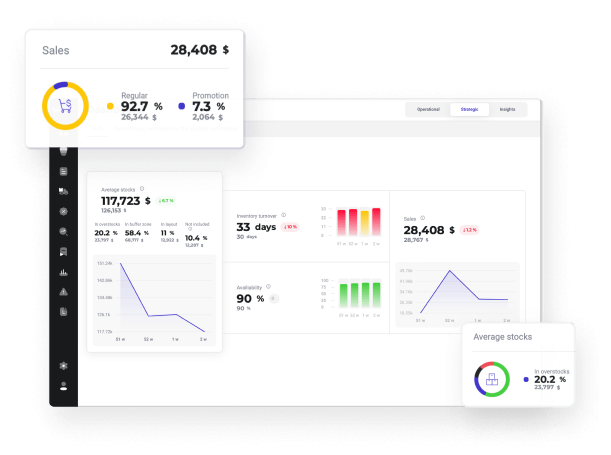
Leading retail technology vendors have moved beyond standard analytics and BI systems to offer powerful dashboards displaying all essential business metrics at a glance. These advanced visual tools can quickly spotlight issues that would otherwise require hours of manual analysis to uncover. For instance, a LEAFIO AI inventory dashboard provides real-time insights, such as the exact amount of capital currently tied up in inventory, enabling faster, data-driven decisions.
How do Retailers Choose Tech Innovation Solutions?
According to the Total Retail report, retailers consider several key factors when selecting technology vendors to ensure the solution aligns with their specific needs and objectives.
#1. Cost and return on investment (ROI).
Cost remains the top consideration for 38% of retailers when evaluating technology investments. Competitive pricing helps retailers achieve a strong return on investment while maintaining budget flexibility, making cost-effective solutions essential in a technology partner.
#2. Vendor support
Reliable vendor support is a priority for 20% of retailers, who need ongoing assistance to ensure smooth implementation and long-term success. Quality support helps retailers manage the adoption of new technology, troubleshoot issues, and optimize system performance.
#3. Employee training requirements
17% of retailers find that minimizing the amount of employee training needed leads to avoiding operational disruptions. Solutions with intuitive interfaces and user-friendly designs streamline training, enabling teams to quickly master new systems with minimal time investment.
#4. System integration
Seamless integration with existing systems is essential for 16% of retailers. Plug-and-play compatibility reduces the need for costly reconfigurations and integrates effortlessly with inventory, POS, CRM, and ERP systems, which ensures data continuity and operational fluidity across platforms.
#5. Time to implement
Speed to market is a critical factor for 9% of retailers, who seek rapid implementation to start seeing the benefits sooner. Quick deployment reduces downtime and ensures that the technology starts contributing to efficiency and performance immediately.
As a leader in retail automation, LEAFIO AI addresses each of these priorities, offering a balanced approach with competitive pricing, robust support, streamlined training, plug-and-play integration, and efficient implementation.
LEAFIO AI system implementation typically takes six months, with payback achieved within the first year. By the third to fourth year, return on investment reaches 300–400%. Throughout the system's lifecycle, the Customer Success team offers continuous support and consultation to users.
Key Takeaways
- AI and Machine Learning: AI-driven demand forecasting, personalized customer interactions, and efficient pricing strategies are reshaping retail, with 91% of retail IT leaders prioritizing AI investments by 2026 (Gartner).
- Unified Tech Ecosystems: As up to 52% of retail tasks could be automated, platforms that integrate inventory, merchandising, and analytics offer seamless data flow, improving operational efficiency and scalability.
- Inventory Automation: Automated replenishment, order processing, and real-time tracking are becoming essential for effective inventory control, minimizing stockouts and overstock situations.
- Omnichannel Integration: With 68% of consumers expecting a unified shopping experience, omnichannel strategies like BOPIS, real-time inventory visibility, and integrated loyalty programs enhance convenience and build customer loyalty.
- Retail Analytics and Insights: Big data and advanced dashboards enable retailers to analyze customer behavior and operational metrics in real time, facilitating faster, data-driven decisions.
Stay on top of what's in store for the retail industry with new retail technology podcasts and articles from our LEAFIO AI blog, or request a demo. Our seasoned automation experts will take you on a tour of the world of innovation in retail.


Have a question?

Jane Medwin
LEAFIO Co-Founder, Retail Optimization Expert
