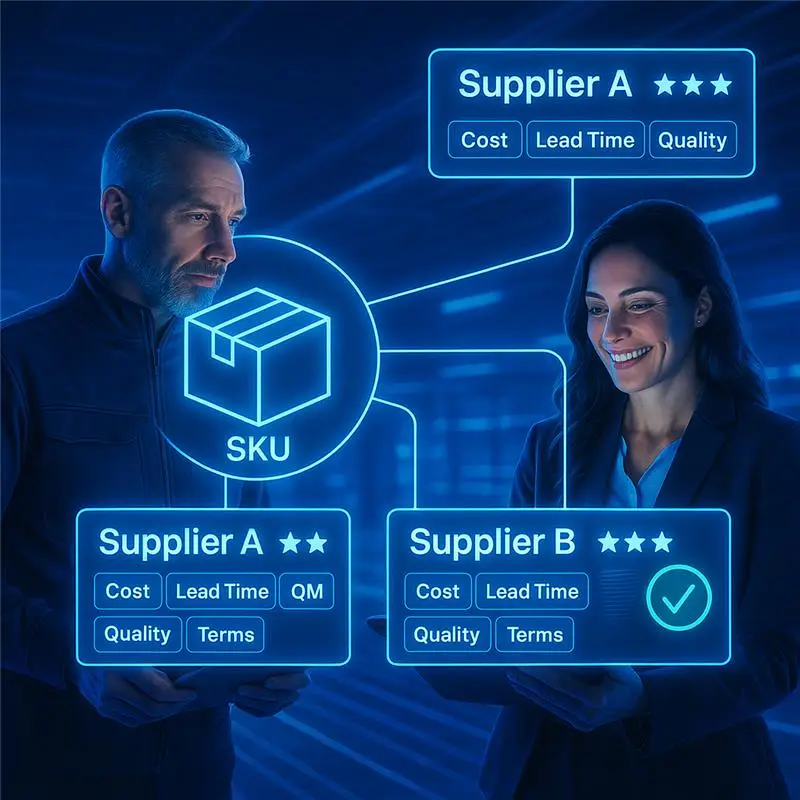



Here is the short answer. Slimstock is a distribution-first inventory optimization specialist built for wholesalers, manufacturers, and mid-to-large retailers running complex networks. LEAFIO AI is a retail-native platform that covers the same forecasting and replenishment core, then extends into planograms, assortment, and store-level execution. Retailers who need planning and shelf execution in one system usually get more from LEAFIO AI.
Both platforms forecast demand, automate replenishment, and aim to cut stockouts without piling up excess stock. But Slimstock has grown up serving distributors and manufacturers across Europe since 1993, while LEAFIO AI built its platform inside retail from day one. That single difference shapes almost everything else, from who configures the system day to day to what happens on the shop floor.
This guide compares LEAFIO AI and Slimstock feature by feature so you can decide which fits your operation in 2026. Searching for a Slimstock alternative with retail execution built in, not bolted on? I will flag exactly where that case is strongest.
Quick Comparison: LEAFIO AI vs. Slimstock
What is the difference between LEAFIO and Slimstock? Slimstock is a demand and inventory planning specialist for distributors, wholesalers, and manufacturers, sold through a consultant-led implementation. LEAFIO AI is a retail-native platform covering the same forecasting and replenishment core, then adding planograms, assortment, and store execution. Both quote pricing per deployment, and both are mid-market accessible, so the split is scope and audience, not raw capability.
| Feature | LEAFIO AI | Slimstock |
|---|---|---|
| Best for | Mid-market & enterprise retailers, distributors, CPG | Distributors, wholesalers, manufacturers, mid-to-large retailers |
| Core focus | Retail supply chain: demand, replenishment, planogram, merchandising | Supply chain planning: demand, inventory, S&OP, commerce management |
| Deployment | Weeks to a few months | Consultant-led, typically a few months |
| Field execution | Web UI plus a mobile SuperApp for store staff | Planner and buyer dashboards; limited store-level UI |
| Pricing | Two-part: implementation + subscription, built for multi-store retail networks, scaled by store count & SKU volume | Custom quote, mid-market to enterprise |
| Free trial / demo | Demo on request | Demo on request |
| G2 rating | 5.0 / 5 (30+ reviews) | 4.7 / 5 (18 reviews) |
| Analyst status | Strong user reviews; planogram and retail niche leader | Positive Gartner Peer Insights coverage; distribution and wholesale niche strength |
| Key difference | Retail-native, faster to value, adds shelf and store execution | Deep distribution and MEIO planning, consultant-led rollout |
Ratings reflect 2026 data. See the source reviews on Slimstock's G2 page and LEAFIO AI's G2 page. If you searched Slimstock vs. LEAFIO instead, this table answers that question either way around.
Overview of Slimstock
Slimstock is a Dutch supply chain planning specialist founded in 1993. The company reports more than 30 years of experience in the category and has grown without outside venture funding, which is unusual for a software vendor of its size. Its flagship platform, Slim4, unifies demand forecasting and sensing, inventory optimization, automated replenishment, and broader supply chain planning in one system, plus a commercial layer covering pricing, promotions, and assortment strategy.
Slim4 serves distributors, wholesalers, and manufacturers most heavily, alongside a smaller base of retailers across grocery, fashion, and specialty categories. Customer counts vary by source, from roughly 650 to more than 1,700 depending on which figure is cited, so confirm the current number with a Slimstock rep before quoting it in a board deck.
Key Features
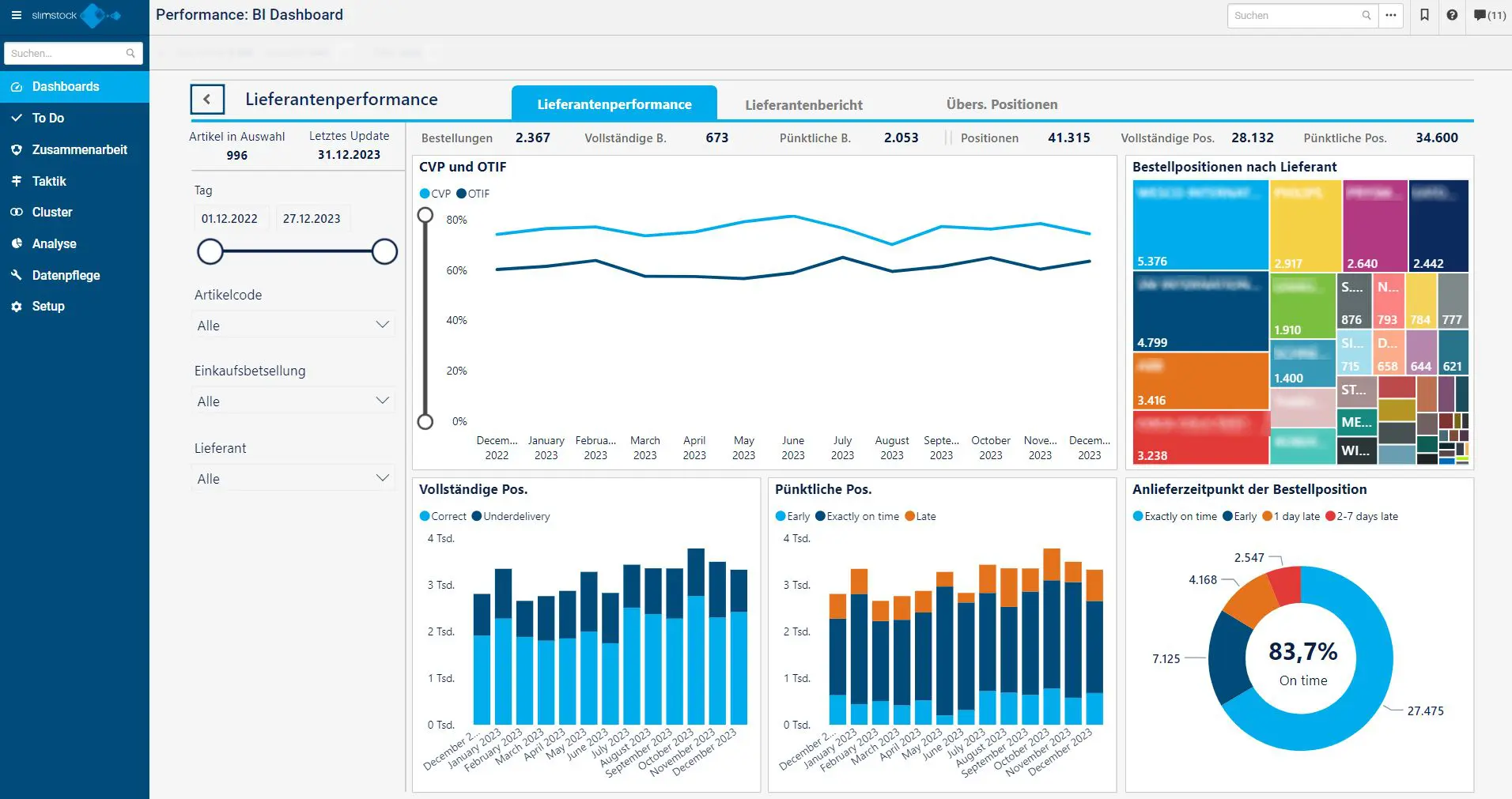
- Demand forecasting and sensing: AI-driven models with automatic method selection across SKUs and locations.
- Automated replenishment: exception-based ordering that flags what needs attention instead of reviewing every line.
- Multi-echelon inventory optimization (MEIO): stock balancing across warehouses, distribution centers, and stores.
- S&OP and S&OE: tactical and strategic planning tied to one shared dataset.
- Open-to-buy and scenario planning: budget-aware ordering and what-if modeling for disruptions or seasonal peaks.
- Commerce management: AI-assisted pricing, promotion planning, and assortment strategy layered on top of inventory data.
- ERP-agnostic integration: connectors for more than 80 ERP and business platforms, including SAP, Oracle, and Microsoft Dynamics.
User experience. Slim4 is organized around prioritized to-do lists and exception management for planners and buyers. Reviewers on G2 and Capterra regularly praise the forecasting accuracy and the clear dashboard, though several note a real learning curve and describe customization as slower when it has to route through Slimstock's head office.
Pricing. Slimstock pricing is not public. The company sells through a consultant-led implementation model, with custom quotes sized to SKU count, location count, and module scope.
Pros and cons
| Pros | Cons |
|---|---|
| Deep multi-echelon inventory optimization for complex distribution networks | No dedicated planogram, shelf, or store-execution tooling |
| 30-plus years of domain expertise, independent of outside investors | Limited trade promotion management beyond campaign-related demand adjustments |
| Strong Gartner Peer Insights scores for support and account management | Customization often runs through head office rather than the local team |
| Broad ERP compatibility across more than 80 systems | Built around distribution and wholesale, so retail-specific workflows take extra configuration |
Where Slimstock Genuinely Wins
To be fair, Slimstock is strong where distribution complexity is the main problem. Its multi-echelon optimization and open-to-buy tools are built for businesses managing thousands of SKUs across many suppliers and warehouse nodes, and its 80-plus ERP connectors mean it drops into almost any existing system landscape.
If your core challenge is balancing inventory across a distribution network, tightening supplier performance, or running a formal S&OP process, and shelf execution is not part of your remit, Slimstock's depth in that lane is a real advantage.
Retailers that like Slimstock’s inventory-planning depth but want to compare other approaches can also review Slimstock alternatives.
Overview of LEAFIO AI
LEAFIO AI is an AI-powered retail platform built around the jobs retailers do every single day. It combines retail demand planning software, inventory optimization, automated replenishment, planogram and shelf management, and merchandising.
The company has stayed in one lane since 2014. LEAFIO did not start broad and narrow down to retail; it started in retail and built outward. LEAFIO's own materials cite 250-plus retailers across 40-plus countries; some older third-party listings show earlier figures.
Key Features
- AI demand forecasting: models seasonality, promotions, new product launches, and fresh goods behavior out of the box.
- Automated replenishment: multi-echelon store and warehouse ordering with most orders generated automatically.
- LEAFIO Shelf Efficiency: auto-planogram generation, execution control, and AI shelf-image recognition.
- Assortment performance: AI matrix recommendations and smart store clustering in one module.
- Merchandising and promotion management: promo planning and forecasting tied directly to inventory.
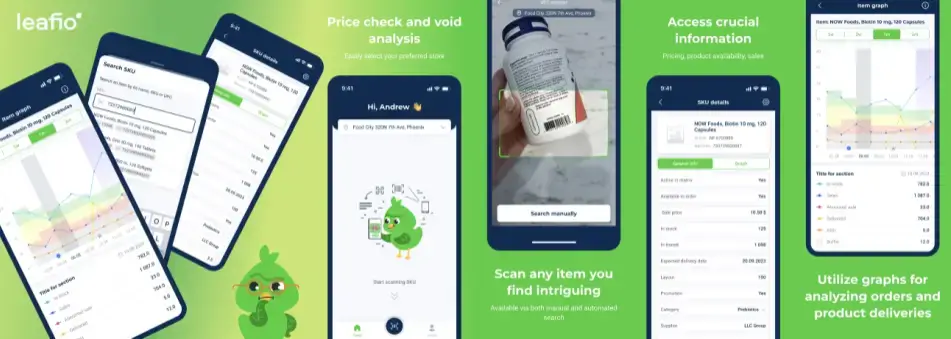
- Mobile SuperApp: a field app for merchandisers and store staff, separate from the analyst web UI.
- Ready-made connectors: prebuilt ERP and POS integrations that cut implementation time.
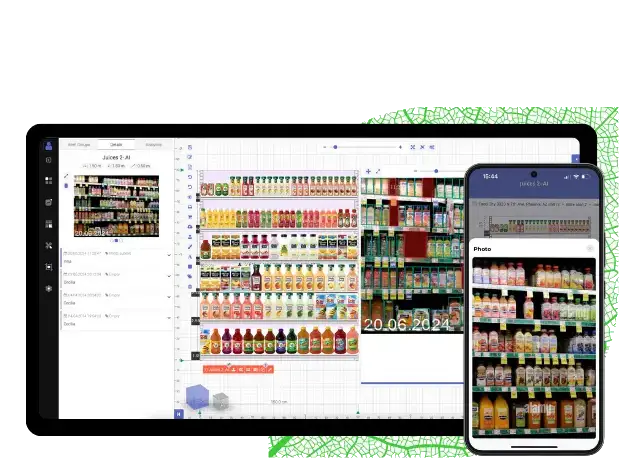
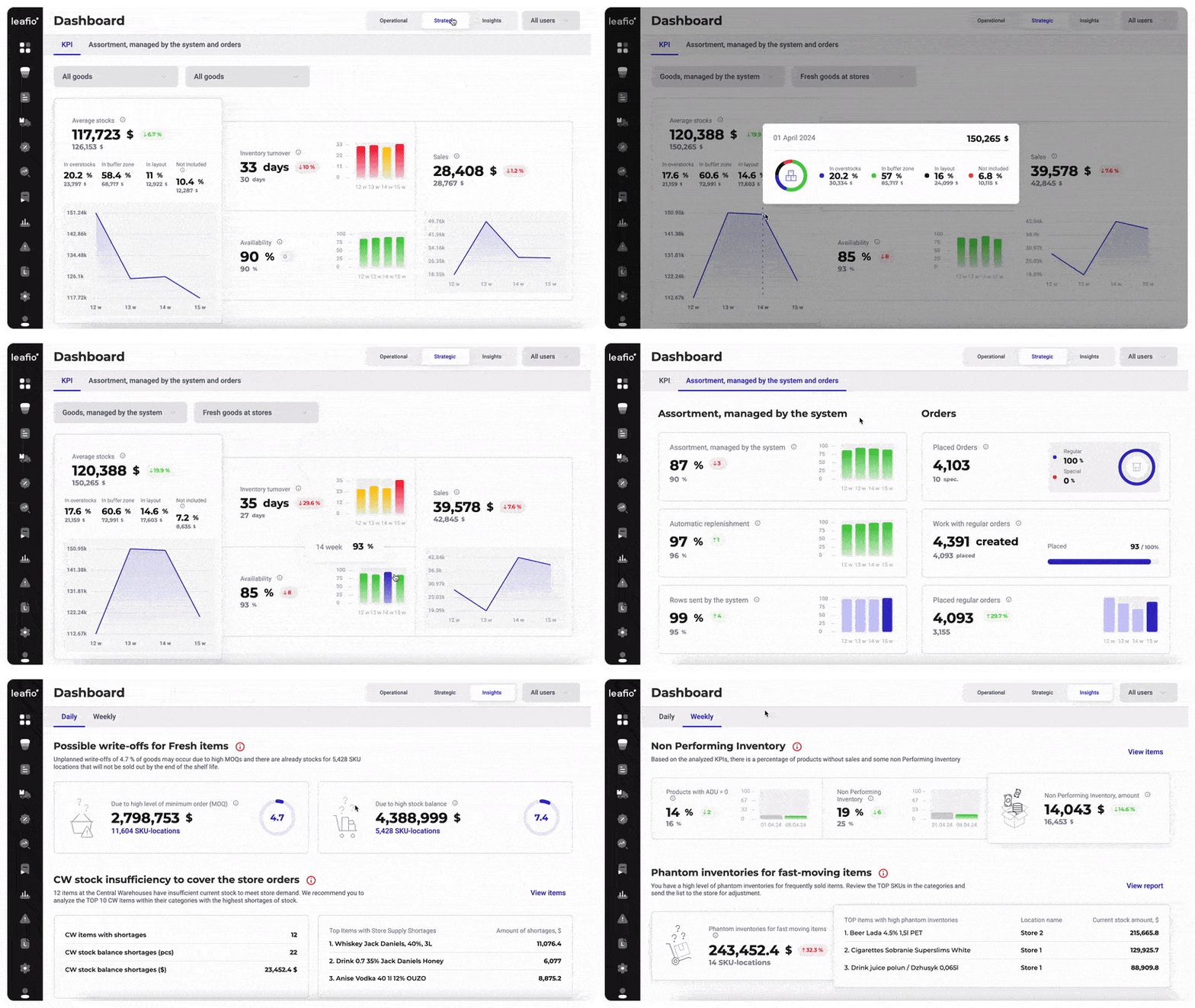
User experience. LEAFIO splits its interface by role. Planners use detailed web dashboards, while field teams use the mobile SuperApp. Reviewers consistently praise the analytics depth and ease of use, with the clearest complaint being slower loading on very large datasets.
Pricing. LEAFIO AI uses a subscription model with a custom quote and a demo on request. There is no public free trial, but the sales cycle is lighter than a consultant-led enterprise rollout.
Pros and cons
| Pros | Cons |
|---|---|
| Retail-native design covering forecasting through shelf execution | Pricing is not published; you need a quote |
| Planogram, replenishment, and demand planning in one platform | Smaller vendor than a 30-year distribution specialist |
| Mobile SuperApp built for store-level field teams | Setup and loading can slow down on very large or highly unique item sets |
| Strong independent reviews: G2 5.0/5, 30+ reviews | Less multi-echelon distribution depth than a pure supply-chain planning suite |
Why Retailers Choose LEAFIO Over a Distribution-First Planning Tool
Picture a 120-store grocery chain that adopts Slim4 for forecasting and replenishment. The demand and inventory math holds up, but the chain still needs a separate planogram tool, a separate mobile app for store compliance, and a separate process for tying promotions to shelf space. LEAFIO packages all of that into one platform, so the retail team is not stitching together three vendor relationships to run one store network.
Feature-by-Feature Comparison
I will compare the two platforms across the areas that drive a real buying decision. In any LEAFIO vs. Slimstock evaluation, both are capable planning engines, so the question is scope and fit, not whether a feature exists somewhere in the stack.
Demand Planning and Forecasting
Slimstock's forecasting engine is mature and built for distribution complexity, with automatic method selection across large SKU counts and many supplier relationships. Reviewers consistently praise its accuracy once it is tuned.
LEAFIO's demand planning is built around retail realities from the start. It models seasonality, promotions, new-product launches, and fresh-goods behavior with less configuration for a grocery or pharmacy assortment specifically. In my view, LEAFIO wins on retail-specific fit, while Slimstock wins on breadth across supplier and warehouse-level demand signals.
Replenishment and Inventory Optimization
Both platforms automate ordering and aim to balance stock across a network. Slimstock's multi-echelon inventory optimization and open-to-buy tools are a strong match for distributors managing many warehouse nodes and supplier terms at once.
LEAFIO focuses tightly on retail replenishment, with close attention to fresh inventory and shelf life. One LEAFIO customer reported a 10% increase in sales and a 15% boost in turnover. The same rollout delivered an 11% reduction in stock and a 98% SKU service level. Results vary by retailer, but the pattern holds across most LEAFIO case studies: more sales carried on less stock.
Planogram and Merchandising
Ask a Slimstock rep about planogram or shelf compliance tooling, and the honest answer is that it is not part of the platform. Slim4 handles campaign-related demand adjustments, but dedicated shelf management, auto-planogram generation, or store-level compliance tracking sit outside its scope.
LEAFIO's planogram and shelf efficiency tools sit at the core of the platform, with auto-planogram generation and AI shelf image recognition built in. If shelf and category execution matters to your business as much as forecasting does, LEAFIO has the clear edge here.
Deployment and Time to Value
Slimstock implementations run through a consultant-led model, commonly a few months, with Slimstock's own team guiding configuration alongside the client. LEAFIO is built to go live in weeks to a few months, using ready-made connectors instead of a mandatory external systems integrator. For a mid-market retailer, that difference can mean seeing results this quarter instead of next.
Usability and Field Execution
Store managers rarely open Slim4. That is not a knock; it is built for planners and buyers at the head office, and it does that job well. LEAFIO adds the mobile SuperApp so merchandisers and store staff act on the same data in the field, not just planners at a desk. This matters more than people expect when adoption depends on store teams.
Pricing and Trials
Neither vendor publishes pricing; both quote per deployment. In practice, Slimstock's consultant-led model tends to add services cost on top of the license, while LEAFIO AI's implementation runs closer to a standard SaaS rollout. LEAFIO AI's pricing has two components: a one-time implementation fee and an ongoing subscription that scales with your store count and SKU volume. Always request a tailored quote based on your scope.
Support and Reviews
On G2, Slim4 scores 4.7 out of 5 across 18 reviews, with users highlighting forecasting accuracy and responsive support. LEAFIO scores 5.0 out of 5 across 30+ reviews, with strong marks for support and partnership. Slimstock reviewers occasionally mention a learning curve and slower head-office-driven customization; LEAFIO reviewers point most often to slower loading and more complex setup on very large item sets.
Where LEAFIO AI Pulls Ahead for Retailers
A distribution-first planning tool is not the only path for a retailer, and for most chains running stores rather than warehouses, it is not the practical one either. LEAFIO covers the same forecasting and replenishment ground that matters day to day, then adds planograms, assortment, and store-level execution without a second vendor contract.
Named results back this up. One LEAFIO customer reported a 10% increase in sales and a 15% boost in turnover after rollout. The same retailer saw an 11% reduction in stock alongside a 98% SKU service level. Results vary by retailer, but the pattern, more sales carried on less stock, shows up across most LEAFIO case studies.
Why LEAFIO AI May Be a Stronger Option
| Why LEAFIO AI stands out | What does it mean for a retailer? |
|---|---|
| Retail-native design | Built for grocery, pharmacy, and shelf execution from day one, not adapted from distribution planning |
| Shelf and planogram built in | Auto-planogram generation and AI shelf recognition live in the same platform as forecasting |
| Faster rollout | Weeks to a few months, without a mandatory external systems integrator |
| Field adoption | A mobile SuperApp for store teams, not just planner dashboards |
| Merchandising and promotions | Promo planning tied directly to inventory, not a separate add-on |
| Stronger review footprint | G2: 5.0/5 from 30+ reviews vs. 4.7/5 from 18 reviews for Slimstock |
See LEAFIO AI for your retail network
If you are evaluating a Slimstock alternative because your business runs stores, not just warehouses, book a walkthrough built around your store count and category mix.
Book a free demo →
Final Verdict: LEAFIO AI or Slimstock?
Scope decides this one more than any single feature. A distributor, wholesaler, or manufacturer with deep multi-echelon planning needs and no store-level execution requirement gets more out of Slimstock's specialization; its 30-plus years in that lane and its Gartner Peer Insights track record are built for that use case.
Flip the scenario, though, and the calculus reverses. A retailer that needs forecasts to turn into orders, planograms, and shelf compliance in the same system, not three separate tools, gets more real value out of LEAFIO, even though both platforms forecast demand and automate replenishment.
Here is what tends to play out: chains running both stores and a distribution operation shortlist Slimstock for its supply chain depth, then choose LEAFIO once shelf execution and store adoption enter the conversation. If you want to see how LEAFIO compares with other vendors, read our LEAFIO vs. RELEX comparison, or browse our guides to Slimstock alternatives and Netstock alternatives if a broader search for an inventory planning alternative led you here.
Switching doesn't have to be painful
Our implementation team has moved retailers off distribution-first planning tools before and knows where the friction usually hides.
Talk to our team →
Switching From Slimstock to LEAFIO AI
Migrating off a distribution-first planning tool sounds daunting, but a structured plan keeps it manageable. Here is the path I would walk through with any retailer making the move.
- Map your needs: list the workflows you rely on today, forecasting, replenishment, S&OP, and the retail gaps you want to close, like planograms or store compliance.
- Export your data: pull historical sales, product and store master data, and supplier terms out of Slim4 in a clean format.
- Plan integrations: confirm connectors to your ERP and POS systems before go-live; LEAFIO's ready-made connectors cut this step down.
- Run a pilot: start with one region or category to validate forecasts and order quality before committing further.
- Train your teams: onboard planners on the web interface and store staff on the SuperApp separately.
- Roll out in waves: expand by region or banner once the pilot proves the model works for your data.
- Track results: measure service levels, stock, and sales against your old Slimstock baseline.
Most retailers reach live operation in weeks to a few months, without the services-heavy timeline common with a consultant-led migration. For more detail, explore LEAFIO's inventory optimization, replenishment, and planogram pages, or see how it fits alongside merchandising workflows.
FAQ
Is LEAFIO AI better than Slimstock?
Neither is better for everyone. LEAFIO AI is usually the better fit for retailers that want forecasting, replenishment, and shelf execution in one platform. Slimstock is better for distributors, wholesalers, and manufacturers that need deep multi-echelon inventory planning without a store execution requirement.
What is the main difference between LEAFIO AI and Slimstock?
Slimstock is a distribution-first supply chain planning platform built for wholesalers and manufacturers, sold through a consultant-led implementation. LEAFIO AI is a retail-native platform focused on demand planning, replenishment, planograms, and merchandising, built to go live faster for store-based retailers.
How much does LEAFIO AI cost compared to Slimstock?
Neither vendor publishes prices; both quote per deployment. Slimstock's consultant-led model typically adds services costs to the license, while LEAFIO AI's rollout runs closer to a standard SaaS implementation. LEAFIO AI's pricing has two components: a one-time implementation fee and an ongoing subscription that scales with your store count and SKU volume. Contact us for a quote sized to your network.
Can I migrate from Slimstock to LEAFIO AI easily?
Yes. Export historical data, connect your ERP and POS systems, and define a pilot region first. Most retailers move onto LEAFIO AI in weeks to a few months, well short of a services-heavy migration timeline.
Which platform is better for planograms and shelf management?
LEAFIO AI. It treats planogram, shelf efficiency, and merchandising as a core part of the platform, with auto-planogram generation and AI shelf image recognition built in. Slimstock does not offer dedicated shelf or planogram tooling.
Does Slimstock work well for retailers, not just distributors?
Yes, for the inventory and forecasting layer. Slimstock serves a base of mid-to-large retailers alongside its core distribution and manufacturing customers. What it does not cover natively is shelf execution, planograms, or a store-facing mobile app, which is where retailers most often look at LEAFIO AI instead.
Is there a more retail-focused alternative to Slimstock?
Yes. LEAFIO AI covers the same forecasting and replenishment ground as Slimstock and then extends into planograms, assortment, and store-level execution built specifically for retail operations.