


Two category managers pull up the same demand forecast in a Monday planning meeting and get two different numbers. Finance built its version off last quarter's margin targets. Merchandising built its version off a promo calendar nobody in finance has seen. That is not a technology problem. It is the gap between running S&OP and running integrated business planning (IBP). Most retailers do not know which side of that gap they are standing on.
The debate over IBP vs S&OP shows up constantly in vendor blogs and consultant decks. It is almost always framed around manufacturing: production capacity, EBITDA targets, and CFO sign-off. Retail has its own version of this problem, and it looks different. Your capacity constraint is not a factory line. It is shelf space, a promotion calendar, and a perishables clock that does not wait for a monthly meeting.
This article breaks down the real difference between IBP and S&OP for retail operators. It covers when an SOP to IBP evolution actually pays off. It also covers what changes once you account for planograms, assortment churn, and promotion volatility instead of production runs. Those two topics rarely get discussed together (which is part of why so much writing on this subject feels one step removed from how retail planning actually works).
What Is S&OP? A Quick Recap
Sales and operations planning (S&OP) is the process most retail supply chain teams already run in some form, even if nobody calls it by that name. Sales and operations planning and integrated business planning sit on the same spectrum rather than in competing camps. Both aim to reconcile what the business expects to sell with what it can actually supply. The IBP and S&OP differences that matter most show up in scope, not in the basic goal. S&OP does this at the operational level, month to month.
A typical S&OP planning process runs monthly, on a rolling horizon of one to twelve months. Demand planners bring a statistical forecast. Inventory and replenishment teams check it against warehouse and store capacity. Category managers flag upcoming promotions or new listings the forecast has not caught yet. The output is a single, agreed operational plan: how much stock moves where and by when.
In a retail setting, S&OP usually lives inside supply chain or merchandising leadership. It answers questions like, 'Can we support next month's promo calendar without blowing out safety stock?' Do we have enough inbound coverage for the back-to-school assortment shift? It rarely reaches the boardroom. It does not usually touch pricing strategy, new store openings, or category-level profitability targets. That is where integrated business planning and S&OP start to diverge.
What Is IBP (Integrated Business Planning)?
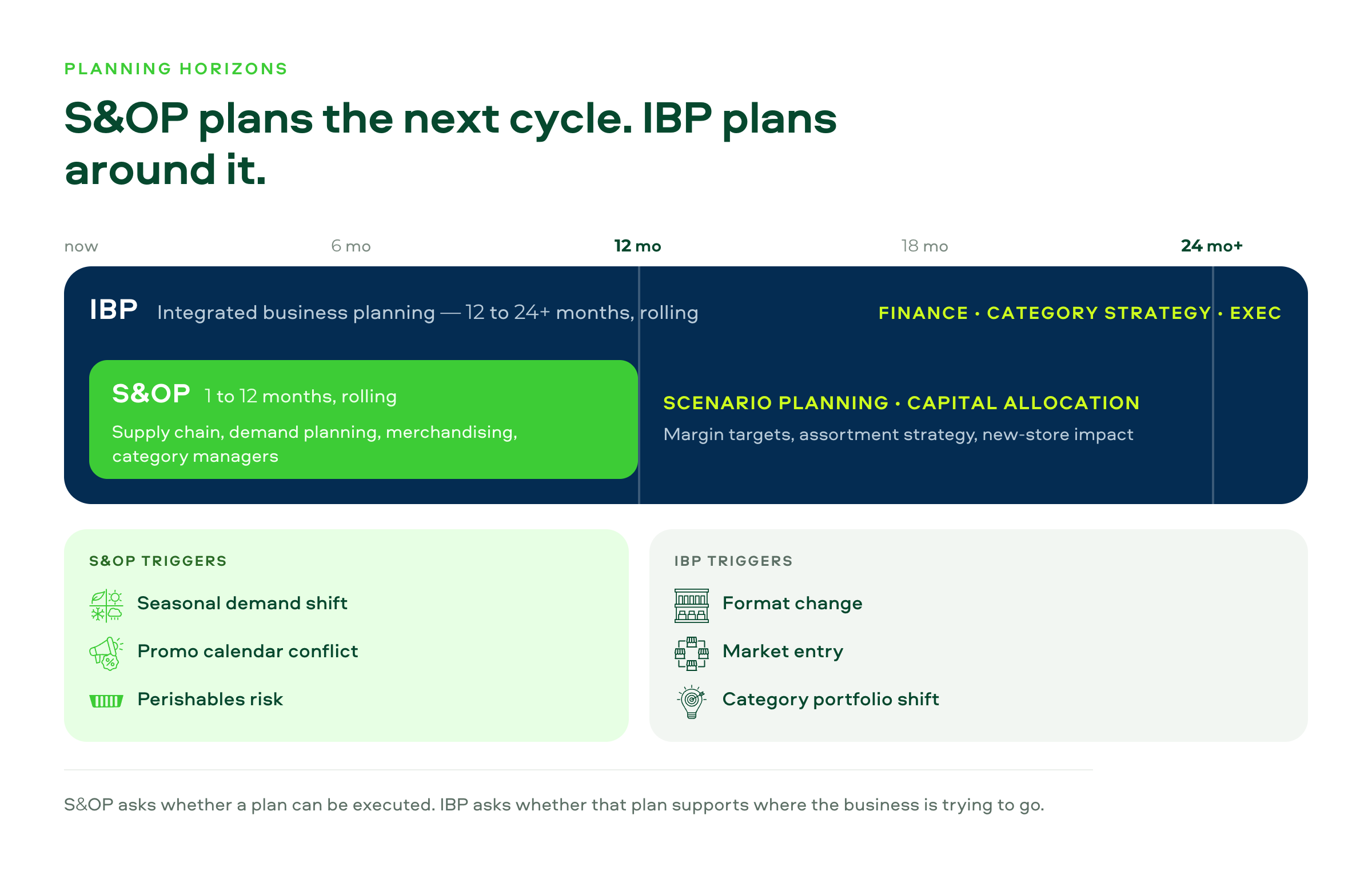
Integrated business planning extends the S&OP planning process in two directions: further out in time and further up the org chart. In practice, the IBP planning process pulls category strategy and financial targets into the same conversation as replenishment and demand. That is what makes it a genuine step up in integrated business planning supply chain management, not just a bigger spreadsheet. Instead of a one-to-twelve-month horizon, IBP typically plans twelve to twenty-four months out. Retailers with long lease cycles or major format changes on the roadmap often plan even further.
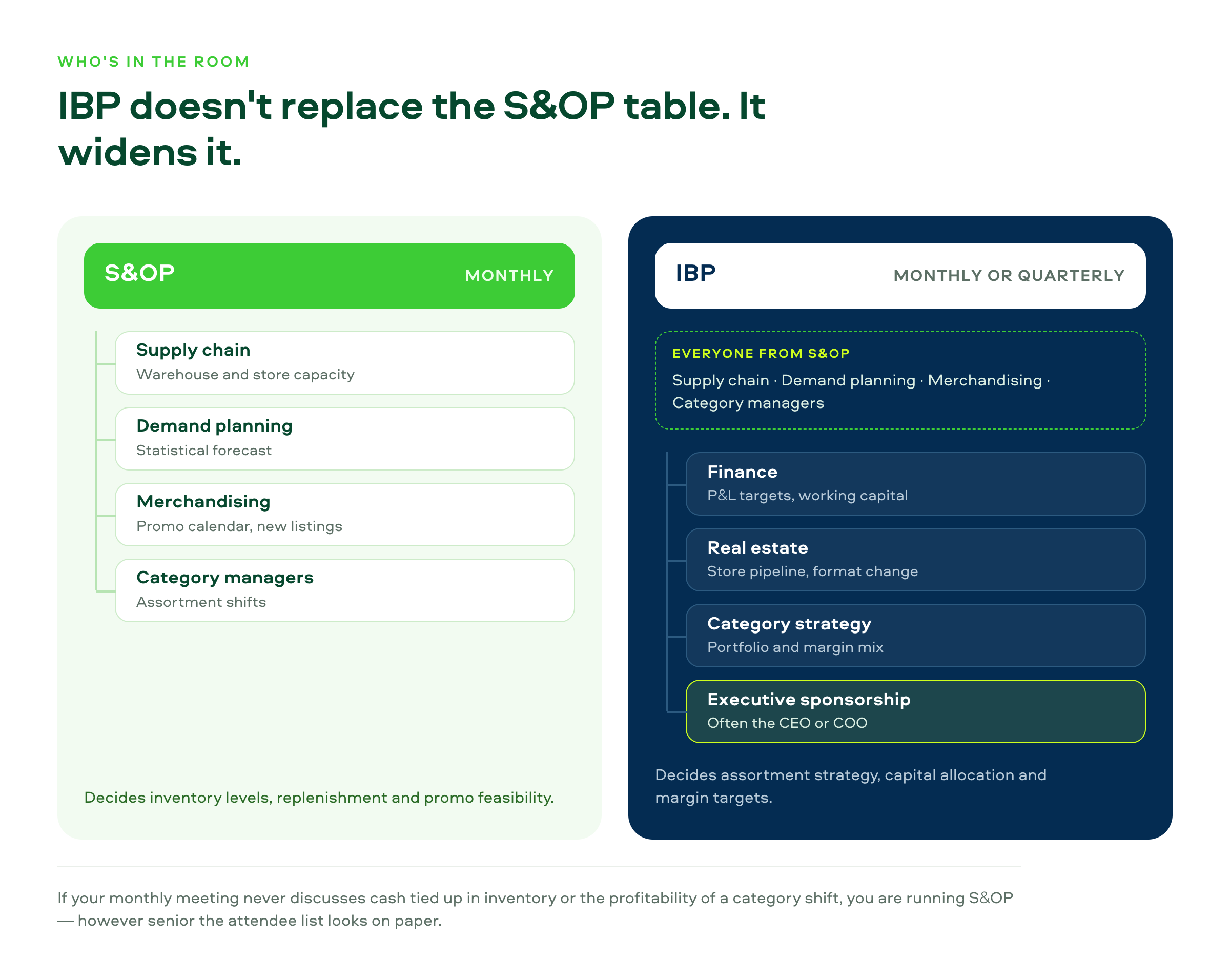
McKinsey describes IBP's full business scope as synchronizing a company's mid- and long-term plans across revenue, product portfolios, capital investments, and procurement. That is a wider net than the supply-demand balance S&OP was built for. An IBP and S&OP comparison usually comes down to one thing: who else is in the room. IBP pulls in finance, real estate, category strategy, and often the CEO or COO, not just supply chain and merchandising. The goal shifts. S&OP asks whether a plan can be executed. IBP asks whether that plan supports where the business is trying to go, financially and strategically. Scenario planning becomes a bigger part of the process too. What happens to margin if fuel costs spike? What happens if a major competitor opens two miles from your flagship store?
None of this makes S&OP obsolete. IBP maturity is usually described as an evolution, not a replacement. Gartner's own S&OP maturity model treats IBP-style integration as the top rung of a five-stage ladder. It moves a retailer from purely operational planning toward strategic planning that finance actually signs off on. Most organizations climb it gradually rather than jump straight to the top. A retailer with strong S&OP does not need to abandon it to add IBP. It needs to widen the table.
S&OP vs IBP: Key Differences at a Glance
Here is where the difference between IBP and S&OP gets concrete, especially on IBP vs. S&OP scope and time horizon, the two dimensions that trip up most comparisons. The table below reflects how each process typically runs inside a retail organization, not a generic manufacturing template borrowed from a factory floor.
| Dimension | S&OP | IBP |
|---|---|---|
| Primary focus | Balancing demand and supply for the next planning cycle | Aligning the operating plan with financial and strategic targets |
| Planning horizon | 1 to 12 months, rolling | 12 to 24+ months, rolling |
| Who's in the room | Supply chain, demand planning, merchandising, category managers | Adds finance, real estate, category strategy, executive sponsorship |
| Cadence | Monthly | Monthly or quarterly, with continuous scenario updates |
| Decision scope | Inventory levels, replenishment, promo feasibility | Assortment strategy, capital allocation, margin targets, new-store impact |
| Data inputs | Sales history, current promo calendar, warehouse and store capacity | All S&OP inputs plus P&L targets, real estate pipeline, category profitability |
| Retail-specific trigger | Seasonal demand shift, promo conflict, perishables risk | Format change, market entry, category portfolio shift |
Reading this table left to right is the fastest way to answer S&OP vs IBP: which is better for my business. It depends on which column your current planning conversations actually live in. It has less to do with which one your org chart says you're supposed to be running.
Is IBP Just a Rebranded S&OP?
Is IBP just S&OP with a different name? Not exactly, though the confusion is understandable. Much of it comes from vendors who use IBP and S&OP interchangeably in marketing copy, mostly because the underlying software often supports both processes. Retailers picking between IBP or S&OP for a new planning tool often end up more confused than when they started. The sales pitch rarely draws the line clearly. That is a naming problem. It is not evidence the two processes are actually the same thing.
The real distinction is financial integration. A mature S&OP process can be excellent at balancing demand and supply and still never touch the P&L directly. IBP, by definition, ties the operating plan to financial outcomes: margin, working capital, and capital spend. If your monthly meeting never discusses cash tied up in inventory or the profitability of a category shift, you are running S&OP. That is true no matter how senior the attendee list looks on paper.
There is a related but separate distinction worth knowing here: sales and operations execution, or S&OE. S&OP and IBP set the plan on a monthly or quarterly cadence. S&OE handles the daily and weekly adjustments when reality diverges from that plan: a late shipment, a stockout, or a sudden demand spike nobody forecast. Our guide on S&OE and S&OP goes deeper into how the two layers work together. That distinction matters here. Retailers sometimes mistake a strong S&OE process for having outgrown S&OP. Really, they have just automated execution without ever fixing the planning process underneath it.
When Should You Move From S&OP to IBP?
There is no universal trigger point for an S&OP to IBP evolution. It tends to show up as a mismatch between what your planning process can answer and what the business is actually asking it to answer.
Signs Your S&OP Has Outgrown Itself
A few patterns show up again and again in retailers ready for IBP. Finance and merchandising build separate versions of the forecast because nobody trusts a single shared number. Category expansion or store format decisions get made without checking whether supply chain and inventory can actually support them. The monthly meeting spends most of its time on this month's stockouts instead of next quarter's assortment risk.
That last pattern is more common than most planning teams admit. A recent industry survey of inventory management professionals found that 51% had knowingly proceeded with demand forecasts they believed were unreliable, simply because no better alternative existed. Another 16% did not formally measure forecast accuracy at all, according to Chain Store Age. If your team recognizes itself in that finding, the underlying problem usually is not the forecasting technique. It is a planning process with no mechanism for financial or strategic sign-off, which is exactly the gap IBP is built to close.
Signs You're Not Ready for IBP Yet
IBP maturity assumes a working S&OP foundation underneath it. Maybe your current process still runs on spreadsheets stitched together the night before the meeting. Maybe category managers routinely override system-generated orders because they do not trust them. If either sounds familiar, adding a financial and strategic layer on top will not fix the underlying issue. It will just give the same unreliable numbers a bigger audience.
In practice, this means fixing the S&OP planning process first. Get to one shared forecast. Automate replenishment so it reflects real constraints instead of manager intuition. Build analytics that catch surplus and lost sales before they become a monthly fire drill. IBP is the next step after that foundation holds. It is not a shortcut around building it in the first place. Retailers who try to run S&OP or IBP planning side by side before either process works rarely see the business performance gains they were chasing.
The Role of Technology in Bridging S&OP and IBP
Whether a retailer runs S&OP, IBP, or something in between, the constraint is usually the same. Getting everyone to work from one set of numbers instead of five slightly different spreadsheets is harder than it sounds. This is where supply chain planning technology earns its place. It matters less as a forecasting engine and more as a shared source of truth that both the merchandising team and the finance team can actually trust.
Here is what that gap looks like in a real retail planning cycle. A grocery chain plans a two-week Easter promotion on chocolate and confectionery. The S&OP process checks whether distribution centers and stores can handle the volume: safety stock, delivery windows, and shelf space freed up by a temporary planogram change. That is a cross-functional alignment problem, but it stays inside the supply chain and merchandising. Now suppose the same promotion also needs a markdown on a slow-moving private-label SKU to free up planogram space, and that markdown affects category margin for the quarter. That decision needs finance and category strategy at the table, and it needs to happen before the promotion ships, not after the quarterly P&L review. That is the moment a retailer's planning process stops being S&OP and starts needing IBP, whether anyone in the room calls it that or not.
Gartner research backs this up with a number worth sitting with. Organizations with a well-designed S&OP process are 1.2 times more likely to outperform competitors on metrics like on-time-in-full delivery, cost, and inventory levels. At the same time, 42% of supply chain organizations still struggle to lift S&OP planning beyond short-term firefighting, according to Gartner data reported by Supply Chain Management Review. Technology alone does not close that gap. Shared data, consistent algorithms, and a planning cadence everyone actually follows do the real work.
For retail specifically, this means AI demand planning that accounts for promotions and seasonality rather than a flat statistical baseline. Connect that forecast to retail inventory optimization that turns the agreed plan into actual replenishment orders automatically, and category managers stop adjusting every order by hand. Depending on how many SKUs a chain runs, that manual adjustment habit alone can eat an entire team's week every month. Once it is gone, the finance side of the IBP conversation finally has current, trustworthy operational data to build a financial plan on top of.
The cost of skipping this step is not abstract. Global retail inventory distortion, out-of-stocks and overstocks combined, reached $1.73 trillion in 2025. That is roughly 6.5% of global retail sales, according to IHL Group research reported by Chain Store Age. Retailers running mature planning processes, whichever label they use for them, tend to sit meaningfully below that average.
How LEAFIO Supports Your Planning Evolution
LEAFIO AI's inventory optimization platform is built around the same principle behind a healthy S&OP or IBP process. Different teams need one shared, trustworthy set of numbers they can act on, without reconciling five versions of the truth first.
White&Dry, a 194-store liquor retailer in Europe, ran replenishment manually across a decentralized network. That produced overstocks in some stores and lost sales in others, month after month. After implementing LEAFIO Inventory Optimization, White&Dry improved inventory turnover by 36% (from 87 to 64 days) and grew sales by 56%. Lost sales dropped 5%, and order generation is now fully automated across the chain.
OMA, a 38-store DIY and building materials retailer, faced a harder version of the same alignment problem. OMA carries roughly 70,000 SKUs, with a purchasing organization spanning more than 50 specialists, category managers, and logistics staff. Too many stakeholders were working from inconsistent, manually adjusted order data. After connecting 95% of its assortment to LEAFIO Inventory Optimization, OMA reduced stock levels by 15% within twelve weeks on pilot groups. Inventory turnover improved 18% and sales grew 32%. That gave purchasing specialists and category managers a shared, reliable basis for the kind of cross-functional trade-offs an S&OP or IBP process depends on.
Neither retailer set out to "do IBP." Both needed their S&OP foundation, one set of numbers everyone trusted, working first. That is usually the honest starting point, whatever your planning maturity roadmap eventually calls for. If your team is evaluating S&OP software for retail as part of that roadmap, start from the same question these two retailers had to answer. Does everyone in the room, from category managers to finance, currently agree on the numbers in front of them?
FAQ
A few of the questions that come up most often when retail planning teams are weighing IBP vs S&OP for their own organization.
What is the difference between IBP and S&OP?
Sales and operations planning (S&OP) and integrated business planning (IBP) both balance demand and supply, but at different altitudes. S&OP works on a rolling one-to-twelve-month horizon, led by supply chain and merchandising. IBP extends that process to twelve months or beyond and adds finance and executive stakeholders. It ties the plan directly to margin, capital, and strategic targets rather than just operational feasibility.
Is IBP just S&OP with a different name?
No, though they are often marketed as interchangeable. The real difference is financial integration. S&OP can run well without ever touching the P&L. IBP is defined by connecting the operating plan to financial outcomes and strategic decisions, not just supply-demand balance.
When should a company move from S&OP to IBP?
Move toward IBP when your S&OP meetings keep running into questions they cannot answer. That includes whether a category expansion is financially viable, or why finance and merchandising forecasts do not match. This works best once your underlying S&OP process is already solid enough to build on.
What's the difference between IBP and S&OP in scope and time horizon?
S&OP typically covers 1 to 12 months and focuses on operational balance. IBP typically covers 12 to 24 months or more, adding financial planning, category strategy, and scenario simulation on top of that operational base.
Do I need IBP, or is S&OP enough for my business?
If your organization is small enough that finance and merchandising already talk daily and informally, formal IBP may add process overhead without much benefit. Once you have multiple categories, multiple stakeholders, and decisions that need financial sign-off, IBP earns its complexity.
How long does a S&OP to IBP evolution typically take?
There is no fixed timeline, since it depends on how mature your existing S&OP process is. Retailers with clean, automated replenishment and a trusted single forecast can extend into IBP within months. Retailers still fixing manual, spreadsheet-driven S&OP should expect that foundational work to take longer than the IBP layer itself.
Does IBP replace demand planning and inventory optimization tools?
No. IBP is a governance process, not a replacement for the tools that generate the forecast and the replenishment orders underneath it. Demand planning and inventory optimization software feed the numbers that an S&OP or IBP meeting reconciles and approves.
What is IBP maturity, and how do retailers measure it?
IBP maturity describes how far a planning process has moved from disconnected, manual decisions toward a single, financially integrated plan that the whole business trusts. Most maturity models, including Gartner's, treat it as a five-stage progression rather than a pass-or-fail assessment.


Have a question?

Jack Larson
Retail Optimization Expert