


If you're looking for the best RELEX Solutions alternatives, you're not alone. The top alternatives to RELEX include LEAFIO AI, Blue Yonder, Kinaxis, o9 Solutions, ToolsGroup, Slimstock, Netstock, Anaplan, SAP IBP, Logility, and Manhattan Associates.
RELEX Solutions is an AI-driven platform designed primarily for large enterprise retailers, wholesalers, and manufacturers. It provides end-to-end planning across forecasting, replenishment, merchandising, pricing, and workforce management, with customers like Dollar Tree, Lidl, and AutoZone.
However, many businesses start exploring alternatives to RELEX Solutions due to long implementation timelines, high total cost of ownership, and limited flexibility for mid-size retailers. Others look for a more practical RELEX replacement that combines advanced planning with strong day-to-day retail execution.
In this guide, you'll find a side-by-side comparison and a detailed review of each solution to help you choose the best RELEX alternative for your business in 2026.
How I Picked the Best RELEX Solutions Alternatives
To select the most relevant RELEX Solutions competitors, I evaluated each platform against criteria that matter most to retail and supply chain decision-makers:
- Core capabilities: Demand forecasting, inventory optimization, replenishment automation, and merchandising.
- Target audience: Whether the solution fits mid-size retailers, enterprise chains, or both.
- AI and automation depth: How advanced the platform's AI/ML capabilities are for planning and execution.
- Implementation speed: Typical deployment timelines and time-to-value.
- Integration ecosystem: Compatibility with popular ERP systems, POS platforms, and data sources.
- User experience: Interface intuitiveness for analysts, category managers, and store-level teams.
- Customer reviews and analyst ratings: Feedback from G2, Capterra, Gartner Peer Insights, and other platforms.
- Pricing flexibility: How accessible the solution is for businesses at different stages of growth.
Quick Comparison Table
| Solution | Best For | Price Range | Free Trial? | Key Difference vs RELEX |
|---|---|---|---|---|
| LEAFIO AI | Mid-size & growing retail chains | Two-part: implementation + subscription | Simulation available | Faster implementation (1–6 months), modular approach |
| Blue Yonder | Large enterprise supply chains | Enterprise pricing (high TCO) | Demo available | Broader execution suite (WMS, TMS, returns) |
| Kinaxis | Complex manufacturing & retail supply chains | $500–$1,000+/user/mo | Demo available | Patented concurrency for real-time what-if scenarios |
| o9 Solutions | Enterprises connecting finance & supply chain | Enterprise custom pricing | Demo available | "Digital Brain" integrating financial & operational planning |
| ToolsGroup | Distributors & retailers with demand uncertainty | Custom, from ~$5,000/mo | Demo available | Probabilistic forecasting & multi-echelon optimization |
| Slimstock | Mid-market wholesale & distribution | Custom pricing | Demo available | Practical, focused inventory optimization |
| Netstock | SMBs needing ERP-connected inventory planning | ~$900–$2,000/mo | Demo available | 60+ ERP integrations, 30–45 day deployment |
| Anaplan | Cross-functional enterprise planning (finance + SC) | Enterprise pricing | Demo available | Flexible modeling across finance, sales, and supply chain |
| SAP IBP | SAP ecosystem enterprises | SAP licensing model | Demo available | Native SAP ERP integration |
| Logility | Multi-step inventory optimization | Custom pricing | Demo available | Strong in multi-step optimization with AI forecasting |
| Manhattan Associates | Omnichannel retail & warehouse execution | Enterprise pricing | Demo available | Leading WMS combined with supply chain planning |
Why Consider Alternatives to RELEX Solutions?
RELEX is a powerful platform, but it is not the right fit for every business. Here are the most common reasons teams explore RELEX Solutions alternatives:
1. Long and complex implementation cycles
RELEX implementations are typically designed for enterprise-wide transformation. For businesses that need faster results, this timeline can be a challenge. Organizations that want to start optimizing specific functions — like replenishment or shelf management — before committing to a full platform rollout may benefit from a more modular approach.
2. Enterprise-oriented pricing
RELEX's SaaS pricing model can escalate as organizations add modules and users. According to some user reviews on Gartner Peer Insights, the modular pricing structure means costs can increase as features become intertwined. For mid-size retailers, this may represent a significant barrier to adoption.
3. Limited store-level execution tools
RELEX excels at centralized planning but does not emphasize field-level tools such as mobile apps for merchandisers, barcode scanning, or photo-based planogram compliance. Retailers who need a bridge between analytics and in-store execution may find gaps here.
4. Complexity for mid-size organizations
As a platform designed for multinational enterprises, RELEX's depth of configuration can be more than what growing retail chains need. Some teams prefer a solution that balances sophistication with simplicity.
5. Regional support limitations
While RELEX has a global presence, some users in specific regions have noted challenges with language support and localized service.
6. Forecasting gaps in specific categories
User reviews indicate that forecasting for products with very short shelf life or freight-limit constraints could be improved. Businesses dealing with complex fresh product logistics may want to explore specialized options.
Top 11 Alternatives to RELEX Solutions
1. LEAFIO AI — Best for Mid-Size and Growing Retail Chains
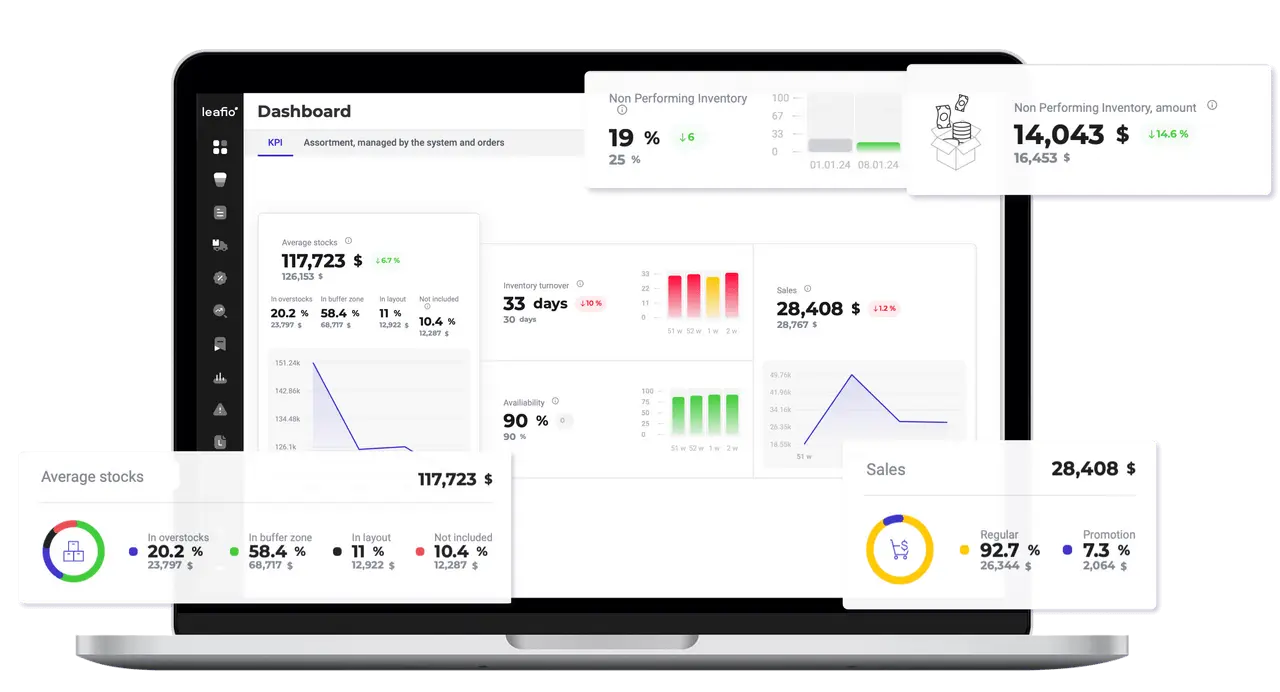
LEAFIO AI is a modular AI-powered retail optimization platform designed for small, mid-size, and growing multi-format retail networks. Operating in 40+ countries across Europe, North America, and South America, LEAFIO AI delivers specialized solutions for inventory optimization, demand planning, shelf efficiency, assortment performance, and promotion management.
Unlike RELEX's unified enterprise approach, LEAFIO AI enables retailers to implement individual modules and expand over time—making it one of the most practical software like RELEX Solutions for businesses that want measurable improvements without a full-scale transformation.
Key Features:
- AI-driven demand forecasting tied directly to automated replenishment, accounting for seasonality, promotions, and trends.
- Automatic replenishment with order creation and transfer across multi-echelon supply chains, achieving up to 99.5% order automation.
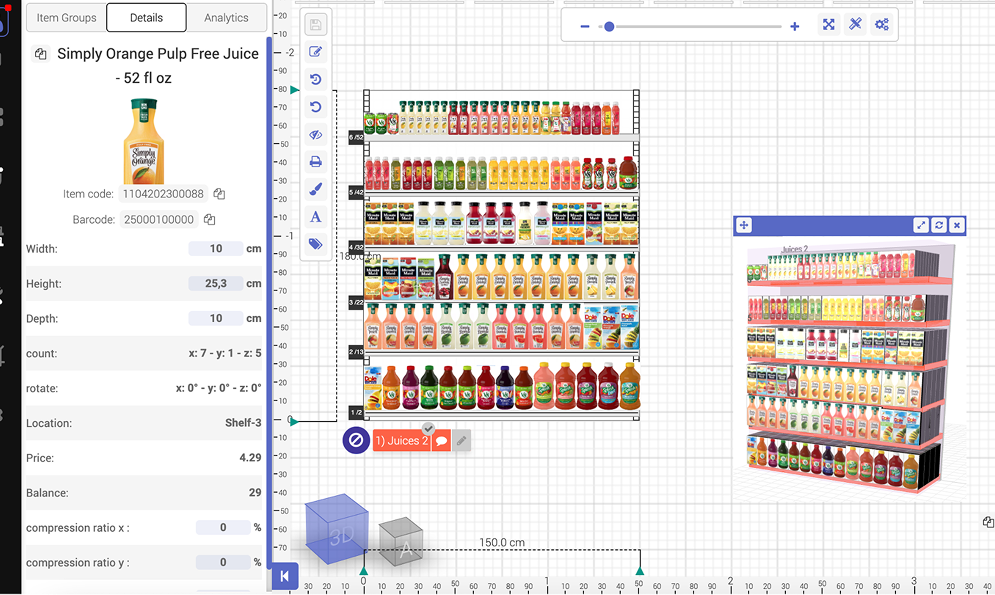
- Shelf efficiency module with autoplanogram generation, AI-powered planogram image recognition, and a mobile app for store-level execution.
- Assortment performance with AI-driven Smart Recommendations for store-level assortment matrix optimization, including automated price segmentation.
- Promotion management featuring the new AI Promo Assistant—an agentic AI that makes promotion forecasting transparent and explainable.
- Strategy automation for one-click intelligence in assortment decisions.
- Agentic AI assistants embedded across modules—from Shelf Efficiency analytics to promotional planning—providing instant, actionable insights.
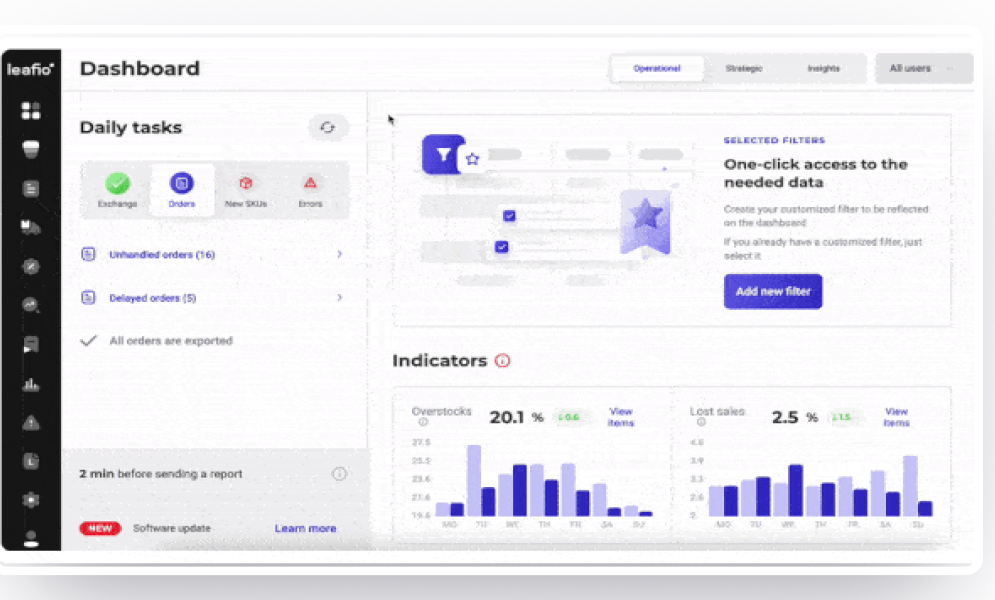
- Retail Management SuperApp for in-store price checking, inventory scanning, task management, and photo reporting.
- BI module and real-time dashboards for full visibility into goods movement across the network.
Pricing: Two-part pricing: a one-time implementation fee plus an ongoing subscription that scales with store count and SKU volume. Significantly more accessible than enterprise-tier platforms for mid-size retailers. Simulation available upon request — no free trial, but retailers can see the platform in action with their own data.
| ✅ Pros | ❌ Cons |
|---|---|
| Fast implementation: typically 1–6 months | Less suited for extremely complex global manufacturing supply chains |
| Modular architecture — start with one solution, expand over time | Growing ecosystem — fewer third-party marketplace integrations than larger platforms |
| Strong mobile tools for field teams (SuperApp) | Primarily focused on retail — not designed for 3PL or transportation management |
| Proven case studies with measurable ROI (50% overstock reduction, 62% sales increase at Baltic Petroleum) | |
| Agentic AI assistants across modules | |
| Dedicated customer success team with 5.0/5 support ratings on Capterra |
How it compares to RELEX:
- Better in: Implementation speed, modular flexibility, store-level execution tools (mobile app, planogram compliance), pricing accessibility for mid-size retailers, dedicated customer success approach.
- RELEX is stronger in unified end-to-end enterprise planning for multinational organizations, workforce management, and deep multi-department orchestration.
Best for: Mid-size and growing retail chains (grocery, convenience, health & beauty, DIY, pharmacies, e-commerce) that need rapid AI-driven inventory, assortment, and shelf optimization without enterprise-level complexity or cost. Notable clients include Carrefour LabelVie (180 stores), Smart & Final Mexico, Baltic Petroleum, and the Daily network.
Verdict: LEAFIO AI is the strongest RELEX alternative for retailers who prioritize speed of implementation, modular flexibility, and operational execution. If you need to start improving inventory performance and in-store execution within months rather than years, LEAFIO AI delivers.
→ Request a simulation from LEAFIO AI
2. Blue Yonder — Best for Large Enterprise Supply Chain Transformation
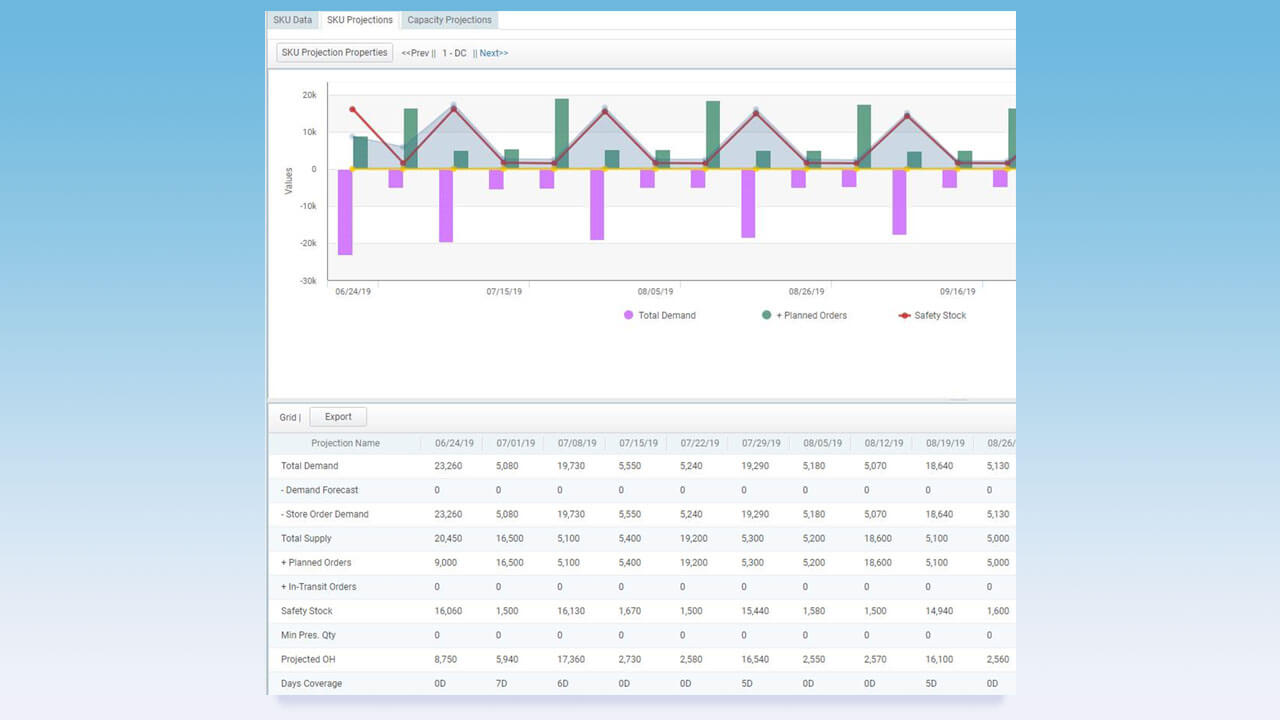
Blue Yonder (formerly JDA Software) is one of the world's largest supply chain technology providers, backed by Panasonic. With more than 35 years of experience and over 3,000 customers globally, the platform offers an end-to-end suite spanning supply chain planning, warehouse management, transportation, order management, returns, and workforce management. Blue Yonder is trusted by retailers and manufacturers like Walmart, DHL, and PepsiCo.
Key Features:
- End-to-end supply chain planning with AI-driven demand forecasting and supply optimization.
- Luminate Control Tower for real-time, network-wide visibility.
- Warehouse and transportation management systems (WMS/TMS).
- Category management, assortment, and space planning for retail.
- AI agents for merchandise financial planning and assortment optimization.
- Multi-enterprise network connecting suppliers, carriers, and partners.
Pricing: Enterprise pricing with custom quotes. The 3-year total cost of ownership can range from $500,000 to several million dollars depending on scope and complexity. Implementation costs can easily exceed hundreds of thousands.
| ✅ Pros | ❌ Cons |
|---|---|
| Broadest suite in the market (planning + execution + commerce) | Very high total cost of ownership |
| Powerful AI with 20 billion+ predictions daily | Lengthy implementations — can take 12+ months |
| Massive global customer base and partner ecosystem | UI perceived as outdated by some users |
| Strong WMS and TMS capabilities | Requires specialized consultants for configuration |
How it compares to RELEX:
- Better in: Breadth of execution capabilities (WMS, TMS, returns), global scale, and warehouse and transportation management.
- RELEX is stronger in retail-focused planning depth, faster implementation relative to Blue Yonder, and a more modern planning interface.
Best for: Large global enterprises with complex, multi-tier supply chains that need a unified planning and execution platform. Best evaluated by organizations with $1B+ revenue and dedicated IT teams.
Verdict: Blue Yonder is the heavyweight option — incredibly powerful but requires significant investment in time, money, and internal resources.
3. Kinaxis — Best for Real-Time Scenario Planning and Concurrent Decision-Making
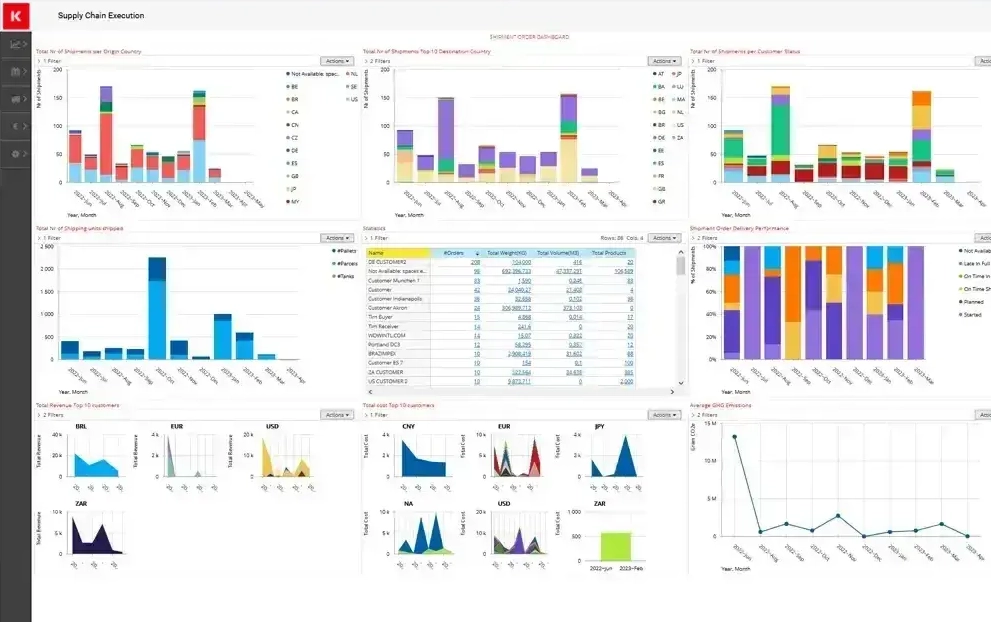
Kinaxis, headquartered in Ottawa, Canada, offers the Maestro platform (formerly RapidResponse) — a cloud-based supply chain orchestration solution known for its patented concurrency technique. This technology enables instant recalculation of the entire supply chain when any single data point changes, making Kinaxis uniquely powerful for what-if scenario planning.
Key Features:
- Patented concurrency for real-time, end-to-end supply chain recalculation.
- Demand.AI with ML-based forecasting models for retail and manufacturing.
- Scenario simulation and what-if analysis across demand, supply, and capacity.
- S&OP, demand planning, supply planning, inventory, and production scheduling.
- New Maestro Agent Studio for building no-code AI agents.
- Replenishment planning with store-level guardrails.
Pricing: Subscription-based, starting around $500–$1,000+ per user per month, tiered by organization size and feature requirements.
| ✅ Pros | ❌ Cons |
|---|---|
| Industry-leading what-if scenario planning | Primarily focused on planning, not execution (no WMS/TMS) |
| 50x faster MRP processing than legacy ERP systems | Enterprise pricing can be prohibitive for mid-size businesses |
| Strong in manufacturing (auto, pharma, high-tech) | Retail-specific capabilities still maturing compared to RELEX |
| Rapidly expanding retail-focused innovations |
How it compares to RELEX:
- Better in: Real-time concurrent planning, scenario simulation speed, manufacturing-oriented supply chain.
- RELEX is stronger in retail-specific depth (merchandising, space planning, promotions) and a broader retail customer base.
Best for: Large enterprises in manufacturing, automotive, life sciences, and high-tech with complex, volatile supply chains. Increasingly relevant for retail chains seeking advanced scenario planning.
Verdict: Kinaxis is the top choice for organizations that prioritize rapid what-if analysis and real-time supply chain recalculation. Less retail-specialized than RELEX or Leafio AI.
4. o9 Solutions—Best for Connecting Financial and Operational Planning
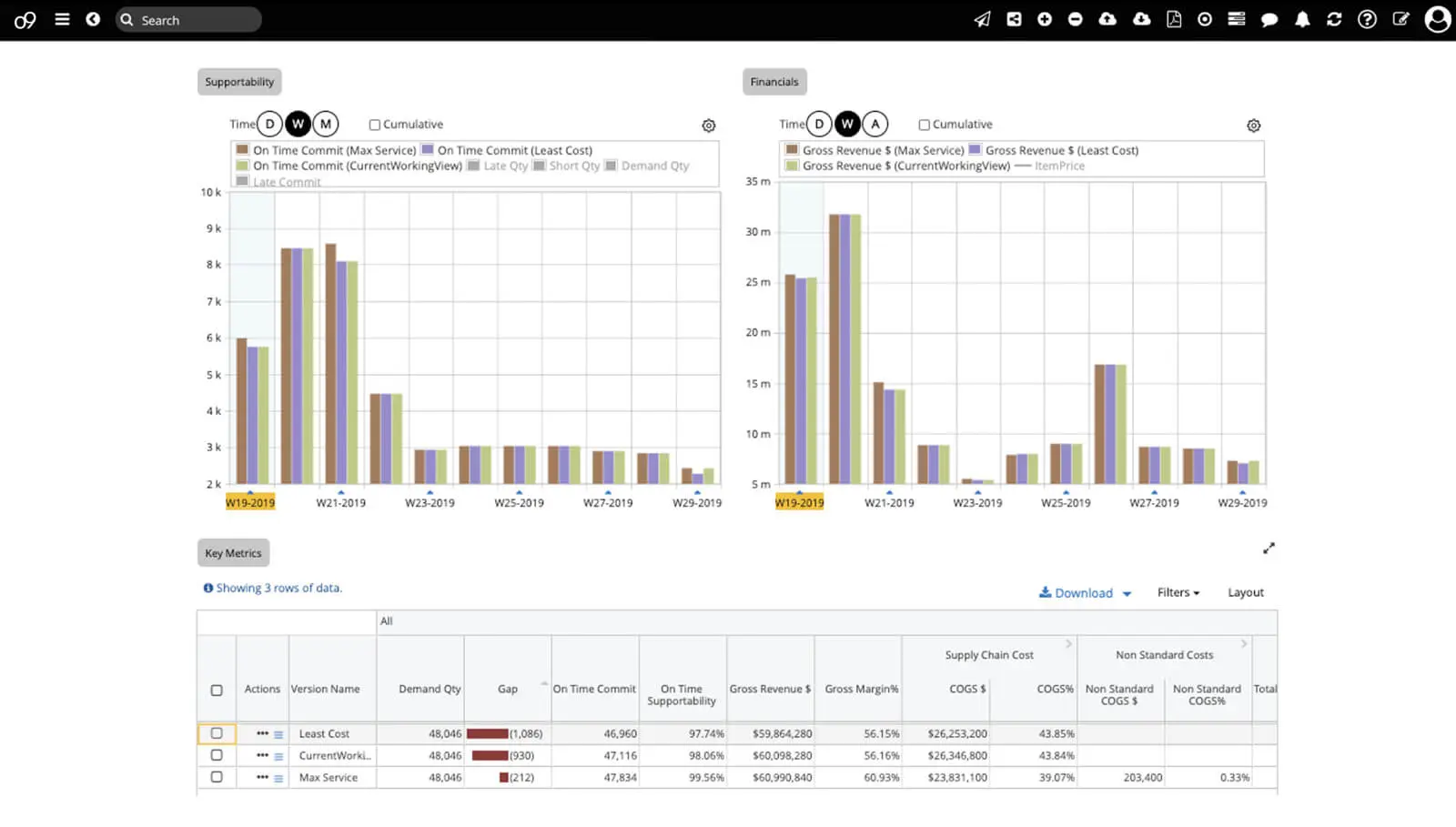
[Image placeholder: o9 Solutions Digital Brain Interface
o9 Solutions offers its "Digital Brain" platform—an AI-powered, cloud-native solution that integrates supply chain, commercial, and financial data into a unified decision-making engine. Founded in Dallas, Texas, o9 uses an enterprise knowledge graph to connect data sources and break down planning silos across departments.
Key Features:
- AI/ML-driven integrated business planning (IBP) connecting finance, sales, and supply chain.
- Enterprise Knowledge Graph for unified data modeling.
- Demand sensing and scenario planning.
- Supply chain digital twin capabilities.
- Revenue management and pricing optimization.
- Real-time alerts for supplier delays and demand peaks.
Pricing: Enterprise custom pricing. Tailored to organization size and modules selected.
| ✅ Pros | ❌ Cons |
|---|---|
| Powerful integration of financial and operational planning | Platform reliability initially had issues (improved over 5+ years per reviews) |
| Highly flexible and configurable | Steep learning curve for new users |
| Strong AI/ML capabilities with continuous improvement | Less proven in mid-size retail compared to RELEX or LEAFIO AI |
| Solution-oriented partner support | Enterprise-level complexity and cost |
How it compares to RELEX:
- Better in: Cross-functional planning (connecting finance + supply chain), digital twin capabilities.
- RELEX is stronger in retail-specific execution (merchandising, space, and workforce) and an established retail customer base.
Best for: Large enterprises seeking to unify financial planning with supply chain operations, particularly in CPG and manufacturing.
Verdict: o9 Solutions is ideal for organizations that need a holistic "digital brain" connecting all business functions—but it's more suited to strategic IBP than day-to-day retail execution.
5. ToolsGroup — Best for Demand Uncertainty and Distribution Optimization

ToolsGroup, with its SO99+ (Service Optimizer 99+) platform, specializes in AI-powered probabilistic forecasting and multi-echelon inventory optimization. The platform is particularly effective for distributors, wholesalers, and retailers dealing with complex demand patterns and long-tail inventory.
Key Features:
- Probabilistic forecasting using machine learning for demand uncertainty.
- Multi-echelon inventory optimization (MEIO).
- Automated replenishment and order planning.
- Service-level-driven inventory strategies.
- Supply chain analytics and visibility.
Pricing: Custom subscription-based pricing, starting from approximately $5,000/month depending on company size and modules.
| ✅ Pros | ❌ Cons |
|---|---|
| Industry-leading probabilistic forecasting | Less focused on retail merchandising and space planning |
| Strong multi-echelon optimization | The interface can feel less modern than newer platforms |
| Well-suited for distribution and wholesale | Limited store-level execution tools |
| Good partner support (4.4/5 on Gartner) | Smaller customer base than Blue Yonder or RELEX |
How it compares to RELEX:
- Better in: Probabilistic forecasting methodology, long-tail SKU management, distribution network optimization.
- RELEX is stronger in retail breadth (merchandising, space, pricing, workforce) and unified retail planning.
Best for: Distributors and retailers with high SKU complexity, unpredictable demand, and multi-echelon supply chains.
Verdict: ToolsGroup is a strong RELEX alternative for organizations that prioritize demand uncertainty management and service-level optimization over full retail planning.
6. Slimstock — Best for Practical Mid-Market Inventory Optimization

Slimstock is a Netherlands-based provider offering Slim4, a cloud-based inventory optimization platform designed primarily for mid-market wholesalers, distributors, and retailers. The company emphasizes practical, focused inventory management without the complexity of full supply chain suites.
Key Features:
- AI-driven demand forecasting with automatic model selection.
- Safety stock optimization and replenishment automation.
- Supplier performance management.
- S&OP planning capabilities.
- Integration with major ERP systems.
- Focus on reducing excess stock and improving product availability.
Pricing: Custom pricing based on business size and requirements.
| ✅ Pros | ❌ Cons |
|---|---|
| Practical, focused approach to inventory optimization | Limited merchandising and space planning features |
| Strong implementation methodology (vendor implements directly) | Smaller global footprint than RELEX or Blue Yonder |
| Good fit for mid-market distribution and wholesale | Fewer advanced AI capabilities compared to newer platforms |
| Exceeded customer expectations per Gartner reviews | Not as strong in retail-specific use cases |
How it compares to RELEX:
- Better in: Implementation simplicity for mid-market businesses, direct vendor implementation.
- RELEX is stronger in AI sophistication, retail-specific planning, and unified platform breadth.
Best for: Mid-market wholesalers and distributors needing practical, reliable inventory optimization without enterprise-level complexity.
Verdict: Slimstock is a solid mid-market choice for organizations that want straightforward inventory optimization—but it lacks the retail execution depth of LEAFIO AI or the enterprise planning power of RELEX.
7. Netstock — Best for SMBs Seeking ERP-Connected Inventory Planning
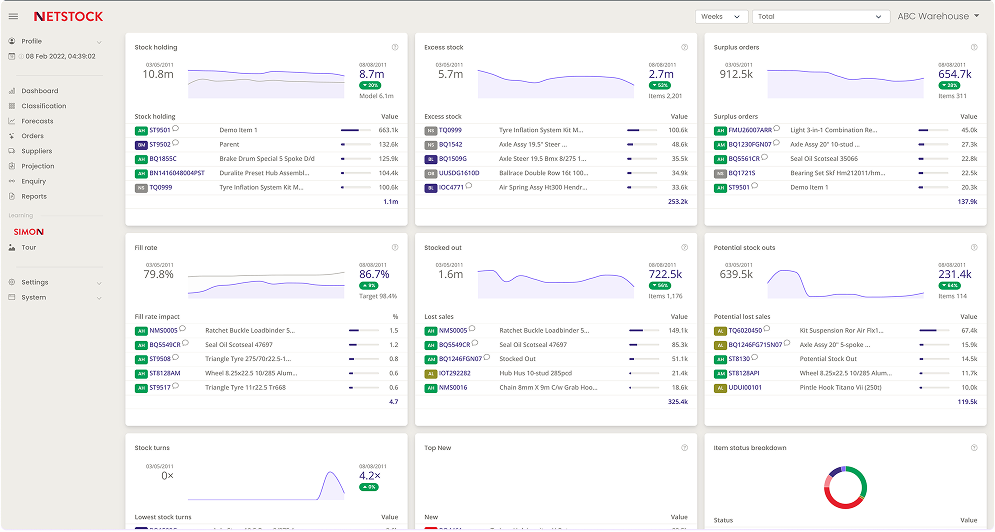
Netstock is a cloud-based demand and supply planning platform built specifically for small and medium-sized businesses. With 2,400+ customers and 20,000+ users globally, Netstock focuses on transforming ERP data into predictive inventory insights. The platform integrates with over 60 ERP systems, making it one of the most connected solutions in its category.
Key Features:
- AI-powered demand forecasting with automatic model selection per SKU.
- Dynamic safety stock calculations based on supply and demand variability.
- Inventory classification by value and velocity.
- Automated replenishment recommendations.
- What-if scenario planning for demand and supply changes.
- Intuitive dashboards with real-time visibility.
- 60+ ERP integrations (SAP, NetSuite, Dynamics, Sage, and more).
Pricing: Subscription-based, typically starting around $900–$2,000/month depending on users, SKUs, and ERP integrations. Designed to be affordable for SMBs.
| ✅ Pros | ❌ Cons |
|---|---|
| 60+ ERP integrations — widest range in the market | Limited capabilities for large enterprises with complex supply chains |
| Rapid deployment: 30–45 days to go live | No merchandising, space planning, or shelf efficiency features |
| 98% user satisfaction rating on SelectHub | Reporting customization options are limited |
| Dedicated account managers and learning academy | Primarily focused on inventory — not a full supply chain platform |
How it compares to RELEX:
- Better in: Affordability for SMBs, ERP integration breadth, deployment speed.
- RELEX is stronger in enterprise-scale planning, retail merchandising, and unified supply chain platforms.
Best for: Small and mid-size distributors, wholesalers, and retailers using ERP systems who want to add AI-driven inventory planning without major cost or complexity.
Verdict: Netstock is the best RELEX alternative for SMBs on a budget who need practical, ERP-connected inventory optimization. For mid-size retailers needing both inventory and merchandising, LEAFIO AI provides a more comprehensive solution.
8. Anaplan — Best for Cross-Functional Enterprise Planning
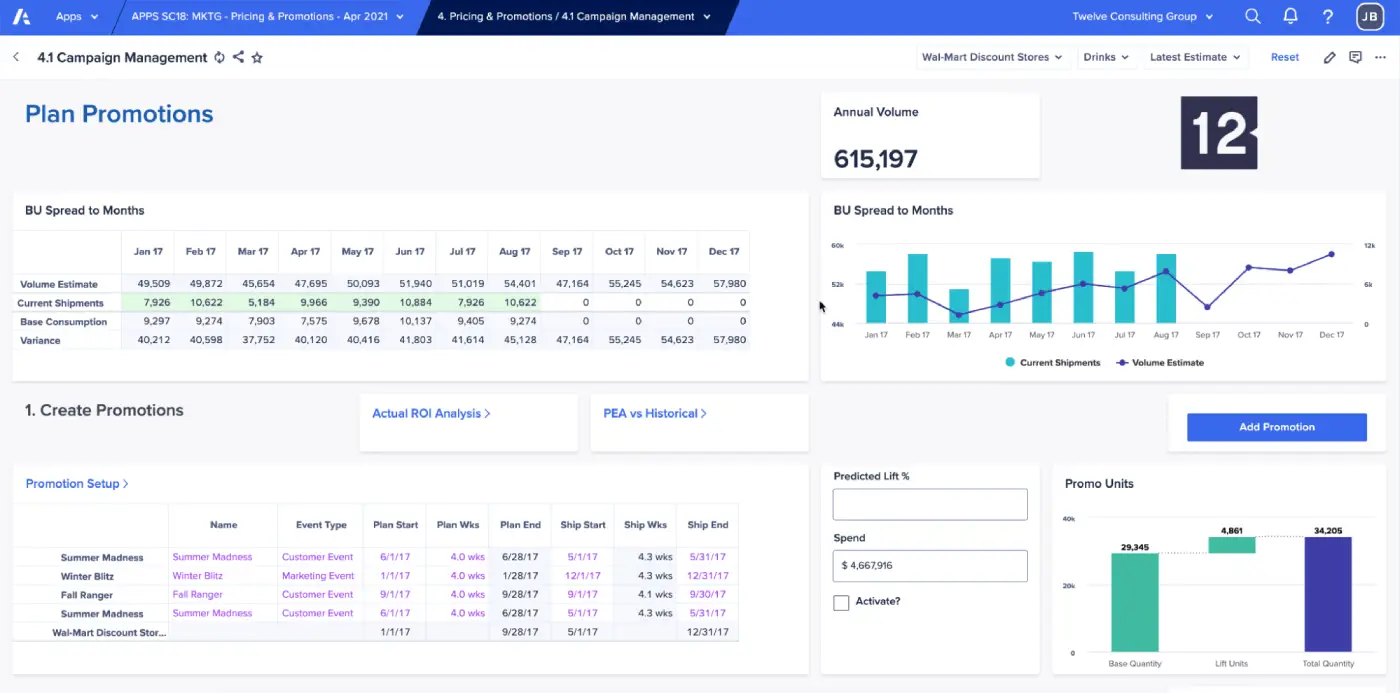
Anaplan is a SaaS planning platform that enables enterprise-wide modeling across finance, sales, supply chain, and workforce functions. Rated as the top supply chain planning solution by ISG in 2025 (and a leader in six categories), Anaplan is known for its flexible, model-anything architecture.
Key Features:
- Hyperblock calculation engine for large-scale, multi-dimensional modeling.
- Connected planning across finance, sales, marketing, and supply chain.
- Scenario planning and what-if analysis.
- Demand forecasting and S&OP.
- Pre-built supply chain planning apps and templates.
Pricing: Enterprise pricing. Custom quotes based on workspace size and user count.
| ✅ Pros | ❌ Cons |
|---|---|
| Most flexible planning platform — model virtually any process | Not purpose-built for retail execution |
| Strong cross-functional planning (finance + SC + sales) | Requires skilled modelers for initial configuration |
| Highest ISG rating for supply chain and retail planning | It can be expensive for mid-size organizations |
| Excellent scenario planning capabilities | Lacks inventory execution features like replenishment automation |
How it compares to RELEX:
- Better in: Cross-functional planning flexibility, financial planning integration.
- RELEX is stronger in retail-specific execution (demand, inventory, merchandising, and space) and operational automation.
Best for: Large enterprises seeking a connected planning platform across finance and supply chain. Often selected alongside execution-focused tools.
Verdict: Anaplan is a strategic planning powerhouse but lacks the operational execution depth that retailers need for day-to-day inventory and shelf management.
9. SAP Integrated Business Planning (IBP) — Best for SAP Ecosystem Enterprises
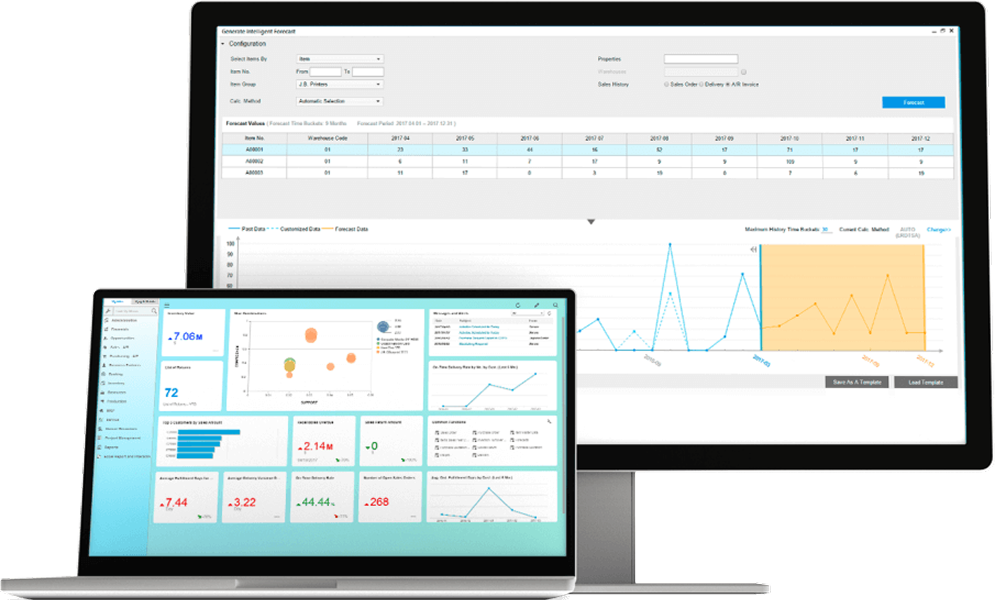
SAP IBP is a cloud-based supply chain planning solution built on SAP HANA's in-memory computing platform. It combines demand planning, response and supply planning, and inventory optimization within the SAP ecosystem. For organizations already running SAP S/4HANA or SAP ERP, IBP offers native integration and a familiar technology environment.
Key Features:
- Demand planning with statistical forecasting and ML.
- Response and supply planning with real-time scenario simulation.
- Inventory optimization across multi-echelon networks.
- S&OP and integrated business planning.
- Native integration with SAP S/4HANA and SAP ERP.
Pricing: SAP licensing model — typically enterprise-level subscription, often bundled with other SAP solutions.
| ✅ Pros | ❌ Cons |
|---|---|
| Seamless integration for SAP-centric organizations | Connecting with non-SAP systems can be complex and costly |
| Powerful in-memory computing for real-time planning | Steep learning curve and significant implementation effort |
| Strong inventory optimization and S&OP | Less specialized in retail execution compared to RELEX |
| Part of a broader enterprise platform | High total cost of ownership |
How it compares to RELEX:
- Better in: SAP ecosystem integration, financial planning alignment.
- RELEX is stronger in retail-specific planning and execution, faster time-to-value, merchandising, and space management.
Best for: Large enterprises already invested in the SAP ecosystem that want to consolidate supply chain planning within their existing technology stack.
Verdict: SAP IBP is the natural choice for SAP shops — but for retail-specific optimization, platforms like RELEX or LEAFIO AI offer deeper capabilities.
10. Logility — Best for Multi-Step Inventory Optimization with AI
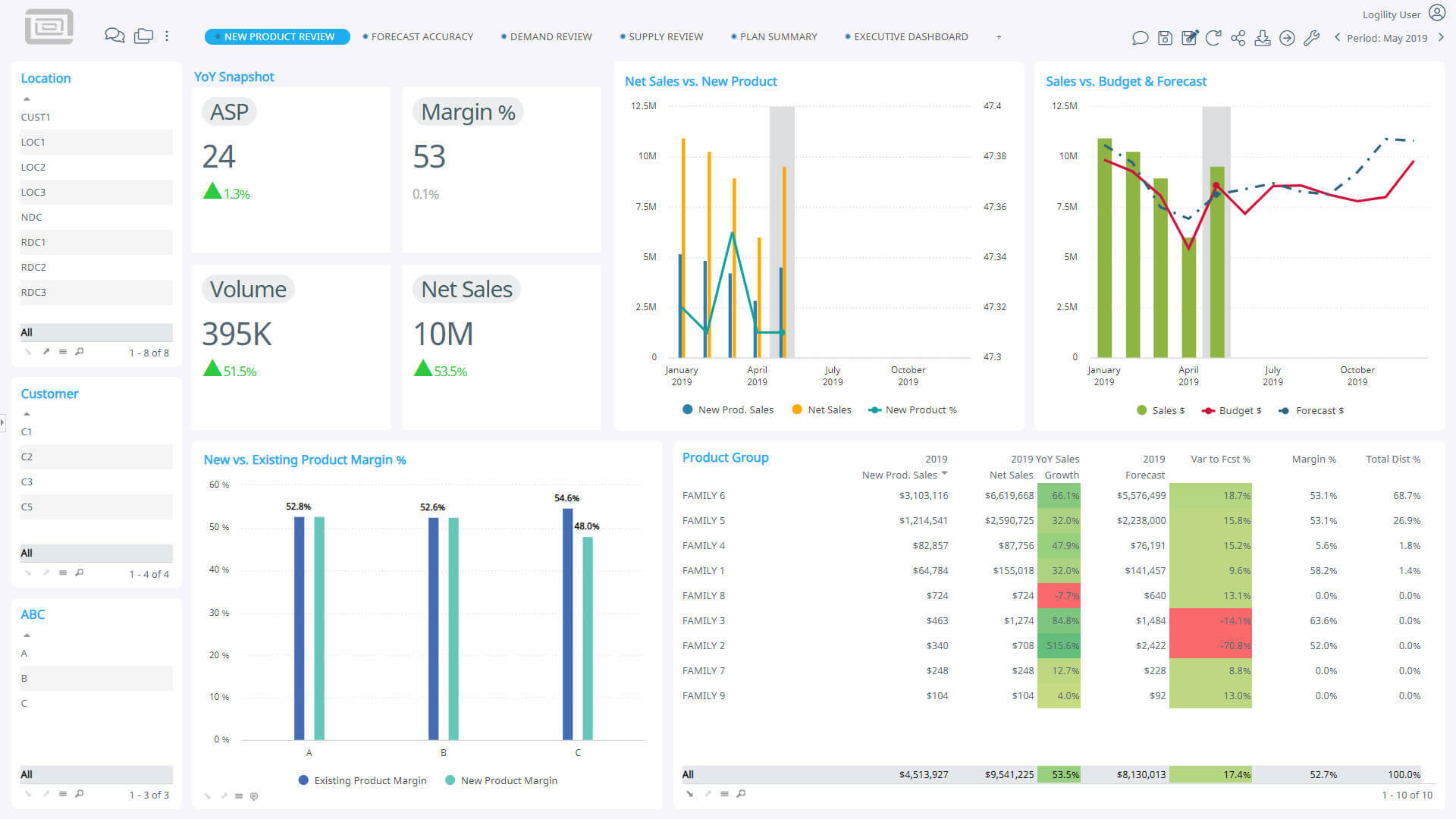
Logility is a supply chain planning provider specializing in demand planning, inventory optimization, and supply planning. The platform combines advanced analytics with AI-powered forecasting and multi-step optimization, helping distributors and retailers balance service levels with inventory investment.
Key Features:
- AI-driven demand forecasting and demand sensing.
- Multi-step inventory optimization across the supply chain.
- Supply planning and S&OP capabilities.
- Retail allocation and replenishment.
- Sustainability and waste reduction analytics.
Pricing: Custom pricing based on deployment scope and user count.
| ✅ Pros | ❌ Cons |
|---|---|
| Strong multi-step inventory optimization | Smaller market presence than RELEX or Blue Yonder |
| AI capabilities with practical demand sensing | The interface and UX lag behind newer platforms |
| Good fit for distribution and wholesale | Limited retail merchandising and space planning |
| ISG-rated as Innovative for supply chain planning | Implementation can require significant consulting |
How it compares to RELEX:
- Better in: Multi-step inventory optimization methodology.
- RELEX is stronger in retail planning breadth, modern interface, and unified platform.
Best for: Distributors and retailers focused on optimizing inventory across multiple supply chain echelons.
Verdict: Logility is a solid option for inventory-focused optimization but doesn't match the retail execution depth of RELEX or the practical accessibility of LEAFIO AI.
11. Manhattan Associates — Best for Omnichannel Retail Execution and Warehouse Management
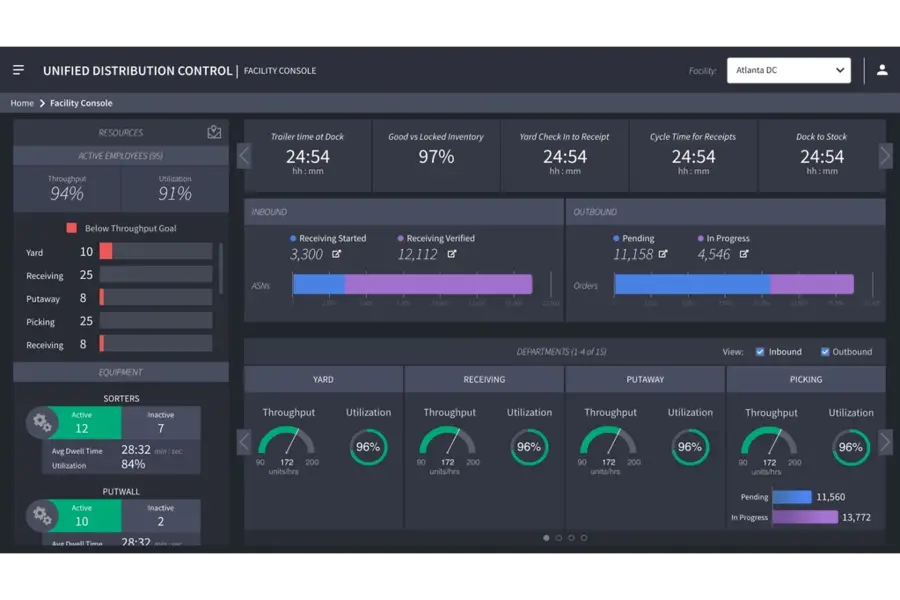
Manhattan Associates is a technology leader in supply chain and omnichannel solutions, best known for its industry-leading warehouse management system (WMS). The company also offers supply chain planning, inventory optimization, and order management capabilities, making it a comprehensive option for retailers focused on execution excellence.
Key Features:
- Industry-leading WMS for complex distribution operations.
- Order management and omnichannel fulfillment.
- Supply chain planning and inventory optimization.
- Point-of-sale and store operations.
- Demand forecasting and replenishment.
Pricing: Enterprise pricing, custom quotes.
| ✅ Pros | ❌ Cons |
|---|---|
| Best-in-class warehouse management system | Planning capabilities not as deep as RELEX or Kinaxis |
| Strong omnichannel fulfillment and order management | Higher complexity for organizations focused primarily on planning |
| Proven at scale with major retailers | Enterprise-level cost and implementation |
| Recognized as Innovative by ISG for retail supply chain planning | Less focused on shelf efficiency and merchandising |
How it compares to RELEX:
- Better in: Warehouse management, order fulfillment, omnichannel execution.
- RELEX is stronger in demand forecasting depth, merchandising, pricing, and promotions planning.
Best for: Large retail and distribution enterprises prioritizing warehouse operations and omnichannel fulfillment alongside supply chain planning.
Verdict: Manhattan Associates is the top choice for retailers whose primary challenge is warehouse and fulfillment execution. For demand-side planning and retail optimization, RELEX or LEAFIO AI offers deeper capabilities.
How to Choose the Right RELEX Solutions Alternative
Selecting the best RELEX alternative depends on your specific business context. Here's a practical checklist:
Define your primary challenge. Is it inventory optimization, demand forecasting, shelf management, supply chain planning, or all of the above? Platforms like LEAFIO AI excel in retail-specific optimization, while Blue Yonder covers planning and execution end-to-end.
Assess your company size and complexity. Enterprise platforms (Blue Yonder, Kinaxis, SAP IBP) are built for global complexity. Mid-size retailers often get faster results with LEAFIO AI, Slimstock, or Netstock.
Consider the implementation timeline. If you need results in 1–6 months, prioritize platforms with modular deployment like LEAFIO AI or Netstock. Enterprise solutions may require 12+ months.
Evaluate the total cost of ownership. Look beyond license costs—include implementation, consulting, training, and ongoing maintenance. Modular platforms often deliver lower TCO for mid-size businesses.
Check ERP and integration compatibility. Ensure the platform integrates with your existing systems. Netstock offers 60+ ERP connectors; SAP IBP is native to SAP; LEAFIO AI provides pre-built connectors for widely used ERPs.
Test with your own data. Request a demo or simulation with your actual data. LEAFIO AI offers data-driven simulations; most enterprise vendors offer guided demos.
Review analyst ratings and user feedback. Consult G2, Capterra, Gartner Peer Insights, and ISG Buyer's Guides for validated comparisons.
Switching from RELEX Solutions to LEAFIO AI
If you're considering moving from RELEX to LEAFIO AI, here's a practical roadmap:
Step 1: Define scope and objectives
Identify which modules you need first — inventory optimization, shelf efficiency, assortment, or promotions. LEAFIO AI's modular architecture lets you start focused and expand.
Step 2: Data assessment and export
Work with your RELEX team to export historical sales, inventory, product, and store data. LEAFIO AI's implementation team will map this to their data model.
Step 3: Integration setup
LEAFIO AI offers pre-built connectors for widely used ERP systems. The integration team configures data flows from your ERP, POS, and other sources.
Step 4: Configuration and simulation
Before full deployment, LEAFIO AI runs a data-driven simulation with your actual data to demonstrate expected impact — a unique step that provides clarity before commitment.
Step 5: Phased deployment
Begin with a pilot group of stores or a single module. Typical initial deployment takes 1–3 months. LEAFIO AI's customer success team supports onboarding and training.
Step 6: Training and adoption
LEAFIO AI provides training for both analysts and field teams, including mobile SuperApp training for store-level execution.
Step 7: Expand and optimize
Once initial modules deliver measurable results, expand to additional modules (e.g., add shelf efficiency after inventory optimization). LEAFIO AI's customer success team continuously supports KPI achievement.
→ Ready to explore? Request a simulation from LEAFIO AI
FAQ
What are the best alternatives to RELEX Solutions?
The best RELEX Solutions alternatives in 2026 include Leafio AI, Blue Yonder, Kinaxis, o9 Solutions, ToolsGroup, Slimstock, Netstock, Anaplan, SAP IBP, Logility, and Manhattan Associates. The right choice depends on your business size, industry focus, and primary use case.
Is LEAFIO AI better than RELEX Solutions?
For mid-size and growing retail chains, LEAFIO AI often provides faster time-to-value, more accessible pricing, and stronger store-level execution tools. RELEX may be a better fit for large multinational enterprises requiring unified end-to-end supply chain orchestration across departments.
How much does LEAFIO AI cost compared to RELEX Solutions?
LEAFIO AI's pricing has two components: a one-time implementation fee and an ongoing subscription that scales with store count and SKU volume, making it significantly more accessible for mid-size retailers. RELEX uses an enterprise SaaS subscription model where costs can increase as modules and scope expand. Neither publishes public price lists — contact each vendor for a tailored quote.
Can I easily migrate from RELEX Solutions to LEAFIO AI?
Yes. LEAFIO AI's implementation team supports data migration from existing systems. The phased deployment approach means you can start with a pilot and expand without business disruption. Typical initial deployment takes 1–6 months, depending on scope.
Which alternative is best for small retail chains?
For smaller retail chains, Netstock (best for ERP-connected inventory planning) and LEAFIO AI (best for modular retail optimization, including shelf management and assortment) are the most practical options. Both offer faster deployment and more accessible pricing than enterprise platforms.
Does RELEX offer a free trial?
RELEX offers demos but does not publicly offer a free trial. Similarly, LEAFIO AI offers a data-driven simulation rather than a free trial, allowing retailers to see projected impact with their own data.
What is the fastest RELEX alternative to implement?
Netstock can be deployed in 30–45 days for basic ERP-connected inventory planning. LEAFIO AI typically deploys in 1–6 months for more comprehensive retail optimization, including inventory, shelf efficiency, and assortment.
Which RELEX competitor is best for grocery stores and supermarkets?
LEAFIO AI and RELEX itself are both strong in grocery and supermarket optimization. LEAFIO AI offers specialized fresh inventory management and promotion planning with its new AI Promo Assistant, along with faster implementation for growing chains. Blue Yonder is also well-established in grocery at the enterprise level.
Is there a RELEX alternative with merchandising and planogram features?
LEAFIO AI is the strongest alternative offering both inventory optimization and shelf efficiency (including autoplanogram generation, AI image recognition, and a mobile merchandising app) in a single platform. Most other RELEX alternatives focus on planning and do not include merchandising execution.
How does RELEX pricing compare to other supply chain platforms?
RELEX is positioned at the enterprise tier. Per Gartner reviews, some users note that costs can escalate as modules are added. Blue Yonder and SAP IBP have similar enterprise-level pricing. ToolsGroup and Slimstock offer mid-market pricing. Netstock and LEAFIO AI are among the most accessible options for mid-size businesses.


