

Business has moved beyond traditional supply chain operations. The time when retailers simply placed orders and suppliers fulfilled them is long gone. In the face of market challenges and competition, it is important to stay on top of your partner's capabilities and limitations. That's why effective supply chain collaboration is increasingly at the center of attention.
Key Takeaways
Building supplier trust is essential, but constant verification protects your business.
Monitor delivery accuracy.
Audit supplier quality regularly.
Diversify supply sources.
Leverage tech for transparency.
Clear contracts reduce future disputes.
What is supply chain collaboration?
Effective supply chain collaboration is a management strategy based on open communication, mutual trust, and cooperation between suppliers and retailers to optimize and achieve a common goal. It goes beyond contractual supplier relationships. It's more like a partnership where you share information, align goals, and work together to find solutions to current challenges.
Why is this necessary?
Why can't supply chain partners work under the traditional “buy and sell” scheme anymore? It is simply because the business world now includes too many challenges from instantaneous changes in trends and short product cycles (due to the influence of social media) to global changes caused by international political confrontations.
The latest data from McKinsey confirms it. Almost every survey participant said that they faced supply chain challenges in the past year. 44% admitted that the problems were serious and led to important changes. 49% of business representatives had major planning problems due to supply chain disruptions.
In such conditions, it is wiser to try to preempt catastrophic consequences of problems that are sure to arise than to just wait for them to come. One of the ways to do just that is effective supply chain collaboration. This may include:
- Joint planning. The result is obvious: optimal inventory levels, without shortages or excess stock.
- Optimization of logistics. Coordinated schedules cut transportation costs and reduce delays.
- Data exchange for forecasting. If the supplier knows more about your needs and you know more about their capabilities, it will increase the efficiency of cooperation.
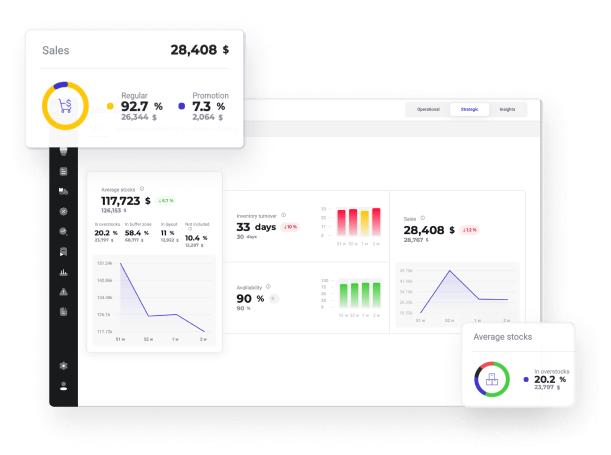
In our opinion, the most important point is retail supply chain collaboration. Leaders are already doing this. For example, Walmart has delegated inventory management to some of its suppliers and has developed programs to encourage suppliers to reduce costs and increase efficiency. At the same time, the retailer has automated most of its routine processes, which has increased its productivity and allowed it to respond quickly to market changes.
As you can see, supply chain collaboration is a complex process. It requires investment and the establishment of external and internal operations. At the same time, it helps to create additional value for customers. Better products in stock without delays, better service, and more favorable prices.
Supplier collaboration benefits
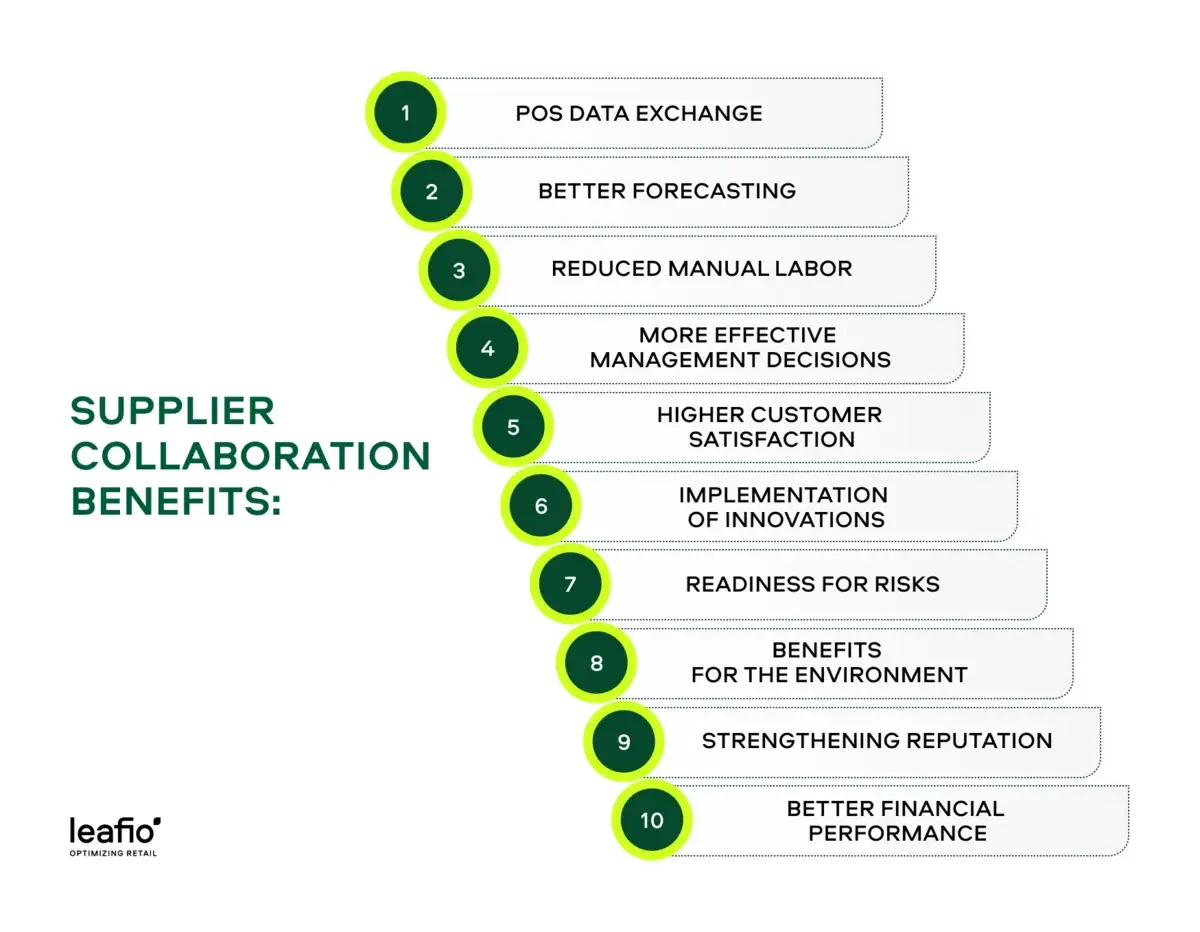
Successful supply chain collaboration provides several important benefits—and not just the economic ones.
POS data exchange
A retailer that provides access to such data helps the supplier to track demand here and now and know how to better meet current needs.
Better forecasting
Collaborative retail demand planning software provides greater accuracy and helps optimize production and logistics schedules.
Reduced manual labor
The implementation of supply chain collaboration software provides higher data accuracy, faster operations, and better results. You save resources and reduce human error.
More effective management decisions
Transparent supply chain operations allow for more informed decision-making on both the supplier and retailer sides.
Higher customer satisfaction
Timely delivery means having the right products on the shelves. Being prepared for supply chain collaboration challenges and proactively addressing issues together is key to maintaining customer satisfaction.
Implementation of innovations
If suppliers understand the retailer's business goals, they can offer solutions that will improve processes, but it works the other way around, too.
Readiness for risks
Well-established supply chain collaboration helps to respond quickly to unforeseen situations that cause sudden changes in demand.
Benefits for the environment
Logistics optimization reduces resource waste, whether in raw materials for manufacturing or finished goods, as well as the number of transportation operations. This, in turn, lowers energy consumption and air emissions.
Strengthening reputation
Being ready for effective and transparent cooperation shows a company in the best possible light. Having a positive image makes it easier to find reliable partners.
Better financial performance
Ultimately, supply chain collaboration leads to a shorter inventory cycle and a number of other positive changes. As a result, you spend less and can earn more.
So, you're looking to improve supplier reliability, you're willing to share data, and you're implementing new technologies to optimize processes. Is this enough to succeed? In theory, yes. In practice, partners face a lot of challenges.
Challenges of supply chain collaboration
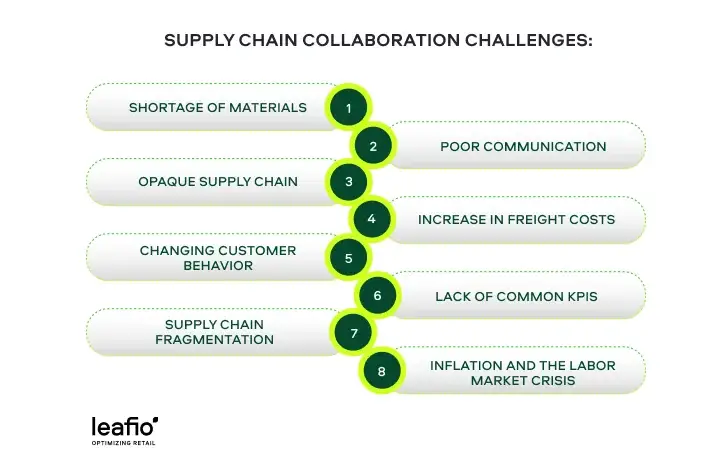
In real life, supply chain performance depends not only on the retailer's desire and the supplier's capabilities. There are many other factors that affect the processes. And we are not talking about such global risks as a pandemic or political sanctions. There are other challenges in supplier relationship management that cannot be ignored.
#1 Shortage of materials
This is the biggest challenge according to the Supply Chain Resilience Hubs in 2023. When a manufacturer is unable to create value due to a lack of materials, effective cooperation with a supplier will not solve this problem 100%. Production schedules change, and shortages occur with obvious consequences: increased supply costs and higher final prices.
To counteract this, retailers are looking for additional supply chain partners to diversify their sources of supply, create strategic stocks, and switch to alternative goods from local producers.
#2 Poor communication
It often happens that communications between a supplier and a retailer do not go beyond routine production processes. Naturally, it is difficult to maintain more effective communication, especially if several dozen or even hundreds of companies are involved across the supply chain. However, it is precisely transparent interaction that allows you to notice potential problems in time and find solutions.
#3 Opaque supply chain
Not to sound like a broken record, but businesses should really start dealing with their supply chain problems before they turn into a disaster.
Imagine two hypothetical situations. In the first, the supplier and the retailer work together in the old-fashioned way, i.e., the retailer sends an order via email and has no idea how many products the supplier has in stock, when the order will be generated, and how long to actually wait for delivery. The supplier can't predict demand, so often there aren't enough products in stock. As a result, both parties suffer losses.
In the second situation, the companies have established data exchange: the retailer provides information on demand for specific groups and types of goods, and the supplier shows the stage of the order. The result is a supply chain efficiency that benefits both parties.
Retailers can also share market research and historical data, and suppliers can share information about delivery times and production capabilities. This is especially important to accurately predict demand in situations where companies operate on a just-in-time model: with minimal warehouse capacity.
#4 Increase in freight costs
This happens for many reasons: from rising fuel prices to a shortage of containers. This is an area that is difficult to influence, so you have to look for other ways to optimize. Once again, supply chain collaboration can help: for example, jointly searching for new routes.
#5 Changing customer behavior
Shopping habits are changing very rapidly. The explosive growth of demand in online channels has heightened customer expectations. Today’s customers not only want the convenience of placing orders from their phones but also demand swift order fulfillment and delivery. This speed often becomes a key deciding factor. To meet these expectations, it’s essential to maintain adequate stock levels and implement efficient order fulfillment processes.
For example, a supermarket chain could offer ordering products online with delivery, but the more sales channels there are, the more support is needed. Plus, obtaining higher quality data on the product availability, timing, and delivery options becomes necessary. Making customers wait for a long time will only push them to take their business elsewhere.
Another factor in unstable customer behavior is social media trends. Of course, this factor is not present in all areas, but particularly in clothing, gadgets, hobby and creative goods are affected. However, working with a supplier will help you identify the trend in time and respond to it with increased fast deliveries. You need to strike while the iron is hot because modern trends are short-lived.
#6 Lack of common KPIs
Establishing effective communication and cooperation between retailers and suppliers is hampered by the lack of cooperation between departments within companies. It is a normal practice for different teams to have different KPIs. But at the same time, they should have common strategic goals.
After that, it's time to develop common supply chain collaboration metrics. Their absence greatly hinders cooperation, because the retailer, for example, may focus on fast inventory turnover and increased sales, while the supplier may focus on cost reduction. The retailer may demand an increase in the supply of a promotional product, and the supplier does not count on it due to a limited budget. Therefore, for effective supply chain collaboration, it is necessary to eliminate the differences in priorities.
Obviously, it's impossible to find partners who are on the same page in all matters, but it is ideal if KPIs in terms of sales volume and delivery time are shared.
#7 Supply chain fragmentation
The source of inefficiency is supply chain fragmentation. This happens when many manufacturers, distributors, transportation companies, etc., are involved in the process. It is very difficult to coordinate and establish mutual data exchange, but the problem can be solved through negotiations and the integration of supply chain collaboration software.
#8 Inflation and the labor market crisis
These are global economic trends that all market players face. For example, a shortage of truck drivers leads to delays in delivery times and causes a rise in the price of goods. Prices are also rising due to inflation caused by global political and economic processes. This problem requires strategic solutions: from finding local suppliers with as little logistics leverage as possible to implementing a hiring system that will motivate job seekers.
How to improve supply chain collaboration
So how do you overcome the challenges and implement successful supply chain collaboration? Here are some ideas.
Automate data transfer
Use common platforms to automatically upload and update data: forecasts, trading results, promotions, order plans, shipping schedules, etc. Even if this information comes from different sources and in different formats, modern systems are able to adapt it and make it available for use in planning. Automation additionally frees staff from routine tasks. As a result, you can manage a larger number of stores or bigger spaces with the same team size, or reallocate resources to more strategic tasks.
Use the information you receive
It's one thing to set up data exchange, but it's another to use it properly to identify trends and predict demand more accurately. For example, if you anticipate increased demand and plan to purchase more, share this information with the manufacturer or supplier in advance. This allows all levels of the supply chain to prepare for the demand spike, ensuring timely responses and maximizing the efficiency of collaboration.
Recognize clear roles
Make professions effective both internally and externally. For example, your marketing department should be responsible for customer satisfaction, and it is in this context that you should worry about increasing market share and profits. The finance department should increase value and profitability, and so on. When all the processes in the company are aligned, everyone knows their role, and works with the same values in mind, you will be able to set up a supply chain network more efficiently.
Focus on what matters most
Focus your efforts where they truly contribute to your business goals. If you have thousands of SKUs, it's impossible to work efficiently with the entire assortment at the same time. You need to do your best to ensure that you supply the products that bring you the most profit. That's why you should segment your assortment by cost and volume, variability and predictability, promotional and seasonal products. Based on the data obtained, make separate decisions for each type of product:
- High-value products with low volatility. Use sales history to make decisions.
- High-value products with high volatility. Additionally, use market analytics.
- Low-value products with low volatility. Trust the solutions offered by an AI-based forecasting system.
- Low-value products with high volatility. Analyze the market and set limits on purchase volumes.
Supplier reliability assessment with LEAFIO AI
Obviously, you need to establish cooperation with trusted suppliers. You need to be sure that you are spending resources and giving part of the data to a reliable partner. How do you evaluate supplier reliability? The detailed report provided by AI inventory optimization software will help. It displays the information under three tabs:
- Supplier Reliability. Contains information about all orders from all your suppliers and their fulfillment rate. Data can be filtered.
- Supplier Reliability – Orders. Contains data on orders of specific suppliers with details for each item. The particularly interesting indicators are the initial quantity of goods in the order, its cost, and the actual delivered goods.
- Data statistics. This is where you can find charts and graphs with information about the main indicators of supplier reliability. You can draw a conclusion about the importance and reliability of the supplier for the company over time. To view analytics, you can select different periods: week, month, quarter, half a year. In the settings, you can go to the third page of the report—Supplier Data Statistics. It displays key performance and reliability indicators of the supplier.
If you select all suppliers, you will get a brief analysis of the company's work with all partners and the dynamics of changes in the company's key indicators. These are the supplier's shares in the company's purchases and sales over time, as well as stocks, surpluses, sales, missed sales, inventory turnover of the supplier's goods, and their dynamics.
The report is multifunctional and will be of interest to both procurement specialists and category managers, as well as company directors. The report can be used for internal analytics, as well as during negotiations with a supplier, as the partner is also interested in long-term and effective cooperation.
Comparison of the supplier's share in the company's purchases and sales, timeliness of order delivery, and reliability of the supplier will help you decide whether to continue working with this partner or signal the need to revise the terms of work.
Conclusions
Enhanced supply chain visibility is the main answer to today's challenges. You need to find reliable suppliers and establish data exchange with them and set common goals. This way, you can work together to find ways to overcome problems and increase the efficiency of business operations. To help things further, use modern software solutions that take care of data collection, analysis, exchange, forecasting, as well as order fulfillment tracking and supply chain management.


Have a question?

Kristi Miller
Retail optimization expert