If you're searching for the best SymphonyAI alternatives, the top options include LEAFIO AI, RELEX Solutions, Blue Yonder, Kinaxis, o9 Solutions, ToolsGroup, Slimstock, Netstock, Anaplan, SAP IBP, and Quant.
SymphonyAI Retail/CPG is a vertical AI platform offering end-to-end, integrated solutions for merchandising, marketing, and supply chain management for retailers and CPG manufacturers. Built on its Eureka AI platform, SymphonyAI provides demand forecasting, replenishment, supply chain intelligence, master data management, assortment optimization, pricing, promotions, planogram and shelf planning, and store intelligence. The company was founded in 2017, is backed by Romesh Wadhwani, and has grown through acquisitions including ReTech Labs (shelf intelligence/image recognition).
Why do retailers look for alternatives to SymphonyAI? Common reasons include complex and time-consuming implementations; high total cost of ownership; a product portfolio assembled through acquisitions (which can mean inconsistent user experiences across modules); limited transparency around AI model specifics; and the need for faster time-to-value—especially for mid-size retail chains that don't require an enterprise-grade roll-up suite.
This article provides a quick comparison, a detailed review of each alternative with features, pros, cons, and a practical guide to help you select the best SymphonyAI replacement for your retail business.
How I Picked the Best SymphonyAI Alternatives
I evaluated each platform against the criteria most important for retail and CPG decision-makers:
- Retail-specific capabilities: Demand forecasting, inventory optimization, replenishment automation, merchandising, assortment, and promotion management.
- AI and automation maturity: Depth and transparency of AI/ML models, availability of copilots or AI agents.
- Target audience fit: Whether the platform is built for mid-size retailers, enterprise chains, CPG manufacturers, or all of the above.
- Implementation speed and complexity: How quickly teams can see measurable results after deployment.
- Integration ecosystem: Compatibility with ERP systems, POS platforms, and existing data infrastructure.
- User experience: Usability for planners, category managers, and store-level teams.
- Pricing accessibility: How the cost structure serves businesses at various scales.
- Customer reviews and analyst recognition: Ratings from G2, Capterra, Gartner Peer Insights, and ISG Buyer's Guides.
Quick Comparison Table
| Solution | Best For | Price Range | Free Trial? | Key Difference vs SymphonyAI |
|---|---|---|---|---|
| LEAFIO AI | Mid-size & growing retail chains | Two-part: implementation + subscription | Simulation available | Faster implementation (from 1 mo), modular, strong mobile execution tools |
| RELEX Solutions | Large enterprise retail & wholesale | Contact for pricing | Demo available | Unified AI-native planning with proven retail customer base |
| Blue Yonder | Global enterprise supply chains | High TCO ($500K–$M+ over 3 years) | Demo available | Broadest execution suite (WMS, TMS, returns, workforce) |
| Kinaxis | Complex supply chains needing scenario planning | $500–$1,000+/user/mo | Demo available | Patented concurrency for instant what-if recalculation |
| o9 Solutions | Enterprises integrating finance & supply chain | Enterprise custom pricing | Demo available | "Digital Brain" connecting financial and operational planning |
| ToolsGroup | Distributors with demand uncertainty | Custom, from ~$5,000/mo | Demo available | Probabilistic forecasting & multi-echelon optimization |
| Slimstock | Mid-market wholesale & distribution | Custom pricing | Demo available | Focused, practical inventory optimization |
| Netstock | SMBs with ERP-connected inventory needs | ~$900–$2,000/mo | Demo available | 60+ ERP integrations, deployment in 30–45 days |
| Anaplan | Cross-functional enterprise planning | Enterprise pricing | Demo available | Flexible model-anything platform across finance + supply chain |
| SAP IBP | SAP ecosystem enterprises | SAP licensing model | Demo available | Native SAP ERP integration |
| Quant | Space planning & planogram management | Custom pricing | Demo available | Integrated planogram + shelf label + POS printing solution |
Why Consider Alternatives to SymphonyAI Retail/CPG?
SymphonyAI offers a broad suite, but several factors lead retailers to explore other options:
1. Product built through acquisitions
SymphonyAI has grown rapidly through acquiring multiple companies (including ReTech Labs for shelf intelligence). While this broadens the feature set, it can result in inconsistent user experiences across modules and integration challenges between components originally built as separate products.
2. Implementation complexity and timeline
G2 reviews note that SymphonyAI can be "expensive and time-consuming to implement" and "requires a significant amount of data to be effective." For mid-size retailers that need fast results, this represents a meaningful barrier.
3. Limited pricing transparency
SymphonyAI does not publish pricing publicly, and user feedback suggests costs can be high — particularly when deploying multiple modules across the full merchandising, marketing, and supply chain stack.
4. Technical transparency concerns
Independent analysis has noted that SymphonyAI's public materials are "largely outcome- and workflow-driven, with limited published technical depth on models/solvers." For organizations that value explainability in AI-driven decisions, this may be a concern.
5. Turnaround time on customizations
G2 reviewers have mentioned that "turnaround time for customizations takes a little time sometimes"—which can slow down adaptation to specific business requirements.
6. Maybe more than mid-size retailers need
As an enterprise-oriented suite covering merchandising, marketing, and supply chain, SymphonyAI's breadth can be more than what growing retail chains require — leading to higher costs and complexity without proportional value.
Top 11 Alternatives to SymphonyAI Retail/CPG
1. LEAFIO AI — Best for Mid-Size and Growing Retail Chains
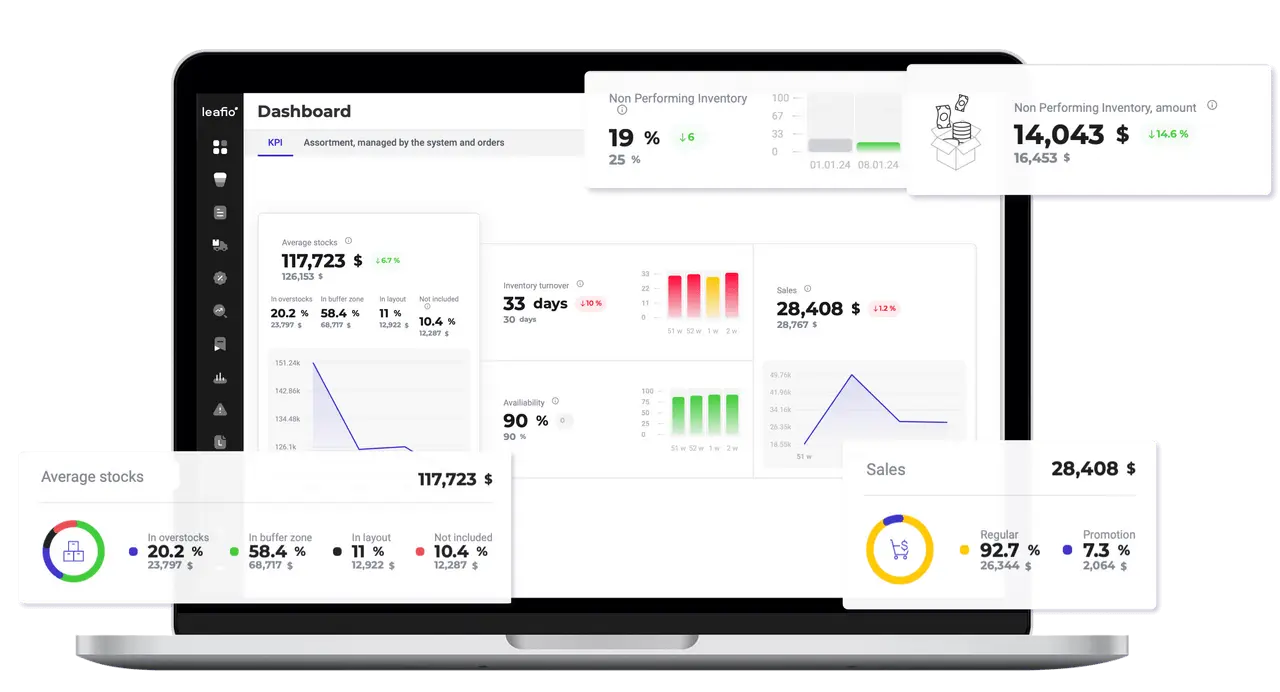
LEAFIO AI is a modular AI-powered retail optimization platform serving 250+ retailers in 40+ countries across Europe, North America, and South America. The platform delivers specialized solutions for inventory optimization, demand planning, shelf efficiency, assortment performance, and promotion management — covering many of the same retail use cases as SymphonyAI, but with a fundamentally different approach.
Where SymphonyAI positions itself as an enterprise-grade suite assembled through acquisitions, LEAFIO AI was built from the ground up as a unified, modular platform. Retailers can implement individual solutions — such as automatic replenishment or planogram software — and expand over time. This makes LEAFIO AI one of the most practical programs like SymphonyAI for businesses that want measurable results without committing to a full enterprise transformation.
Key Features:
- AI-driven demand forecasting directly connected to automated replenishment across multi-echelon supply chains, with up to 99.5% order automation demonstrated in client cases.
- Shelf efficiency module featuring autoplanogram generation, AI-powered planogram image recognition (through partnership with Marketeye), and a dedicated mobile app for in-store execution and compliance monitoring.
- Assortment performance with AI-driven Smart Recommendations that automatically identify which SKUs to add or remove at the store level, plus automated price segmentation for smarter category management.
- Promotion management with the new AI Promo Assistant—an agentic AI agent that makes promotional forecasting transparent, explainable, and actionable. Includes promotion scenario planning showcased at EuroShop 2026.
- Strategy Automation — one-click intelligence for determining the optimal number of items within every assortment segment.
- Agentic AI Assistants embedded across analytics modules, enabling category managers to get instant, conversational insights from complex retail data.
- Retail Management SuperApp for in-store barcode scanning, price verification, task management, photo reporting, and planogram compliance checking.
- A BI module and real-time dashboards providing complete visibility into goods movement, inventory health, and operational KPIs across the network.
- Fresh inventory management—specialized logic for short shelf-life products, including perishables and fresh categories.
Pricing: Two-part: a one-time implementation fee plus an ongoing subscription that scales with store count and SKU volume. Designed to be significantly more accessible than enterprise-tier platforms like SymphonyAI or RELEX, particularly for mid-size retailers. No free trial, but a data-driven simulation is available — retailers can see projected results using their own data before committing.
| ✅ Pros | ❌ Cons |
|---|---|
| Fast implementation: typically 1–6 months, with measurable KPI impact from early stages | Not designed for CPG manufacturer-side supply chain (retailer-focused) |
| Modular architecture — deploy what you need, expand over time | Growing but smaller global footprint than SymphonyAI or Blue Yonder |
| Strong mobile execution tools (SuperApp) bridging analytics and store operations | No built-in marketing personalization or loyalty analytics (though a customer loyalty module exists) |
| Proven ROI: Baltic Petroleum achieved 50% overstock reduction and 62% sales increase; KOLO saw 20% sales growth and 43% overstock reduction | |
| Agentic AI assistants across shelf, promo, and assortment modules | |
| Dedicated customer success with 5.0/5 support ratings (Capterra, Software Advice) | |
| Unified platform built from the ground up (not assembled through acquisitions) |
How it compares to SymphonyAI:
- Better in: implementation speed, modular flexibility, store-level mobile execution (SuperApp, planogram compliance app), pricing accessibility for mid-size retailers, platform architecture consistency (single codebase vs. acquisition-assembled suite), and transparency of AI-driven recommendations (AI Promo Assistant with explainability).
- SymphonyAI is stronger in CPG manufacturer-side collaboration features, marketing personalization (customer data platforms), master data management depth, and a broader enterprise IT integration narrative.
Best for: Mid-size and growing retail chains — grocery, convenience, health & beauty, DIY, pharmacies, e-commerce — that need rapid, AI-driven inventory optimization, shelf management, assortment intelligence, and promotion planning without enterprise-level cost or complexity. Notable clients include Carrefour LabelVie (180 stores in Morocco), Smart & Final Mexico, Baltic Petroleum (86 stations), the Daily network, and Rancho 17.
Verdict: LEAFIO AI is the strongest SymphonyAI alternative for retailers who want the same breadth of retail-specific capabilities (inventory, shelf, assortment, promotions) but delivered through a faster, more modular, and more accessible platform. If your priority is operational impact within months rather than years, LEAFIO AI delivers.
→ Request a simulation from LEAFIO AI
2. RELEX Solutions — Best for Unified Enterprise Retail Planning
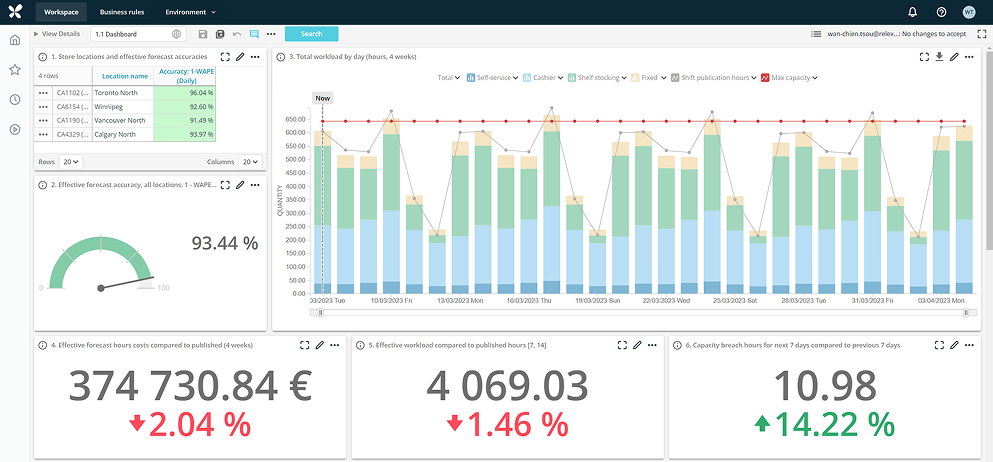
RELEX Solutions is a Finnish AI-native supply chain planning platform serving large enterprise retailers, manufacturers, and wholesalers. Founded in 2005, RELEX offers unified end-to-end planning across demand forecasting, inventory optimization, merchandising, pricing, promotions, and workforce management. Customers include Dollar Tree, Lidl, AutoZone, and PetSmart.
Key Features:
- Unified planning platform connecting demand, supply, merchandising, pricing, and workforce.
- AI/ML-driven demand forecasting with demand-sensing capabilities.
- Automated replenishment across multi-echelon supply chains.
- Space and assortment planning with data-driven optimization.
- Pricing and promotion optimization.
- Workforce management for store operations.
Pricing: RELEX does not publicly disclose standard pricing for its solutions. Pricing is typically provided on request and may vary depending on the modules, scope of deployment, number of locations, and other implementation requirements.
| ✅ Pros | ❌ Cons |
|---|---|
| Truly unified platform — single architecture across all planning functions | Enterprise-oriented pricing and implementation complexity |
| Strong AI/ML capabilities with proven retail results (30–40% inventory reduction) | Long implementation timelines for enterprise-wide deployment |
| 97% customer satisfaction rating | Forecasting for very short shelf-life products could improve per reviews |
| Broad retail customer base globally | Limited store-level mobile execution tools |
How it compares to SymphonyAI:
- Better in: Unified single-architecture platform (vs. acquisition-assembled), proven enterprise retail planning depth, workforce management, and pricing and promotions optimization.
- SymphonyAI is stronger in CPG-focused collaboration tools, master data management, and marketing personalization capabilities.
Best for: Large enterprise retailers and wholesalers seeking a unified, AI-native planning platform that covers demand through workforce management.
Verdict: RELEX is the premier enterprise alternative to SymphonyAI for retailers who prioritize unified planning architecture and proven retail scale. For mid-size retailers, LEAFIO AI offers faster time-to-value at more accessible pricing.
3. Blue Yonder — Best for End-to-End Supply Chain Planning and Execution
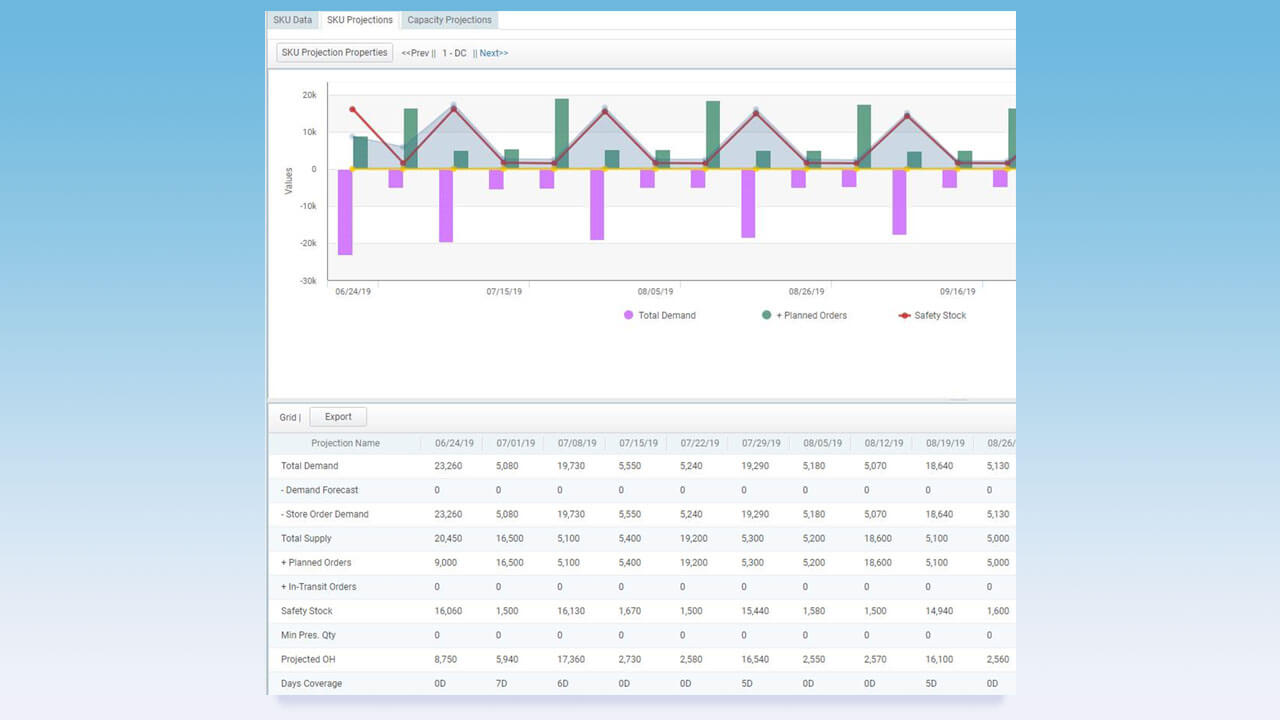
Blue Yonder (formerly JDA Software), backed by Panasonic, is one of the world's largest supply chain technology providers with 35+ years of experience and 3,000+ customers globally. The platform covers supply chain planning, warehouse management, transportation, order management, returns, workforce, and retail category management.
Key Features:
- End-to-end supply chain suite: planning, WMS, TMS, order management, returns.
- Luminate Control Tower for real-time network visibility.
- AI agents for merchandise financial planning, assortment, and allocation.
- Category management and space planning.
- Multi-enterprise network connecting suppliers, carriers, and partners.
- Over 20 billion AI predictions daily.
Pricing: Enterprise pricing with high total cost of ownership — typically $500,000 to several million dollars over 3 years. Implementation costs can exceed hundreds of thousands of dollars.
| ✅ Pros | ❌ Cons |
|---|---|
| Broadest suite in the market (planning + full execution stack) | Very high TCO and implementation costs |
| Massive global customer base and partner ecosystem | Implementation can take 12+ months |
| Powerful AI with enormous prediction scale | UI perceived as outdated and clunky by some reviewers |
| Strong WMS and TMS capabilities beyond pure planning | Requires specialized consultants for configuration |
How it compares to SymphonyAI:
- Better in: Execution breadth (WMS, TMS, returns, workforce), global scale, multi-enterprise network.
- SymphonyAI is stronger in retail-specific merchandising and marketing analytics, CPG collaboration, and potentially faster deployment for specific modules.
Best for: Global enterprises with complex, multi-tier supply chains that need unified planning and execution under one platform.
Verdict: Blue Yonder is the full-spectrum enterprise heavyweight. It demands significant investment but delivers unmatched breadth for organizations operating at a global scale.
See also top retail category management software list.
4. Kinaxis — Best for Real-Time Scenario Planning and Supply Chain Agility
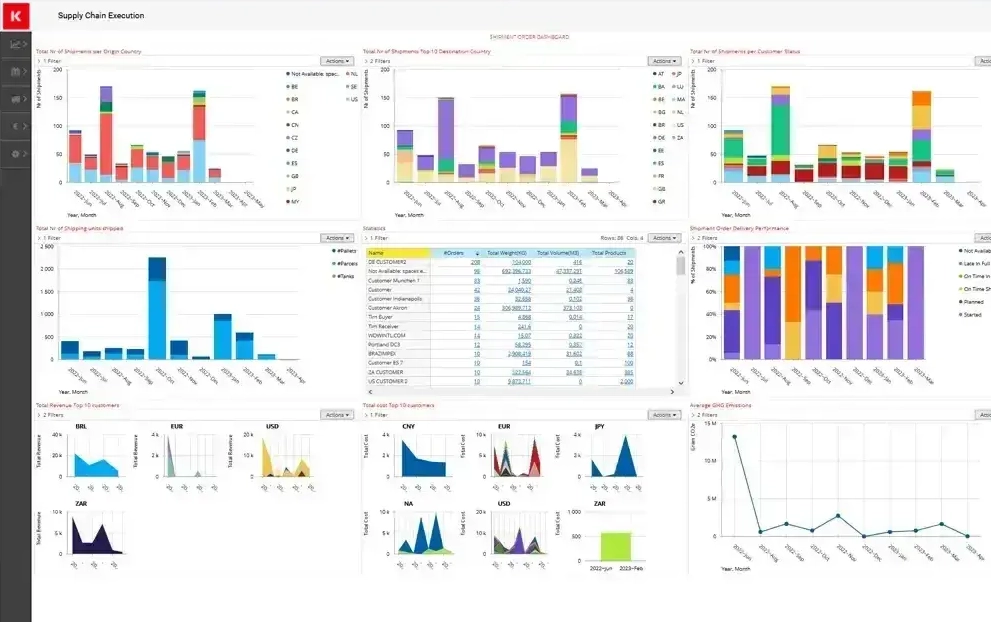
Kinaxis offers the Maestro platform (formerly RapidResponse), a cloud-based supply chain orchestration solution renowned for its patented concurrency technique enabling instant recalculation of the entire supply chain when any data point changes. Founded in 1984 in Ottawa, Canada, Kinaxis serves 40,000+ users across 100+ countries.
Key Features:
- Patented concurrency for real-time, end-to-end supply chain recalculation.
- Demand.AI with ML-based forecasting models for retail and manufacturing.
- Maestro Agent Studio for building no-code AI agents.
- Scenario simulation and what-if analysis across all planning dimensions.
- Replenishment planning with store-level guardrails.
- S&OP, demand, supply, inventory, and production scheduling.
Pricing: Subscription-based, starting around $500–$1,000+ per user per month.
| ✅ Pros | ❌ Cons |
|---|---|
| Industry-leading what-if scenario planning speed | Primarily planning-focused — no WMS, TMS, or store execution tools |
| 50x faster MRP processing vs. legacy ERP | Retail-specific features still maturing compared to dedicated retail platforms |
| No-code AI agent builder (Maestro Agent Studio) | Enterprise pricing can be prohibitive for mid-size businesses |
| Strong in manufacturing, expanding in retail | Smaller retail customer base than RELEX or SymphonyAI |
How it compares to SymphonyAI:
- Better in: Real-time concurrent planning speed, scenario simulation, manufacturing supply chain depth.
- SymphonyAI is stronger in retail merchandising, marketing, CPG collaboration, and master data management.
Best for: Large enterprises in manufacturing, automotive, life sciences, and increasingly retail, with complex supply chains demanding rapid scenario analysis.
Verdict: Kinaxis is unmatched for speed of decision-making and scenario planning — but less retail-specialized than SymphonyAI or LEAFIO AI.
5. o9 Solutions—Best for Connecting Financial and Operational Planning
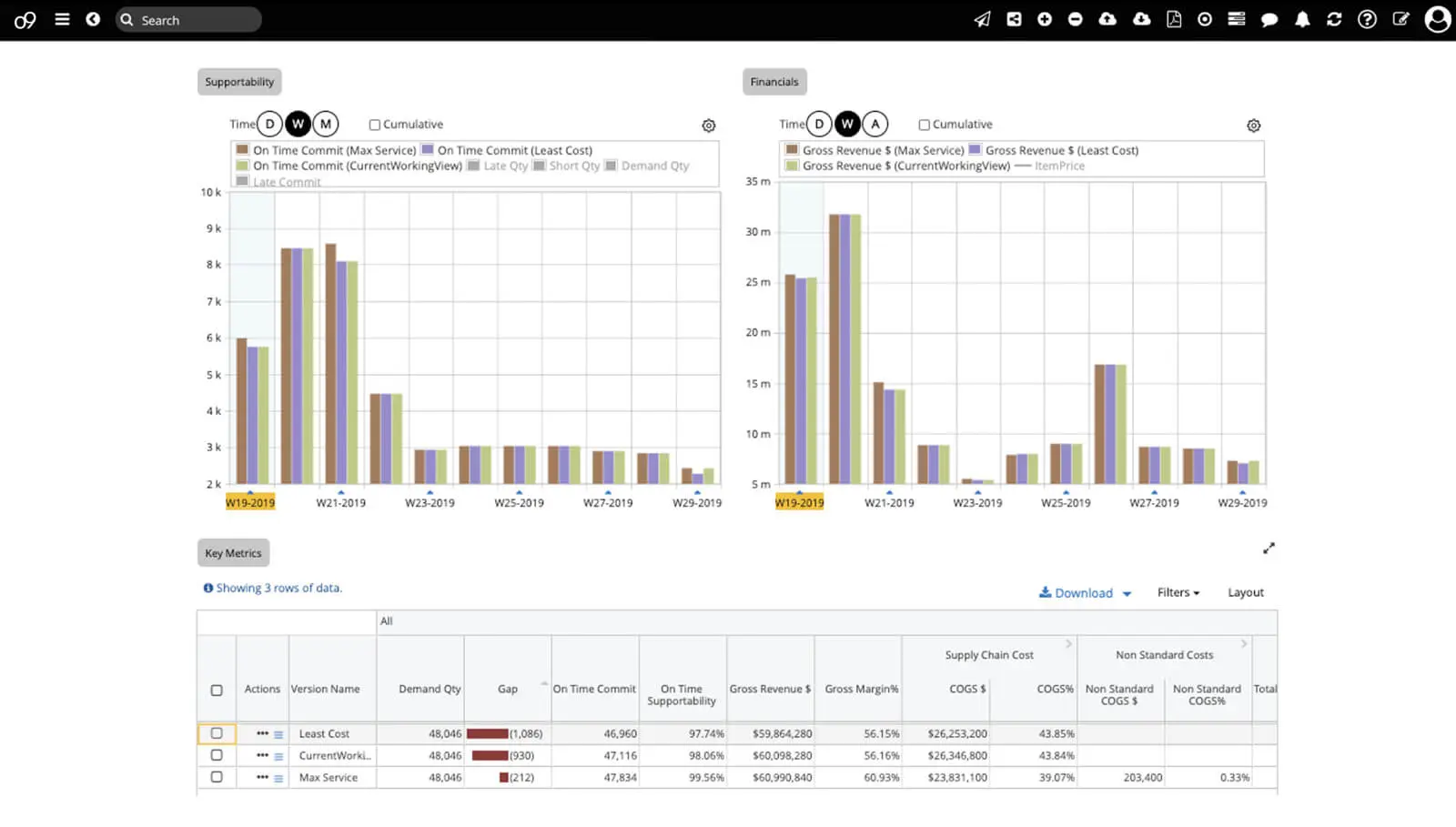
o9 Solutions offers its "Digital Brain"—an AI-powered, cloud-native platform that integrates supply chain, commercial, and financial data into a unified decision-making engine. The Enterprise Knowledge Graph connects data across departments, breaking down planning silos.
Key Features:
- Integrated business planning connecting finance, sales, and supply chain.
- Enterprise Knowledge Graph for unified data modeling.
- AI/ML demand sensing and forecasting.
- Digital twin and scenario planning capabilities.
- Revenue management and pricing optimization.
Pricing: Enterprise custom pricing.
| ✅ Pros | ❌ Cons |
|---|---|
| Powerful cross-functional planning (finance + SC + commercial) | Platform reliability had early issues (improved over years per Gartner reviews) |
| Highly flexible and configurable | Steep learning curve |
| Strong AI/ML with continuous improvement | Enterprise pricing and complexity |
| Solution-oriented partner support | Less proven in mid-size retail execution |
How it compares to SymphonyAI:
- Better in: Financial-operational planning integration, digital twin capabilities.
- SymphonyAI is stronger in retail-specific merchandising, CPG collaboration, and shelf and store intelligence.
Best for: Enterprises unifying financial and operational planning, particularly in CPG and manufacturing.
Verdict: o9 is a strategic IBP powerhouse but more suited to enterprise-level connected planning than day-to-day retail store execution.
6. ToolsGroup — Best for Probabilistic Demand Forecasting and Distribution

ToolsGroup specializes in AI-powered probabilistic forecasting and multi-echelon inventory optimization through its SO99+ platform. Rated 4.4/5 on Gartner Peer Insights with 102 reviews, it's particularly strong for distributors, wholesalers, and retailers managing complex demand patterns and long-tail SKU portfolios.
Key Features:
- Probabilistic forecasting for demand uncertainty using machine learning.
- Multi-echelon inventory optimization (MEIO).
- Service-level-driven inventory strategies.
- Automated replenishment and order planning.
- Supply chain analytics and visibility dashboards.
Pricing: Custom subscription, starting from approximately $5,000/month.
| ✅ Pros | ❌ Cons |
|---|---|
| Industry-leading probabilistic forecasting methodology | No retail merchandising, shelf planning, or store execution features |
| Strong multi-echelon optimization | Interface less modern than newer platforms |
| Well-suited for distribution and wholesale complexity | Smaller overall customer base |
| ISG-rated Innovative for midsize supply chain planning | Not designed for CPG manufacturer collaboration |
How it compares to SymphonyAI:
- Better in: Demand uncertainty management, long-tail SKU optimization, distribution network focus.
- SymphonyAI is stronger in a full retail suite (merchandising, marketing, store intelligence) and CPG collaboration.
Best for: Distributors and retailers with high SKU complexity and unpredictable demand.
Verdict: ToolsGroup excels at what it does — probabilistic forecasting and MEIO — but doesn't attempt to cover SymphonyAI's full retail breadth.
7. Slimstock — Best for Practical Mid-Market Inventory Optimization

Slimstock, based in the Netherlands, offers Slim4 — a cloud-based inventory optimization platform designed for mid-market wholesalers, distributors, and retailers. The company emphasizes practical, focused inventory management with a strong implementation methodology.
Key Features:
- AI-driven demand forecasting with automatic model selection.
- Safety stock optimization and replenishment automation.
- Supplier performance management.
- S&OP planning capabilities.
- Integration with major ERP systems.
Pricing: Custom pricing based on business size and requirements.
| ✅ Pros | ❌ Cons |
|---|---|
| Practical, focused approach — not over-engineered | No merchandising, space planning, or shelf execution |
| Direct vendor implementation (no third-party consultants) | Smaller global footprint |
| Exceeded customer expectations per Gartner reviews | Limited advanced AI compared to newer platforms |
| Good fit for mid-market distribution and wholesale | Not suited for full retail optimization |
How it compares to SymphonyAI:
- Better in: Implementation simplicity, mid-market focus, direct vendor support model.
- SymphonyAI is stronger in the following: full retail suite, AI sophistication, CPG collaboration, and marketing analytics.
Best for: Mid-market wholesalers and distributors needing reliable inventory optimization without enterprise complexity.
Verdict: Slimstock is straightforward and practical — ideal for distribution, but retailers needing shelf and assortment management should consider LEAFIO AI instead.
8. Netstock — Best for SMBs Seeking Quick ERP-Connected Inventory Intelligence
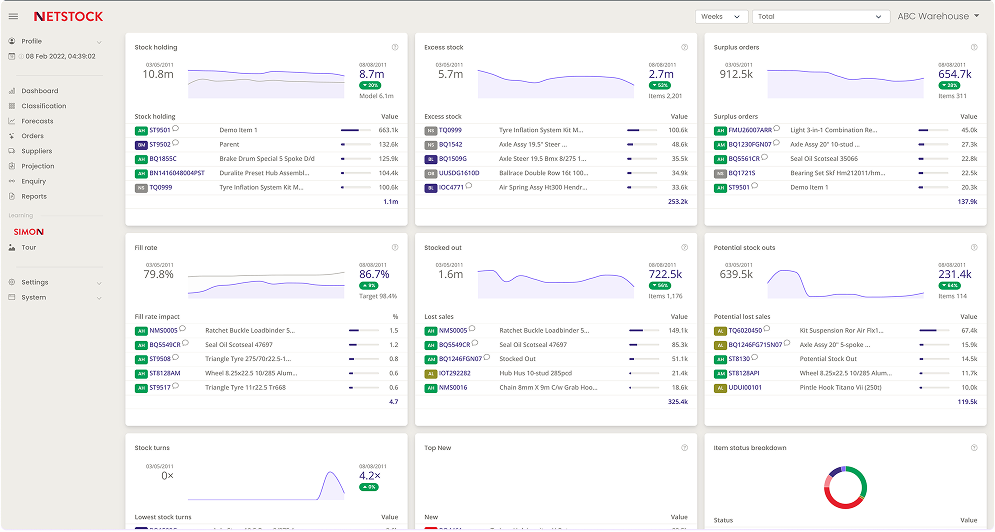
Netstock is a cloud-based demand and supply planning platform purpose-built for SMBs. With 2,400+ customers, 20,000+ users, and integration with 60+ ERP systems, Netstock transforms ERP data into predictive inventory insights with one of the fastest deployment timelines in the category.
Key Features:
- AI-powered demand forecasting with per-SKU model selection.
- Dynamic safety stock based on supply and demand variability.
- Inventory classification by value and velocity (ABC/XYZ).
- Automated replenishment recommendations.
- What-if scenario planning.
- 60+ ERP integrations (SAP, NetSuite, Dynamics, Sage, and more).
Pricing: Subscription-based, typically $900–$2,000/month. Designed to be affordable for SMBs.
| ✅ Pros | ❌ Cons |
|---|---|
| 60+ ERP integrations — the widest range in market | No merchandising, assortment, or shelf planning |
| 30–45 day deployment for basic use cases | Limited for enterprises with complex supply chains |
| 98% user satisfaction on SelectHub | Reporting customization options are limited |
| Dedicated account managers and learning academy | Purely inventory-focused — not a retail platform |
How it compares to SymphonyAI:
- Better in: Affordability, deployment speed, ERP integration breadth for SMBs.
- SymphonyAI is stronger in everything beyond inventory—merchandising, marketing, space, and CPG collaboration.
Best for: Small and mid-size distributors, wholesalers, and retailers on ERP systems who need AI-driven inventory planning without major investment.
Verdict: Netstock is the best option for SMBs on a budget. For mid-size retailers needing merchandising and shelf management alongside inventory, LEAFIO AI covers more ground.
9. Anaplan — Best for Cross-Functional Enterprise Planning
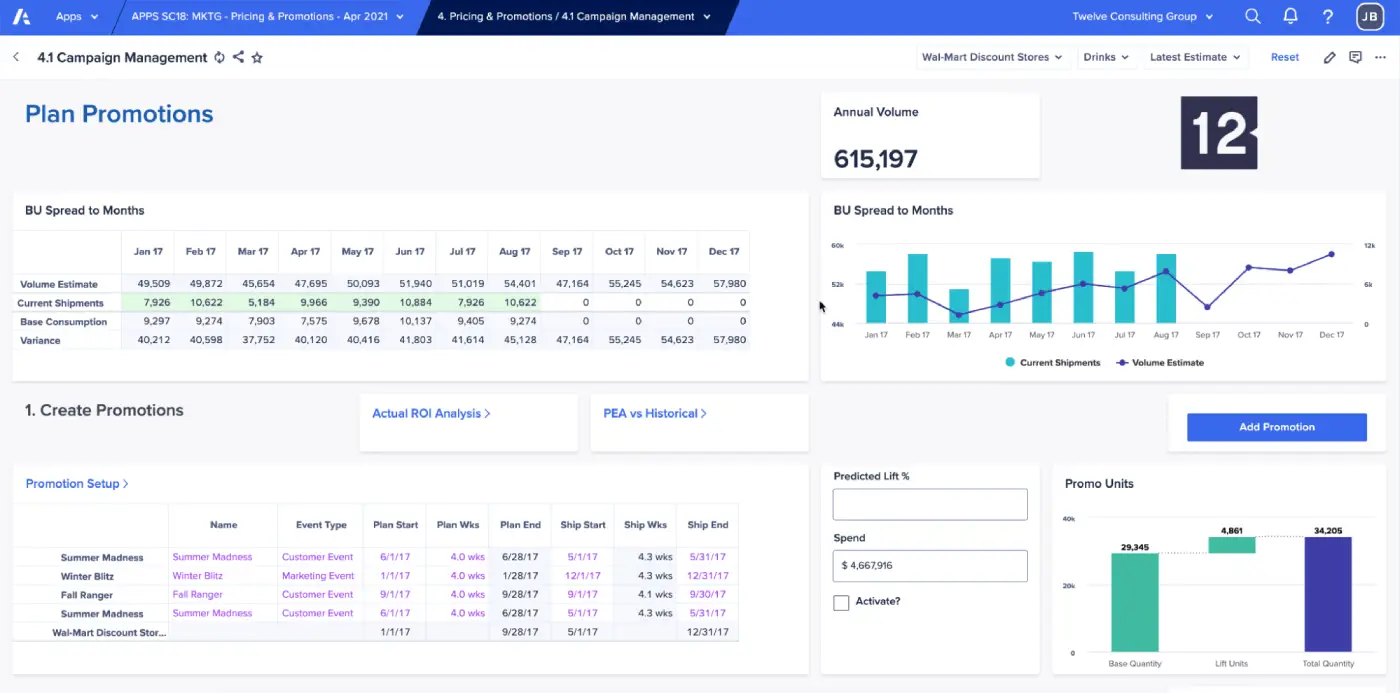
Anaplan is a SaaS enterprise planning platform enabling flexible modeling across finance, sales, supply chain, and workforce. Rated highest by ISG for retail supply chain planning in 2025, Anaplan excels at connected planning but is not a retail execution tool.
Key Features:
- Hyperblock calculation engine for multi-dimensional modeling.
- Connected planning across finance, sales, marketing, and supply chain.
- Demand forecasting and S&OP.
- Scenario planning with rapid what-if analysis.
- Pre-built supply chain planning apps.
Pricing: Enterprise pricing with custom quotes.
| ✅ Pros | ❌ Cons |
|---|---|
| Most flexible planning platform — model any process | Not purpose-built for retail execution |
| Highest ISG rating for retail supply chain planning (2025) | Requires skilled modelers for configuration |
| Strong cross-functional planning integration | No inventory replenishment, shelf management, or store tools |
| Excellent scenario planning | Enterprise pricing |
How it compares to SymphonyAI:
- Better in: Planning flexibility across business functions, financial planning depth.
- SymphonyAI is stronger in retail-specific execution (demand, inventory, merchandising, and marketing).
Best for: Large enterprises needing connected planning across finance and supply chain. Often deployed alongside execution-focused tools.
Verdict: Anaplan is a strategic planning powerhouse but needs to be paired with execution-focused platforms for operational retail impact.
10. SAP Integrated Business Planning (IBP) — Best for SAP-Centric Enterprises
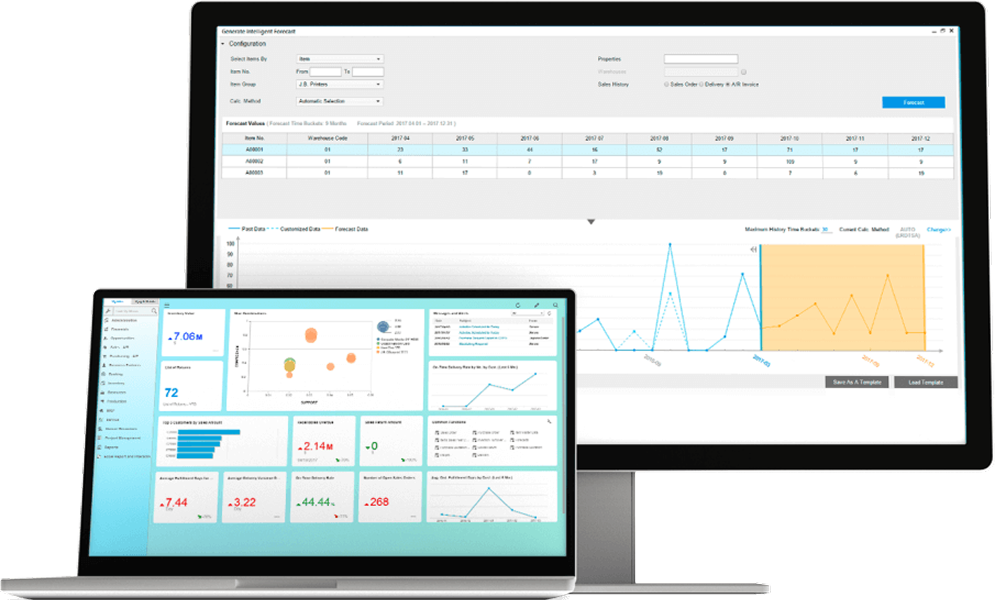
SAP IBP is a cloud-based supply chain planning solution built on SAP HANA's in-memory computing. For organizations already running SAP S/4HANA, IBP offers native integration and a consistent technology experience.
Key Features:
- Demand planning with statistical forecasting and ML.
- Response and supply planning with scenario simulation.
- Multi-echelon inventory optimization.
- S&OP and integrated business planning.
- Native SAP S/4HANA and SAP ERP integration.
Pricing: SAP licensing model, typically enterprise-level subscription.
| ✅ Pros | ❌ Cons |
|---|---|
| Seamless integration for SAP shops | Connecting non-SAP systems is complex and costly |
| Powerful real-time in-memory computing | Steep learning curve |
| Strong inventory optimization and S&OP | No retail merchandising, shelf, or store execution |
| Part of broader SAP enterprise platform | High total cost of ownership |
How it compares to SymphonyAI:
- Better in: SAP ecosystem integration, financial planning alignment, and in-memory processing speed.
- SymphonyAI is stronger in retail-specific execution, merchandising, CPG collaboration, and marketing personalization.
Best for: Large enterprises already invested in SAP that want supply chain planning within their existing tech stack.
Verdict: SAP IBP is the natural choice for SAP environments, but for retail-specific optimization, LEAFIO AI or RELEX offer deeper capabilities.
11. Quant — Best for Dedicated Space Planning and Planogram Management

Quant Retail is a cloud-based solution focused specifically on retail space management, planograms, category management, and shelf labels. Unlike the broader platforms in this list, Quant is a specialized tool that does one set of things very well — making it relevant for retailers whose primary pain point with SymphonyAI is shelf and space management.
Key Features:
- Automatic planogram generation optimized by sales data and user-defined templates.
- Category management and ranging.
- Shelf label and POS printing integrated with planograms.
- Store communication and in-store marketing tools.
- Cloud-based with support for large retail networks.
Pricing: Custom pricing based on network size and features.
| ✅ Pros | ❌ Cons |
|---|---|
| Deep specialization in space planning and planograms | No inventory optimization, demand forecasting, or replenishment |
| Integrated shelf labels and POS printing | Not a supply chain platform |
| Can maintain up-to-date planograms at scale without heavy human resources | Limited AI capabilities compared to broader platforms |
| Good fit for retailers focused specifically on shelf execution | Needs to be paired with other solutions for full optimization |
How it compares to SymphonyAI:
- Better in: Dedicated planogram and shelf label management, simplicity of purpose.
- SymphonyAI is stronger in everything beyond space planning—supply chain, demand forecasting, marketing, and CPG collaboration.
Best for: Retailers whose primary need is planogram management and shelf execution, often as a complement to broader planning tools.
Verdict: Quant is a solid niche player for space and planogram management. For retailers wanting both shelf efficiency and inventory optimization in one platform, LEAFIO AI offers an integrated alternative.
How to Choose the Right SymphonyAI Alternative
Here's a practical checklist for selecting the best platform for your business:
Identify your core pain points. Is the primary challenge inventory management, shelf optimization, demand forecasting, promotion planning, or all of them? LEAFIO AI covers inventory, shelves, assortment, and promotions in a modular platform. RELEX offers unified enterprise planning. Netstock focuses on ERP-connected inventory intelligence.
Assess your business scale. Enterprise platforms (Blue Yonder, RELEX, Kinaxis, SAP IBP) are built for global complexity. Mid-size retailers typically get faster, more cost-effective results with LEAFIO AI, Slimstock, or Netstock.
Prioritize implementation speed. If you need measurable results within months, prioritize modular platforms. LEAFIO AI deploys in 1–6 months. Netstock deploys in 30–45 days. Enterprise solutions like Blue Yonder or SymphonyAI itself may require 12+ months.
Evaluate platform consistency. Platforms built organically (LEAFIO AI, RELEX, Kinaxis) tend to offer more consistent user experiences than those assembled through multiple acquisitions.
Check integration requirements. Ensure the platform works with your existing ERP and POS systems. Netstock offers 60+ ERP connectors. SAP IBP is native to SAP. LEAFIO AI provides pre-built connectors for widely used systems.
Request a demo or simulation with your data. LEAFIO AI offers data-driven simulations. Most enterprise vendors provide guided demos. Testing with real data is the most reliable way to evaluate fit.
Consult analyst ratings. Review G2, Capterra, Gartner Peer Insights, and ISG Buyer's Guides for validated, unbiased comparisons.
Switching from SymphonyAI to LEAFIO AI
If your team is considering a move from SymphonyAI to LEAFIO AI, here's how the transition typically works:
Step 1: Scope and prioritize
Determine which modules to deploy first — inventory optimization, shelf efficiency, assortment performance, or promotion management. LEAFIO AI's modular approach lets you start where the business impact is greatest.
Step 2: Data export and mapping
Work with your SymphonyAI and IT teams to export historical sales, inventory, product master, and store data. LEAFIO AI's implementation team maps this to their data model, ensuring continuity.
Step 3: ERP integration
LEAFIO AI provides pre-built connectors for major ERP systems. The integration team establishes automated data flows from your existing technology stack.
Step 4: Simulation before commitment
Before full deployment, LEAFIO AI runs a data-driven simulation with your actual business data—demonstrating projected KPI improvements before you commit to rollout.
Step 5: Phased deployment
Start with a pilot group of stores or one module. Initial deployment typically takes 1–3 months. LEAFIO AI's customer success team provides hands-on support throughout.
Step 6: Training across roles
LEAFIO AI trains both central office analysts and field teams, including mobile SuperApp training for store-level planogram compliance, price checking, and inventory scanning.
Step 7: Expand and optimize
Once initial modules show measurable results (typical early outcomes include 15–50% overstock reduction and 10–60% sales increases based on published case studies), expand to additional modules. Continuous customer success support ensures ongoing KPI achievement.
→ Ready to see what LEAFIO AI can deliver? Request a simulation
FAQ
What are the best alternatives to SymphonyAI Retail/CPG?
The top SymphonyAI alternatives in 2026 include LEAFIO AI, RELEX Solutions, Blue Yonder, Kinaxis, o9 Solutions, ToolsGroup, Slimstock, Netstock, Anaplan, SAP IBP, and Quant. The best choice depends on your business size, primary pain points, and budget.
Is LEAFIO AI better than SymphonyAI?
For mid-size and growing retail chains, LEAFIO AI typically delivers faster time-to-value, more accessible pricing, stronger store-level execution tools, and a more consistent platform experience. SymphonyAI may be preferred by large enterprises needing CPG manufacturer collaboration, marketing personalization, and master data management depth.
How much does LEAFIO AI cost compared to SymphonyAI?
LEAFIO AI's pricing has two components: a one-time implementation fee and an ongoing subscription that scales with store count and SKU volume, making it significantly more accessible for mid-size retailers. SymphonyAI uses enterprise pricing that isn't publicly disclosed. Contact both vendors for tailored quotes based on your specific scope.
Can I migrate from SymphonyAI to LEAFIO AI?
Yes. LEAFIO AI's implementation team supports data migration from existing systems. The modular deployment approach means you can run a pilot and validate results before full rollout, with typical initial deployment in 1–6 months.
Which SymphonyAI alternative is best for small retail chains?
Netstock is strongest for basic ERP-connected inventory optimization at SMB scale. LEAFIO AI is best for small-to-mid-size retailers who also need shelf management, assortment optimization, and promotion planning in a single platform.
Does SymphonyAI offer a free trial?
SymphonyAI offers demos but does not publicly offer a free trial. LEAFIO AI similarly offers a data-driven simulation rather than a free trial, letting retailers evaluate projected results with their own data.
Which SymphonyAI alternative has the fastest implementation?
Netstock can deploy in 30–45 days for inventory planning. LEAFIO AI deploys in 1–6 months for comprehensive retail optimization. Enterprise platforms like RELEX or Blue Yonder typically require 6–12+ months.
Is there a SymphonyAI alternative with both inventory and merchandising?
LEAFIO AI is the strongest alternative covering both inventory optimization and shelf efficiency (auto-planogram generation, AI image recognition, and mobile merchandising app) within a single platform. RELEX also offers both but at enterprise-level pricing and complexity.
Which alternative is best for grocery retailers?
LEAFIO AI and RELEX are both excellent for groceries. LEAFIO AI offers specialized fresh inventory management, AI-powered promotion planning, and rapid deployment for growing chains. RELEX excels for large grocery enterprises with complex multi-format operations. SymphonyAI itself is also well-positioned for grocery through its CINDE Connected Retail offering.
How does SymphonyAI compare to RELEX Solutions?
Both are enterprise platforms, but RELEX was built as a unified, single-architecture platform while SymphonyAI was assembled through acquisitions. RELEX is generally stronger in supply chain planning depth and has a more established retail customer base, while SymphonyAI offers broader CPG collaboration and marketing analytics. For mid-size retailers looking for a more accessible option than either, LEAFIO AI provides a practical alternative.


Have a question?

Mary Makarchuk
Retail Optimization Expert