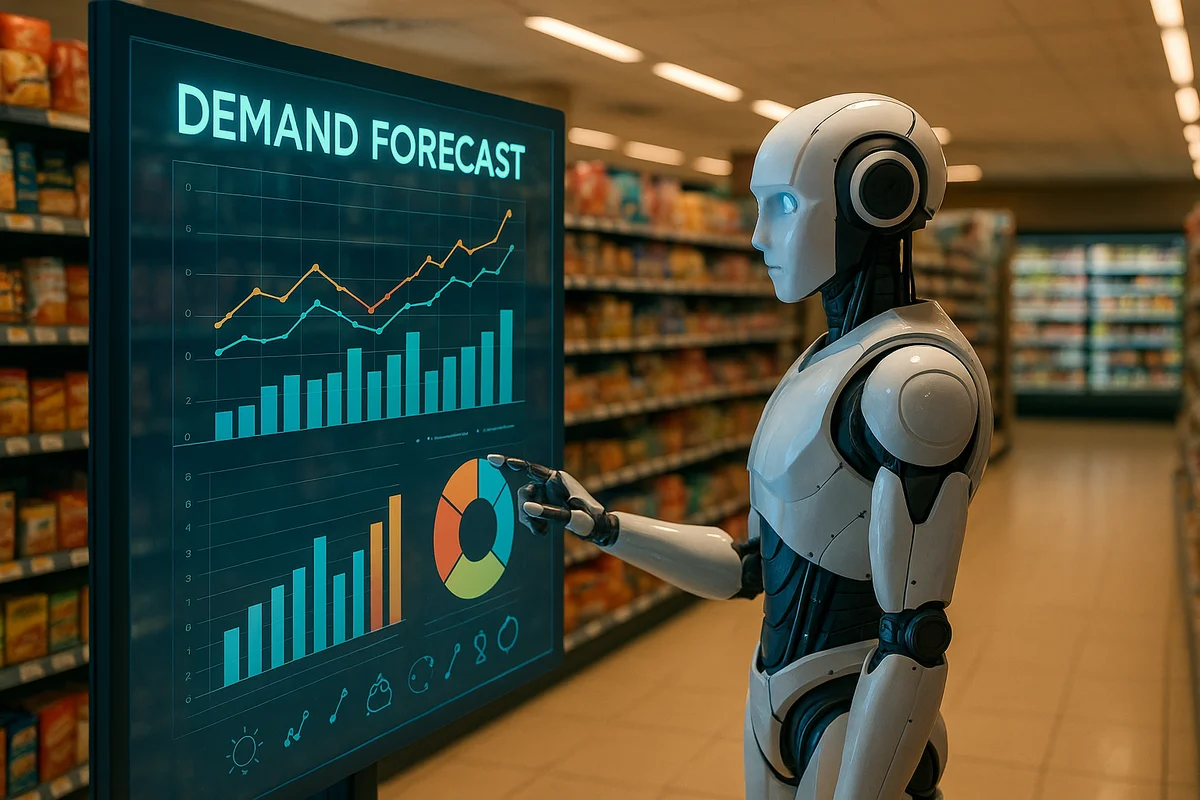



A heatwave hits, and a grocery chain runs out of bottled water for two days because the truck was still en route. Three states over, the same company has a warehouse full of last season's snacks nobody wants at full price. Water and snacks don't matter. The root cause is the same: supply chain planning, or the lack of it. It's the discipline of figuring out what you'll need, when you'll need it, and how to get it there on time.
For retailers, this carries extra weight. A manufacturer can plan a production run months out and adjust gradually. Retail doesn't work that way. A viral TikTok video, a surprise cold snap, or a competitor's flash sale can flip demand within hours. Generic supply chain planning advice, written for factories and distribution networks, tends to ignore all of that. It's exactly the gap a category manager juggling promotions, perishables, and seasonal SKUs across hundreds of stores runs into every week.
This guide covers what supply chain planning actually is, why it matters, and the core steps of the supply chain planning process. It also covers supply chain planning best practices, the strategies worth knowing, and where most planning breaks down in retail specifically. Finally, it looks at how AI-based supply chain planning software is changing what "good" looks like, with real numbers from retailers who've made the shift.
What Is Supply Chain Planning?
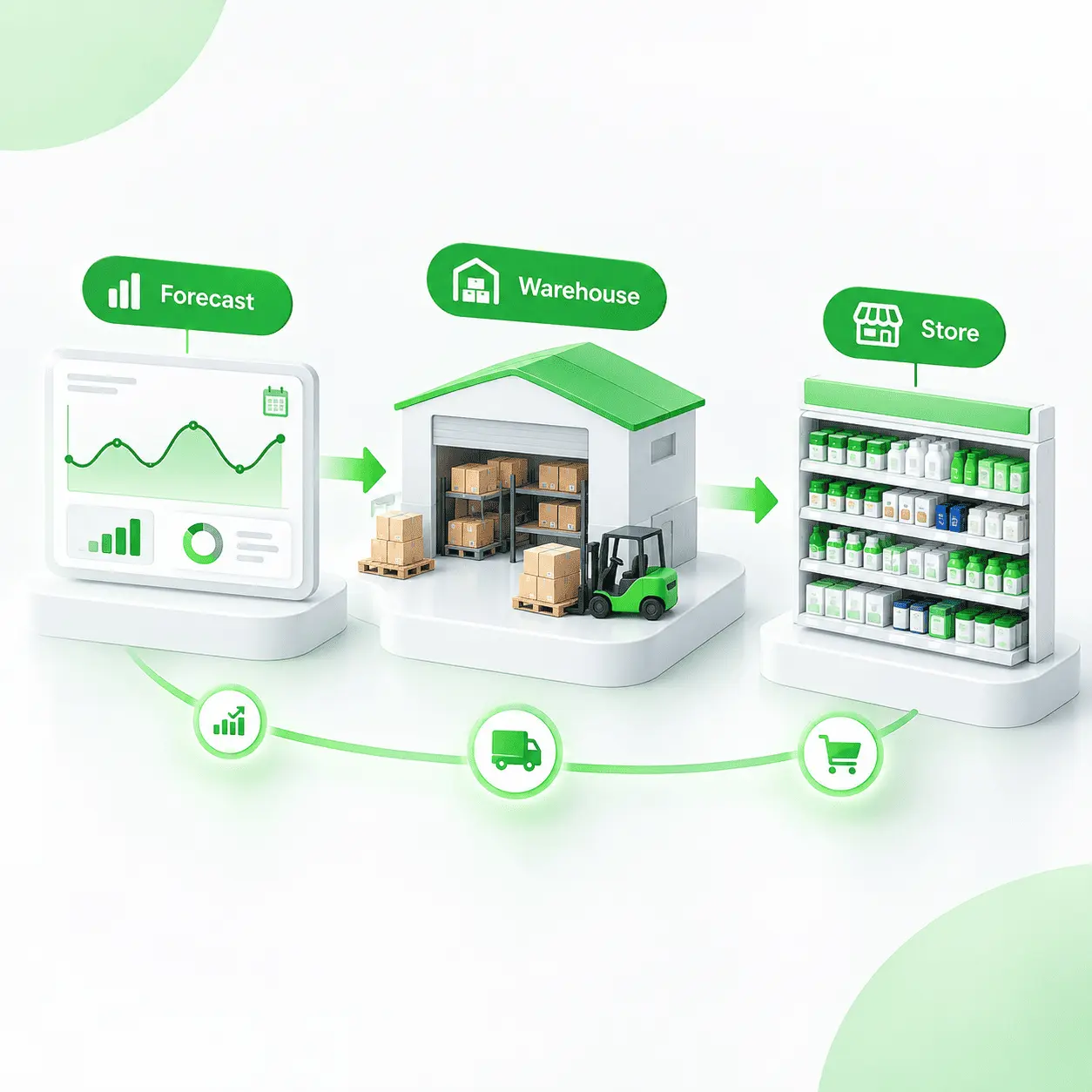
At its core, supply chain planning means forecasting demand and then aligning inventory, production, and logistics to meet it at the lowest reasonable cost. In plain terms: how much of what do we need, where, and by when?
A supply chain plan pulls together several moving parts: sales history, upcoming promotions, supplier lead times, warehouse capacity, transportation schedules. A supply chain planner turns all of that into something concrete: an actual purchase order, a production schedule, a replenishment run. Not a guess on a spreadsheet.
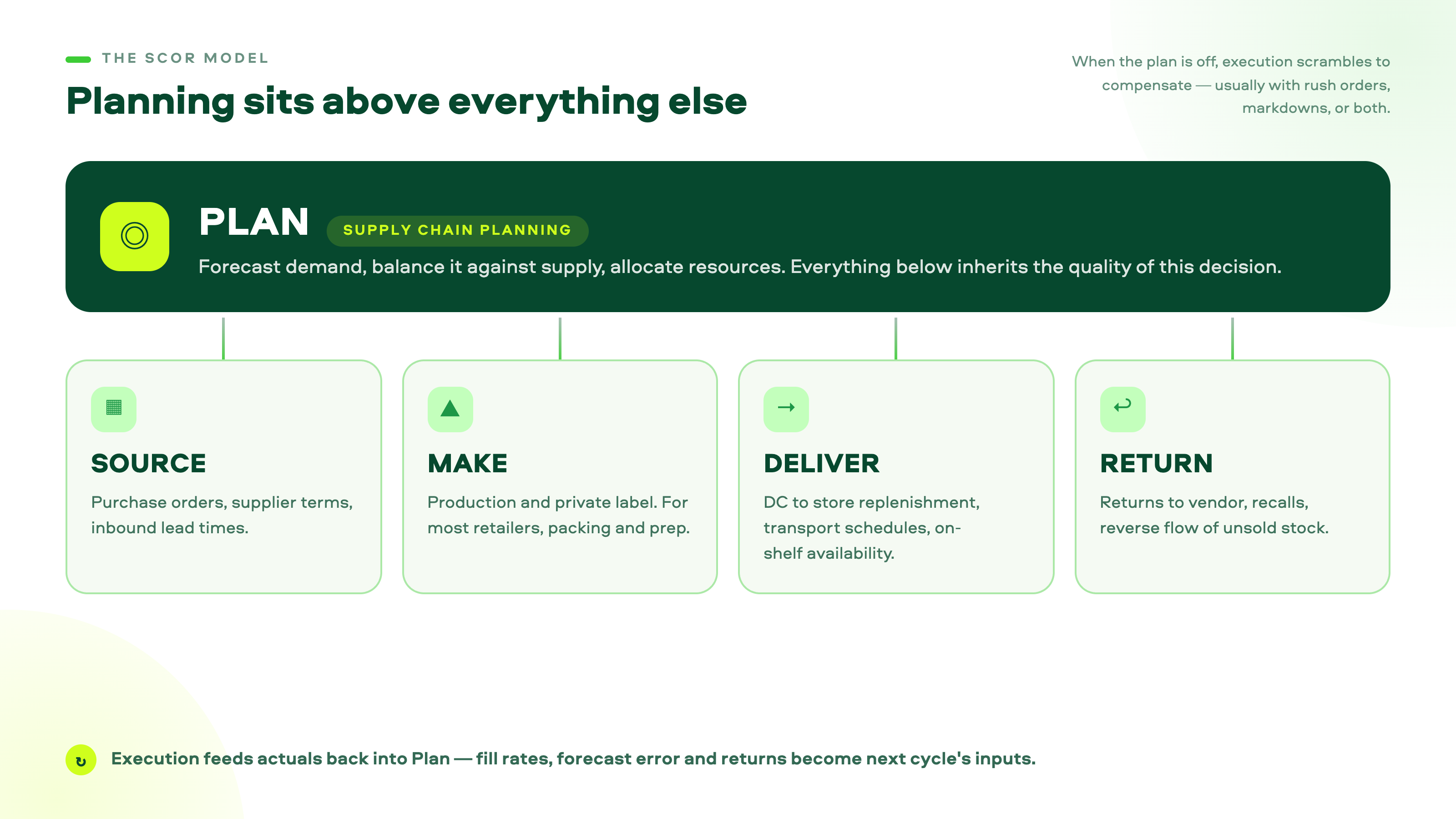
Supply chain planning sits upstream of execution. Planning decides what should happen; execution (buying, moving, shelving) is what happens. In the widely used SCOR model, supply chain planning is literally the "Plan" stage that sits above Source, Make, Deliver, and Return. When the plan is off, execution scrambles to compensate, usually with rush orders, markdowns, or both.
Supply Chain Planning vs. Supply Chain Management: What's the Difference?
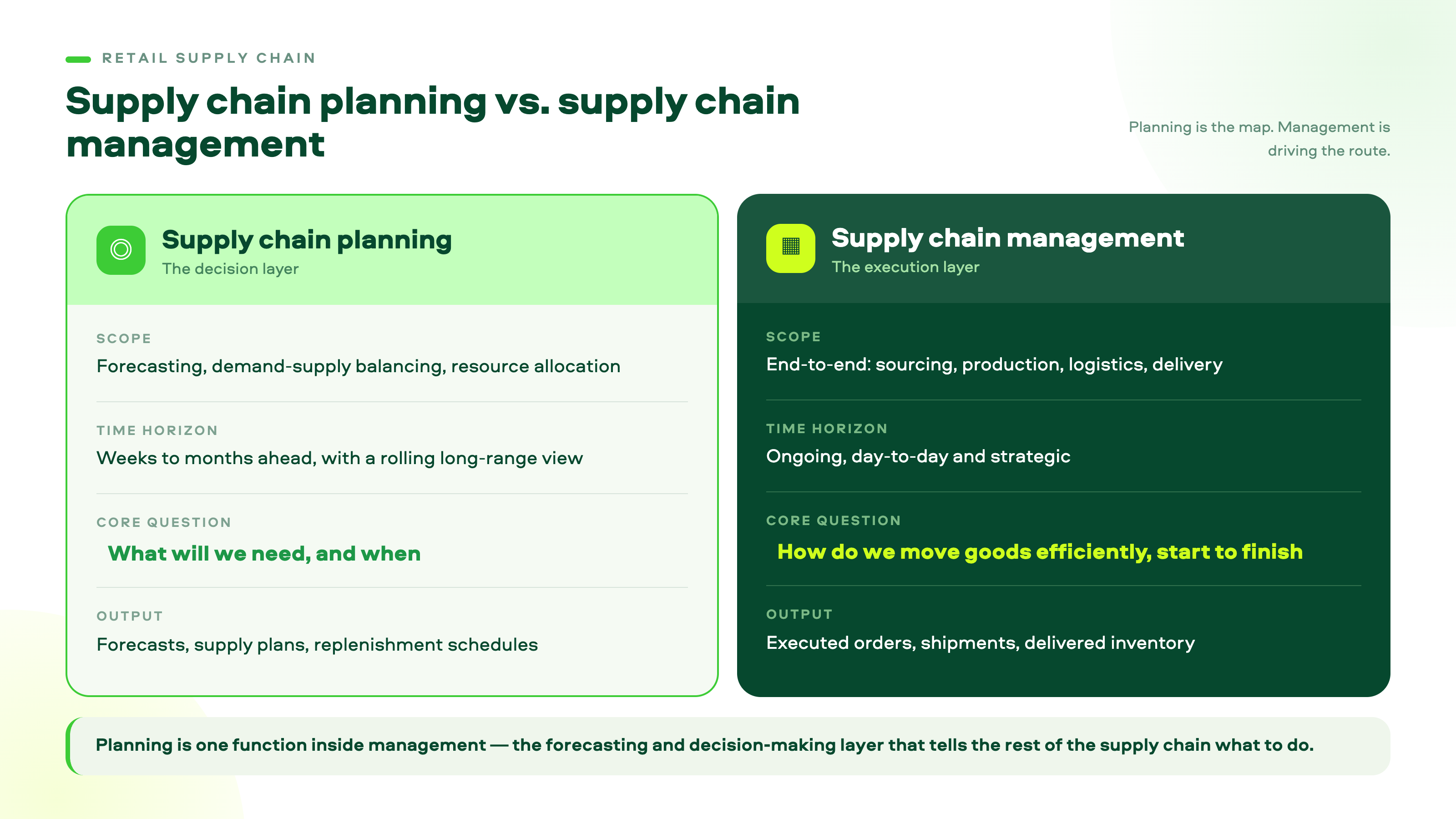
People use these terms interchangeably, but they're not the same thing. Supply chain management (SCM) is the broader discipline: everything from supplier relationships to warehousing to last-mile delivery. Supply chain planning is one function inside that discipline, specifically the forecasting and decision-making layer that tells the rest of SCM what to do.
| Supply Chain Planning | Supply Chain Management | |
|---|---|---|
| Scope | Forecasting, demand-supply balancing, resource allocation | End-to-end: sourcing, production, logistics, delivery |
| Time horizon | Weeks to months ahead (with a rolling long-range view) | Ongoing, day-to-day and strategic |
| Core question | "What will we need, and when?" | "How do we move goods efficiently, start to finish?" |
| Output | Forecasts, supply plans, replenishment schedules | Executed orders, shipments, delivered inventory |
A rough analogy: planning is the map, management is actually driving the route. A good map doesn't stop you from hitting traffic, but you're lost without one.
Why Supply Chain Planning Matters: Key Benefits
Do this well and a few things happen. Shelves stay fuller, less stock goes to waste, and the person running the plan spends less time firefighting.
Fewer Stockouts and Lost Sales
An empty shelf costs more than today's sale. It teaches a shopper that your store, or your app, can't be relied on for that item. A meaningful share of them will simply buy it somewhere else next time. Inventory distortion, the combined cost of out-of-stocks and overstocks, cost global retailers an estimated $1.73 trillion annually. IHL Group put that figure at 6.5% of global retail sales, according to reporting by Chain Store Age. Better supply chain planning is one of the most direct ways retailers can pull that number down.
Lower Carrying Costs and Less Markdown Waste
Overstock ties up cash in inventory sitting on a shelf instead of working for you, which is precisely what good inventory management aims to prevent. For perishables and seasonal goods, it's worse. Excess stock ends up marked down, donated, or thrown away. A tighter supply plan keeps you closer to what you'll actually sell instead of a buffer built on guesswork.
Better Cash Flow and Working Capital
Every dollar tied up in excess inventory is a dollar you can't spend on new products, better terms with suppliers, or store improvements. Retailers that plan well free up working capital simply by carrying less "just in case" stock across their network.
Faster, More Confident Response to Disruption
Disruptions aren't rare events anymore; they're the operating environment. According to McKinsey's most recent Global Supply Chain Leader Survey, nine in ten supply chain leaders say they encountered supply chain challenges in the past year. Once a disruption hits, it takes companies an average of two weeks to plan and execute a response. A mature planning process shortens that window and builds real resilience, because the scenarios have already been thought through before the disruption happens, not during it.
Key Components of Supply Chain Planning
A complete supply chain plan is really four smaller plans working together, and they only work if they talk to each other.
Demand Planning
Demand planning forecasts what customers will actually buy, by SKU, by store, by week. It draws on historical sales, seasonality, promotional calendars, and (increasingly) external signals like weather or local events. This is the foundation everything else in the supply chain planning process is built on; get the forecast wrong, and every downstream decision inherits that error.
Supply and Inventory Planning
Once you have a demand estimate, supply planning figures out how to meet it. How much inventory to hold, where to hold it, and how it should flow between distribution centers and stores. Safety stock, lead time, and reorder points all live here.
Production and Replenishment Planning
For retailers who manufacture or private-label, production planning covers production schedules and raw material timing. For most retailers, the equivalent is automated replenishment: turning the supply plan into actual purchase orders and delivery schedules, store by store, SKU by SKU.
Sales and Operations Planning (S&OP)
S&OP is the recurring cross-functional process (usually monthly) where demand, supply, finance, and merchandising teams reconcile their numbers into one shared plan. Done well, it's the connective tissue that keeps demand forecasts from drifting away from what supply chain can realistically deliver. Retailers running a structured S&OP process tend to catch mismatches between forecast and capacity early. They spot problems weeks before they become stockouts or overstock.
Key Steps for Effective Supply Chain Planning
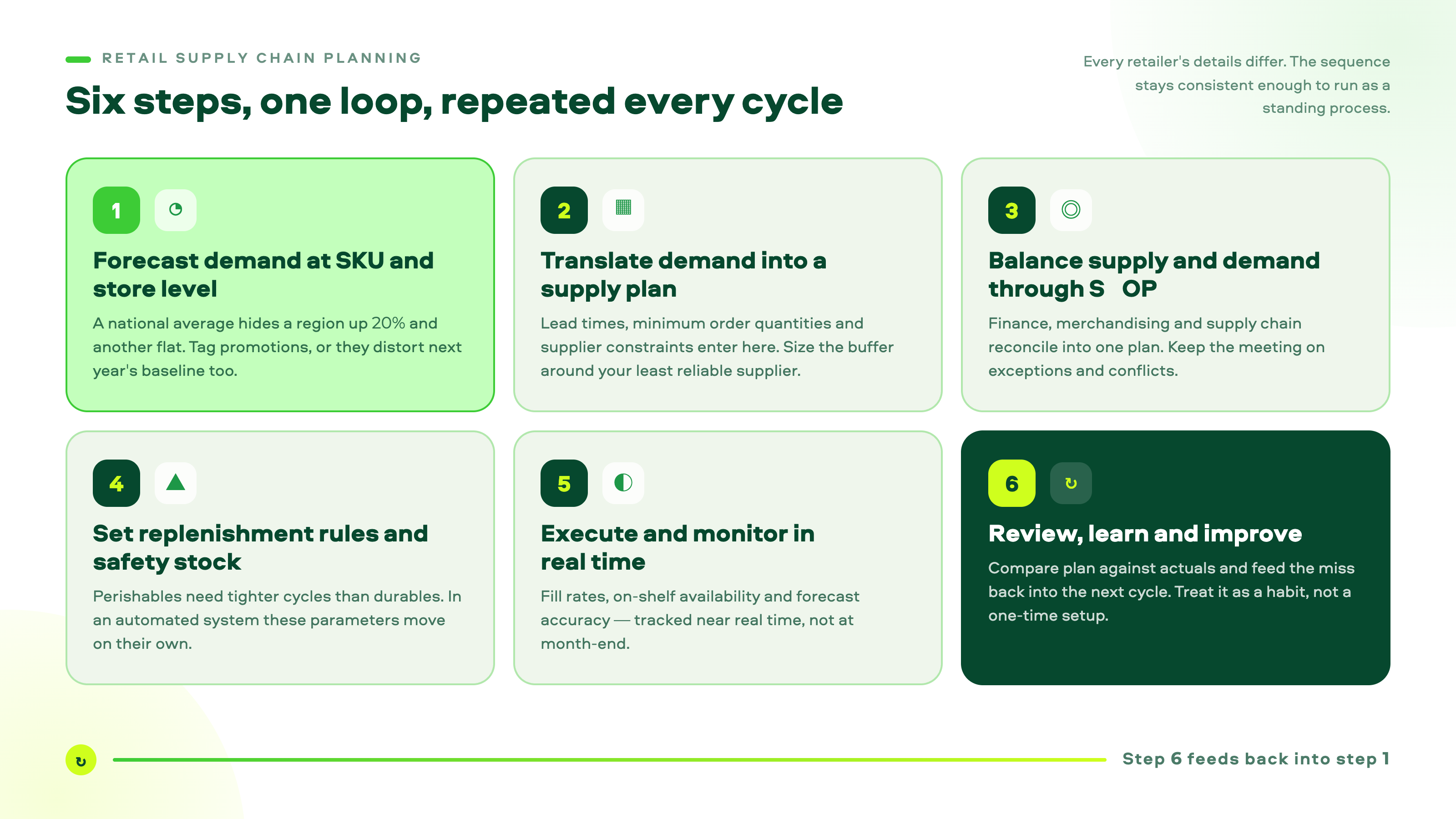
Every retailer's version of this looks a little different in the details. The underlying supply chain planning steps stay consistent enough to lay out as a sequence, start to finish.
Step 1: Forecast Demand at the SKU and Store Level
Start with granular demand planning, not a company-wide average. A national forecast might say "sales are up 5%," but that number hides a lot: one region is up 20% and another is flat. Forecasting at SKU and store level catches those differences before they turn into a stockout in one location and a pile of overstock in another.
Worth flagging: if your forecasting tool doesn't already account for promotions, layer the event calendar in manually. A demand spike from a planned promotion looks identical to organic growth until you tag it. Leave it untagged and it'll throw off next year's baseline too.
Step 2: Translate Demand Into a Supply Plan
Once you have a demand forecast, convert it into an actual supply plan. Decide how much inventory needs to be where and by when, without overcommitting capital. This step is where lead times, minimum order quantities, and supplier constraints get factored in.
Say two suppliers carry the same SKU. One is cheaper but needs 12 days to deliver; the other costs more but can replenish in four. There's no universally right answer here. The correct call shifts with current stock on hand, expected demand over the next few weeks, and how expensive it would be to guess wrong. That trade-off is what supply planners are actually paid to make, day after day.
Size the buffer around your least reliable supplier, not your average one. A single weak link in supplier management can quietly undo an otherwise solid forecast.
Step 3: Balance Supply and Demand Through S&OP
Run the numbers through a cross-functional review before committing. Finance may flag a budget constraint. Merchandising may know a competitor is about to run a conflicting promotion, and supply chain may know a key supplier is behind schedule. S&OP is where those perspectives get reconciled into one plan everyone can actually execute against.
Keep the meeting itself focused on exceptions and conflicts. A line-by-line review of every SKU is nobody's idea of a good hour, and it buries the decisions that actually matter.
Step 4: Set Replenishment Rules and Safety Stock Levels
Define how and when inventory gets reordered: fixed reorder points, min/max levels, or continuous review, depending on the category. Perishables need tighter, more frequent replenishment cycles than durable goods; a one-size-fits-all rule set will underperform on both ends.
If safety stock is still set manually, review it by category at least quarterly, and more often for anything seasonal or volatile. In an automated planning system these parameters should move on their own, adjusting as demand variability and supplier reliability shift, rather than waiting for a scheduled review.
Step 5: Execute and Monitor With Real-Time Visibility
A plan is only as good as your ability to see whether it's working. Track fill rates, on-shelf availability, and forecast accuracy against actuals as core planning KPIs. Do it in near real time, not at month-end, when it's too late to correct course. Supply chain visibility across the network, not just at the warehouse, is what turns monitoring into something actionable.
Step 6: Review, Learn, and Continuously Improve
Close the loop. Compare what you planned against what actually happened, identify where the forecast missed and why, and feed that back into the next planning cycle. Retailers that treat this as a one-time setup instead of an ongoing habit tend to see their forecast accuracy quietly decay over a year or two.
Common Supply Chain Planning Strategies
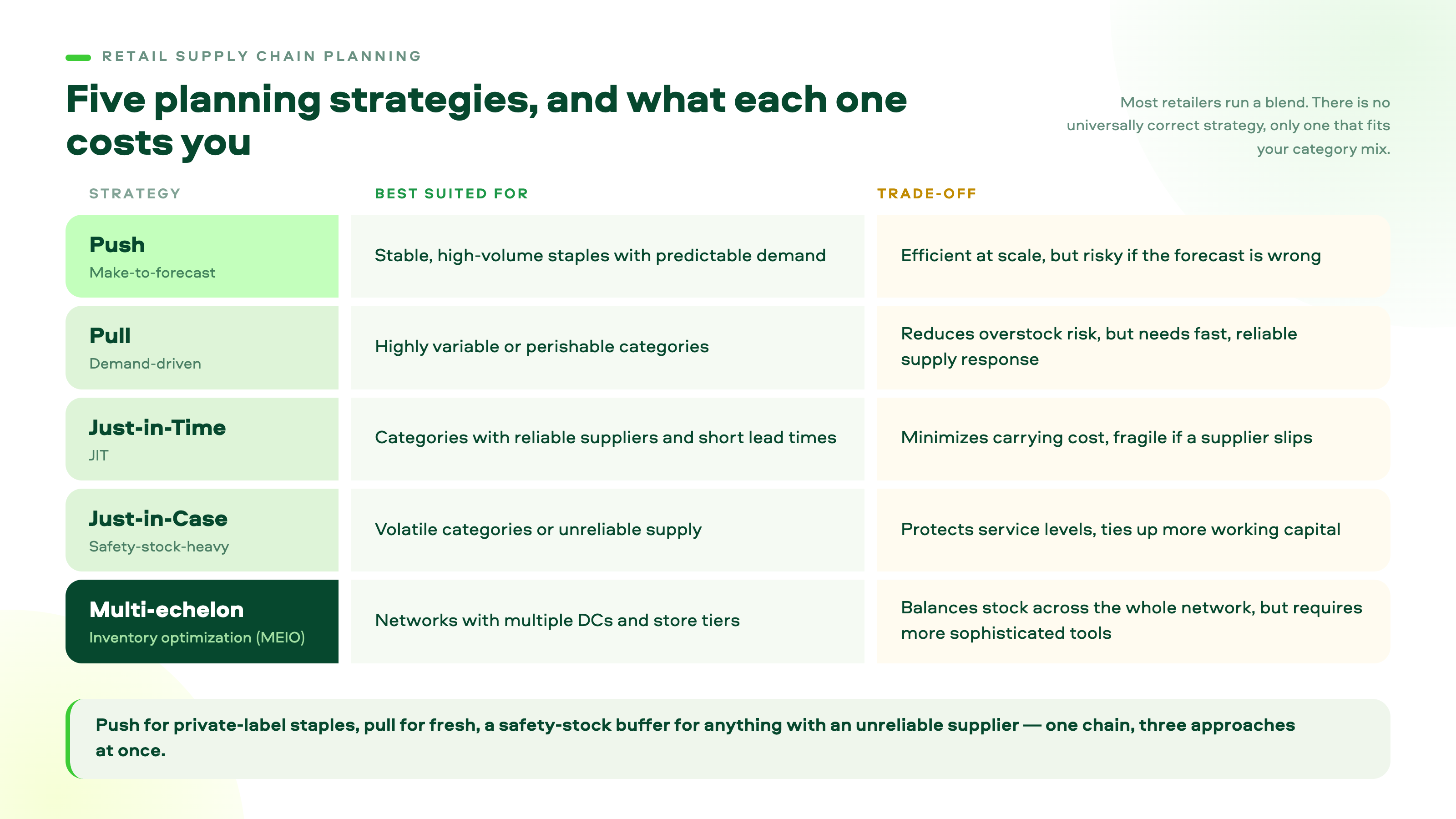
Not every category, or every business, should run the same supply chain planning strategy. The right approach depends on how predictable your demand is and how much risk you can tolerate carrying in inventory.
| Strategy | Best suited for | Trade-off |
|---|---|---|
| Push (make-to-forecast) | Stable, high-volume staples with predictable demand | Efficient at scale, but risky if the forecast is wrong |
| Pull (make-to-order / demand-driven) | Highly variable or perishable categories | Reduces overstock risk, but needs fast, reliable supply response |
| Just-in-Time (JIT) | Categories with reliable suppliers and short lead times | Minimizes carrying cost, fragile if a supplier slips |
| Just-in-Case (safety-stock-heavy) | Volatile categories or unreliable supply | Protects service levels, ties up more working capital |
| Multi-echelon inventory optimization | Networks with multiple DCs and store tiers | Balances stock across the whole network, but requires more sophisticated tools |
Most retailers end up running a blend. Push planning works for private-label staples, pull-style replenishment suits fresh categories, and a safety-stock buffer covers anything with an unreliable supplier. There isn't a universally "correct" supply chain planning strategy, only one that fits your specific mix of categories.
How to Measure Supply Chain Planning Performance
A plan you can't measure is just a guess with extra steps. Retailers serious about supply chain planning track a consistent set of KPIs across forecasting, inventory, and service. Not just one favorite metric that happens to look good this quarter.
| KPI | What it tells you |
|---|---|
| Forecast accuracy / WAPE | How closely the forecast matches actual demand |
| On-shelf availability | Whether planning is translating into product actually being on the shelf |
| Lost sales / stockout rate | Revenue impact of underplanning |
| Inventory turnover | How efficiently inventory is being used |
| Days of inventory | How much capital is tied up in stock at any given time |
| Overstock | The cost of planning too conservatively |
| Service level / fill rate | Ability to meet expected demand from available stock |
No single metric tells the full story on its own. High on-shelf availability paired with rising overstock usually means the safety-stock buffers are too generous, not that planning is working well. Rising inventory turnover alongside falling service levels can mean the opposite: cuts that will show up as stockouts a few weeks later. The KPIs matter most in combination, tracked together over time rather than checked one at a time in isolation.
Common Challenges in Supply Chain Planning, and How to Overcome Them
The steps above are the easy part to write down. Getting them to actually work is where retailers usually get stuck, and the obstacles tend to repeat across companies.
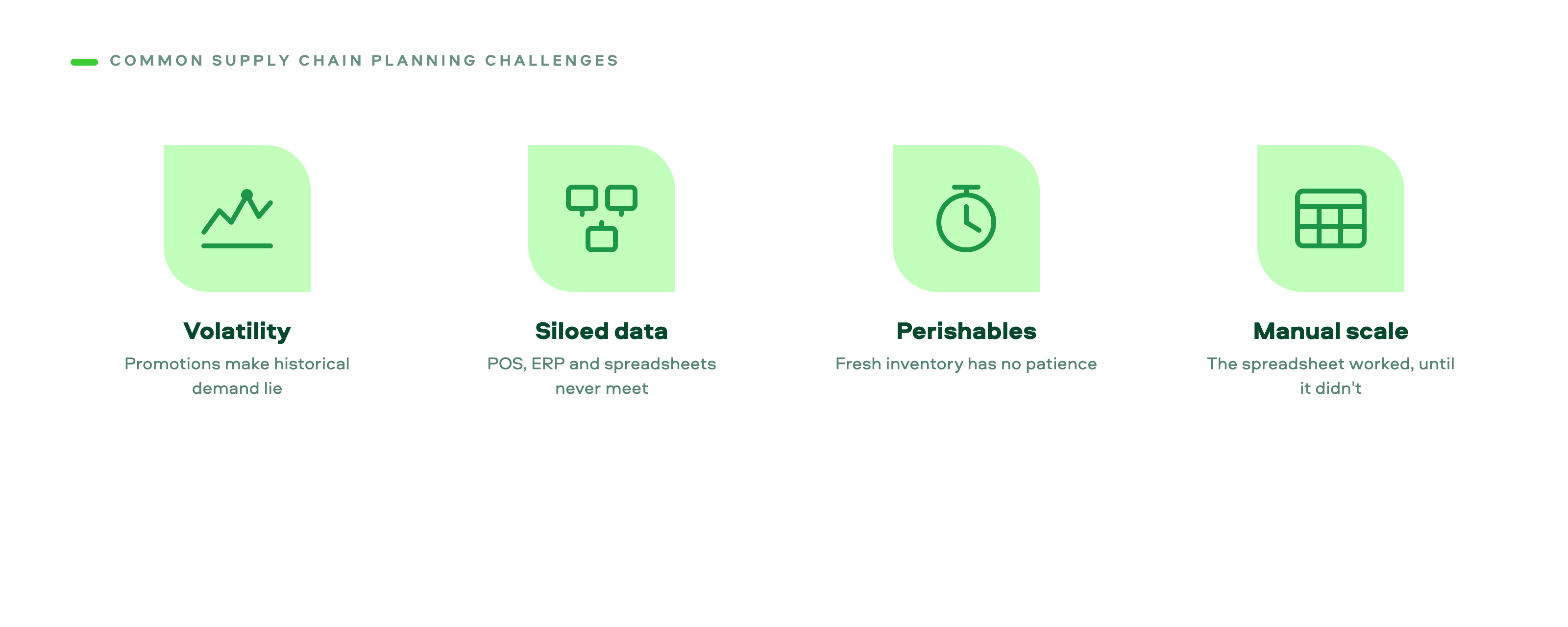
Challenge 1: Promotions Make Historical Demand Lie
Retail demand doesn't move smoothly. A promotion can multiply demand for a SKU for several days, then send it straight back to baseline. Generic forecasting models built for steady industrial demand handle that badly. A spreadsheet can record the spike well enough. What it usually can't tell you is whether that spike was baseline growth, promotional lift, cannibalization from a neighboring SKU, or a one-off event. That distinction is exactly what next month's forecast needs.
Challenge 2: The Data Exists, Just Not in One Place
Demand data lives in the POS system, supply data lives in the ERP, and promotional calendars live in a shared spreadsheet nobody updates consistently. Planning built on disconnected data is planning built on guesswork, no matter how sophisticated the forecasting math underneath it. It's one of the most common ways a supply chain planning process fails quietly, with nobody noticing until the numbers are already wrong.
Challenge 3: Fresh Inventory Has No Patience
Fresh and short-dated categories punish both overstocking and understocking almost immediately. Overstock becomes waste within days; understock is a stockout by the weekend. Category managers in fresh often need daily or even multiple-times-a-day replenishment cycles, not the weekly cadence that works fine for durable goods.
Challenge 4: The Spreadsheet Worked, Until the Business Grew
A planner with a spreadsheet can manage a few hundred SKUs reasonably well. Multiply that across thousands of SKUs and hundreds of stores, and manual planning stops being a workflow and starts being triage. This is usually the point where retailers start evaluating supply chain planning software. Manual planning isn't impossible at that scale. It's just no longer worth the toll it takes on the team.
How AI and Software Transform Supply Chain Planning
Modern supply chain planning tools don't replace the steps above. They compress the time it takes to run them and catch patterns a person juggling a spreadsheet would likely miss. Industry analysts expect this shift to accelerate. Gartner projects that 70% of large organizations will adopt AI-based demand forecasting by 2030, moving away from purely manual, statistical forecasting methods.
AI-Driven Demand Forecasting
AI-based forecasting models pick up on patterns that traditional statistical methods miss: weather sensitivity, cross-SKU cannibalization during a promotion, or a slow shift in customer preference. According to a 2024 McKinsey survey covered by Supply Chain Dive, 74% of supply chain leaders say they have already implemented AI in demand planning or plan to. Most of the industry, in other words, is past the experimental stage.
One honest caveat here: AI forecasting is only as good as the data feeding it. A retailer with messy POS data and no clean promotional history won't get a magic forecast just by turning on a new algorithm.
Better forecasting gets most of the attention in this conversation, but it isn't always the first problem worth solving. If planners still convert forecasts into purchase orders by hand, another few points of forecast accuracy may do surprisingly little for the business. The same is true when supplier constraints live outside the planning system entirely. The value shows up when forecasting connects directly to the decisions that follow it, not when the forecast itself gets marginally sharper in isolation.
Automated Replenishment and Order Generation
Once the forecast is solid, automated replenishment turns it into purchase orders and delivery schedules without someone manually reviewing every SKU-store combination. This is where the time savings compound. A supply chain planner overseeing automated replenishment across a large assortment can focus on the exceptions, not re-approve routine reorders all day.
What does that look like at retail scale? Kolo, a European grocery retailer, was managing replenishment across 236 stores. Once store-level demand planning and automated replenishment were connected into a single process with LEAFIO, the impact went beyond planner productivity. Within the first year, like-for-like sales rose 20%, inventory turnover improved 17%, overstock dropped 43%, and on-shelf SKU availability climbed 14 percentage points.
No single number here is the story. What matters is that availability and inventory efficiency moved in the same direction at once, which is the trade-off manual, reactive planning usually struggles to pull off. Retailers chasing fewer stockouts often accept some overstock as the cost of doing it, and vice versa. Kolo's numbers moved together instead of trading off against each other.
Real-Time Visibility Across the Supply Chain
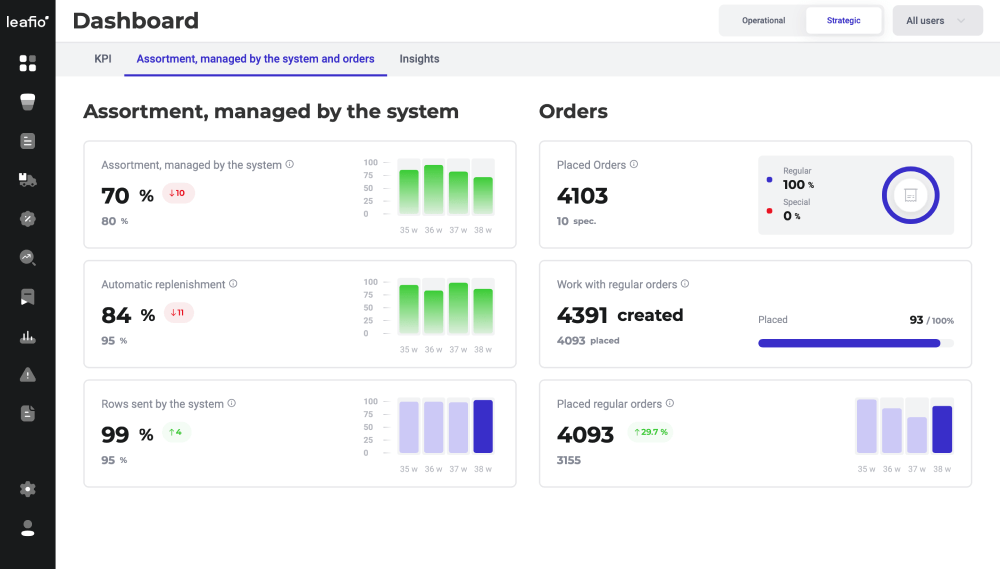
Real-time dashboards replace the month-end report with a live view of fill rates, forecast accuracy, and inventory position by store and category. That's what lets a planner catch a developing stockout while there's still time to act, instead of reading about it in a report two weeks later.
Minii Delguur, a discount retail chain in Mongolia, used LEAFIO to bring automated demand and supply planning to a network previously run on manual reordering. Sales grew 34%, overstock fell 18%, and total inventory days dropped 30%.
A 30% cut in inventory days would be a lot less impressive if it came at the expense of sales. It didn't. Sales grew 34% while inventory got leaner at the same time, and that combination matters more than either number on its own. The retailer wasn't simply cutting stock to hit a target; it was getting more sales out of less inventory. That's the balance effective supply chain planning is supposed to create.
Retailers evaluating supply chain planning software for the first time don't need to rebuild their entire process on day one. Most start with one high-friction area, usually demand forecasting or replenishment, prove the value with a pilot category, and expand from there.
If you want to see what a retail inventory optimization platform looks like in practice, LEAFIO's team can walk you through it. They can also show how automated replenishment fits into a broader planning process, using your own SKU and store data.
FAQ
What is supply chain planning, in simple terms?
Forecasting what you'll need, when, and where, then aligning inventory, production, and logistics so supply meets demand without excess cost. It sits ahead of the actual buying, moving, and shelving of goods, the decision layer, not the execution layer.
How does supply chain planning work in retail specifically?
It starts with demand forecasting at the SKU and store level, moves through supply and replenishment planning, gets reconciled through S&OP, and closes with monitoring and review. Retail layers on extra volatility from promotions, seasonality, and perishables that manufacturing-style models were never built to handle.
Why is supply chain planning important for a retail business?
Without it, retailers swing between stockouts and overstock, lost sales on one side, markdowns and wasted cash on the other. Good planning narrows both extremes and shortens recovery time when something goes wrong.
What are the main steps of the supply chain planning process?
Forecast demand, turn it into a supply plan, reconcile through S&OP, set replenishment and safety stock rules, execute with real-time monitoring, then review and adjust. Six steps, one loop, repeated every cycle.
How do I create a supply chain plan if I'm starting from scratch?
Start with clean historical sales data at the SKU-store level and layer in known future events like promotions. Then define replenishment rules, supplier constraints, and realistic safety stock for the categories that matter most. You don't need a perfect forecast before you start, just a reliable enough demand signal and a process that turns it into supply decisions. Formal S&OP and broader automation can follow as the operation grows.
What's the difference between demand planning and supply planning?
Demand planning predicts what customers will want. Supply planning works out how to actually have it on hand, inventory levels, supplier lead times, replenishment logistics. One feeds the other, and supply planning is never more accurate than the forecast underneath it.
Do small or mid-sized retailers need formal supply chain planning, or is that just for large chains?
Formal planning helps at almost any scale, though the tooling should match the size of the operation. A five-store chain probably doesn't need a full S&OP calendar. Even a handful of locations benefit from SKU-level forecasting and defined replenishment rules instead of ad hoc reordering.
What supply chain planning systems should retailers actually look for?
Look for retail-specific forecasting (it should handle promotions and seasonality natively, not as a workaround), automated replenishment, and real-time visibility into inventory across stores and DCs. Generic manufacturing-oriented planning systems often need heavy customization to work for a store-based, SKU-dense retail environment.