

Most pages that promise an AI in inventory management case study describe "a leading retailer" and stop there. This one names names: 11 retail chains that used LEAFIO AI to tackle six inventory problems, with published results. They range from a 7-location DIY business to a 332-store pharmacy network. LEAFIO AI works with 250+ retailers in 45+ countries, and these eleven have made their numbers public.
The stakes are not small. According to a 2026 Gartner survey on AI investment returns, 67% of supply chain digital investment now goes to AI. Yet 55% of chief supply chain officers are unclear on what that spending returns. Named results with real numbers are the quickest way to close that gap.
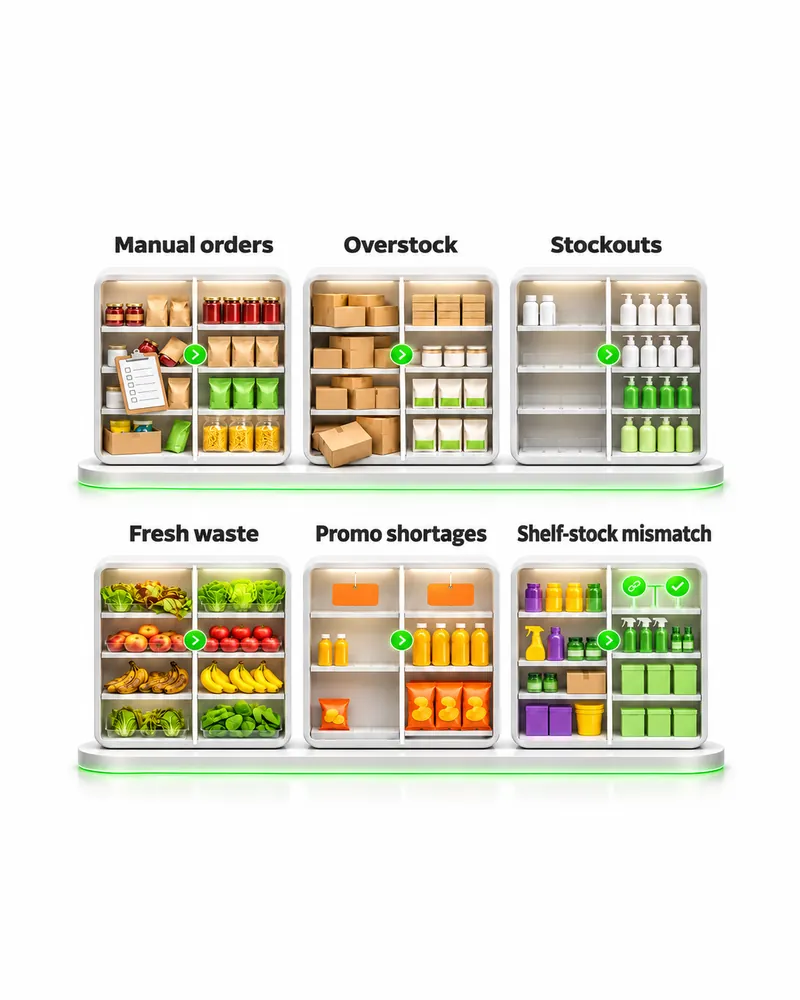
The cases are grouped by the problem each retailer set out to fix, so you can jump to yours. Read them side by side and one pattern stands out. The biggest gains did not come from a sharper forecast alone. They came when ordering stopped depending on the judgment of each store manager.
What the eleven cases show:
- Centralized ordering is the common thread. Daily now sends 99.5% of orders without manual edits, and an eight-person team orders for all 332 Aversi pharmacies.
- Overstock fell by 6% to 50% in the cases that report it, and lost sales fell by 9% to 78%.
- Results arrive on different timelines. Daily cut fresh write-offs from 11% to under 2% in two months; other cases report periods from three months to several years.
- Inventory is the usual starting point, not the limit. The LEAFIO AI Retail Platform connects assortment, shelf and replenishment decisions.
If you want the basics first, start with how AI inventory management works. If you want proof, read on.
The 11 AI inventory management case studies at a glance
Named, published results like these are still rare, because few retailers have taken AI all the way. Demand sensing is the most widely scaled AI capability, yet only 38% of consumer supply chain leaders run it at scale. That figure comes from a February 2026 McKinsey survey of senior supply chain leaders.
All eleven chains below use LEAFIO's retail inventory optimization software, one of four modules of the LEAFIO AI Retail Platform. Five of them also run Shelf Efficiency for planograms.
| Problem | Retailer | Segment | Stores | LEAFIO modules | Headline result | Period |
|---|---|---|---|---|---|---|
| Manual store orders | Local Discounter | Supermarkets | 82 | Inventory Optimization, Shelf Efficiency | Store ordering workload down 80% | Not stated |
| Manual store orders | Toy House | Toy retail | 67 | Inventory Optimization | Auto-generated reorders up from 72.1% to 96.2% | 2018 to 2019 |
| Overstock | Aversi | Pharmacy | 332 | Inventory Optimization | Inventory turnover up 16%, 98% SKU availability | Not stated |
| Overstock | Al.Capone | Liquor | 120 | Inventory Optimization, Shelf Efficiency | Inventory turnover 46% faster | Pilot |
| Lost sales | MINII Delgur | Discount grocery | 70 | Inventory Optimization | Sales up 34% | First year |
| Lost sales | Maxibuild | DIY building materials | 7 | Inventory Optimization | Lost sales down 78% | First year |
| Lost sales | Grupo Camilo | Supermarkets and wholesale | 8 | Inventory Optimization, Shelf Efficiency | Lost sales down 67%, overstock down 41% | Second phase, like-for-like |
| Fresh write-offs | Daily | Grocery | 227 | Inventory Optimization | Fresh write-offs from 11% to under 2% | Two months |
| Promotions | L Cosmetics | Health and beauty | 26 | Inventory Optimization | Inventory turnover up 25% | Three months |
| Shelf and inventory silos | Baltic Petroleum | Fuel convenience | 86 | Inventory Optimization, Shelf Efficiency | Overstock down 50% | First year |
| Shelf and inventory silos | VIADA Baltija | Fuel convenience | 93 | Inventory Optimization, Shelf Efficiency | Overstock down 35%, lost sales down 29% | Not stated |
Problem 1: Store teams spend hours building orders by hand
Ask a store manager how long ordering takes and you will usually hear "a couple of hours." Multiply that by every store and every order day. The cost rarely shows up on a P&L, because it hides inside store payroll.
The bigger cost is quality. An order built at the end of a shift reflects that manager's memory, not the demand curve.
Local Discounter: 80% less ordering work
Local Discounter, an 82-store supermarket chain, had each store manager spending 2 to 3 hours on orders across about 300 suppliers. After switching to automated replenishment with LEAFIO Inventory Optimization, store ordering workload fell 80%. Sales rose 20%, product availability 10% and inventory turnover 15%. Average inventory did not grow at all, even though the chain expanded parts of its assortment by 30 to 70%.
That last figure is the one to show your CFO. The project team explains it simply: the algorithm works through the entire assortment matrix, so no SKU depends on one manager's memory.
Toy House: two planners for 67 stores
Toy House runs 67 toy stores and an online shop, with more than 50,000 SKUs. Its planners used to manage 5 to 7 stores each in Excel, and the New Year peak stretched them thin. With LEAFIO's AI demand forecasting, the share of auto-generated reorders rose from 72.1% to 96.2% between 2018 and 2019. Machine learning now sets safety stock for each store from current demand, order frequency and seasonal trends, including the New Year peak. Today two planners run replenishment for the whole network.
A fair caveat: none of this happened in a quarter. Toy House has worked with LEAFIO since 2017, and the automation rate climbed over several seasons.
Problem 2: "Just-in-case" ordering locks cash in overstock
Store teams over-order for a simple reason. An empty shelf gets noticed, while a full backroom does not. Each extra case looks harmless, but across hundreds of stores it adds up to frozen working capital.
In our experience, overstock is rarely a forecasting problem first. It is a trust problem: people pad orders because they do not trust the next delivery.
Aversi: from 332 order desks to one team of eight
Aversi, a 332-store pharmacy chain, let each pharmacy build its own orders, and managers kept large "just-in-case" reserves. LEAFIO Inventory Optimization moved ordering to an eight-person central team. Each pharmacy now receives quantities calculated from actual demand instead of defensive reserves. Like-for-like sales rose 11%, inventory turnover improved 16% and SKU availability reached 98%. The chain's own team reports that excess stock dropped by several million.
Aversi first tried to build a replenishment system in-house. It dropped that project after comparing vendor algorithms against its own build.
Al.Capone: the overstock came from supplier terms
Al.Capone, a 120-store liquor chain, found a less obvious source of overstock. Once the system calculated order quantities from daily usage, stock on hand and goods in transit, some supplier requirements turned out to be too high. The chain renegotiated them. Orders now run on schedules matched to delivery frequency, with day-of-week coefficients built into the forecast. In the pilot of LEAFIO Inventory Optimization and Shelf Efficiency, inventory turnover became 46% faster and sales grew 5.2%. The rollout to the full network is still under way.
The same shift worked at fuel stations. VIADA Baltija, a 93-station fuel convenience chain, cut overstock by 35% after switching all its stations to automatic ordering.
Problem 3: Empty shelves and lost sales
Lost sales are the quiet side of inventory distortion. Nobody records the shopper who left without the item. Worse, a system that reads a stockout as zero demand will order even less next time.
MINII Delgur: sales up 34% by putting stock where it sells
MINII Delgur, a hard-discount grocery chain with 70 stores, ordered semi-manually, with min-max levels typed into its ERP. It had no data on lost sales or supplier reliability. LEAFIO's AI demand forecasting now plans orders from SKU sales history, seasonality and promotions, with separate fresh logic for perishables. In the first year with LEAFIO Inventory Optimization, sales rose 34% and average overstock fell 18%. Total inventory days dropped 30%.
One detail looks odd at first. MINII's total inventory grew 21% while overstock fell. The extra stock went into availability, which rose sharply, and that is where the sales growth came from.
The chain also began scoring suppliers on late and incomplete deliveries. It now uses that data in negotiations.
Maxibuild: lost sales down 78% in DIY
Maxibuild, a building materials retailer and distributor with 7 locations and 10,000 SKUs, ordered manually with limited warehouse space. Its main worry was running out of top seasonal items. The system now generates orders from sales history, forecasts, planned promotions and seasonality. An analytical report flags warehouse surpluses and shortages, so goods can be moved quickly. In the first year with LEAFIO Inventory Optimization, lost sales fell 78% and warehouse overstock dropped 39%. Inventory turnover improved from 43 to 25 days.
Maxibuild shows that AI ordering is not only for large networks. With 10,000 SKUs, seven locations already hold more items than a manual process can track one by one.
Grupo Camilo: lost sales down 67% once the system settled in
Grupo Camilo, a supermarket and wholesale group with 8 stores and more than 15,000 items, managed replenishment by hand in a legacy system. It rolled out LEAFIO Inventory Optimization and Shelf Efficiency in phases, from the distribution center to stores and then to suppliers. In the first phase (February to May 2025), like-for-like sales rose 11% and lost sales fell 10%. In the second phase (June to September 2025, like-for-like), with replenishment and promotions in sync, lost sales fell 67% and overstock 41%. By then the system managed about 40% of the active assortment.
The gap between the two phases is the point. The system needed a few months to tune replenishment buffers and sharpen its forecasts before the big gains showed up.
Toy House, the 67-store toy retailer, reached the same goal from another direction. It now holds 98% SKU availability and has cut lost sales by 26%.
Problem 4: Fresh write-offs
Fresh is where an ordering mistake turns into waste within days. U.S. retail generated 3.98 million tons of surplus food in 2024, worth $26.9 billion, most of it in fresh categories. That estimate comes from ReFED's 2026 report on how AI is used to cut food waste.
Fresh ordering has to weigh expiry dates, uneven weekday demand and several deliveries a day. That is why fresh inventory management needs its own logic, not the same rules as canned goods.
Daily: fresh write-offs from 11% to under 2%
Daily, a 227-store grocery chain, ran on ERP orders that store managers then adjusted by hand. LEAFIO Inventory Optimization now builds an order for every SKU, store and order day from sales, stock and in-transit data. When stock runs low, it corrects for the stockout instead of reading it as zero demand. After the switch, fresh-category write-offs fell from 11% to under 2% within two months. Today 99.5% of Daily's replenishment orders go out without a manager touching them. Inventory turnover improved from 30 to 24 days, and overstock fell 17%.
Over the full project, Daily's total sales rose 23% while the chain grew from 170 to 227 stores. Availability rose 8%, and an ABC analysis showed the gain held across categories, not only on fast movers.
Fresh also tends to show results quickly. The feedback loop is days, not months, so a bad order and a good one look very different by the end of the week. For more on the category, see our guide to grocery inventory management.
Problem 5: Promotions out of sync with replenishment
A promotion is a forecast with a deadline. If stock lands after the promo starts, you pay for the campaign and the shelf stays empty. If it lands too heavy, the leftovers sit for weeks.
Most promo problems look like forecasting problems. In practice, they are usually timing problems.
L Cosmetics: turnover up 25% in three months
L Cosmetics, a 26-store health and beauty chain, had three departments ordering separately. Promo stock often reached stores after the promotion had already started, while store managers over-ordered best-sellers. LEAFIO Inventory Optimization now forecasts demand and builds orders on a schedule, and half of the order schedules reach suppliers automatically. Across the project, inventory turnover improved 25% and average overstock fell 6% within three months. All store assortment now runs on automated orders.
The overstock figure is modest, and that is worth saying. The quick win here was turnover and timing, not a dramatic stock cut.
Aversi took a similar step with its promotion planning. Promotions are now announced up to two weeks ahead. Before each one, managers set an expected sales uplift in the system, instead of guessing order volumes store by store.
Problem 6: Inventory and shelf decisions live in separate systems
In many chains, the shelf and the order live in two different worlds. The planogram says four facings. The replenishment system has never seen the planogram, so it orders against a static display quantity.
When retailers use Shelf Efficiency with Inventory Optimization, facings and shelf capacity from published planograms can feed the replenishment model. Minimum presentation stock is then shown in days of sales. Planners can see when "three rows on the shelf" for a slow mover will turn into overstock. Both modules run on one data model, fed by a single integration with the retailer's ERP.
Baltic Petroleum: planograms and orders in one system
Baltic Petroleum runs 86 fuel-station convenience stores with about 2,500 SKUs. Before the project, 84 station managers placed orders by hand, and the chain had almost no planograms. It moved ordering to four head-office specialists with LEAFIO Inventory Optimization and digitized planograms with Shelf Efficiency. Both modules ran on a shared data layer, so replenishment decisions and planogram data stayed in sync. Across the network, overstock fell 50%, inventory turnover improved 13% and lost sales dropped 9%.
The chain reports payback within one month and a 1,581% ROI in the first year. Sales in planogrammed categories rose 62% on a like-for-like basis.
VIADA Baltija: the shelf sets the safety buffer
VIADA Baltija operates 93 fuel stations, where station managers used to handle replenishment without standard planograms. Today every station orders automatically, and the safety buffer comes straight from the planogram in shelf and planogram management. Overstock fell 35%, lost sales dropped 29% and availability rose 17%.
Beyond inventory: one plan from assortment to shelf and order
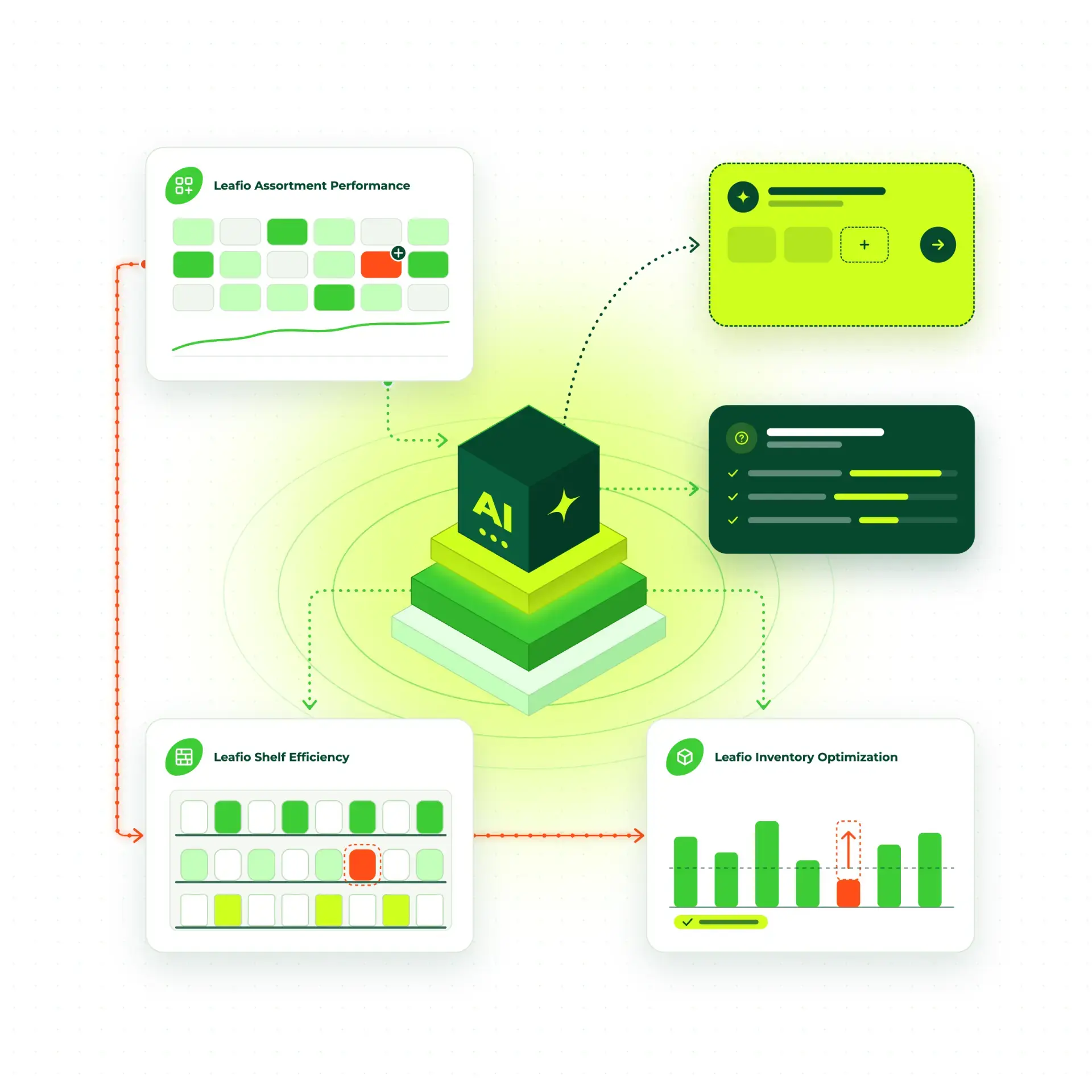
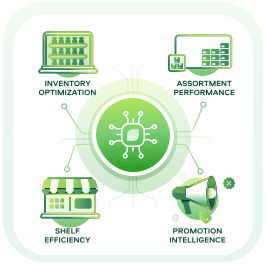
Most projects above started with inventory. Yet Inventory Optimization is one of four modules of the LEAFIO AI Retail Platform, alongside Assortment Performance, Shelf Efficiency and Promotion Intelligence. When retailers use them together, assortment decisions reach shelf planning and replenishment automatically.
A category manager lists or delists an SKU, and its status and dates flow to the planogram and to ordering. A delisting, for example, stops supplier orders, sells out remaining stock through the chain and removes the item from shelves store by store. The shelf and the order act on the same decision.
That is the case for running more than one module. Planning runs end to end, from assortment to shelf to order, and fewer decisions fall into the gaps between teams. Retailers can still start with one module and add others later by extending the same integration.
Each figure above comes from that retailer's published case. Treat them as results of those projects, not as a promise for every chain.
Dealing with one of these six problems? See how LEAFIO AI works on your own data.
The pattern behind the numbers: the gains came when people stopped overriding the system
Put the eleven cases side by side and the forecast is not the common thread. The common thread is who makes the final call on the order.
The wider industry is learning this the hard way. ReFED's May 2026 report on AI and food waste found that store managers often override accurate AI ordering recommendations. Store metrics punish an empty shelf harder than a spoiled case, so people default to over-ordering.
Planning teams show the same caution. Gartner's September 2026 forecast on autonomous supply chain planning expects slow progress. By 2030, only 5% of organizations automating planning will make at least 10% of their planning decisions autonomously. As Gartner puts it, investment alone does not create readiness.
Now look at what the retailers in this article changed.
Daily, Aversi and Baltic Petroleum moved the final call from store managers to the system. A small central team now watches the exceptions.
Toy House did the same. A representative of L Cosmetics put the mindset plainly: "We have complete confidence in the system, so we didn't want to impose our processes on it."
None of these chains removed people from inventory. They moved people from typing orders to handling exceptions, suppliers and assortment. How much to delegate stayed each retailer's choice.
Here is the uncomfortable part. If your store scorecard only counts empty shelves, expect padded orders, whatever software you buy. Decide who may override an order, track how often they do, and judge stores on overstock as well as availability.
How to read an AI inventory case study before you trust it
Vendor case studies, ours included, squeeze a long project into a few big numbers. Gartner has warned planning software buyers about "agent washing", where AI hype runs ahead of what tools actually deliver. Four questions tell you what a number really means.
Total sales or like-for-like?
Total sales include new stores. Daily's 23% growth, for example, came while the chain was expanding. Aversi (+11%) and Toy House (+10%) report like-for-like growth, which is the cleaner comparison.
Pilot or full network?
A pilot proves the method on a slice of stores or SKUs. Al.Capone's turnover result is a pilot figure. Ask how the pilot was chosen, and whether the result held after scaling.
Which module produced the number?
Multi-module projects mix effects. Baltic Petroleum's 62% figure covers planogrammed categories only. Local Discounter's headline 28.3% came from Shelf Efficiency, and its inventory project added a separate 20% sales gain.
Even separate figures never split cleanly. When shelf and replenishment share data, as at VIADA, a gain in availability owes something to both. The planogram sets the buffer, and the order fills it. Read module-level numbers as parts of one connected result, not as independent effects you can add up.
Over what period, and from what baseline?
The cases above span periods from two months to several years, so compare results over similar windows. Phases matter too: Grupo Camilo cut lost sales by 10% in its first phase and by 67% in its second. The case also notes that the system managed about 40% of the active assortment at that point. Coverage like this is worth asking about in any case study. And check the baseline. Baltic Petroleum's 50% overstock cut started from decentralized ordering with no inventory analytics, so there was a lot to fix.
AI inventory management case studies: FAQ
What are real examples of AI in inventory management?
Daily, a 227-store grocery chain, improved inventory turnover from 30 to 24 days with LEAFIO Inventory Optimization. Aversi, a 332-store pharmacy chain, raised inventory turnover by 16%. Baltic Petroleum, an 86-store fuel convenience chain, cut overstock by 50%. All three publish their results on named case pages, as do the eight other retailers in this article.
How much can AI reduce overstock in retail?
Among the LEAFIO cases above that report it, overstock reductions range from 6% to 50%. L Cosmetics cut 6% within three months, and Baltic Petroleum cut 50% in the first year. The size of the cut depends mostly on the starting point. These are results the retailers reported, not a forecast for other chains.
Can AI reduce fresh food waste in grocery?
Yes. Daily cut fresh-category write-offs from 11% to under 2% within two months of moving to LEAFIO's automated ordering. Fresh ordering works when the system accounts for expiry dates, uneven weekday demand and delivery frequency.
How long does it take to see results from AI inventory management?
It varies by retailer and by what you measure. In these cases, L Cosmetics reported results within three months, Daily saw its fresh result within two, and Maxibuild reported first-year figures. Toy House's automation rate rose over several seasons.
Why do AI inventory projects fail to deliver?
A common reason is that people keep overriding the system. ReFED's 2026 report found that store managers often override accurate AI orders, because empty shelves are penalized more than waste. Most retailers in this article centralized ordering and kept people for exceptions.
Does AI inventory management work for small retail chains?
Yes. Maxibuild runs 7 DIY locations and cut lost sales by 78% in the first year. L Cosmetics, with 26 stores, improved inventory turnover by 25% in three months. Grupo Camilo, with 8 stores, cut lost sales by 67% in its second phase.
Is LEAFIO AI only an inventory optimization tool?
No. Inventory Optimization is one of four modules of the LEAFIO AI Retail Platform, alongside Assortment Performance, Shelf Efficiency and Promotion Intelligence. When retailers use them together, assortment decisions reach shelf planning and replenishment automatically. Retailers can start with one module and add others by extending the same integration.
What should a good AI inventory case study report?
It should report overstock, lost sales, availability and inventory turnover, plus the period measured. It should also say whether sales growth is total or like-for-like, and whether results come from a pilot or the full network.


Have a question?

Jack Larson
Retail Optimization Expert