

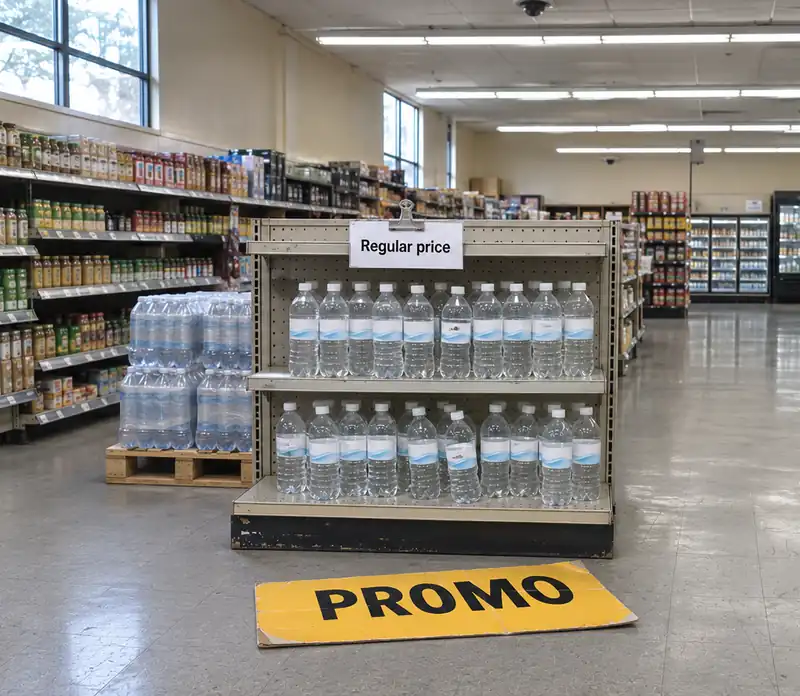


Take a 45-store grocery chain running a two-week promotion on bottled water. On the first morning back at the regular price, each store still holds 180 units, nine days of regular sales. Only 50 of them are needed before the next delivery, safety stock included. Nobody overbought at the start. The other 130 units came in the last delivery before the promotion ended, sized as if the discount would keep going.
Leftover stock like this is an ordering decision, made a few days before the end date. You avoid it with an exit plan set on the day the promotion is created. In practice, the last order covers promotional demand through the end date and forecast demand until the next delivery. Add the safety stock needed after the promotion, then subtract the stock you expect on hand when the order arrives. Below is that plan step by step, with a worked example for one store. The last section covers where the method falls short.
Leftover promotion stock is ordered before the promotion ends
Leftover stock after a promotion usually builds up through four mechanisms, and most of them act in the final week, before the price goes back up. The first is the last order. Most replenishment rules size each order on recent demand, and in the last week of a promotion, recent demand is the promotion itself. So an order placed on day 11 assumes the discounted rate will hold on days 15 and 16, when the price is already back up.
Safety stock follows the same logic. Many chains raise it to protect the first days of a promotion, and in the rush of the launch it often stays there. That extra layer arrives with the last delivery and stays on the shelf when the price returns.
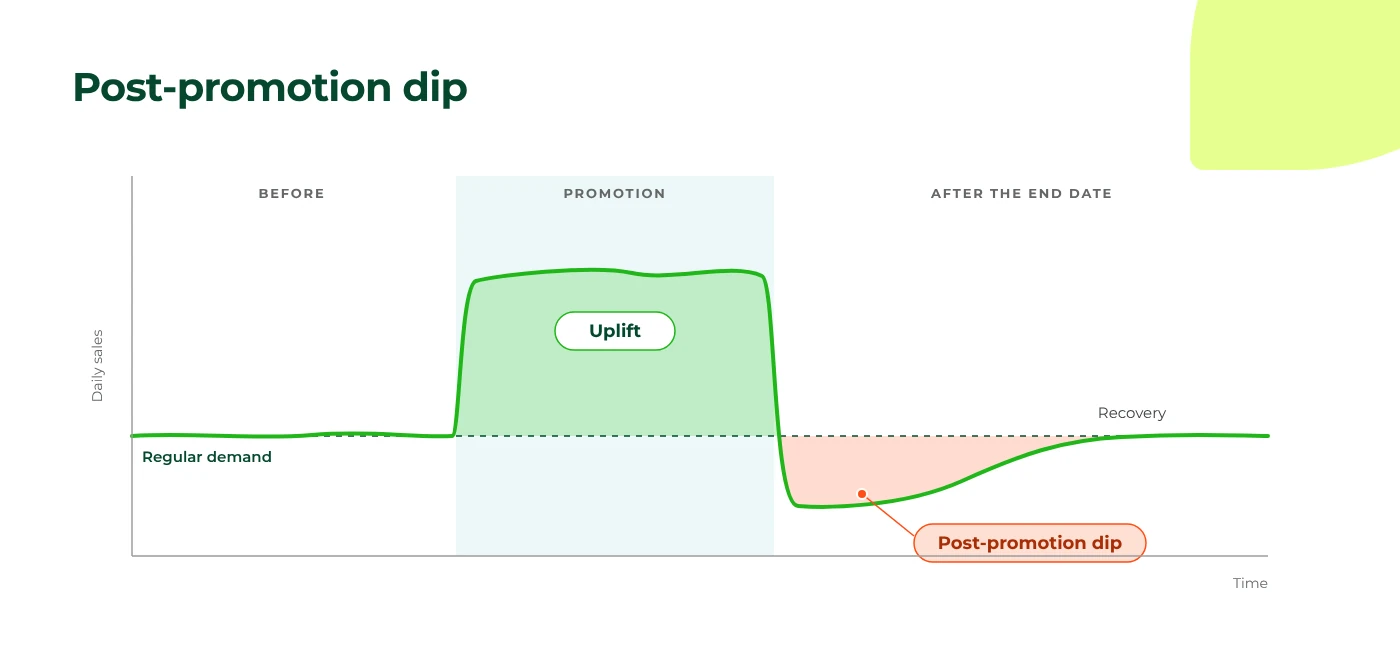
Then demand drops below its usual level. Shoppers who stocked up at the discount have the product at home, so for a while they buy less of it. This post-promotion dip hits storable items hardest, such as water, detergent, canned goods and pet food. Few ordering rules plan for it, and the first regular delivery after the promotion often lands on top of stock that is not moving.
The last mechanism is uneven uplift across stores. A promotion that triples sales in city stores may barely move a small rural store, yet both received allocations from the same forecast. Substitutes add to the pile. When a discounted brand pulls buyers from its neighbor on the shelf, the neighbor piles up stock without ever being on promotion. A planner usually sees all of this only after the end date, when the category's stock report lights up, often on the first Monday after.
How to plan a promotion exit, step by step
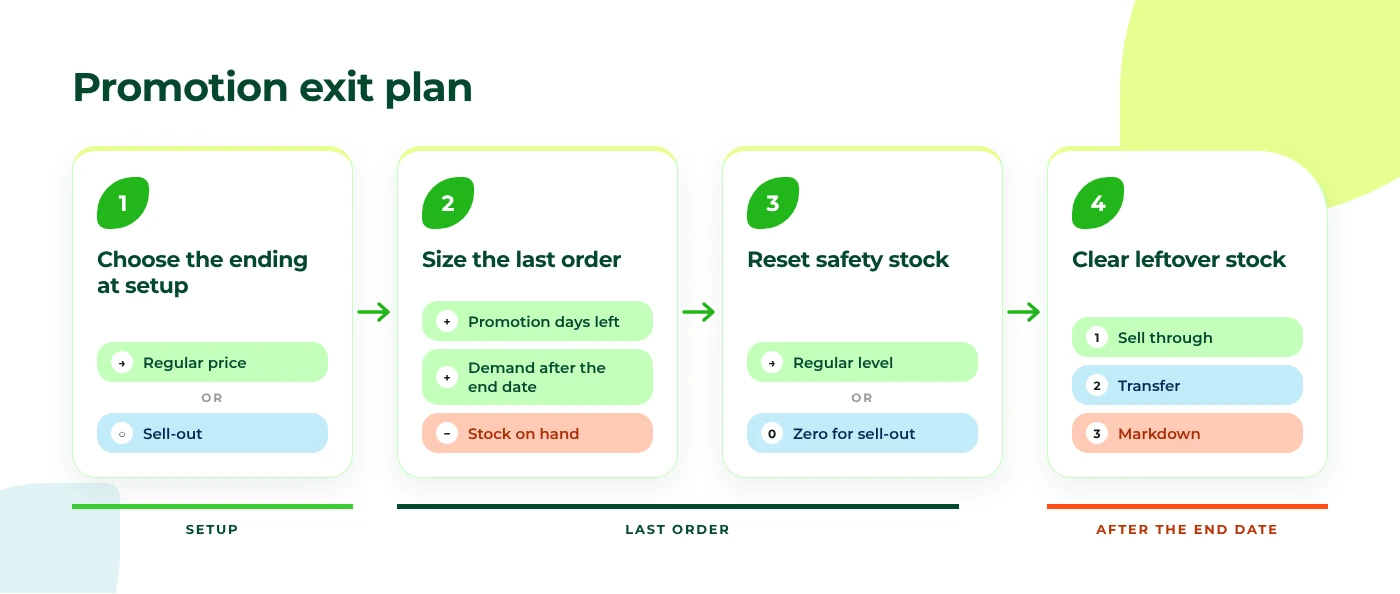
A promotion exit plan has seven steps, and five of them happen before the end date.
Step 1: Decide how the promotion ends when you set it up
A promotion can end in one of two ways. The item either returns to its regular price and stays in the range, or the chain sells it out. The two endings need different last orders. A continuing item needs enough stock to reach the next regular delivery. An item being sold out may need no new stock, depending on what is on hand and how full the display must stay.
Make the choice on the day the promotion is created. In the final week, the category manager is already busy with the next promotion, and the decision falls to whoever opens the order screen first.
Step 2: Size the last order for the days that are left
The last order before the end date should cover only what the store needs until the next delivery. That need has two parts: the promotion days left after the order arrives, and forecast demand after the end date. Without a forecast of the dip, use regular demand as the baseline. Add regular safety stock, then subtract the stock you expect to have on hand just before the delivery arrives. Say the order lands on day 13 of a 14-day promotion, and the next delivery comes on day 17. That is two days at the promotional rate and two at the regular rate.
Mark that order in the promotion calendar when the promotion is set up. Then the planner reviewing orders on day 11 knows which one it is.
Step 3: Return safety stock to its regular level before the last order
Safety stock raised for a promotion should drop back to its regular level in the last order, not after the end date. If the chain is selling the item out, safety stock for that order can be zero. An empty shelf on the last day is then the goal, not a failure, unless a display agreement requires a full shelf to the end.
This is the step teams skip most often. A higher safety stock never looks like a mistake while the promotion is still selling.
Step 4: Plan for a dip, not an instant return to regular demand
Sales after a promotion often run below regular demand for anything shoppers can store at home. Check demand after comparable promotions of the same SKU or category, and build that dip into the forecast. If the last promotional delivery also covers days at regular price, use the adjusted forecast for those days. Use it again when sizing the first order after the promotion, together with the stock you expect on hand and safety stock.
Perishables may behave differently, since fresh bread or chilled dairy cannot sit in a pantry. Past promotions show how deep the dip really is for each category.
Step 5: Watch sell-through by store in the final week
Store-level sell-through in the last five to seven days of a promotion shows which stores will finish with leftover stock. Compare each store's sales with its promotional forecast, then check that the product was actually on the shelf. Sales at half the forecast can mean weak demand, or stock stuck in the backroom. Only weak demand calls for a smaller last order, or none. A store selling above plan may need the stock the weak one will not use.
A category manager should check this list before the cutoff for the last order that can still be changed.
Step 6: Choose the cheapest way to clear what remains
Leftover stock can be sold through at regular price, moved to another store, or marked down. Selling through costs nothing extra (beyond the shelf space it holds) when the item stays in the range and it will sell within days. A transfer can avoid a markdown if the receiving store sells the stock at regular price and the move costs less than the discount.
A markdown usually comes last, because a second discount right after the first can teach shoppers to wait for the next one. With a short shelf life the order flips, and a markdown close to the expiry date may be the first move. For transfer rules and other ways to clear leftover stock, see our guide to managing excess inventory.
Step 7: Measure stock on the first day after the promotion
Stock on hand on the first day after a promotion, by store and SKU, is the clearest measure of how the exit went. Record it in days of regular demand, so a slow item and a fast one can be compared. Compare it with what the store needs until the next delivery plus regular safety stock. Anything above that is leftover stock.
Ten days of leftover stock is a reason to review the next allocation, not to cut it on reflex. First find the cause: an oversized opening delivery, weak demand, or the last order. Otherwise the team changes the wrong decision and gets the same result next time.
One store, one SKU, three ways to size the last order
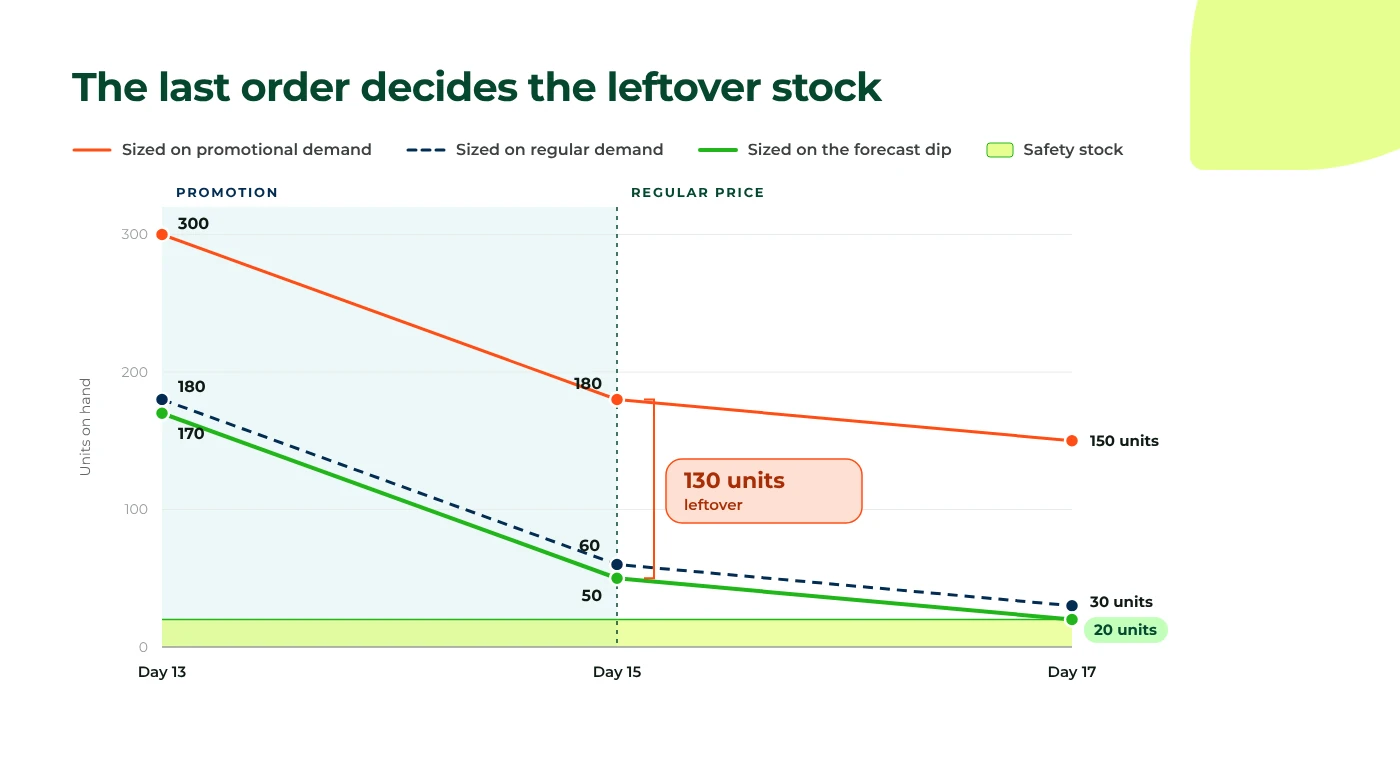
A single store selling 20 units of bottled water a day shows how much of the leftover stock is decided by the last order. The promotion triples sales to 60 units a day for 14 days. The last delivery of the promotion lands on day 13, and the next regular delivery comes on day 17. Assume the store has no stock left when the last delivery arrives. After the end date, demand dips to 15 units a day. The chain-wide row assumes every store has the same demand and delivery schedule.
| Sized on promotional demand | Sized on regular demand | Sized on the forecast dip | |
|---|---|---|---|
| Demand covered after day 14 | 2 days × 60 = 120 | 2 days × 20 = 40 | 2 days × 15 = 30 |
| Safety stock in the order | 60 units (promotion level) | 20 units (regular level) | 20 units (regular level) |
| Last order (2 days × 60 + the two rows above) | 300 units | 180 units | 170 units |
| On hand on day 15, before opening | 180 units (9 days of regular demand) | 60 units | 50 units |
| Leftover stock on day 15 (above the 50 units needed) | 130 units | 10 units | 0 |
| Left on day 17, before the next delivery | 150 units (7.5 days) | 30 units (1.5 days) | 20 units (safety stock) |
| Leftover stock across 45 stores | 5,850 units | 450 units | 0 |
In all three scenarios, the store sells 150 units through day 16. Switching to regular demand after the end date cuts the last order by 80 units, and resetting safety stock cuts another 40. Planning for the dip takes off the last 10. Without an exit plan, 150 units are still on the shelf when the day 17 delivery arrives. Of those, 130 are leftover stock tying up cash and backroom space.
The third column is the target, and it depends on a forecast of the dip (Step 4). Without one, the second column is still a large step. Leftover stock falls from 130 units to 10.
LEAFIO builds the exit into the promotion setup
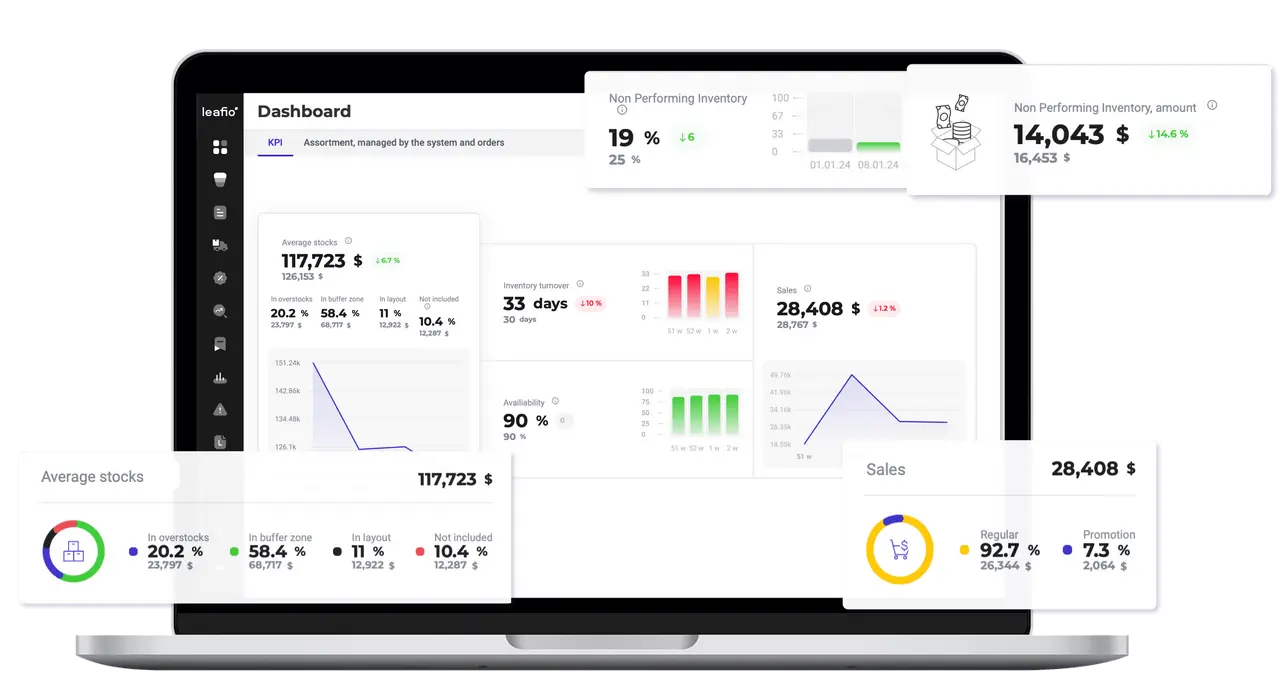
With LEAFIO Promotion Intelligence, the exit rules are set the day the promotion is created, so nobody has to remember them on day 11. The planner chooses whether the item returns to regular price or sells out. The quantity itself is calculated closer to delivery, from that choice and the latest sales. For a continuing item, the order is sized for forecast demand after the end date. That demand comes from an ML forecast built on full sales history, promotions, store traffic, seasonality and weather. For an item being cleared, replenishment stops unless the planner decides otherwise.
The last delivery is sized for life after the promotion too. In LEAFIO Inventory Optimization, the last order before the end date gets its own calculation for the days that follow. Promotional safety stock is not carried into them. For a sell-out, the last order can carry no safety stock at all, so the display empties on the final day as planned.
Stock also follows the stores that actually sell. During the promotion, orders for each store are recalculated from that store's own sales, so a weak store gets less. After the end date, promotion days stay out of the demand history behind the regular forecast, and the first regular orders start from normal sales. LEAFIO sums up the principle in one line: the ordering engine "adjusts before each promotion and reverts once it ends."
A promotion also cannot quietly refill stock the chain is trying to clear. When an item is being removed from the range in LEAFIO Assortment Performance, planned promotions on it stop. Only a sell-out promotion still runs. And each promotion feeds the next one. After the end date, performance analysis compares forecast and actual promotional sales, stock balances, turnover, availability and lost sales by store.
The planner keeps two calls the data cannot make. One is which stores take the leftover stock, the other is whether a markdown is worth the margin.
Aversi, a pharmacy chain in Georgia, shows what changes when promotions stop being a last-minute store decision. Before LEAFIO, promotion timing and quantities depended on individual managers, and campaigns often launched late. Now promotions are announced up to two weeks ahead, with the expected sales uplift set before each event. The chain reports 16% faster inventory turnover and 98% SKU availability. Those figures describe the whole inventory project, and promotions were one part of it.
An exit plan cannot fix a promotion that was overbought on day one
An exit plan controls the last one or two orders of a promotion, so it cannot remove stock that arrived with the first. Some supplier deals require a fixed volume up front. Then the leftover stock was bought on the day the deal was signed. The exit plan can only decide where that stock goes. Sizing the opening allocation is a separate job, covered in our trade promotion optimization guide.
Short promotions leave even less room. In a four-day promotion with two deliveries a week, the first order may also be the last. The exit plan then merges with the opening one. Perishables have the opposite problem. With a shelf life of a few days, leftover stock can end up as waste before a transfer helps.
Some leftover stock is also a choice. A supplier-funded display may have to look full until the last hour of the promotion (the agreement often says so in writing). There, an empty endcap on day 14 can cost more than a few days of extra stock. Sometimes that is the right trade. It should still be made on purpose, with the number in front of the category manager. Nobody should discover it in a stock report a week later.
Before you approve a promotion, identify the order that will carry the item back to regular price. Then check that order against the demand and safety stock you expect after the discount ends.
FAQ
Should the last order before a promotion ends be zero?
Yes, if the stock expected on hand when the order would arrive already covers demand through the next delivery plus regular safety stock. A sell-out may also call for a zero order, as long as the display can stay presentable until the end date.
Who should own the promotion exit, the category manager or the planner?
Both, at different moments. The category manager sets how the promotion ends when it is created, because that choice depends on the range. The planner checks the last order before it goes out and watches sell-through by store in the final week.


Have a question?

Kristi Miller
Retail optimization expert