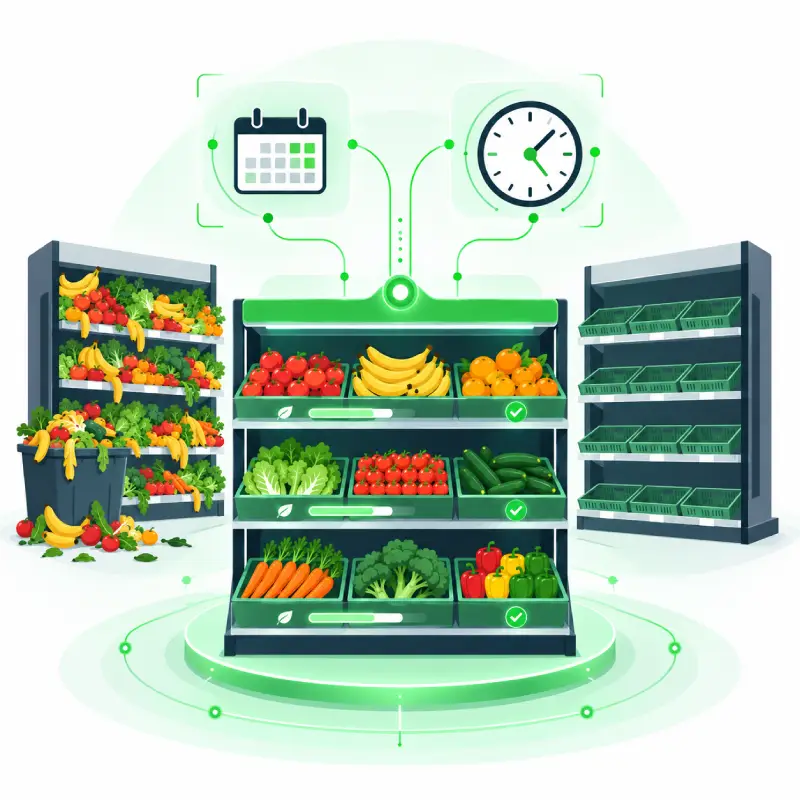


Walk into most supermarkets at 7 p.m. and check the salad and bakery shelves. Usually you get one of two pictures. A half-empty shelf, with shoppers leaving without dinner. Or a full one, with a write-off waiting for the morning shift. Fresh software solutions exist to get you out of that trap: they plan orders around shelf life, weekday demand, and delivery timing.
What fresh software solutions do
Fresh software solutions are planning and replenishment tools for products with a short shelf life. Think produce, dairy, meat, bakery, ready meals and chilled convenience food. Their job is to calculate how much of each item every store should order and when so that stock sells before it expires.
The category goes by several names. You will see fresh item management software, perishable inventory management, fresh produce software or plain fresh food inventory management. The labels differ, and so does the scope. Some tools focus on store production (how many rotisserie chickens to cook by noon). Others focus on ordering and replenishment across a chain. A few combine both with shelf-life tracking and markdown support.
According to Deloitte, 52% of grocery executives call fresh their most strategically important department for the next one to three years. Produce alone is still growing: NielsenIQ puts U.S. fruit sales at about $50 billion over a recent 12-month period, up 4% year over year. Shoppers judge a store by its fresh aisles. That's also where the margin ends up in the bin.
Why standard replenishment breaks on fresh
Classic replenishment logic was built for shelf-stable goods like pasta, detergent, and canned tomatoes. A pack of rice can sit on the shelf for months, so a slightly high forecast just means a little extra stock. On fresh, the same error turns into a write-off within days. It breaks in four places.
Shelf life shrinks the planning window
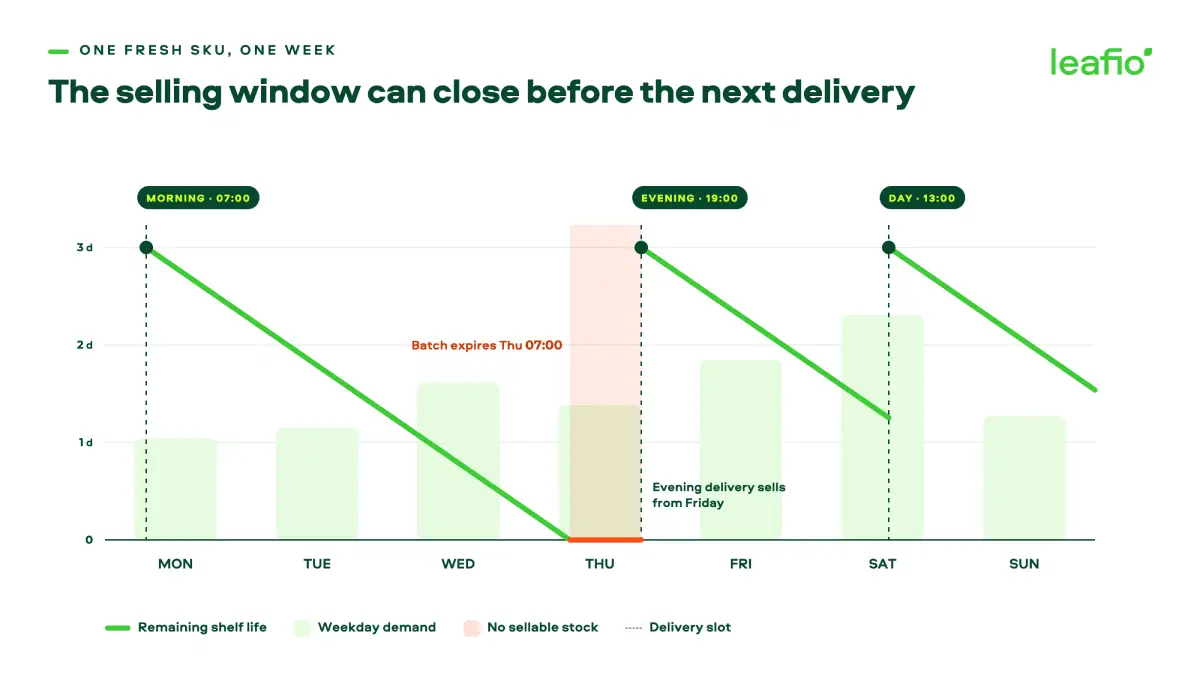
For ambient goods, safety stock is cheap insurance. For a yogurt with six days of remaining shelf life, every extra unit is a bet that it sells before day six. Fresh item management has to know how much usable life the product will have on the day it lands. Then it plans only what the store can sell inside that window.
Demand follows the weekday and the delivery slot
Fresh demand moves with the calendar. Bread and milk may peak on Saturday, while ready meals spike midweek after work. Timing matters too. A 7 a.m. delivery gets a full selling day. An evening one effectively starts tomorrow. A tool that treats every day and every delivery the same will overstock on slow days and run out on busy ones.
Loose and weighed goods confuse stock records
Tomatoes sold by weight, bakery baked in store and meat cut to order all make system stock unreliable. Shrink, trimming and unrecorded waste pile up, so the ERP believes the store has product it threw away yesterday. Orders built on that number come out too small, and shelves go empty.
Promotions hit harder
A two-for-one on strawberries lifts demand for a few days, then leaves a hangover. If the order for the day after the promo ends still reflects promo volumes, you pay for it in waste. Fresh promotions need their own logic for the build-up and for the drop afterwards.
Across retail, IHL Group's 2025 study, reported by Chain Store Age, puts the yearly cost of out-of-stocks and overstocks at $1.73 trillion. Fresh is where both sides of that loss tend to show up in the same week. Closer to home, ReFED estimates that U.S. retailers generated 3.98 million tons of surplus food in 2024, worth $26.9 billion, and most of it came from fresh categories.
Features that matter in fresh item management software
On a slide, every vendor's feature list looks the same. What differs is whether a feature actually feeds the order calculation or just sits in a report. I'd check these first.
Remaining shelf life inside the order calculation
Ask whether the system uses remaining shelf life (RSL) when it calculates order quantities, or only reports on it afterwards. The useful version estimates how much stock will still be sellable on the day the next delivery arrives, and orders only the gap. Bonus points if the vendor will show you the formula.
Service levels that flex with shelf life
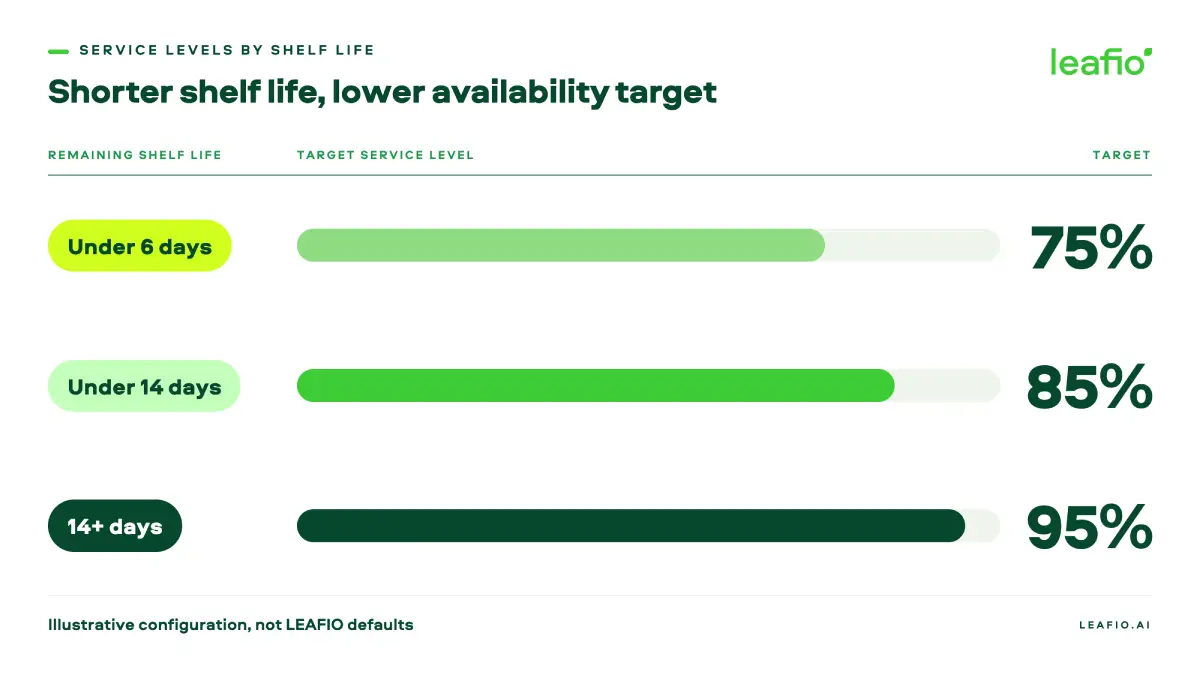
One availability target for the whole fresh department is a blunt instrument. A spare tub of six-day yogurt costs you far more than a spare block of hard cheese. LEAFIO's own fresh inventory software handles this by giving each item a default target based on remaining shelf life: lower for short-life items, higher for longer-life ones. Teams can then shift the balance by category. As an illustration, a chain might target around 75% availability for items with under six days of shelf life, 85% under 14 days and 95% above that.
Batch-level stock and FIFO or FEFO logic
The system should track batches with different expiry dates and estimate how much stock will still be sellable before the next delivery. FIFO follows arrival order; FEFO assumes the earliest-expiring stock sells first. Without batch awareness, the forecast treats all stock as equally fresh and underestimates tomorrow's write-offs. For loose goods, look for a virtual stock position that rebuilds daily stock from deliveries and sales rather than trusting the ERP count. The same batch view makes markdowns smarter: stock close to expiry can be discounted early in the day instead of written off at close.
Weekday coefficients and delivery slots
Look for demand coefficients by day of week, set at item and store level. You also need a way to tell the model whether a delivery lands in the morning, during the day or in the evening. Get these two right and you have closed much of the forecast accuracy gap between a good fresh tool and a poor one.
Automation that stores trust
Store teams in most chains still spend hours a day adjusting fresh orders by hand. And labor isn't getting cheaper: McKinsey's State of Grocery Retail 2026 report shows labor costs rose 5.1% on average across Europe in 2025, ahead of 4.0% food inflation. Good automated replenishment takes routine order entry off their plate. At Daily, a 227-store Georgian grocer, 99.5% of all replenishment orders, fresh and non-fresh, now go out with no manual touch. Store managers still need a way to flag a street festival or a school holiday, though.
Reporting that shows waste and lost sales side by side
This one sounds minor and is not (ask any fresh category manager). If write-offs and lost sales sit in different reports owned by different teams, each side will keep pushing its own number. A useful fresh dashboard shows both for the same item and store. Then you can tell whether a waste cut came at the cost of empty shelves.
Fresh software vendors to compare
Fresh Software Solutions is also the name of a company that sells ERP software to produce distributors. If that's your business, it belongs on a different shortlist. Everything below is about fresh tools for grocery retail.
They fall into two groups. Fresh specialists handle fresh departments only and sit on top of whatever runs your center store. Full platforms plan fresh, center store and often the shelf on one data model. The right group depends on what else you need to fix.
Full platforms
LEAFIO AI Retail Platform runs fresh on its own FRESH algorithm, next to separate algorithms for regular SKUs and warehouse flows. Inventory, promotions, assortment and shelf planning sit in the same platform, so fresh orders can be planned alongside center-store, promo and planogram decisions instead of in a separate tool. The FRESH algorithm ties service levels to shelf life and supports batch tracking and virtual stock for weighted goods. It serves 250+ retailers in 40+ countries. It has no built-in labor scheduling.
RELEX Solutions is the enterprise benchmark for fresh planning. It offers recipe-based replenishment for in-store bakeries and kitchens and is usually chosen by larger chains. Enterprise rollouts can run 12 months or longer, depending on scope.
Blue Yonder offers fresh planning, AI markdowns and food production modules inside a full supply chain suite. It makes most sense for global chains already running Blue Yonder.
Fresh specialists
Afresh is the best-known fresh specialist in US grocery. It covers store ordering, production planning and DC buying for fresh, working as a layer over existing ordering systems. Its client base is concentrated in US grocery.
Logile combines fresh item management with workforce management. It offers detailed FDA labeling and USDA grind tracking. That makes it a good match for US grocers with heavy deli, bakery and meat production.
Upshop merged with Invafresh in July 2024. It covers fresh production, waste tracking, food safety and e-commerce picking for 400+ retailers in 35 countries. Planograms and assortment analytics sit outside its scope.
Freshflow is a Berlin startup offering AI store-level ordering for fresh produce. It works with independent merchants within groups such as EDEKA, Carrefour and Intermarché in Germany and France. The product is narrow and the company is younger than most in this list.
Upstream fresh planning
Slimstock (Slim4) sits on top of an ERP and adds shelf-life and FEFO logic at warehouse level. It is a strong pick when your waste problem starts in the DC. Store-level features for weighted goods and in-store production are lighter.
| Vendor | Type | Best for | Watch out for |
|---|---|---|---|
| LEAFIO AI | Full platform | Chains wanting fresh and center store in one system | No labor scheduling |
| RELEX Solutions | Full platform | Large chains with bakery or deli | Long enterprise rollouts, enterprise cost |
| Blue Yonder | Supply chain suite | Global chains on Blue Yonder | Long, complex implementation |
| Afresh | Fresh specialist | US chains adding a fresh layer | US-focused, second system to run |
| Logile | Fresh plus labor | US grocers with heavy in-store production | Store-level fresh focus |
| Upshop | Store operations | Grocers focused on store execution | Product integration after merger |
| Freshflow | Fresh specialist | European franchise stores | Produce-focused, two countries |
| Slimstock | DC inventory | Distributors and DC-heavy retailers | Weaker at store level |
My rule of thumb: if your center-store system works and fresh waste is the main pain, a specialist can be a quick win. Replacing spreadsheets or a legacy tool across all categories? Then a platform saves you from running two forecasts side by side, and lets you coordinate replenishment with assortment and shelf decisions.
What results look like in practice
AI ordering does move waste numbers. In a Pacific Coast Food Waste Commitment pilot reported by ReFED, AI ordering tools at two large retailers cut food waste by 14.8% per store on average. Two LEAFIO clients, two different formats: a supermarket chain and a convenience chain.
Daily, a Georgian supermarket chain with 227 stores, was running decentralized ordering, with store managers adjusting ERP orders by hand. After implementing LEAFIO Inventory Optimization with automatic replenishment, fresh-category write-offs fell from 11% to under 2% within two months. Across the business, availability rose by 8% and overstock dropped by 17%.
KOLO, an Eastern European convenience chain with 236 stores, needed its fresh orders to reflect weekday demand swings. After moving from its previous auto-order system to LEAFIO Inventory Optimization, KOLO got day-of-week coefficients and a service-level setting for fresh. Between Q1 and Q2 2023, overstock fell by 43%, lost sales decreased by 13% and availability improved by 14%.
Both retailers cut excess stock while improving availability. In fresh, those two usually pull against each other. Good fresh planning narrows that trade-off instead of forcing you to pick a side.
Curious how this would work on your own fresh categories? Request a LEAFIO demo and bring a few weeks of sales and write-off data.
How to evaluate fresh software solutions
Most of the risk sits in fit: your data, your stores, your people. Here's how I'd run the process.
Start with a data readiness check
Before any demo, pull a sample of sales, deliveries, stock and write-offs for 20 to 30 fresh SKUs across a handful of stores. You will quickly learn whether write-offs are recorded consistently and whether shelf life is stored in the master data. Gaps here will hurt any tool, so find them before the vendor does.
Ask vendors to explain one order line
Pick a single item, store and date, and ask each vendor to walk through how their system would calculate the order. You want to hear about remaining shelf life, weekday demand, delivery slot, stock in transit and expected write-offs. If the item was on promotion last week, ask how the order drops back once the promo ends. A vague answer about "AI" should make you cautious.
AI claims are cheap. The same McKinsey report found that 70% of grocery CEOs report no measurable EBIT impact from AI so far, or say it is too early to tell. A formula you can audit beats a black box every time.
Design the pilot around both KPIs
Run the pilot on a mix of short-life and longer-life fresh categories, in stores with different traffic patterns. Track write-offs, availability and lost sales together, weekly, against a control group of stores. Because fresh turns so fast, four to eight weeks usually shows an early trend. Judging promo cycles and seasonality takes longer.
Check the store workflow
Visit a pilot store and watch how staff interact with the orders. Do they understand why the system suggests a number? Can they override it with a reason code? ReFED's 2026 report on AI and food waste flags a common trap: managers scored on full shelves often override AI orders, however accurate they are. Fresh tools fail most often at the store level, when teams lose trust and go back to their own spreadsheets.
Confirm the integration path
Ask how the tool gets POS sales, deliveries, write-offs and promo calendars, and how often. Daily data is the minimum for fresh. If you sell produce, seafood or deli items on the FDA's Food Traceability List, also ask how the tool stores lot codes. FSMA 204 enforcement starts no earlier than July 20, 2028, but those records have to live somewhere.
Common mistakes in fresh rollouts
Stalled fresh projects tend to trip over the same few things.
- Treating all fresh the same. Salad kits and hard cheese both count as fresh, yet they behave nothing alike. Segment by shelf life before setting service levels.
- Ignoring write-off data quality. If stores record waste in bulk at the end of the week, the model learns the wrong pattern. Fix the recording process early.
- Chasing waste alone. Cutting write-offs to zero is easy if you accept empty shelves. Set a joint target for waste and availability from day one.
- Rolling out to every store at once without a pilot. Start with a pilot category or store cluster, prove the result, then scale. Daily, for example, piloted one category before expanding to the full network.
Frequently asked questions
What are fresh software solutions?
Fresh software solutions are tools that plan orders and stock for perishable products such as produce, dairy, meat and bakery. They use shelf life, weekday demand and delivery timing to decide how much each store should order. The aim is to cut write-offs while keeping shelves full.
How is fresh item management software different from standard replenishment?
Standard replenishment assumes stock keeps its value for weeks or months. Fresh item management software plans around remaining shelf life, expected write-offs and day-of-week demand. It also handles batch-level stock, so older product is assumed to sell first.
Can fresh software handle loose and weighed products?
Yes, if it supports a virtual or calculated stock position. The system rebuilds daily stock from deliveries, sales and recorded waste instead of relying only on the ERP count. This matters for produce, meat counters and in-store bakery.
How quickly can a retailer see results from fresh food inventory management tools?
Fresh categories turn over quickly, so results tend to appear faster than in ambient goods. Daily, a Georgian supermarket chain, cut fresh write-offs from 11% to under 2% within two months. Timelines depend on data quality and how fast stores adopt automated orders.
What data do I need to implement perishable inventory management software?
At minimum you need daily POS sales, deliveries, stock levels and write-offs by item and store. Shelf-life data in the product master and a delivery schedule for each supplier are also important. Promo calendars help the system plan for spikes.
Does fresh produce software work for convenience stores?
It does, and it often matters more there. Convenience formats have small backrooms and frequent deliveries, so ordering errors show up quickly as waste or gaps. KOLO, a convenience chain with 236 stores, added day-of-week demand coefficients and service-level control for fresh. Across the network, overstock fell by 43% and availability improved by 14% within one quarter.
Which vendors offer fresh software solutions for grocery retail?
Full platforms include LEAFIO AI, RELEX Solutions and Blue Yonder, which plan fresh alongside center store. Fresh specialists include Afresh, Logile, Upshop and Freshflow. Slimstock covers fresh at warehouse level.
Should fresh software replace my ERP?
No. Fresh tools usually sit alongside the ERP. They take sales and stock data in, calculate orders, and send the approved orders back for purchasing and supplier communication.


Have a question?

Katrina Walker
Especialista em Otimização de Estoque de Varejo no Brasil