
Different product groups require different merchandising approaches. That's a no-brainer. If you're still displaying and selling tools and T-shirts by the same principle, this article is for you. There's a difference between hard and soft goods and managing the displays of these product groups correctly is of key importance.
Key Takeaways
Different merchandising tactics are needed for hardlines vs softlines to maximize sales.
Hardlines need spec info & demos.
Softlines benefit from inspirational displays.
Stock rotation crucial for fashion.
Hardlines often rely on clear signage.
Data guides strategy per category.
Hardlines vs Softlines: what you need to know
The first thing is that these are two basic forms of goods that are sold differently in a retail business: they have a different path to the customer, cycle, and purchase frequency. Let's explain their main characteristics and differences.
What are hardlines in retail
Products with a long service life are a typical answer to the question of what hard goods are. In most cases, they are not sold on the sales floor but in the warehouse (or shelves, provided that the product is packaged). In the store, hardlines are used exclusively for demonstration. Typical examples of such goods are:
- furniture
- large home appliances
- electronics
- plumbing in a bath store
- tools and equipment
- musical instruments
- sporting goods, sporting equipment, etc.
In a retail store, selling hard goods to consumers takes longer. Such a purchase is an investment, so shoppers take longer to choose, look at alternatives, and then make a decision.
What are soft goods in retail stores?
Softlines include goods that are the exact opposite. They are literally soft, compact, and personal. They take up less shelf space and are sold without packaging in most cases: that is, they can be touched. Soft goods examples include:
- footwear and clothing
- bedding and home textiles
- various accessories and other items
Soft goods are affected by seasonality. Also, their lifespan is quite limited. That is why they are bought more often, and the selection process takes less time.
Despite the proliferation of online sales channels, soft goods retail traditionally takes place offline: customers like to interact with goods, choose them in person, and try them on. It is known that 40% of consumers buy most of their clothes and shoes in stores. At the same time, this indicator is not critical for hard goods.
Typical challenges for hard and soft goods
For both categories of goods, effective merchandising drives sales and improves customer experience. How does this affect retail inventory in soft goods and hard goods?
Hardline goods require the organization of sufficient space for a comprehensive view and clear classification. It is important for customers to find what they need quickly and conveniently.
The main challenge in soft goods retail is managing styles, sizes, and colors, especially with a large assortment. At the same time, you need to maintain an attractive layout. Also, most softlines require frequent updates (for example, due to changes in collections). This creates additional organizational challenges. The solution can be a valuable tool - planograms. Let's see how they help in merchandising hard and soft goods.
Tips for improving hard goods merchandising
With the help of planograms, supermarkets, and other retailers can create a clear layout structure for efficient navigation and potential sales growth. Possible solutions:
- Vertical placement of goods of the same type (with gradation by price category). This makes the process of selection and comparison easier.
- Grouping related products: main products with related ones. Place coffee machines and cleaning products, smartphones and protective cases for them, etc., on the same shelf.
- So much space for presentation so that customers can examine the product from all sides.
- The ability to interact with demonstration models (as far as possible given the product category).
- Use of signs and other additional sources of information. A poster with technical specifications near a washing machine is a classic example.
Tips for optimizing soft goods merchandising
The main task in this category, unlike hard goods, is to organize the space to reduce the time spent searching for goods and stimulate impulse purchases. Here are some good tips for any retailer:
- Place products of the same type vertically, creating a kind of “wall” of the same style or color.
- Create displays with contrasting colors and different textures.
- Choose the most prominent place in the store to showcase new products.
- Showcase clothes and accessories on mannequins.
- Fill the shelves to create the impression of more items being there than there actually are.
- Provide the easiest possible access to the products.
- Create themed, seasonal, and other special displays for personal items.
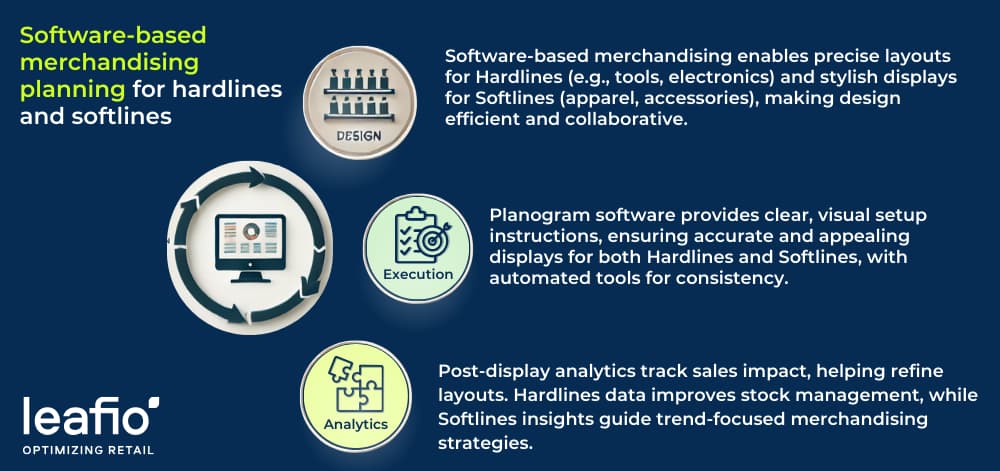
Improve hardlines and softlines merchandising with LEAFIO AI
The merchandising optimization software tool is your opportunity to create an analytical strategy with comprehensive suggestions and control over every step of the merchandising process. Create a store layout and automatically fill it based on your inventory and sales data. Ensure that your planograms are efficient and correctly filled: track performance and make adjustments.
Plan and balance the assortment for each product category with flexible, customizable product categories and a dashboard with all the important data. Increase your retail sales with thoughtful and efficient management of the hall space and each shelf space.
Conclusions
It's clear that effective merchandising of hardline and softline goods requires different approaches. Hard goods need convenient navigation while soft goods are best placed in an attractive layout with emphasis on new products.
Use modern software merchandise solutions to efficiently manage your display, track fulfillment, and improve sales performance. High-quality planograms will help you improve the layout and thus optimize space and entice shoppers to spend more.


Have a question?

Cecilia Flores Castillo
Experta en optimización de estoque