


Year after year, retailers face the constant challenge of balancing stock levels to meet customer demand without overstocking, which ties up valuable capital. According to the National Retail Federation (NRF), out-of-stock items cost U.S. retailers approximately $224 billion annually. There's no hiding from just how critical is the role of effective inventory management in maximizing sales and customer satisfaction.
It is particularly Open-to-buy methods that can bring about up to a 15% increase in stock efficiency and a 10% reduction in markdowns as another report by Retail Systems Research noted.
So let's take a look at the importance of open-to-buy methods, the OTB formula's mechanics, the implementation of OTB merchandising planning, its benefits, challenges, and the future.
Key Takeaways
OTB planning ensures you invest right and avoid tying up cash.
Sets budget for purchasing ahead.
Reacts to demand shifts quickly.
Cuts excess inventory risk.
Links merchandising & financial goals.
Reviewed monthly for accuracy.
The importance of open-to-buy in modern retail
Imagine a storeroom overflowing with unsold products, collecting dust, and eating away at your profits. Open-to-buy is essentially a retail inventory management strategy that helps retailers determine how much inventory they need to purchase within a specific sales period to meet expected sales.
By using the Open-to-buy formula, retailers can precisely determine how much inventory they need to purchase to align with projected demand, avoiding the pitfalls of overstocking, and maintaining optimal cash flow.
Excessive inventory can put a retail business in a stranglehold, tying up capital in unsold goods and forcing markdowns that undermine profit margins (GMROI).
Retail professionals need to carefully manage inventory levels to match market demand and maximize sales and customer satisfaction. On the other hand, low inventory levels can lead to missed sales opportunities and a poor customer experience. Open-to-buy (OTB) enables retailers to achieve a balance, leading to increased profitability and customer loyalty.
Understanding the open-to-buy formula
At the heart of OTB planning lies the following Open-to-buy formula, a simple yet powerful inventory management strategy:
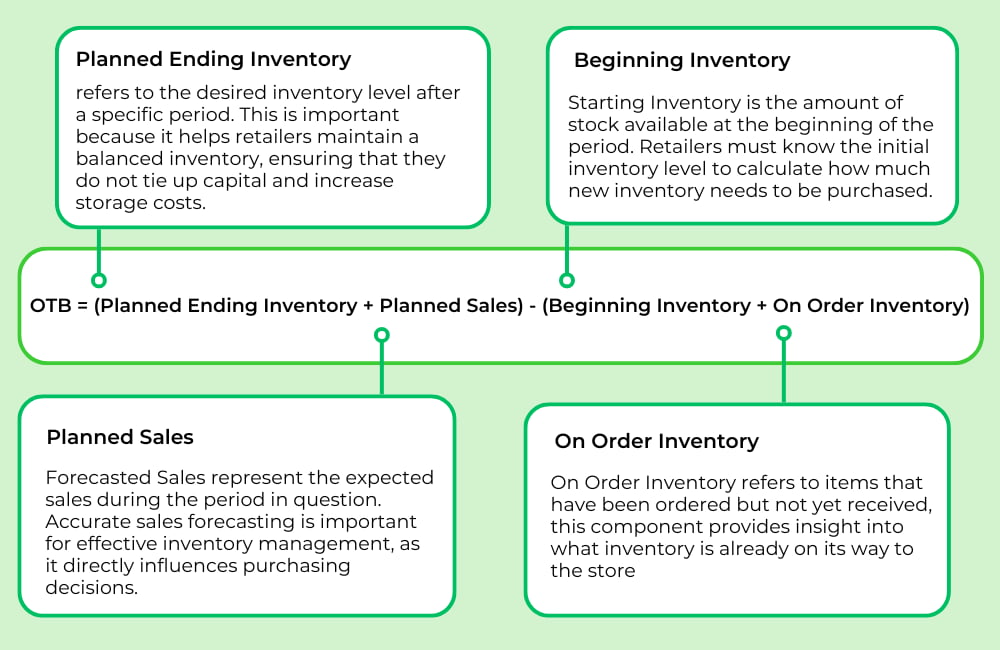
For example, consider a retailer who starts the period with $50,000 in a per month inventory, has $20,000 worth of goods on order and plans for $100,000 in sales by the end of the month, has $20,000 worth of goods on order and plans for $100,000 in sales by the end of the month, aiming for $30,000 in ending inventory.
The OTB calculation would be:
OTB = ($30,000 + $100,000) - ($50,000 + $20,000) = $130,000 - $70,000 = $60,000
This calculation indicates that the retailer can purchase up to $60,000 worth of new inventory to align with their sales and stock objectives.
Implementing OTB Merchandising Planning
Utilizing OTB systems is particularly essential in sectors such as DIY, pharmacy, and electronics stores, where inventory requirements are highly seasonal. These industries experience significant fluctuations in demand based on seasons, holidays, and other temporal factors.
Effectively implementing Open-to-Buy merchandising planning involves several steps to ensure inventory levels are managed efficiently and align with sales projections.
1. Analyze Inventory Turnover
High inventory turnover indicates efficient inventory management, while low turnover suggests excess stock or slow-moving items. This metric helps predict future inventory needs and prevents both overstock and stockouts.
2. Implement Granular Financial Planning
Use the OTB formula to create monthly sales plans at various levels, such as by store or SKU. A detailed financial plan ensures that every aspect of your monthly inventory is accounted for, allowing for better financial control and planning.
3. Monitoring and Adjustment
Make sure to consistently monitor sales and inventory levels to adjust your Open-to-Buy plans as necessary. This monitoring allows retailers to respond quickly to changes in demand and market conditions, ensuring optimal inventory levels are maintained.
To streamline these processes, many retailers turn to advanced Open-to-Buy software solutions. The systems automate OTB budgeting, optimize purchasing decisions, and integrate seamlessly with existing systems.
Benefits of Open-to-Buy Merchandising Planning
Adopting Open-to-Buy (OTB) merchandising planning has numerous benefits that can greatly improve a retailer's operations, including the flexibility it offers. Retailers can quickly adjust inventory levels in response to market changes.
Open-to-buy planning helps retailers determine how much inventory to maintain, preventing both excess stock and shortages. This balance is needed to avoid markdowns and maximize sales opportunities.
Another significant advantage is improved cash flow management. Effective Open-to-Buy planning ensures that capital is not unnecessarily tied up in surplus inventory. This frees up financial resources for other critical areas of the business, such as marketing and expansion initiatives.
Additionally, Open-to-Buy planning improves customer satisfaction by ensuring that products are available when needed. This reliability fosters customer loyalty and encourages repeat business, necessary for growth in the competitive retail market.
What kind of software can help to succeed?
Your software solution should offer several features to further support these benefits:
- Automated Budget Calculations – calculate OTB planning budgets based on real-time sales data and inventory levels.
- Demand Forecasting – uses historical sales data and market trends to predict future demand.
- Inventory Tracking – provides real-time tracking of inventory across multiple locations.
- Integration with Existing Systems – seamlessly integrates with other retail management systems.
- Reporting and Analytics – Offers insights into key metrics like sales rate, inventory turnover, and stock balances in days.
In summary, Open-to-Buy merchandising planning provides the flexibility to adapt to market demands, maintains optimal stock levels, improves cash flow management, and enhances customer satisfaction, all contributing to a more efficient and profitable retail operation.
Challenges and solutions
Retailers across various sectors, such as DIY stores, pharmacies, and electronics retailers, continually face the challenge of managing inventory effectively, particularly when dealing with seasonal demand fluctuations. These unexpected variations can significantly impact a retailer's operations and profitability.
Challenge 1: Weathering the Seasonal Storm
Seasonal demand fluctuations pose a major hurdle. Retailers experience significant variations in demand based on seasons, holidays, and special events. For instance, pharmacies must prepare for the flu season, while DIY stores see fluctuating demand for building materials.
Solution: AI-Powered Demand Forecasting with LEAFIO
LEAFIO Inventory Optimization uses AI to forecast demand with exceptional accuracy. The platform analyzes sales data, market trends, and seasonal factors to give retailers a clear picture of future inventory needs. With LEAFIO’s predictive analytics, retailers can stock up on essential products, anticipate market fluctuations, and maintain optimal stock levels.
For example, a pharmacy can use LEAFIO to ensure they have sufficient health products for the flu season, preventing overstocking while meeting peak demand. Similarly, the DIY retailer Maxibuild reduced lost sales by 78% by anticipating peak demand for seasonal items using LEAFIO AI.
Challenge 2: Striking the Inventory Balance
Balancing inventory to avoid overstocking, which ties up capital, and stockouts, which lead to missed sales, is a constant struggle for retailers.
Solution: Maintaining Optimal Stock Levels with LEAFIO AI
LEAFIO Inventory Optimization helps retailers maintain optimal stock levels by accurately forecasting demand, ensuring they have the right amount of inventory on hand. This minimizes both excess stock and stockouts.
LEAFIO AI provides real-time inventory insights, which empower informed decisions about stock allocation across warehouses. For example, Maxibuild ensures they have the right products in stock when customers need them, without overloading their storage space. This is a common problem in DIY stores due to limited storage capacity. After implementing LEAFIO Inventory Optimization, the company saw a significant 39% reduction in warehouse overstock.
Challenge 3: Demystifying demand with accurate forecasting
Accurate demand forecasting is essential for maintaining optimal inventory levels, but it is difficult to achieve this without advanced tools and precise data analysis.
Solution: Real-time insights with LEAFIO's Inventory Management Dashboard
The LEAFIO Dashboard integrates data from various sources, offering real-time insights into key metrics such as sales rate, inventory turnover, balances, and stock levels. By adopting this approach, retailers can make dynamic adjustments and informed decisions based on current information.
For instance, grocery stores can use LEAFIO’s Inventory Management Dashboard to monitor ongoing sales performance and adjust their real-time inventory strategies.
Additional Solutions for Retail Success
Beyond accurate forecasting, LEAFIO AI offers additional solutions to optimize inventory management:
- LEAFIO Assortment Planning – assists retailers in selecting the right product mix based on detailed sales data and customer preferences, ensuring shelves are stocked with the most sought-after items and boosting customer satisfaction.
- LEAFIO Shelf Efficiency – optimizes shelf space management, ensuring products are displayed effectively and shelves remain well-stocked.
The Power of Advanced Inventory Management
By utilizing advanced tools such as LEAFIO AI's solutions, retailers can greatly improve their inventory management processes. Whether used independently or as a unified platform, LEAFIO AI's solutions provide the flexibility and precision necessary to navigate the intricacies of the retail universe.
"We are extremely comfortable with the LEAFIO Inventory Optimization, not only because the product met our critical requirements in troubleshooting inventory optimization along with the debugging methodology and the high-standard platform functionality but also because of the awareness of all inventory management processes in our company that the LEAFIO AI expert team has acquired," says Maxibuild management.
Future of Open-to-Buy in Retail
Fueled by groundbreaking technological advancements, OTB is poised to become an even more powerful tool for retailers. Let's explore some of the exciting possibilities that lie ahead:
Machine Learning and AI for Hyper-Accurate Forecasting
The Open-to-Buy calculations will be more accurate with the integration of advanced machine learning algorithms. The AI algorithms will analyze sales period data and external factors such as weather patterns, social media trends, and competitor activity. AI will help retailers predict changes in demand very accurately, reducing the risk of having too much or too little stock.
Real-time Inventory Visibility with the Internet of Things (IoT)
The future of Open-to-buy hinges on real-time data. Imagine a scenario where inventory levels are automatically tracked using sensor-equipped shelves and smart packaging. The real-time visibility will enable retailers to adjust OTB dynamically projected sales and inventory plans throughout the day, ensuring they have the right amount of stock readily available to meet fluctuating customer needs.
Omnichannel Integration
OTB planning will transcend physical stores and integrate seamlessly with online marketplaces. Retailers will be able to calculate a unified Open-to-buy that considers in-store sales as well as online orders and fulfillment needs. Customers can easily buy items online and pick them up in the store, or do the opposite, without worrying about differences in stock.
Blockchain Technology for Enhanced Transparency
Blockchain technology has the potential to greatly improve supply chains by making them more transparent and efficient. When integrated with OTB planning systems, retailers can have real-time insights into product provenance, track inventory movement, and identify potential disruptions. It will help retailers to make more informed purchasing decisions and improve Open-to-buy calculations.
The examples above illustrate how your Open-to-buy solution is positioned to evolve with technological advancements. By embracing these innovations, you can anticipate improved inventory management, enhanced cash flow, and increased competitiveness in the future.
Conclusion
A flexible inventory planning system, such as Open-to-Buy, is essential for retail businesses to thrive. Retail merchandise planners consistently face the challenge of balancing inventory levels to meet customer demand while optimizing the sales budget and minimizing inventory carrying costs.
The introduction of AI-driven inventory management software, like those offered by LEAFIO AI, represents a significant advancement in Open-to-Buy inventory planning, seamlessly aligning sales forecasts and inventory levels. Implementing these advanced technologies requires a strategic commitment and readiness to integrate AI capabilities into existing operations. Embracing AI in OTB planning will shape the future of retail success, and those who leverage these innovations will stay ahead.
If this resonates with your retail business needs, don't hesitate - request a demo of LEAFIO AI today, and we'll guide you through the process.


Have a question?

Jack Larson
Retail Optimization Expert