

Yes, for most mid-size and large retailers, switching from manual to automated replenishment can pay for itself within months. In LEAFIO's own deployments, Baltic Petroleum, a major retail and wholesale fuel network, reached a 1,581% ROI in the first year, with payback within the first month. Daily, a 227-store grocery chain in Georgia, now generates and sends 99.5% of replenishment orders automatically, up from a partly manual, ERP-based process, and grew sales by 23%.
Automated replenishment is a system that calculates how much of each product to order for each store, and when. It uses sales history, current stock, supplier lead times, and demand patterns instead of manual judgment. Planners then handle exceptions, such as promotions, new listings and supplier problems, instead of recalculating orders line by line.
The LEAFIO AI Retail Platform automates inventory, shelf, and assortment decisions for 250+ retailers in 45+ countries. Automated replenishment is one capability within it, working alongside inventory optimization, shelf planning, and assortment management. That connection matters because ordering doesn't happen in isolation. What a store should order depends on what it carries and how much shelf space each product gets.
The sections below show where that ROI comes from, how to estimate it for your own network, and how to tell if your operation is a fit.
When switching to automated replenishment is worth it
The answer depends on a handful of conditions; not all retailers have to automate immediately:
When stockouts or overstock persist
It's worth it when your team already fights chronic stockouts or overstock and can't pin down why. It's also worth it when categories like fresh are driving write-offs or lost sales that a faster, daily-recalculated buffer would catch.
When planners spend hours recalculating orders
It's worth it when a planner (or several) spends real hours every week manually recalculating orders across stores or SKUs.
When growth outpaces the manual process
It's worth it when the chain is opening locations or adding SKUs faster than the manual process can realistically track. That's exactly what happened at Daily as it grew from 170 to 227 stores.
When it isn't worth it
It matters less for a single location with a small, stable assortment and a planner who already knows the store. With no real volatility to manage, the overhead of implementing and maintaining a system can outweigh the savings.
Mid-market retailers weighing a new platform against staying manual should size the decision against how much stockouts and overstock already cost them. That number matters more than the software's list price on its own. If the numbers point to switching, our comparison of the best inventory replenishment software for retail shows how the main vendors differ.
| Criterion | Favors switching to automation | Favors remaining manual |
|---|---|---|
| Stock performance | Chronic stockouts or overstock | Isolated incidents with a known cause |
| Planner workload | Significant weekly hours spent recalculating orders | Minimal effort; planner fluently knows the store |
| Network and assortment | Store or SKU count growing faster than manual tracking can follow | Single location; small, stable assortment; low volatility |
| Fresh | Write-offs or lost sales that daily buffers would address | No material write-offs or lost sales |
| Financial case | Stockout and overstock losses exceed implementation and maintenance cost | Losses fall below implementation and maintenance cost |
| Verdict | Automation is likely to pay off | Manual process is sufficient |
Where the ROI of switching to automated replenishment comes from
Automated replenishment ROI comes from three compounding factors:
- Overstock reduction. A system recalculating buffers daily from real sales and stock data catches drift that a weekly or monthly manual review misses.
- Fewer stockouts and less lost revenue, since automated buffers respond to demand changes faster than a person re-running a spreadsheet can.
- Freed up planner time. That time either lets a team run more SKUs and locations with the same headcount, or it goes toward decisions that need human judgment.
The scale of the underlying problem is well documented. IHL Group estimates that inventory distortion (the combined cost of overstocks and out-of-stocks) costs the global retail industry $1.7 trillion a year. That's about 6.2% of global retail sales, and it's the pool of avoidable cost that automated replenishment chips away at, one retailer at a time.
That tracks with what Deloitte found in its 2025 retail outlook. Six in 10 retail buyers said AI-enabled tools improved demand forecasting and inventory management in 2024, a reasonable sign that this isn't a theoretical benefit anymore.
How to calculate replenishment automation ROI
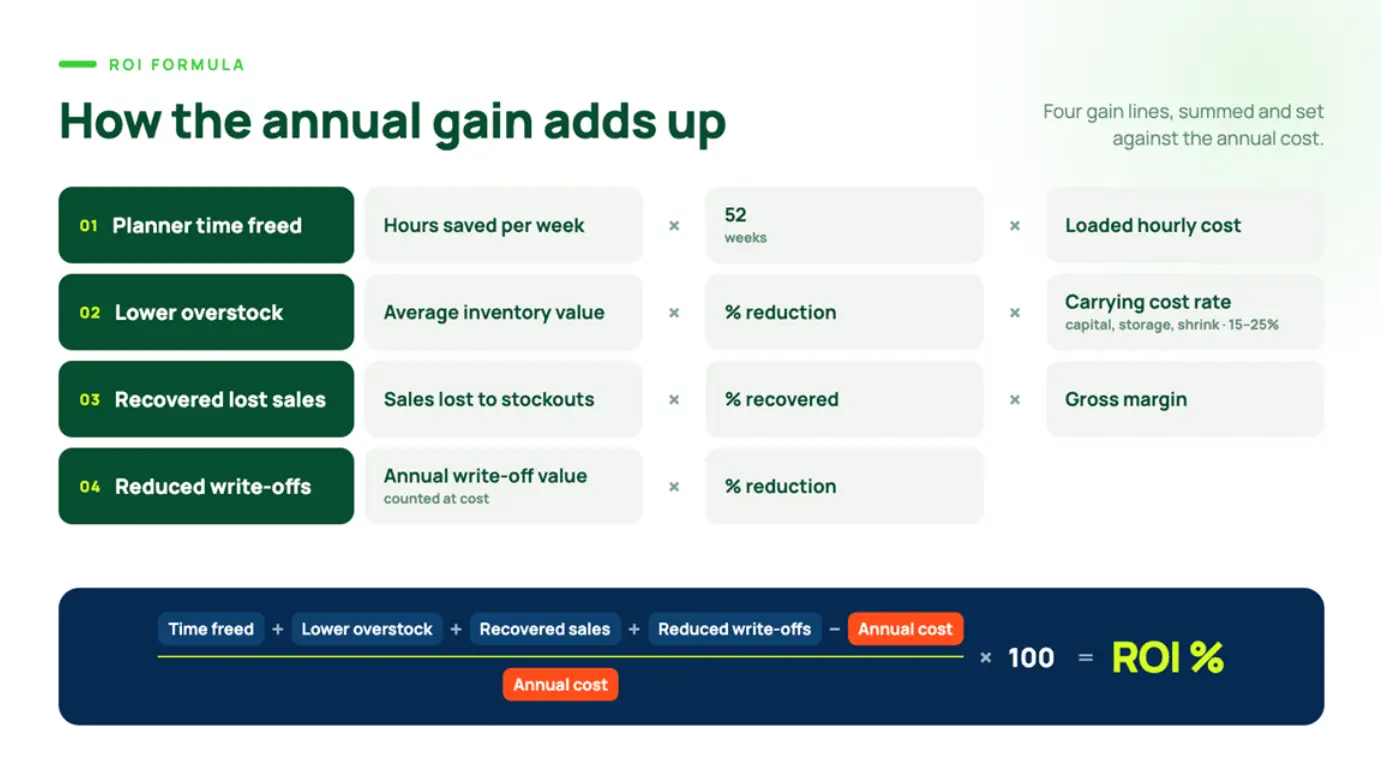
Replenishment automation ROI is the annual gain from lower overstock, fewer stockouts, less waste, and freed planner time, minus what the system costs, divided by that cost. Four inputs from your own data are enough for a first estimate:
Annual gain is the sum of four lines:
- Planner time freed: hours saved per week × 52 × loaded hourly cost
- Lower overstock: average inventory value × % reduction × annual carrying cost rate (capital, storage, shrink, typically 15–25%)
- Recovered lost sales: sales lost to stockouts × % recovered × gross margin
- Reduced write-offs: annual write-off value × % reduction (count it at cost)
ROI (%) = ((time freed + lower overstock + recovered sales + reduced write-offs) − annual cost) ÷ annual cost × 100
Annual cost is the license or subscription, plus one-off implementation spread over year one, plus the internal time your team spends on rollout and buffer tuning.
What manual replenishment actually costs you
In a December 2025 McKinsey survey of 114 merchants, fewer than 10% said they use AI for more than half of their merchandising decisions. A 2020 study by WMG found that a quarter of retailers still managed replenishment analytics in spreadsheets. Only 8% refreshed their demand plans in real time.
Working this way has real costs:
1. The time your planners lose
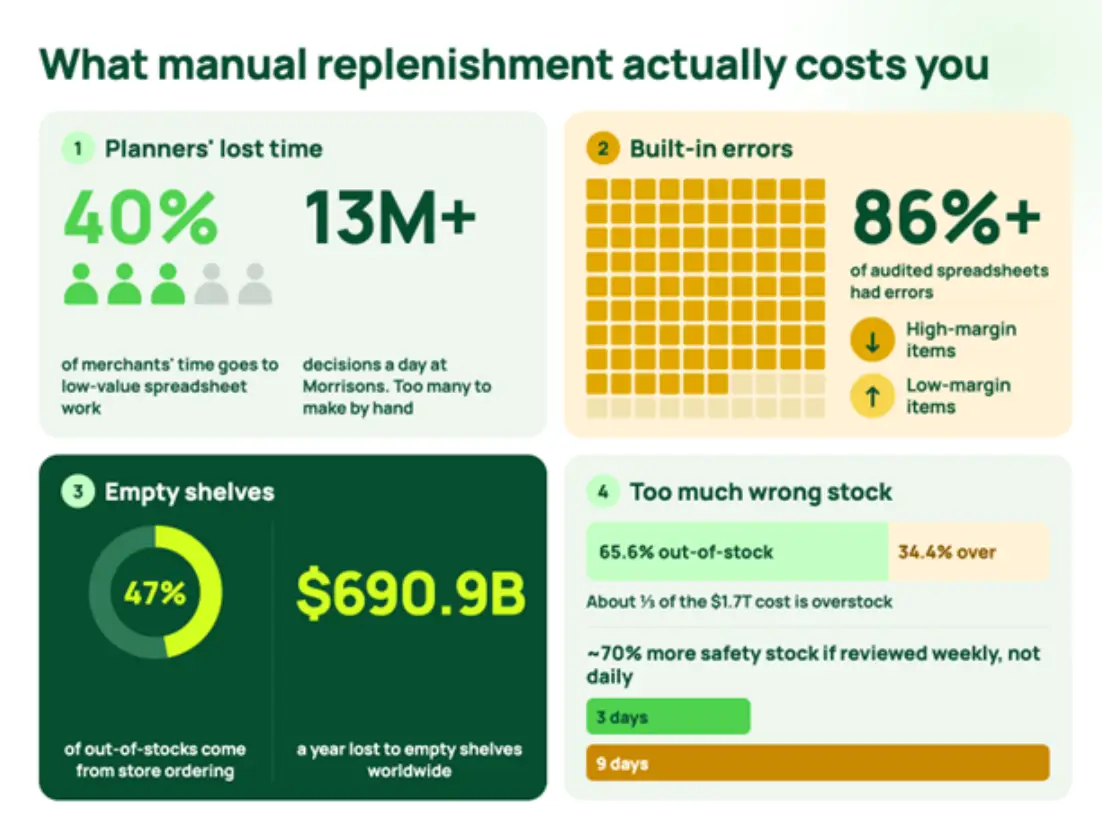
The same McKinsey survey found that merchants spend 40% of their time on low-value tasks: consolidating data, repetitive spreadsheet work and reconciling numbers across siloed systems. On a team of five, that's two full-time salaries spent moving data around. McKinsey estimates that handing this work to AI systems could give up to all 40% of their time back.
Manual ordering also doesn't scale. The average US supermarket carries 33K items. Across 50 stores, that's roughly 1.7 million store-item combinations to get right every ordering cycle. No team can check that many lines carefully by hand. So manual ordering falls back on intuition.
2. Errors built into the process
Manual ordering adds two kinds of error: mistakes in the spreadsheets themselves and bias in human judgment. In Raymond Panko's review of spreadsheet audits, the more recent and more rigorous field audits found errors in at least 86% of the spreadsheets they examined.
The judgment bias is just as consistent. An independent replication of a classic ordering experiment confirmed it: people set order quantities too low for high-margin products and too high for low-margin ones.
3. Empty shelves
Shoppers don't wait. In a worldwide out-of-stock study by Gruen, Corsten and Bharadwaj, 31% of shoppers facing an empty shelf went to another store. Another 9% bought nothing at all. That costs the typical retailer about 4% of sales. In grocery, where the average net margin is 2.1%, that's a significant loss.
IHL Group's 2026 Inventory Distortion Study breaks down the $1.7 trillion distortion figure cited above. Under-ordering makes up about two-thirds of it, and empty shelves alone account for $690.9 billion. Not all of that traces back to ordering, since shoplifting and supplier failures also play a part.
4. Too much of the wrong stock
Manual review cycles make it worse. Say each item gets reviewed weekly instead of daily, with a two-day lead time. The window grows from three days to nine, and you need roughly 70% more safety stock for the same service level, all else being equal.
In fresh categories, extra stock becomes waste. According to Eurostat, EU retail and distribution discard nearly 5 million tonnes of food a year. That's roughly 8% of all food waste in the EU.
What changes when ordering is automated
Automation and AI aren't the same thing. Replenishment can be automated with rules alone, while machine learning improves the forecasts and safety stocks those rules run on. Most of the published evidence below measures the AI side.
McKinsey estimates that AI-driven forecasting can cut forecast errors by 20 to 50% and lost sales and product unavailability by up to 65%. And IHL finds that retailers using AI and ML show 2.3x the sales growth and 2.5x the profit growth.
Manual replenishment isn't free. Its costs are just spread across planners' calendars, empty shelves and markdown racks, where nobody adds them up.
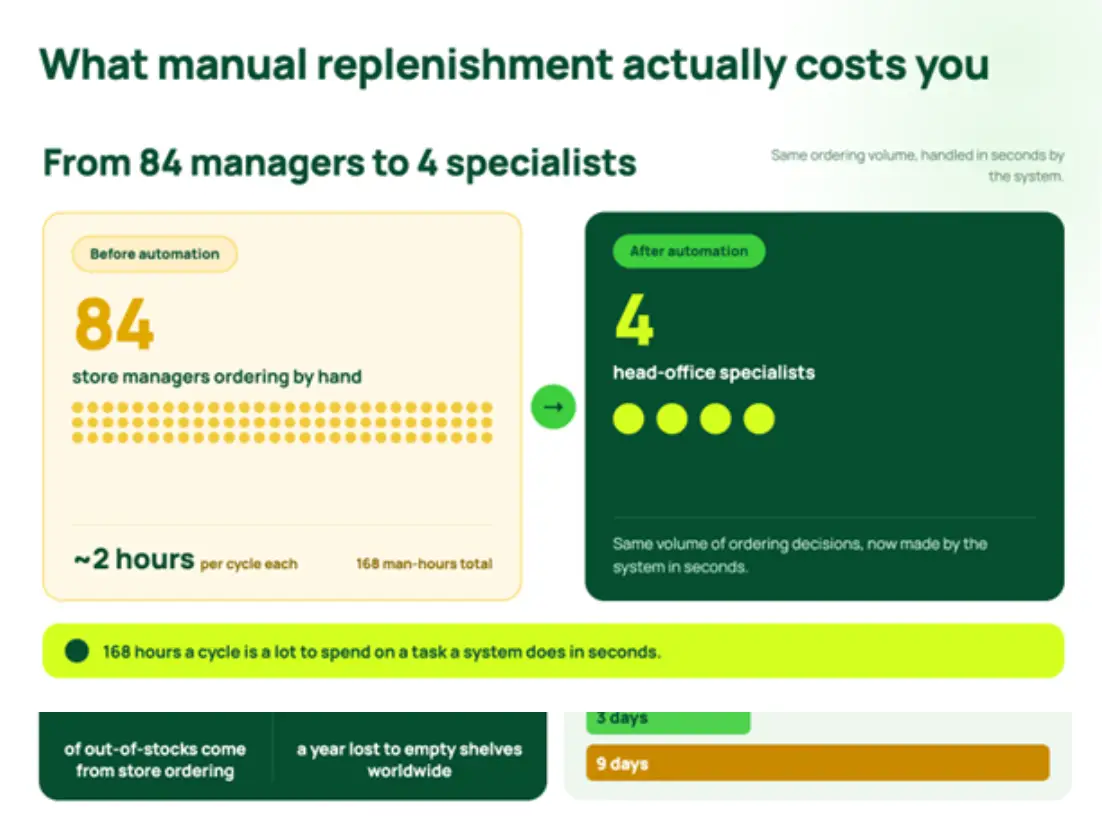
Before automating, Baltic Petroleum had 84 store managers each spending roughly two hours per ordering cycle on manual replenishment. That's about 168 man-hours a cycle across the network (a lot of time to spend on a task a system can do in seconds). After automation, four head-office specialists took over the same volume of ordering decisions.
Real numbers from real deployments
The results below come from three retailers running automated replenishment on the LEAFIO AI Retail Platform: two fuel and convenience networks (Baltic Petroleum and Viada Baltija) and a grocery chain (Daily). In both segments, fresh and tobacco punish manual ordering hard, since fresh spoils fast and tobacco locks up cash:
| Retailer | ROI / payback | Other results |
|---|---|---|
| Baltic Petroleum | 1,581% ROI in year one, payback within the first month | Sales up 62% in planogrammed categories, overstock down 50%, inventory turnover up 13% |
| Daily | Not publicly broken out as a single ROI percentage | Sales up 23%, days of inventory down from 30 to 24, fresh write-offs down from 11% to under 2% |
| Viada Baltija | Not publicly broken out as a single ROI percentage | Overstock down 35%, lost sales down 29%, inventory turnover up 8%, availability up 17% |
Baltic Petroleum is the strongest single ROI figure LEAFIO has published, so treat it as the ceiling rather than the average case. Daily and Viada Baltija show the same pattern (less overstock, fewer stockouts, better turnover) even without a headline ROI percentage attached.
Baltic Petroleum also shows why a platform matters. Its 62% sales growth was measured in categories that also received planograms. So it reflects replenishment and shelf planning working together, not ordering alone.
Want the day-to-day mechanics of how it runs once it's live? Our guide to automated replenishment in grocery retail covers that side of it.
How to start without betting the whole operation
You don't have to revamp your whole ordering process in one day. LEAFIO's Daily deployment started as a pilot in a single category: tobacco products, a fast-moving, cash-locking segment where automated buffers can prove their value quickly.
Only after that did it roll out across the rest of the assortment. That sequence, a focused pilot followed by staged expansion, gives a planning team a real before-and-after comparison instead of a leap of faith. It also keeps the disruption contained if something needs adjusting along the way.
How long does implementation of automated replenishment take?
Implementing automated replenishment takes at least two months. The exact timeline depends mostly on how clean your data is and how many stores and categories you start with, not on the software. Most rollouts follow four stages, with a focused pilot before the chain-wide expansion, so results show up early:
| Phase | What happens |
|---|---|
| 1. Data and scope | Connect POS sales, stock levels, supplier lead times, and order schedules. Choose the pilot category and stores. Set baseline KPIs. |
| 2. Configuration and tuning | Set buffers and service levels, apply supplier constraints (minimum orders, pack sizes, delivery days), and run recommendations beside manual orders to compare. |
| 3. Pilot live | Planners approve or override automated orders. Measure stockouts, overstock, and planner hours against the baseline. |
| 4. Staged rollout | Expand to more categories and stores in waves, once override rates fall and the KPIs hold. |
The main factors that change the timeline:
- Data quality. Wrong lead times, duplicate SKUs, and inaccurate stock counts cause most delays. Fix them before the pilot, not during it.
- Pilot scope. One category in a handful of stores is faster to tune than a whole assortment. Daily started with one category, then expanded.
- Supplier complexity. Many suppliers with different ordering rules add configuration time.
- Team involvement. A named owner who reviews overrides each week keeps the pilot moving. Without one, tuning stalls.
- System integration. Connecting to your ERP or ordering system can add several weeks, depending on how modern it is.
Results usually arrive before the full rollout is done. In the strongest LEAFIO case, Baltic Petroleum, payback came within the first month. In other deployments, measurable improvements appeared within the first two months. Starting with a focused pilot is what makes that early evidence possible.
Curious what this would look like for your own store network? See how automated replenishment works on the LEAFIO AI Retail Platform, or book a demo to run the numbers against your own stockout and overstock data.
FAQ
Is it worth switching from manual replenishment to an automated system?
Yes, in most cases where stockouts or overstock are chronic or planners spend hours each week recalculating orders. It also pays off when your store count and assortment grow faster than manual tracking can follow. The ROI comes from less overstock, fewer stockouts, lower write-offs, and freed planner time. For a single store with a small, stable assortment, the case is much weaker.
What are the benefits and risks of automated replenishment versus manual replenishment?
The main benefits are faster response to demand changes, more consistent ordering across stores, and less planner time spent on repetitive recalculation. The main risk is implementing it somewhere the volatility doesn't justify it, such as a single stable location, where the system adds overhead without much upside.
What are the best practices for implementing automated replenishment?
Start with a pilot in one category or a small group of stores, and measure the before-and-after on stockouts, overstock, and turnover. Then expand in stages once the buffers are tuned. Trying to automate the entire assortment on day one usually creates more exceptions than a team can handle.
Does automated replenishment improve data accuracy?
Not directly. Automation runs on your data, so wrong lead times, duplicate SKUs, and inaccurate stock counts still need fixing. What it does remove is manual re-entry errors, and it surfaces bad data faster because a wrong input produces visibly wrong orders. That's why data cleanup comes before the pilot.
How long does it take to see ROI from automated replenishment?
It varies by scale and category mix. The fastest documented LEAFIO case, Baltic Petroleum, reached payback within its first month, which is the best case rather than the norm. In other deployments, measurable improvements appeared within the first two months. The exact timeline depends on how much manual inefficiency exists to begin with.
Is automated replenishment a standalone tool or part of a retail platform?
It can run as a standalone tool, but it works better when ordering shares data with demand forecasting, assortment, and shelf planning. In a connected platform, a change in assortment or shelf capacity flows straight into order quantities instead of being reconciled across separate systems. The LEAFIO AI Retail Platform takes this approach, with replenishment running alongside inventory optimization, shelf planning, and assortment management.


Have a question?

Jack Larson
Retail Optimization Expert