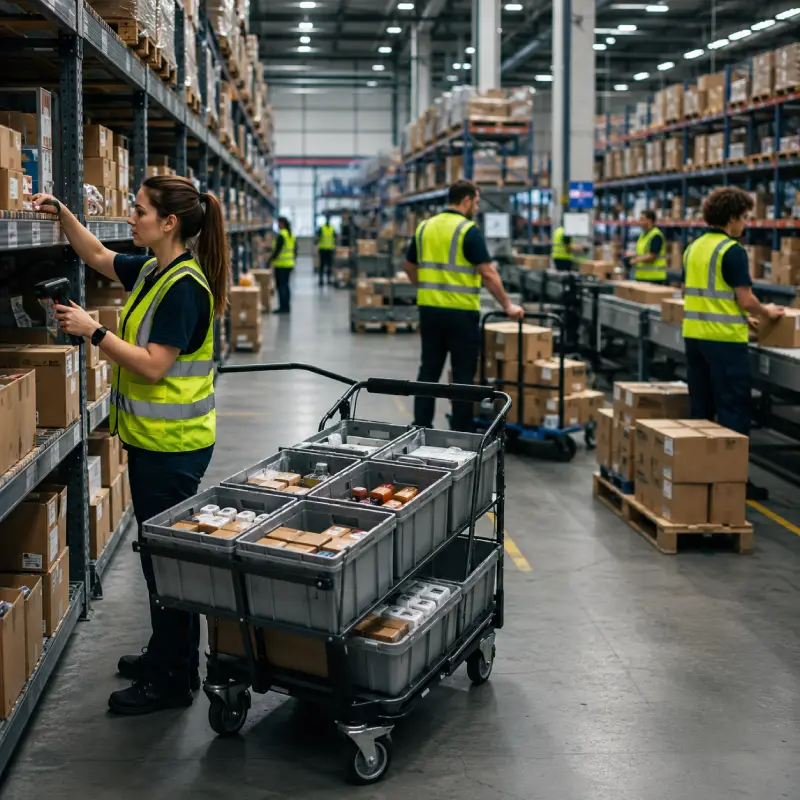


A warehouse management system (WMS) follows a defined process flow: Receiving → Putaway → Storage → Picking → Packing → Shipping. At each stage, the WMS tracks inventory location, automates task assignment, and syncs data in real time - eliminating the manual errors and delays that occur without a system.
For retail operations, that sequence determines whether a pharmacy network rotates stock before expiry, whether a grocery chain replenishes stores without gaps, or whether a retailer can promise a two-hour BOPIS window and actually honour it. Customer satisfaction is built or lost at the execution layer.
This guide breaks down each stage of the warehouse management process flow, explains what happens without a system, and shows how modern WMS software transforms warehouse operations.

The 6-Stage WMS Process Flow
When a delivery arrives, the WMS matches it against the purchase order and, where available, the Advance Shipping Notice. Each item is scanned - batch number, expiry date, and quantity - recorded immediately, not hours later from a clipboard. Discrepancies are flagged on the spot. A non-compliant delivery can be rejected while the truck is still at the dock.
- Manual count - errors discovered after the fact
- Ghost inventory - stock on paper, not on shelf
- No real-time discrepancy flagging
- Inventory control suffers from day one
- Barcode scan at dock - instant batch & expiry capture
- PO matching with ASN in real time
- Rejection possible while truck is at dock
- Zero data lag between receipt and system
Rules account for product dimensions, temperature zone requirements, FEFO or FIFO rotation, velocity classification, and real-time space availability. The system makes the decision automatically - it doesn't depend on who happens to be handling the goods that day.
The payoff shows up at picking. Correct putaway reduces travel time by 20–35% - recovered hours per shift, not a marginal gain.
- Putaway logic walks out with whoever knew it
- Stock in wrong location or temperature zone
- Space wasted, misplaced goods cost pick time
- Directed putaway with zone & rotation rules
- 20–35% reduction in picking travel time
- Consistent regardless of staff experience
The system manages replenishment from reserve to pick face, zone transfers, cycle counting, and expiry monitoring. Tracking happens at the slot level, in real time. When a pick face drops below threshold, the system generates a move task automatically.
Cycle counting runs on a rolling schedule - no annual shutdown, no operational disruption. For distribution centres handling perishables, pharmaceuticals, or cosmetics, FEFO rotation is enforced at the system level. The system doesn't forget.
- Stock movement between scans is invisible
- Expired product picked and shipped
- Replenishment arrives late
- Reports surface problems days after they occur
- Slot-level real-time visibility
- FEFO/FIFO enforced automatically
- Auto pick-face replenishment triggers
- Rolling cycle counts - no shutdown needed
The WMS directs pickers via mobile scanner, voice headset, or pick-to-light. It optimises their route, groups orders into batch runs, and plans waves to balance workload across the shift. Each function eliminates a specific error that manual processes leave open.
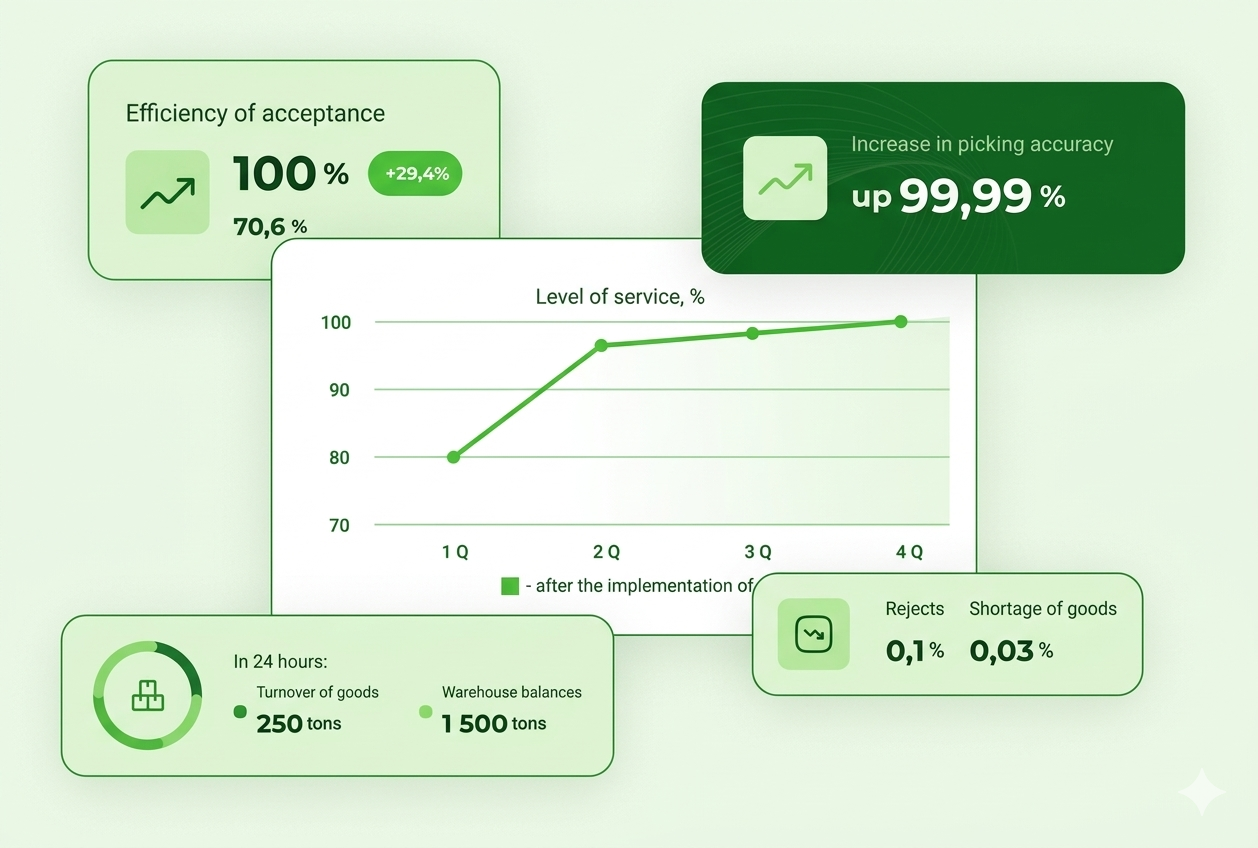
With directed picking, accuracy climbs from a typical 85% to 99.5%+. That improvement translates directly into reduced returns, re-shipments, and customer service costs.
For omnichannel retail, a BOPIS order with a two-hour window requires the WMS to receive the order, prioritise the pick ahead of regular batch runs, and confirm fulfilment in real time. That's not achievable with manual processes or batch-update systems.
- 12–15 km walked per shift, much unnecessary
- 2–5% error rate - direct customer impact
- BOPIS two-hour window not achievable
- No wave planning - uneven workload distribution
- Directed route - optimised path every pick
- 99.5%+ accuracy via scan confirmation
- BOPIS priority queue in real time
- Batch + wave planning across the shift
The WMS recommends the right box size, reducing void fill and making better use of outbound load space. Shipping labels are generated automatically - carrier barcode, destination, and tracking reference - no manual production. Before the box closes, pack verification requires the packer to scan each item, catching picking errors that made it this far.
The cost of a mis-pick reaching the customer isn't just the return and re-shipment - it's the customer service call, the measurable drop in customer satisfaction, and the downstream impact on store availability. Without a WMS, the only check is human attention, inconsistent by nature.
- Manual label production - errors possible
- No pack verification - mis-picks reach customer
- Sub-optimal box sizing - higher void fill cost
- Auto-generated carrier labels with tracking ref
- Scan-based pack verification - last error catch
- Box size recommendation - optimised outbound load
Once an order is packed and verified, the WMS transmits shipment data to the TMS or carrier API, generates the load manifest, and records proof of loading. Dock scheduling is part of warehouse operations at this stage too.
Without a WMS, dispatch relies on paper manifests and manually assembled load lists. Errors in shipping documentation create problems downstream for transportation management systems and carriers - particularly for cross-border movements where documentation gaps have real consequences across the supply chain.
- Paper manifests - documentation errors
- Manual load lists - assembly mistakes
- No dock scheduling - yard queues & delays
- Auto TMS/carrier API transmission
- Digital load manifest + proof of loading
- Dock scheduling - right vehicle, right door, right time
Returns: A Variant of Inbound, Not a Separate Stage
Returns are not a separate warehouse stage - they are a variant of receiving (goods coming back into the warehouse) or shipping (goods being returned to a supplier). That said, they require the same discipline as any inbound movement.
A WMS processes returns through a defined workflow: barcode scanning on arrival, RMA verification, condition assessment, and a disposition record - restock, quarantine, or disposal. Inventory updates immediately. Without that structure, returns pile up uninspected and unrecorded. Damaged items get accidentally restocked and re-picked, inventory levels drift, and customer satisfaction suffers.
How WMS Connects with ERP, OMS, and TMS
A warehouse management system doesn't operate in isolation. The data flow from purchase order to customer delivery is what separates a warehouse that reacts to problems from one that prevents them.
When warehouse management and transportation management systems are properly integrated, supply chain visibility is end-to-end. LEAFIO WMS connects to existing ERP environments via open API - integrating with the stack already in place rather than replacing it.
Real-Time vs. Batch Processing
Legacy warehouse management platforms update inventory in batches - once per hour, once per shift, or once per day. Each cycle is a window where the system doesn't reflect what's actually on the shelf. In an environment where BOPIS carries two-hour windows and same-day delivery is standard, that latency creates inventory levels that don't reflect reality.
Modern WMS systems process every scan, every move, every pick in real time. Managers, pickers, and planners all work from the same live picture of warehouse operations.
| Function | Without real-time | With real-time |
|---|---|---|
| Inventory tracking | Updated hourly or by shift | Updated per scan |
| BOPIS fulfilment | Risk of promising unavailable stock | Accurate at point of order |
| Replenishment triggers | Delayed until next batch | Triggered at threshold |
| Reporting | Available next day | Available now |
Before vs. After: What Changes When a WMS Is in Place
A WMS changes the numbers at every stage - not just the technology behind them. The goal is reliable warehouse operations and inventory control from the moment goods arrive to the moment they reach the customer.
| Metric | Without WMS | With WMS |
|---|---|---|
| Inventory counts | Manual, weekly | Real-time accuracy |
| Picking error rate | 2–5% | Under 0.5% |
| New staff ramp-up | 2–4 weeks to orient | Directed tasks - productive from day one |
| Returns processing | Manual - uninspected backlog | Automated RMA + instant restock decision |
| Reporting | 1–2 days to compile | Dashboard updated in real time |
FAQ
What is a warehouse management system process flow?
The warehouse management system process flow is the sequence of warehouse operations a facility executes from goods arrival to shipment: Receiving, Putaway, Storage, Picking, Packing, and Shipping. The WMS automates and tracks each stage in real time, keeping inventory control tight and fulfilment reliable.
What are the main stages of a WMS?
The six core stages are: (1) Receiving, (2) Putaway, (3) Storage, (4) Picking, (5) Packing, (6) Shipping. Some WMS solutions also include cross-docking and yard management for high-volume or multi-temperature environments. Returns are handled as a variant of the inbound or outbound process, not a separate stage.
How does a WMS improve picking accuracy?
A WMS directs pickers to exact storage locations via mobile scanners or voice systems, optimises their route through the warehouse layout, and requires scan confirmation before completing a pick, reducing human error and lifting order accuracy from 2–5% error rates to under 0.5%, with a direct and measurable impact on customer satisfaction.
Does a WMS integrate with ERP systems?
Yes. LEAFIO WMS integrates with existing ERP systems via open API, keeping data consistent across platforms in real time. Contact the LEAFIO WMS team for a list of certified integrations.
What is the difference between FIFO and FEFO in a WMS?
FIFO dispatches the oldest stock first by receipt date. FEFO prioritises by expiry date the relevant rule for perishables and pharmaceuticals. A WMS enforces whichever rule applies automatically at the pick level.
How long does WMS implementation take for a retail distribution centre?
A standard LEAFIO WMS implementation takes 8 to 12 weeks from contract signing to go-live, including configuration, integration, testing, and staff training. For greenfield distribution centres, the timeline may be more straightforward. Contact LEAFIO for a scoping estimate specific to your warehouse.


Have a question?

Andrew Ivarsen
Logistics Optimization Expert