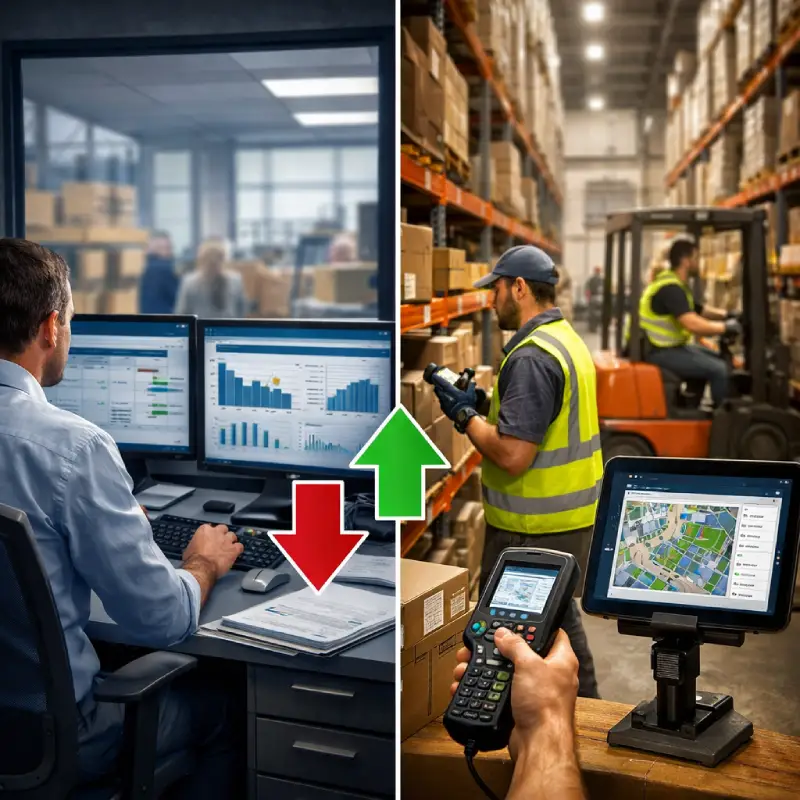


WMS stands for Warehouse Management System, software that tracks, controls, and optimizes every operation inside a warehouse or distribution centre. It handles inventory tracking, task assignment, and operational efficiency from the moment goods arrive to the moment they ship.
So what does WMS mean exactly? In practical terms, WMS meaning is simple: it is the operational layer that runs warehouse processes - receiving, putaway, picking, packing, and shipping - in real time. When stock visibility breaks down, the cost shows up in complaints and write-offs.
This guide explains what WMS means, how it works, which types exist, and how to know when your operation needs one.
What Does WMS Stand For? - The Full Definition
WMS = Warehouse Management System. Software that provides real-time visibility and control over inventory location, warehouse staff tasks, and goods movement from receiving to shipping.
The WMS full form is Warehouse Management System, sometimes referred to as WM System or WMSS in older texts, although the WMS acronym is what is most commonly used.
MHI, the largest material handling and supply chain management association in the US, defines it as a software application designed to support and optimize warehouse functionality and distribution centre management. In practice, it is execution software that manages people, inventory, time, and equipment for picking and processing customer orders.
WMS platforms appeared in the early 1990s, replacing paper pick lists and floor knowledge that lived in people’s heads. This worked when volumes were low, but became expensive as retail distribution scaled. The warehouse management system definition that emerged: a standalone platform for warehouse operations focused on inventory accuracy and inventory control, sitting between the shop floor and the supply chain management layer above it, separate from the ERP managing financials.
What Does a WMS Actually Do?
Here’s what a warehouse without WMS software looks like. Stock locations live in people’s memories or on a spreadsheet. Inventory counts take days. New staff aren’t independent for weeks.
A modern warehouse management system replaces all of that. Location data lives in the system, not in someone's memory. Pick routes are directed. Batch rotation rules, FEFO for perishables or FIFO where applicable, are enforced automatically. Businesses automate warehouse operations and streamline warehouse operations that previously depended on manual effort, improving labor and space utilization at every stage, from how warehouse space is allocated to how each pick is sequenced.
| WMS Function | What It Means in Practice |
|---|---|
| Receiving & putaway | Goods scanned on arrival, storage slot assigned automatically |
| Real-time inventory | Accurate stock count per item and location, updated continuously |
| Picking optimisation | Optimal routes for pickers, FEFO/FIFO/LIFO rules, batch and wave picking |
| Packing & labelling | Shipping labels generated automatically, cartonisation logic applied |
| Shipping & dispatch | Carrier integration, loading manifests, proof of dispatch |
| Returns processing | RMA handling, condition inspection, reclassification |
| Labour management | Task assignment by role, output tracking, per-operator KPIs |
In retail, FEFO in grocery and pharma is a compliance issue. Shipping expired product is a compliance failure, not just an inefficiency. When 20 or more pickers work across multiple zones, real-time inventory tracking is what keeps inventory accuracy and operational efficiency in check. And BOPIS with a two-hour SLA requires live slot-level inventory control. When that promise breaks, customer satisfaction suffers.
In practice, the impact is measurable. LEAFIO WMS customers report picking accuracy improvements from 85% to 99.95%, labor productivity gains of up to 40%, and customer complaint rates dropping from 15% to 0.01% - outcomes documented in published case studies across grocery, pharmacy, and auto parts distribution.
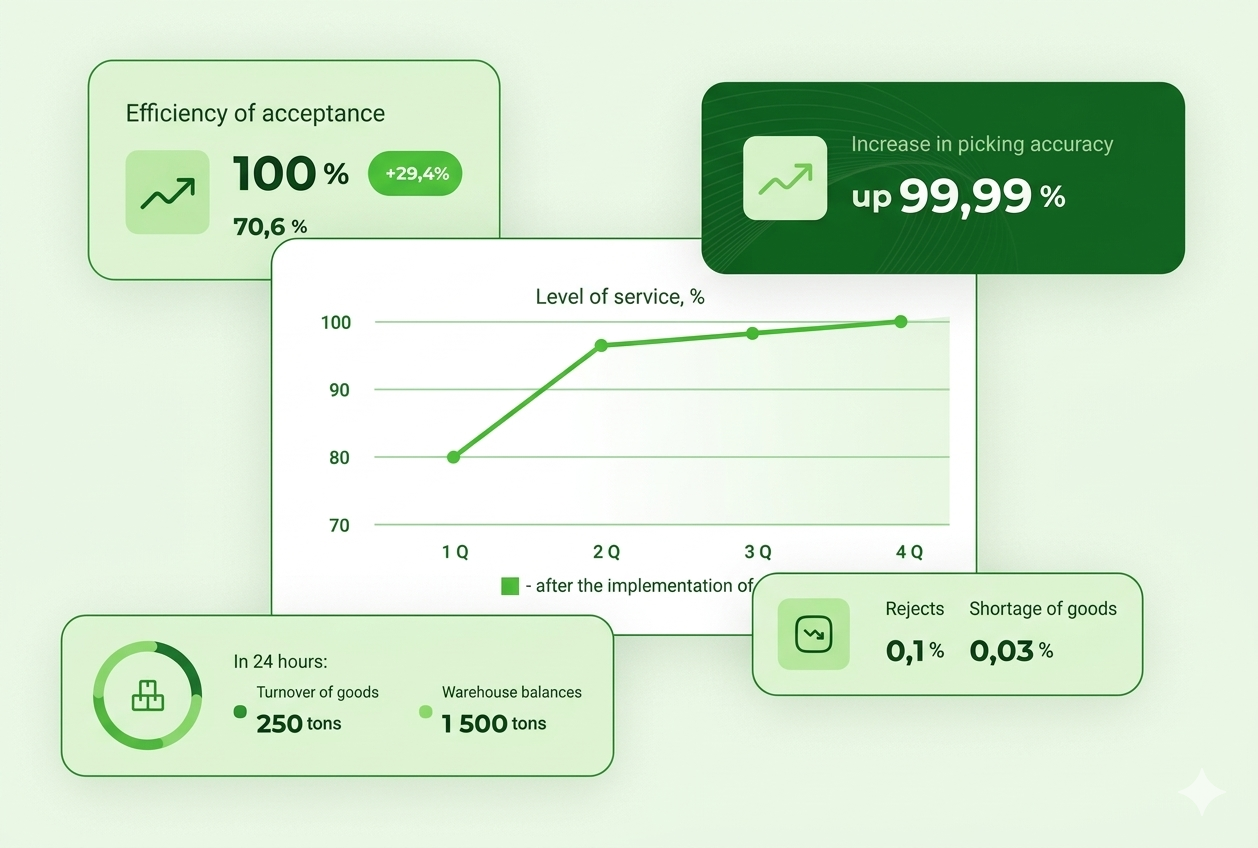
See our WMS process flow guide for a step-by-step breakdown of each stage.
WMS vs ERP vs Inventory Management Software - Key Differences
The question that comes up constantly: we already have an enterprise resource planning system, so why isn’t that enough?
| WMS | ERP (warehouse module) | Inventory software | |
|---|---|---|---|
| Primary focus | Warehouse operations | Business financials | Stock counts |
| Real-time location tracking | ✓ Yes | Limited | No |
| Picking optimisation | ✓ Yes | No | No |
| Labour management | ✓ Yes | No | No |
| Best for | DCs with 5,000+ SKUs | Smaller operations | Very small businesses |
| Example | LEAFIO WMS | SAP, Oracle | QuickBooks, Cin7 |
An enterprise resource planning system records financial transactions: purchase orders, receipts, and invoices. The warehouse module captures those but doesn’t direct physical work: no inventory tracking at slot level, no wave picking, no task routing across zones. It records what happened. Warehouse management software tells people what to do next, maintaining inventory control and operational efficiency at scale across the supply chain.
Under 3,000–5,000 SKUs with a stable team, an ERP module usually manages. Add volume, channels, or a second site and gaps appear: untraceable errors, drifting stock, warehouse space used inefficiently, new staff not independent for weeks. A warehouse management system doesn't replace the ERP. It runs beneath the operation: daily warehouse operations below, supply chain management and broader supply chain performance above.
Types of WMS - Which One Fits Your Business?
Standalone WMS connects to ERPs via API and covers the deepest functional range, slot-level tracking, complex picking logic, labour analytics, and multi-DC management. As WMS software built exclusively for warehouse operations, it’s the most complete option. LEAFIO WMS is standalone, integrating with existing ERPs via API. Most retail DCs evaluating Best Warehouse Management Software in 2026 land here.
ERP-integrated WMS lives inside an existing ERP (SAP EWM, Oracle WM). Simpler to deploy if already on that platform, with less execution depth across warehouse processes.
Cloud WMS (software as a service) is WMS software that runs on subscription, no on-premise hardware, lower upfront cost, and faster go-live. A modern warehouse management system deployed in the cloud lets businesses manage warehouse operations effectively and streamline daily warehouse operations across multiple sites from day one, with full visibility for the supply chain management team at the head office. LEAFIO Warehouse Management System is cloud-first, built for retail networks where the head office needs visibility across several DCs.
| Standalone WMS | ERP-integrated WMS | Cloud WMS | |
|---|---|---|---|
| Deployment | On-premise or cloud | Inside ERP | Cloud (SaaS) |
| Implementation time | 8–16 weeks | 4–12 weeks | 6–12 weeks |
| Cost model | Licence or SaaS | ERP module pricing | Subscription |
| Best for | Mid-to-large retail DCs | ERP-heavy, smaller ops | Fast-scaling, multi-site |
When Does a Business Need a WMS?
Picking errors keep rising. Retail DCs without directed picking typically run at 2-5% errors. A system that helps teams manage warehouse operations correctly brings that below 0.5%. Every mispick is a return, a reship, or failed order fulfillment.
The current tools have stopped keeping up. Inventory accuracy suffers. Inventory counts stretch over days. Discrepancies every cycle. New staff aren’t independent for weeks; that’s what happens when warehouse processes outgrow their tools.
The operation is growing. Most retail DCs with over 5,000 SKUs and 3+ staff in picking benefit from a warehouse management system. Managing BOPIS SLAs, slot-level visibility, and efficient warehouse space all require it.
At that service level, both customer satisfaction and supply chain performance depend on having the right system in place.
For grocery and pharmacy DCs, the trigger is often FEFO compliance, when a manual process can no longer guarantee that the nearest-expiry batch ships first, the regulatory and financial risk becomes unacceptable. For health and beauty and auto parts distributors, the trigger is typically picking accuracy: as SKU counts grow into the thousands, error rates climb and returns eat into margins. In each case, the WMS is not an upgrade - it is the operational baseline the business has outgrown without.
How WMS Integrates with Other Systems
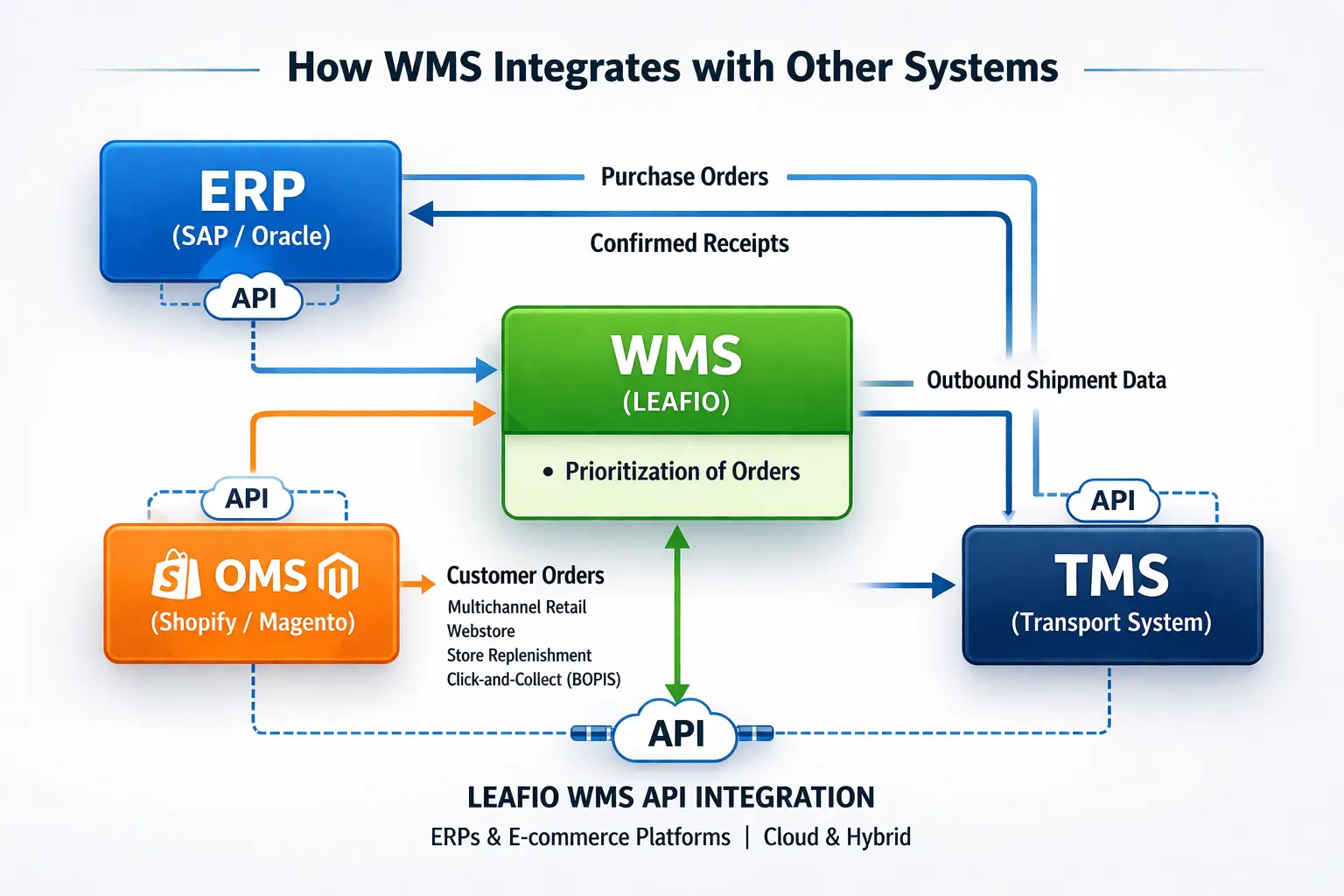
ERP ↔ WMS ↔ OMS ↔ TMS
The ERP sends purchase orders to the warehouse management system and receives confirmed receipts back. The OMS passes customer orders for picking: webstore, store replenishment, and click-and-collect orders all arrive at once and need real-time ranking. WMS systems handle this prioritisation automatically. The TMS picks up outbound shipment data. Shopify and Magento connect directly for DTC and BOPIS order fulfillment.
LEAFIO WMS integrates via open API.
FAQ
What does WMS stand for in logistics?
WMS stands for Warehouse Management System, software that controls and optimizes all operations inside a warehouse or distribution centre, including receiving, putaway, picking, packing, and shipping.
Is WMS the same as ERP?
No. Enterprise resource planning manages business-wide processes (finance, HR, procurement), while a WMS focuses specifically on warehouse operations and is a key part of supply chain management execution. Most companies use both: ERP for business management and WMS for day-to-day warehouse execution. They integrate via API.
What is the difference between WMS and inventory management software?
Inventory management software tracks stock counts and locations. A WMS does that plus optimizes physical warehouse operations: picking routes, labour tasks, FEFO/FIFO rules, and real-time slot management. WMS is more comprehensive and designed for larger, faster-moving operations.
Do small businesses need a WMS?
Small operations (under 2,000 SKUs, 1–2 warehouse staff) can often manage with inventory software or ERP modules. Warehouse management system examples for small businesses include Fishbowl and NetSuite WMS. A dedicated WMS becomes necessary when picking errors increase, stock discrepancies appear regularly, or the operation scales past 5,000+ SKUs and 50+ orders per day.
How long does WMS implementation take?
For a mid-market retail DC, a typical WMS implementation takes 8–16 weeks, including data migration, configuration, ERP integration, and staff training. Cloud-based WMS deployments are generally faster than on-premise.


Have a question?

Andrew Ivarsen
Logistics Optimization Expert