


A regional grocery chain builds next month's orders off last month's sales. A promotion goes live the same week new stock arrives, and by Friday the shelf that was supposed to carry the store through the weekend is empty. The category manager blames the forecast. The supply team blames the promo calendar. Finance asks why margin dropped on the exact SKUs that were meant to drive it.
None of these teams did anything wrong on their own. They just never talked to each other before the numbers hit the P&L. That gap, between what sales expects, what supply can deliver, and what finance can afford, is what sales & operations planning (S&OP) exists to close.
So what is S&OP, exactly? Sales and operations planning is what forces sales, supply chain, and finance to work off one plan instead of three competing ones, the exact gap this grocery chain just fell into.
For manufacturing organizations, that plan centers on production lines and raw materials. In retail, it looks different: thousands of SKUs, hundreds of stores, and a demand curve that moves every time there's a promotion, a heat wave, or a competitor's price cut.
What is Sales and Operations Planning (S&OP)?
Sales and Operations Planning (S&OP) is a monthly, cross-functional process that aligns demand forecasts, supply capacity, and financial targets into a single agreed plan.
Sales and marketing bring what they expect customers to buy. The supply chain brings what can realistically be delivered, whether from distribution centers, suppliers, or manufacturing partners. Finance brings the numbers everyone else has to work inside.
For a retailer, S&OP planning rarely deals with a handful of product families the way a factory does. It deals with an assortment that can run into tens of thousands of active SKUs across dozens or hundreds of stores, each with its own local demand pattern. A national chain's S&OP cycle has to reconcile a heatwave-driven spike in one region with a slow week in another, inside the same monthly plan.
At its simplest, the S&OP process answers one question every month: given what we expect to sell, what we can supply, and what we can afford, what is the one plan everyone works from until the next review? S&OP is the part of supply chain planning that exists specifically to answer it.
Why Do Retailers Need S&OP?
Retail runs on volatility that most manufacturing S&OP models were never built for. A single promotion can move demand for a category by more than the entire monthly forecast error. Weather shifts fresh produce demand by the day, not by the month. A private label listing decision made by one category manager changes the supply picture for a dozen suppliers overnight.
The scale of the problem shows up in the numbers. IHL Group puts the global cost of inventory distortion, out-of-stocks and overstocks combined, at $1.73 trillion a year, roughly 6.5% of global retail sales. That is not one bad quarter. It is the ongoing cost of demand and supply plans that do not talk to each other.
Without a shared planning process, each function optimizes for its own goal. Sales pushes volume. The supply chain protects service levels by holding more stock than the plan calls for. Finance tightens working capital targets without knowing which categories are already running lean. Nobody is wrong, exactly, but nobody is aligned either.
S&OP gives these functions one calendar, one dataset, and one decision point. It does not remove the disagreement between sales, supply, and finance (there is always tension between wanting more stock on hand and wanting less capital tied up in it). What it does is force that disagreement into a monthly meeting instead of letting it play out as stockouts and write-offs on the shop floor.
Key Benefits of S&OP
Fewer stockouts and less overstock at the same time
Most retailers treat stockouts and overstock as opposite problems that trade off against each other. A well-run S&OP process shrinks both at once because it fixes the root cause: a demand and supply plan built on outdated assumptions. When supply constraints and the promotion calendar get reviewed against the same forecast every month, buffers land where the risk actually is instead of everywhere at once.
Groceries are proof this works. Among all retail segments tracked by IHL Group in 2025, food and grocery retailers posted the strongest improvement in inventory distortion of any category, a 43.5% gain.
That lines up with a category that runs tighter margins and shorter shelf life than almost anything else in retail.
Faster, more confident decisions
When a supplier delay hits or a competitor drops prices mid-quarter, a retailer with a working S&OP cycle already knows its constraints, its priorities, and who owns the decision. Retailers without one are relearning that context from scratch every time something goes wrong.
Margin protection that survives contact with the shop floor
Financial targets built without input from supply and category teams tend to fall apart within a quarter. S&OP ties the financial plan to what is actually achievable at the SKU and store level, so a margin target is not just a number in a spreadsheet. It is a plan someone can execute.
Common Business Challenges S&OP Solves
Most of these challenges trace back to the same root cause: capability gaps. Gartner found that only 29% of supply chain organizations surveyed in 2024 had built the capabilities needed to handle what comes next.
The other 71% are working with an S&OP process, if they have one at all, that was not built for today's level of demand volatility.
Promotion-driven demand spikes
A promotion can multiply demand for a single SKU by five or ten times its baseline for one week. If the supply plan was not built around that promotion specifically, the result is either an empty shelf during the highest-margin week of the month or a pile of markdowns three weeks later. S&OP forces the promotion calendar and the supply plan onto the same table before the promotion goes live, not after.
Baltic Petroleum, a Lithuanian convenience retailer running 86 fuel-station stores and around 2,500 SKUs, faced this kind of imbalance directly. Stock decisions were made locally, with no consistent link between what was ordered and what demand actually looked like store by store. After centralizing replenishment and planogram management on the LEAFIO AI Retail Platform, the chain increased sales by 62% and cut overstock by 50% within a year.
Siloed decision-making between category, supply, and finance
When each team builds its own version of the plan in its own spreadsheet, the numbers that reach the executive review are already three different stories. S&OP replaces that with one dataset everyone plans against, which sounds obvious until you have sat through a meeting where sales and supply are arguing about whose forecast is correct.
Slow, backward-looking planning cycles
A monthly cycle that takes three weeks to build leaves almost no time to act on what it finds. Retailers that automate the data-gathering and reconciliation steps get that time back and spend the freed-up hours on the decisions that actually need a person in the room.
How the S&OP Process Works: A Step-by-Step Cycle
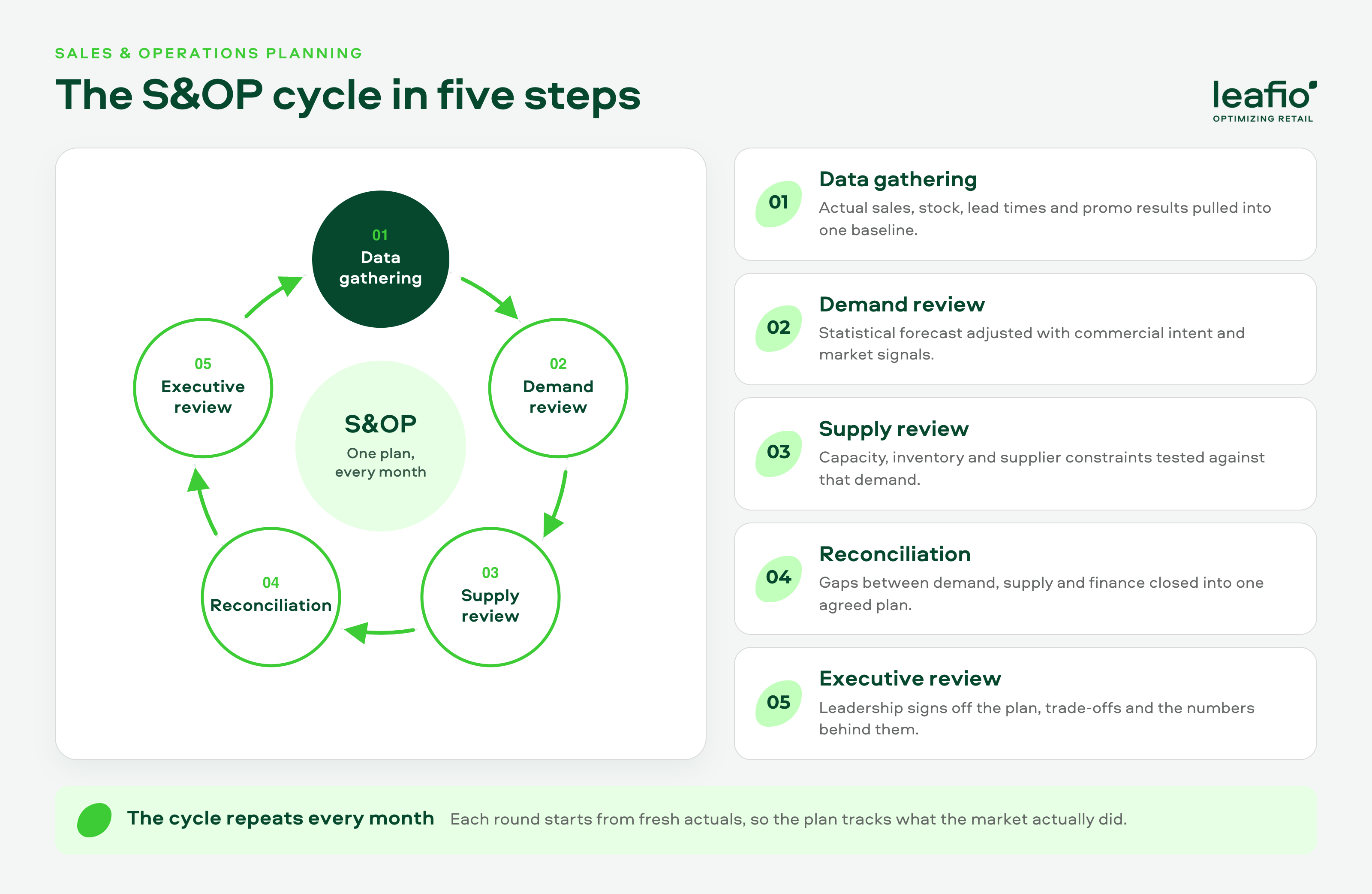
Retail S&OP typically runs monthly, though fast-moving categories often need a lighter weekly check-in layered on top. That is the territory of S&OP execution, or S&OE (S&OE vs S&OP covers exactly where the two diverge). The core S&OP planning process has five steps.
Step 1: Data gathering
Sales history, current stock, open orders, and known demand drivers, promotions, price changes, and new store openings get pulled into one dataset. The goal here is not analysis yet. It is making sure everyone plans from the same numbers.
Step 2: Demand review
Category and demand planning teams build or adjust the forecast, factoring in promotions, seasonality, and any shifts sales and marketing are seeing on the ground. This is where a purely statistical forecast gets corrected by people who know a competitor is closing three stores next month.
Step 3: Supply review
Supply chain checks that forecast against what can actually be delivered, accounting for supplier lead times, distribution center capacity, and constraints on specific categories, such as limited shelf life on fresh items.
Step 4: Reconciliation
Where demand and supply do not match, and they usually do not on the first pass, someone decides what gives. More stock here, a delayed promotion there, a different allocation across regions. This step turns two competing plans into one.
Step 5: Executive S&OP review
Leadership signs off on the reconciled plan, weighing in on anything that affects financial targets or requires trade-offs between categories. Once approved, this becomes the sales and operations plan the business works from until the next cycle.
S&OP Roles and Responsibilities
S&OP process owner
Usually sits in the supply chain or operations. Keeps the calendar on track and makes sure every function shows up with a plan, not just an opinion.
Category and demand planners
Build the SKU and store-level forecast. They are the ones who know why a category's demand does not look like last year's, whether that is a delisted competitor product, a new range, or a shift in customer behavior.
Supply and replenishment teams
Translate the demand plan into what has to move, and when, across distribution centers, suppliers, and stores.
Finance
Keeps the plan honest against budget and margin targets, and flags when a demand plan the category team loves does not actually make money.
Executive sponsor
Owns the final call when sales, supply, and finance cannot agree on their own, which happens more often than any of the three would like to admit.
S&OP Best Practices
S&OP implementation succeeds or fails on discipline, not on which solution a company buys. The operations planning process itself does not change much between a mid-size chain and a large one. What changes is whether these habits actually hold once the first difficult month arrives.
Protect the calendar
An S&OP meeting that gets rescheduled every month because someone is traveling stops being a decision-making forum and turns into an email chain. The cadence only works if it is treated as non-negotiable.
Build the dataset before you build the meeting
A good chunk of most S&OP meetings gets burned reconciling whose numbers are right. Automating data gathering and forecast generation before the meeting means the room can spend its time on decisions instead of spreadsheet archaeology.
Bring finance in early, not at sign-off
A plan finance only sees at the executive review is a plan about to get rejected or reworked. Finance needs visibility into the demand and supply numbers as they are being built, not just the final total.
Plan cross-functionally from the start, and measure it
Grupo Camilo de Alimentos, a Brazilian supermarket and wholesale group managing more than 15,000 SKUs, restructured its planning around exactly this kind of cross-functional coordination, with commercial, supply, IT, and operations teams working under one supply chain department instead of in separate lanes.
After implementing LEAFIO AI's inventory optimization solution, the group cut lost sales by 67% and reduced overstock by 41%, while idle capital tied up in stock dropped from 43.8% to 15.9%.
The result was not just better numbers. It was a shift from intuitive decisions to a plan the whole business could see and act on together.
S&OP vs. IBP: What's the Difference?
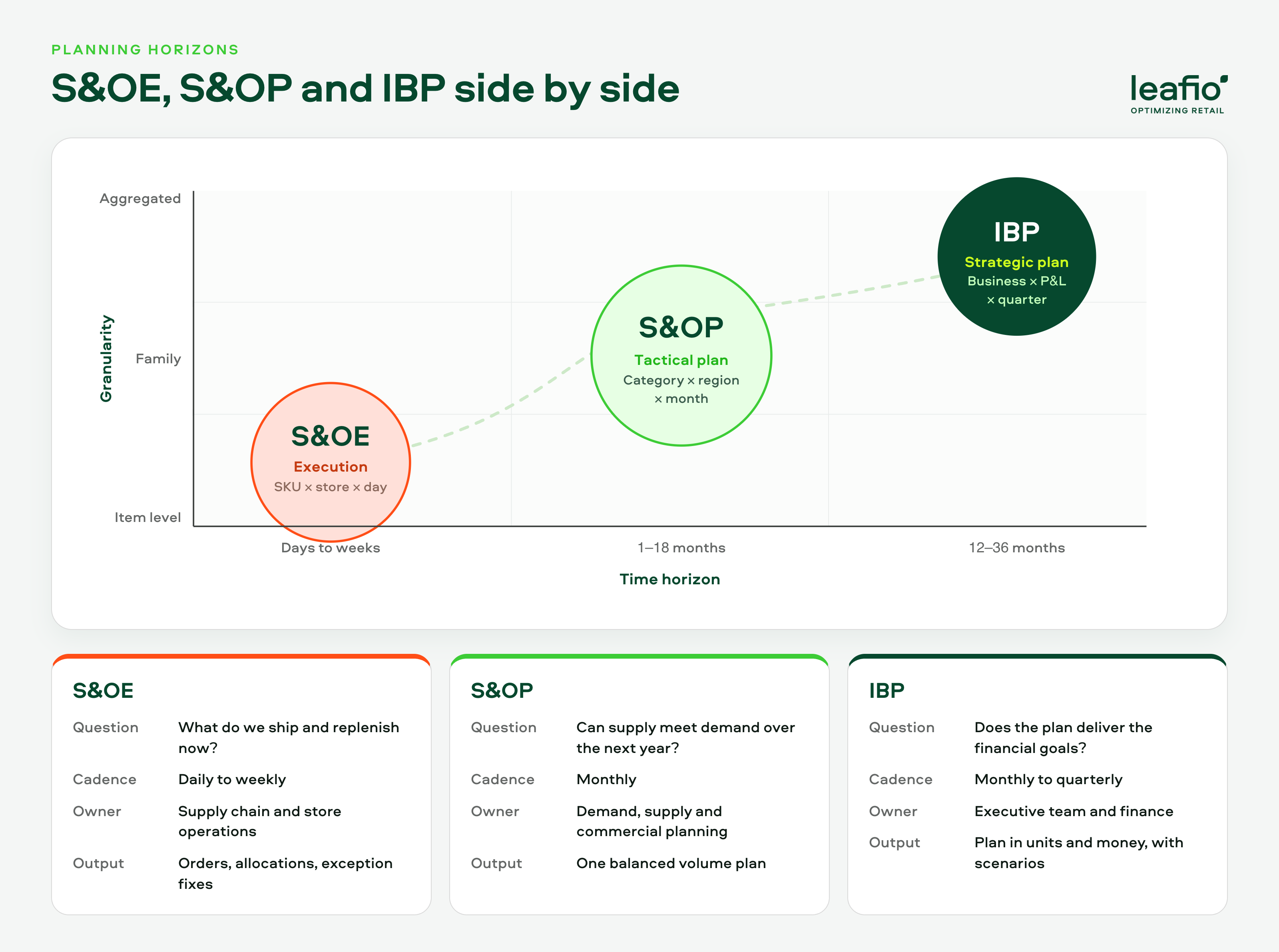
Integrated business planning (IBP) is often described as S&OP's more ambitious sibling (see IBP vs. S&OP guide). Where S&OP focuses on balancing demand and supply over the next several months, IBP extends that same discipline across the entire business, tying it to longer-range financial planning, new product strategy, and capital decisions. Most retailers that adopt IBP already have a working S&OP cycle in place. IBP is less a replacement than the next layer built on top of it.
How Software Strengthens Your S&OP Process
The performance gap between retailers who plan this way and those who do not is measurable. IHL Group's 2025 research found that retailers deploying AI and machine learning in inventory and demand planning saw sales growth 2.3 times higher and profit growth 2.5 times higher than competitors still running on manual or disconnected processes.
Generic, cloud-based planning platforms built for FP&A or manufacturing connect to an ERP and call it done. That is rarely enough for a retailer, where the demand signal that actually matters lives in point-of-sale data, planogram compliance, and the promotion calendar, not just in an ERP's sales order history.
Retail-specific S&OP software, connected to demand planning and promotion management data, pulls demand, assortment, and promotion data into the same forecast that supply and finance are already planning against.
Some platforms go further and correct the forecast itself: when a product sits out of stock for a stretch, the system recognizes that lost demand didn't disappear and adjusts the baseline up, instead of treating an empty shelf as proof nobody wanted the item. A change to next month's planogram or a new promotion feeds the same numbers everyone in the S&OP meeting sees. It does not sit in a separate merchandising system that nobody checks until the shelf is already empty.
This matters most in categories where the constraints are tight. Fresh and perishable items leave almost no room for a slow reconciliation step, since a few days of shelf life is the entire buffer available. High-velocity promotional SKUs are just as tight: the gap between the demand plan and the supply plan shows up within a single week, not a quarter.
FAQ
What does S&OP stand for?
S&OP stands for Sales and Operations Planning, a cross-functional process that aligns demand forecasts, supply capacity, and financial targets into a single monthly plan.
What is the difference between S&OP and S&OE?
S&OP sets the plan at a monthly cadence and a category or product-family level. S&OE, or Sales and Operations Execution, works at a weekly or even daily cadence, tracking whether SKU-level reality on the ground still matches what S&OP agreed to. For a closer look at how the two work together, see S&OE vs. S&OP.
How often should S&OP meetings happen?
Most retailers run the core S&OP cycle monthly. Fast-moving categories, like fresh or promotion-heavy assortments, often need a weekly check-in layered on top to catch problems the monthly cycle would miss.
What's the difference between S&OP and IBP?
S&OP balances demand and supply over a matter of months. IBP extends that process across the whole business, connecting it to long-range financial planning and strategic decisions, usually once a retailer's S&OP cycle is already working well.
Who owns the S&OP process in a retail business?
An S&OP process owner, typically in supply chain or operations, runs the calendar and keeps every function accountable to it. Final decisions on trade-offs usually sit with an executive sponsor.
What software is used for S&OP in retail?
Retailers typically need a solution that connects demand forecasting, assortment and promotion data, and supply planning in one place, rather than a generic FP&A or ERP-based S&OP tool built for a manufacturing company.


Have a question?

Jack Larson
Retail Optimization Expert
