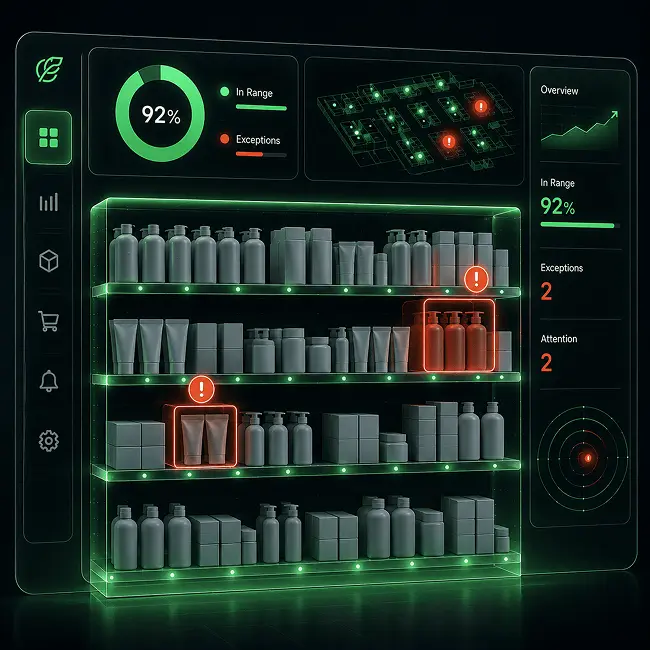


A grocery buyer covering 12,000 SKUs across forty stores cannot personally check the daily status of every case of yogurt, every seasonal display, and every promotional pallet. Nobody can. Somewhere around SKU 2,000 or so, most buyers stop actually looking and start guessing which alerts matter. Management by exception is the discipline retailers use to stop guessing. Instead of monitoring everything equally, you route your attention to the handful of situations that genuinely need a human decision and let the rest run on autopilot.
What is Management by Exception (MbE)?
Management by exception (MbE) is a management approach where leaders and staff only intervene when performance deviates meaningfully from an expected standard.
If a metric sits within its normal range, the process runs without oversight. If it breaks the range, either too high or too low, it becomes an "exception" and gets escalated for review.
The idea is old. It comes out of classical management theory and shows up in everything from budget variance reporting to project management frameworks like PRINCE2. But it has a second life in retail operations. There, the volume of daily decisions (thousands of SKUs, hundreds of stores, constant promotions) makes it less of a leadership philosophy and more of an operational necessity. You cannot review every reorder point calculation by hand. You can review the ones that fall outside expected bounds. That's really what an example of managing by exception looks like on a sales floor: not reviewing less, but reviewing selectively.
Exception management, control by exception, and "managing by exception" are phrases people often use interchangeably with MbE. Strictly, exception management refers to the narrower practice of handling process deviations as they arise. Management by exception describes something broader. It's the policy of designing your entire oversight system and choosing to manage by exception in the first place around deviations rather than constant review.
Active vs. Passive Management by Exception
Not all exception handling looks the same. Two variants show up in the literature and in practice:
Active management by exception means you set thresholds in advance and monitor continuously. You step in the moment a metric crosses the line before it turns into a bigger problem. A category manager who gets an automatic alert the day a fast mover's stock dips below three days of cover is practicing active MbE.
Passive management by exception means you wait until a problem has already caused visible damage (a stockout, a customer complaint, a missed KPI) before getting involved. It's reactive rather than preventive.
Most retailers start out doing passive MbE by accident, simply because nobody built proactive thresholds. They graduate to active MbE later, once they have the data and tools to define "normal" precisely enough to catch deviations early. Active MbE takes more setup work, but it's the version that actually saves money, since it catches the overstock or stockout before it becomes a write-off.
Why Retailers Need Management by Exception
Most articles on this topic are written for general office management: finance teams reviewing budget variances, project managers escalating risks, HR tracking performance thresholds. That's a fine starting point. But it undersells how differently exception management plays out on a retail sales floor, where the "normal" you're comparing against shifts constantly with seasonality, promotions, and perishability.
The Challenge of Managing Large, Volatile Assortments
A mid-size grocery chain might carry anywhere from 15,000 to 40,000 active SKUs across a network of stores, each with its own local demand pattern. Layer in promotions, seasonal swings, and supplier lead time changes, and the number of variables that could go wrong on any given day is enormous.
According to NielsenIQ, 40% of retailers planned to cut SKUs in 2024 alone. That shift was part of a broader shelf-simplification trend that also saw UPC counts drop 8% year over year.
Retailers are already admitting their supply chain and planning teams cannot watch every SKU line by line, and cutting the assortment is one company-wide way to cope. Management by exception is the other way: keep the assortment, but stop watching all of it equally.
The Cost of Treating Every SKU Equally
Suppose a planner spends the same five minutes reviewing a top-selling SKU that never has problems as they do reviewing a genuinely volatile one. That's five minutes wasted on the first, and probably not enough on the second.
According to Chain Store Age's coverage of IHL Group's research, inventory distortion (the combined cost of out-of-stocks and overstocks) still drains $1.73 trillion from global retail every year.
That figure includes $248 billion tied to personnel issues alone. Attention, not headcount, is the scarce resource here. Spread it evenly across an assortment and you'll always be under-serving the SKUs that actually need it (and over-serving the ones that don't).
How Management by Exception Works: 4 Key Steps
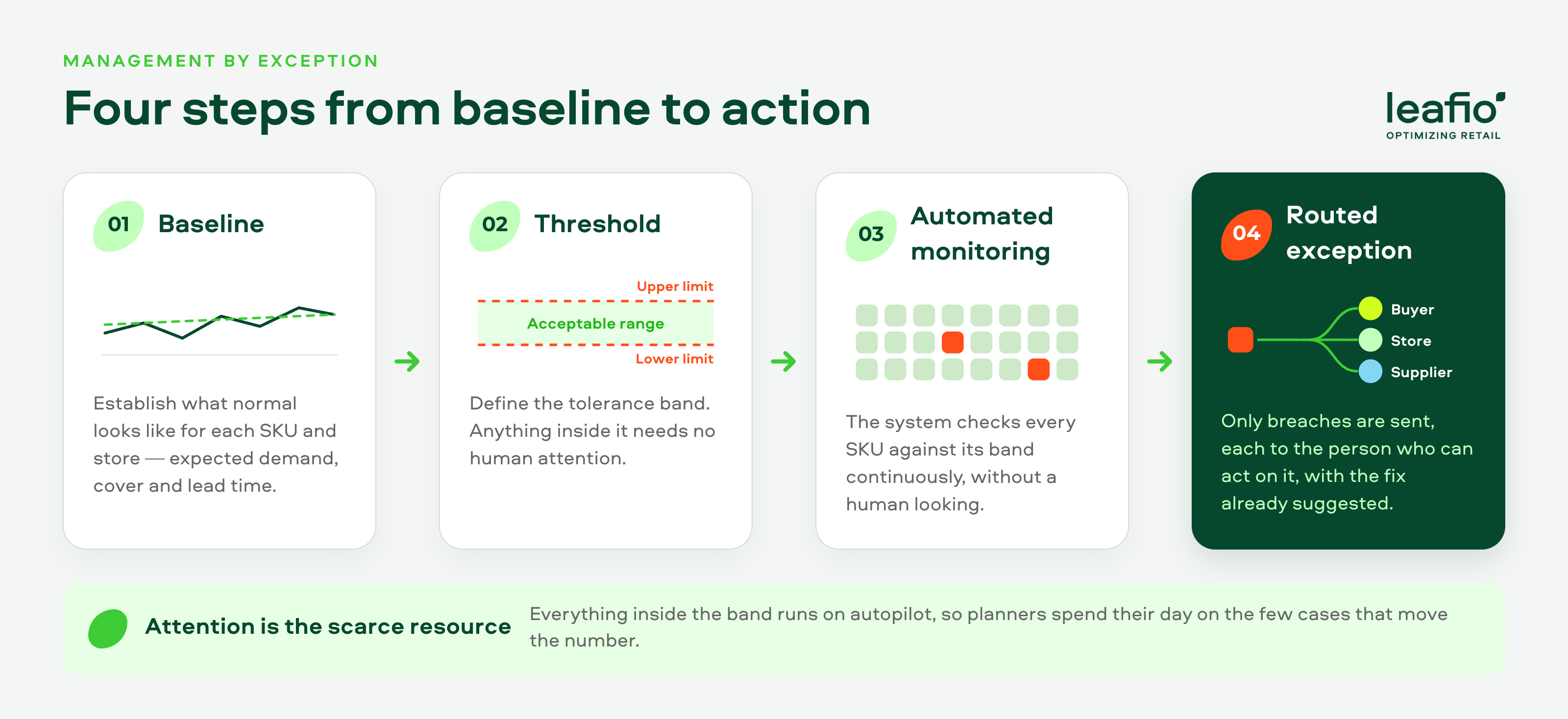
Building a working MbE system comes down to four steps, whether you're setting up budget variance reports or replenishment thresholds for a retail chain.
Step 1: Establish the baseline for "normal"
Before you can spot a deviation, you need a defensible expectation for what normal looks like. That means expected demand, target stock level, expected margin, or expected sell-through rate for each SKU-store combination. This baseline usually comes from historical sales data, adjusted for seasonality and known promotional lift.
Step 2: Define deviation thresholds
Decide how far a metric has to move before it counts as an exception. A controller might flag any expense 20% or $10,000 over budget, whichever is greater. A retail planner might flag any SKU with fewer than two days of cover or any location running more than 30% over its target stock. Thresholds should differ by product criticality; a top-20 fast mover deserves a tighter threshold than a slow-moving accessory line.
Step 3: Automate the surfacing of exceptions
Manual review doesn't scale past a few hundred SKUs. Most retailers now rely on software to compare actual performance against a baseline continuously and generate a daily or weekly exception list. That list gets sorted by financial impact, so the biggest issues surface first.
Step 4: Route each exception to the right decision-maker
Not every exception belongs on a senior manager's desk. Route routine deviations, like a single store running 10% over target stock, to the category manager or store team. Reserve escalation to senior leadership for exceptions with real financial stakes, such as a supplier-wide delivery failure or a chain-wide forecast miss.
What Criteria Define an Exception in Inventory Management?
The criteria you use to define an exception should reflect what actually matters to your business, not a generic percentage rule borrowed from a finance textbook. Three criteria come up constantly in retail:
Product Lifecycle Stage
A brand-new SKU still building sales history needs a wider tolerance band than a mature one with three years of stable demand. Otherwise you'll flag it as an "exception" every week simply because its sales curve hasn't settled yet. A product nearing discontinuation needs the opposite treatment: any leftover stock at all might count as an exception worth clearing out.
Product Profitability
High-margin, high-volume SKUs deserve tighter monitoring than low-margin filler items. The cost of getting them wrong (a stockout on your best seller, an overstock on a thin-margin line) is simply higher. Some retailers weight their exception thresholds directly by gross margin contribution.
ABC Classification
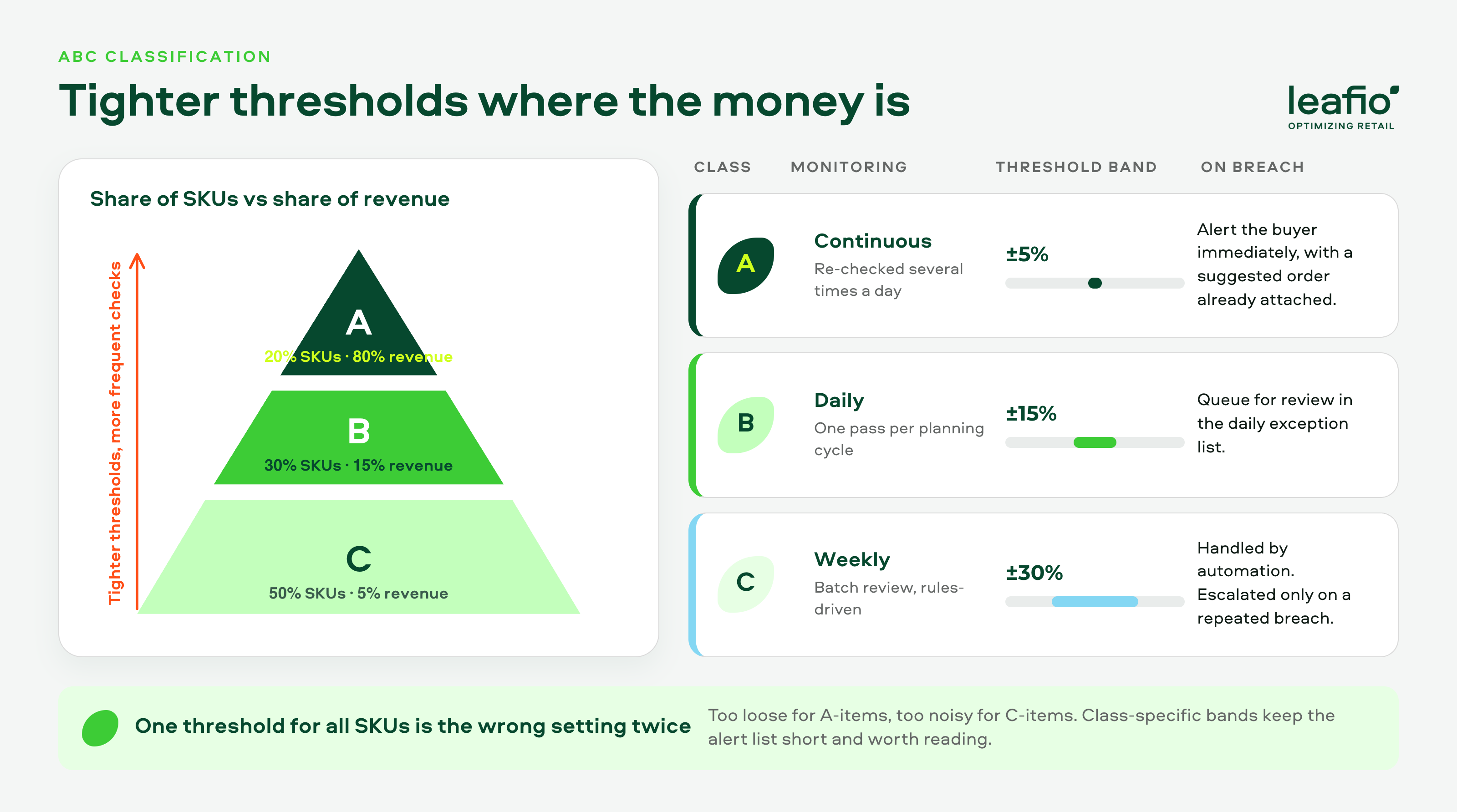
The classic ABC split (A items driving most of the revenue, C items contributing little) maps naturally onto exception thresholds. A-items might get daily monitoring with tight bands; C-items might only get reviewed monthly, or only flagged if stock hits zero. This alone can cut the number of items a planner actively reviews by more than half.
Types of Exception Selections in Inventory Management
In practice, retail exception systems tend to surface a handful of recurring exception types.
Overstock Exceptions
A SKU or location sitting well above target stock, usually flagged for markdown or transfer before it becomes dead stock.
Stockout Risk Exceptions
A SKU projected to run out before the next delivery window, flagged for an expedited order or emergency transfer from a nearby store.
Forecast Deviation Exceptions
Actual demand diverging sharply from the statistical forecast. This often signals a promotion effect, a competitor closure nearby, or a data quality problem worth investigating.
Supplier Reliability Exceptions
A vendor consistently under-delivering or delivering late is flagged not for a one-off order fix but for a supplier conversation.
Perishable Write-off Exceptions
A fresh category showing write-off rates well above its historical norm, which often points to a specific store's ordering behavior rather than a demand problem.
Practical Examples of Management by Exception
Two LEAFIO AI retail clients show how this looks with real inventory, not just theory.
Example 1: Fresh-category write-offs at a fuel retailer
Baltic Petroleum, a Lithuanian gas station convenience store chain, faced fresh-category write-offs and occasional stockouts it couldn't explain store by store. Orders were placed manually by 84 individual station managers, each with their own methodology and no shared visibility into what "normal" looked like.
After implementing LEAFIO Inventory Optimization's exception-based fresh reporting, the chain cut write-offs in its "Sandwiches" category from 11% to 1.9% within two months. Overstock fell 50% and inventory turnover improved 13% within the first year.
Example 2: ABC-driven turnover at a liquor retailer
White&Dry, a 194-location European liquor store chain with over 2,000 active SKUs, faced chronic overstocks in some locations and lost sales in others. Its replenishment process treated the entire assortment the same way.
After implementing LEAFIO Inventory Optimization with automatically calculated target stock levels by SKU and location, the chain improved inventory turnover by 36% (from 87 to 64 days). Sales grew 56% within the first year, and the chain also cut the costs tied up in surplus stock.
Principles of Management by Exception
A few principles separate MbE systems that actually save time from ones that just add another dashboard nobody trusts.
Set Thresholds You Can Defend
An exception rule that's too tight buries planners in noise; one that's too loose lets real problems slide through unnoticed. Review and adjust thresholds quarterly as demand patterns shift.
Delegate Authority Alongside Responsibility
MbE only works if the people closest to a routine decision are trusted to make it without escalation. If every "exception" still gets rubber-stamped by someone three levels up, you haven't actually reduced anyone's workload.
Automate the Routine, Escalate the Meaningful
According to McKinsey, a retail merchandiser's stock-adjustment analysis takes two to three weeks today.
With the right AI and automation in place, that could shrink to two or three hours. That reclaimed time should go to the SKUs and decisions that genuinely need a human. (It's a bit sobering how much of that two-to-three-week timeline was probably just waiting on a spreadsheet to update.)
Benefits of Management by Exception
The biggest benefit is time. Planners and managers stop spending equal effort across an entire assortment of products and instead concentrate on the subset of decisions that carry real financial weight. That's a meaningful efficiency gain on its own. It also tends to show up as a faster response to genuine problems: a stockout gets caught in days, not weeks. Overlooked issues drop too, and burnout eases among staff. Nobody feels obligated to review everything manually anymore. Once the model is running, it also tends to improve morale on the floor. Store teams get more autonomy over routine decisions instead of waiting on head-office sign-off for every reorder.
Disadvantages and Challenges of Management by Exception
MbE isn't free of downsides. Getting the thresholds wrong in either direction (too tight or too loose) undermines the whole system. Building those thresholds properly takes real historical data and some trial and error. It can also create a blind spot. If your monitoring only tracks the metrics you thought to define, a genuinely new kind of problem might not trip any threshold at all. And in smaller operations without much sales history, "normal" is harder to define with confidence. The exception rules end up cruder than they would be at scale.
How to Implement Management by Exception: Step-by-Step
Here's a practical rollout sequence, based on how most retailers actually get from zero to a working exception system.
1. Audit Your Current Decision Volume
Work out roughly how many reorder, pricing, or allocation decisions your team makes weekly. Then figure out how many actually require judgment versus how many just repeat the same pattern.
2. Define Baseline and Thresholds by Product Tier
Start with your A-items, since that's where the financial stakes are highest, then extend the same logic to B and C items with looser tolerances.
3. Pick a Tool That Can Monitor Thresholds Continuously
Spreadsheets can define thresholds; they can't watch thousands of SKUs daily and flag deviations without someone opening the file.
4. Pilot on One Category or Store Cluster Before Scaling
Treat this as a distinct phase: confirm the thresholds are catching real problems, not noise, before rolling the approach out chainwide.
5. Revisit Thresholds on a Fixed Schedule
Demand patterns shift with seasonality, so a threshold that made sense in March may be wrong by October.
How Software Enables Management by Exception
Manual exception management works up to a point, usually a few hundred SKUs, before the review burden becomes unmanageable. Inventory optimization platforms like LEAFIO AI's are built around exactly this pattern. They calculate a target stock level per SKU per location and monitor actual performance against that target continuously. They surface only the deviations that cross a defined threshold, ranked by financial impact. That's the practical difference between a spreadsheet and a system actually designed for exception-based work. The software does the constant comparison so your team only sees what needs a decision. Some platforms take this further.
LEAFIO’s AI assistant can also answer a plain-language question, such as why a specific SKU or location fell outside its normal range. That's a step beyond simply flagging that a deviation happened.
If you want to see how that translates into daily practice, LEAFIO's inventory optimization software applies exception-based logic across replenishment. The assortment performance module extends the same thinking to ABC classification and category decisions.
FAQ
A few quick answers to the questions that come up most often once you start setting up management by exception.
What Is the Difference Between Management by Exception and Exception Management?
Management by exception is the broader managerial policy of designing oversight around deviations from a baseline. Exception management usually refers more narrowly to the process of handling individual deviations once they occur. In practice, most people use the two terms interchangeably.
What Does "Management by Exception Helps" Achieve in a Business Context?
It frees up managers' time by removing the need to review processes that are running normally. They can focus attention on situations that actually require a decision or intervention.
Can You Give a Simple Example of Management by Exception?
A store manager who only gets alerted when stock falls below a set threshold is practicing management by exception. That's different from checking every product's stock level daily.
Is Management by Exception the Same as Micromanagement?
No, they're close to opposites. Micromanagement means reviewing everything regardless of performance. Management by exception means reviewing only what deviates from expected performance, which requires trusting staff with routine decisions.
What Are the Risks of Setting Exception Thresholds Too Loosely?
Real problems, like a slow but steady overstock buildup, can go unnoticed until they've caused significant financial damage. Nothing crosses the threshold early enough to trigger a review.
How Does ABC Classification Relate to Management by Exception?
ABC classification helps decide how tightly to monitor each SKU. A-items (high revenue contribution) usually get the tightest thresholds and most frequent review; C-items get looser thresholds and less frequent attention.
Does Management by Exception Work for Small Retailers Without Much Sales History?
It's harder, since a reliable baseline needs enough historical data to distinguish normal variation from a genuine deviation. Small retailers can still apply the principle with simpler rules, like fixed reorder points, while they build up the sales history needed for more precise thresholds.


Have a question?

Jack Larson
Retail Optimization Expert