
The global food cold chain last mile delivery market is expected to reach $12.4 billion by 2030 with a CAGR of 6.2% every year. Nevertheless shipping in the cold chain logistics sector is still exposed to particular risks. Specifically, perishable products must be maintained in premium condition throughout the final leg of the journey and often have to be delivered at a precise time.
Below, we explore the main bumps in the road for efficient last-mile delivery as well as innovative perishable shipping solutions that will make it much easier.
Key Takeaways
Handling perishables needs smart shipping to cut waste & protect margins.
Use real-time temp monitoring.
Plan shortest transport routes.
Match packaging to product.
Build contingency for delays.
Align with seasonal demand.
Understanding the perishable food transportation specifics
Perishable goods are various types of products with a limited shelf life. These include, for example, dairy products, meat, fruits, and prescription drugs. Unlike frozen food, cold food requires greater efficiency in shipping. The main task is to ship food as fast as possible while maintaining freshness.
When it comes to products with a 72-hour shelf life, the longer they are in transit, the less time the retailer has to sell them. In addition, with each passing minute, therefore, the efficiency of logistics in the perishable food delivery is a critical point that affects business profitability.
As the transportation market for perishable goods is expected to grow rapidly over the next few years, the need for technological perishable shipping solutions will rise as well.
Top 5 Challenges for Perishable Food Last-mile Delivery
Ensuring perishable orders are promptly delivered and in perfect condition requires overcoming several unique hurdles.
#1 Temperature control
Setting the correct temperature requires modern technology and accurate calculations. If you make a mistake, at best, you will ship food too cold or too warm. At worst, retailers will receive dangerously spoiled food, which is especially problematic for fresh meat delivery. Maintaining proper temperature control is challenging and costly, but the costs of delivering spoiled food would be much higher.
If you don't monitor the temperature during delivery, it can lead to unpleasant situations. For example, a customer measures the product temperature upon receipt and claims that it does not match the declared temperature and returns the entire batch. What to do next? The goods need to be transported somewhere, frozen, or resold quickly – these are all unnecessary problems and costs.
#2 High shipping costs
The last mile is the most expensive leg of the journey for a business. Huge overhead costs are associated primarily with building the right infrastructure. The following factors should be taken into account when calculating the shipping cost:
- Failed deliveries, for example, deliveries where you have to replace spoiled food, pay extra for time and fuel for a second delivery.
- Complicated routes, especially in rural areas.
- Extra stops, for example, to refuel vehicles.
- Driver salaries.
- Operation and maintenance of the fleet.
- Refrigeration equipment and its maintenance.
Some of these costs, of course, can be passed on to retailers, but they won't be too happy if the order price goes up due to this. Instead, try to reduce your costs through more efficient route planning.
#3 Inefficient routes
To cover the last mile, you need to anticipate all possible problems and develop the most efficient route, taking into account factors ranging from weather conditions to maintenance work and traffic congestion. Poor route planning leads to excessive fuel costs and increased travel time, which is unacceptable when transporting cold food.
Inefficient routes are often the result of a lack of proper technology. If your tools and software are outdated, you won't be able to stay competitive and meet the growing expectations of retailers.
#4 Long receiving process
The ultra-fresh category is usually received on separate ramps and requires a special procedure. If the receiving time at the delivery point is not determined in advance, a retailer may be unprepared and delay the process. Therefore, it is important to simplify and organize this process as much as possible to avoid delays in shipping.
#5 Extra time to work with returns
The percentage of returns should stay low – usually around 1–2%. This applies to expired goods, unsold goods, or any trimmings if we are talking about the farm fresh meat delivery. Stores try to make sure that all trimmings or expired goods are returned. This is a complicated procedure that requires a clear prediction of the time required for the return – this should be taken into account in route planning.
LEAFIO Rinkai TMS Innovative Solutions for Perishable Food Delivery
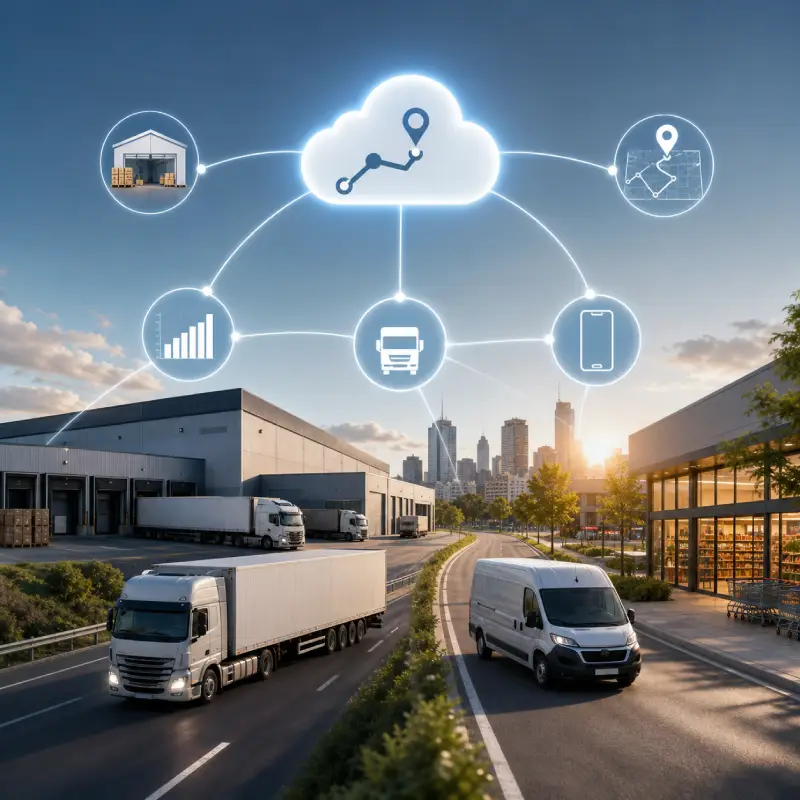
LEAFIO Rinkai Transportation Management System is an innovative cloud-based solution that centralizes the shipping management process and allows you to effectively control the temperature, economic, and quality parameters of delivery. With these perishable shipping solutions, you'll no longer have to worry about shipping perishable food correctly.
#1 Dynamic route planning
The system can automatically schedule the shipping of thousands of orders in minutes. The artificial intelligence algorithm easily determines the most efficient routes and cost-effective vehicles. The system can take into account all factors, such as warehouse capacity, customer time windows, and product requirements.
Smart planning is the key to reducing delivery costs. When the sequence of delivery points is known in advance, it significantly reduces loading time, prevents product spoilage, and increases customer satisfaction when you ship food fresh, and just in time.
By using LEAFIO Rinkai TMS, the major international brand of chicken meat Qualiko has decreased the percentage of late deliveries from 12% to 5%.
#2 Real-time GPS delivery monitoring
Monitor deliveries in real-time, comparing planned routes with actual ones. The system provides logistics managers with detailed insights into driver paths, potential delays, and point visitations enabling analysis and the adjustment of time indicators and geo-coordinates.
Unexpected changes always happen, but it's not a problem either. If a vehicle breaks down, new orders come in, or weather conditions change, you can always make changes in real time and the system will optimize all routes.
With LEAFIO Rinkai TMS, a single logistics manager in Qualiko, a major international brand of chicken meat, can now plan routes for all 1,136 delivery points and 231 vehicles.
#3 Built-in temperature tracking information
The system processes data from temperature trackers, enabling further analysis and comparison. This allows monitoring the temperature at which goods arrive at the delivery point. By tracking temperature indicators, businesses can ensure delivery quality and provide evidence of proper temperature conditions in case the customer's measurements upon receipt are inaccurate.
#4 Enhanced driver optimization
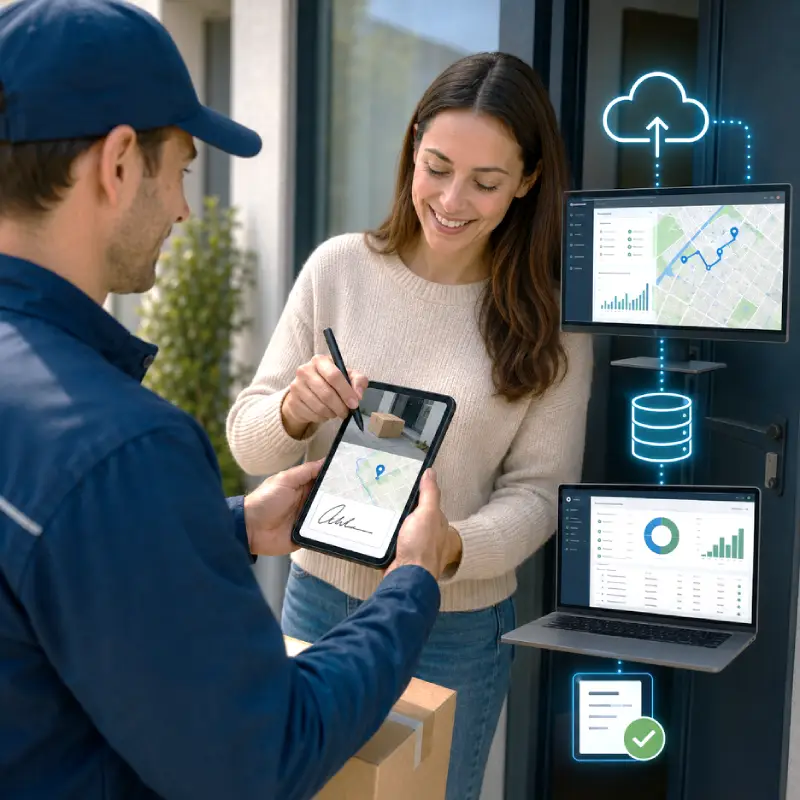
LEAFIO Route Sense is an intuitive driver app that provides all route and order information. Drivers benefit from easy navigation and the ability to update delivery statuses for individual orders. The app offers many opportunities to optimize driver performance. For example, drivers can add photos of both point entrances and product photos. This is convenient, especially if there is a dispute – a quick response is important and it is worth being able to provide evidence in the form of photos that can be taken right in the app.
#5 Optimizing vehicle loading and unloading times
You can also send notifications to the points with the exact delivery time through the system. This gives the retailer time to prepare and accept the goods on time – this eliminates potential delays at other points. If there are any returns, the system allows you to calculate the vehicle loading time and adjust the route schedule. This is especially relevant after the holidays when there are large returns that require more time for weighing, checking, and loading.
After LEAFIO Rinkai TMS implementation, prominent poultry producer MHP achieved a 30% reduction in unloading time at delivery points and an 8% increase in the average number of points on each route. MHP saved 1,000,000 km of mileage in its inaugural year thanks to Rinkai's route planning.
#6 Vehicle allocation based on retailer's ramp level
The LEAFIO solution automatically allocates vehicles to routes depending on the retailer's ramp level. For example, it doesn't send small vehicles to delivery points where the ramp is high, because then the goods have to be transferred manually, which delays the unloading process. And doesn't send tall vehicles to a delivery point with no ramp at all. Taking into account the customer's ramp level eliminates this inconvenience.
#7 Taking into account different temperature conditions
The system can automatically take into account shipping vehicles with two temperature modes when planning a route. For example, when some vehicles can serve any route, and a vehicle with one temperature mode can take either only cold or frozen food.
#8 Faster adjustment of logistics resources and routes
If production cannot fully satisfy customer orders within the specified time frame, you can reduce orders in the system according to production limits. The system will automatically adjust the number of vehicles and build routes in accordance with the limit. The logistics manager has the opportunity to add data to the system either at the stage of order acceptance or after routes have been built.
#9 Comprehensive delivery analytics
The LEAFIO Rinkai's analytics module allows you to see an objective picture of shipping cost to each point clearly. You have access to analytics for the entire period, can track key indicators, and create customized dashboards according to your specific requirements. The analytical module gives you full control over logistics costs, customer satisfaction, driver efficiency, and other important aspects.
Key Takeaways
- Perishable items have a short shelf life, so every minute spent on shipping is priceless.
- There are many challenges in delivering the last mile of chilled products, including temperature control, handling returns, failed deliveries, and more.
- Proper planning is the key to reducing shipping costs.
- AI-powered perishable shipping solutions allow a logistics manager to work with thousands of orders at once and organize efficient routes for minimum transit time and safe arrival.
- To build effective routes, you need to take into account various factors, including shipping restrictions, different vehicle temperature conditions, refueling stops, and the availability of a ramp at the delivery point.
- LEAFIO's perishable shipping solutions provide tools to optimize driver management, reduce loading times, temperature tracking, and more.
- To see an objective picture of the shipping cost to each point, use detailed analytics and track key logistics performance indicators.
FAQ
What is the difference between shipping perishable and frozen food?
Shipping perishable food is more challenging than frozen food because it has a shorter shelf life and requires consistent refrigeration rather than freezing. While frozen items can be transported with ice packs and maintained at a stable temperature, cold food requires faster delivery, and precise temperature control to prevent spoilage.
How to ship frozen items?
Shipping frozen food requires using proper packaging, dry ice, or gel packs to prevent temperature fluctuations. The outer packaging includes insulated containers with shipping labels like styrofoam boxes or thermal bags. Dry ice is the best packing material for international shipping, while gel packs work well for shorter deliveries. In case of using wet ice, bottom shipping container with an absorbent material for extra protection.


Have a question?

Andrew Ivarsen
Logistics Optimization Expert