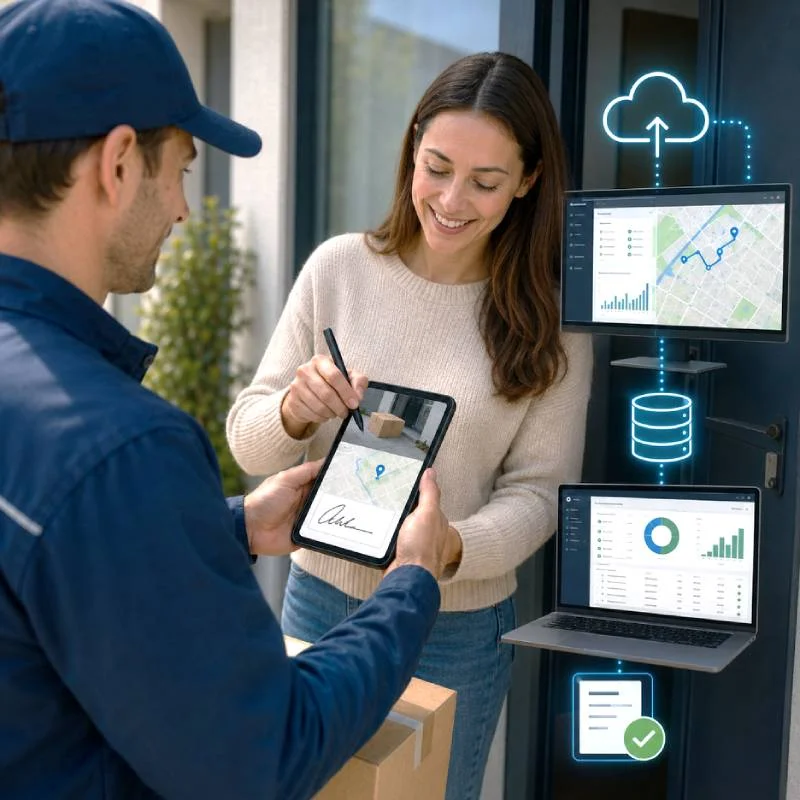


Proof of delivery software is a digital tool that captures delivery confirmation at the moment goods change hands. A photo of the goods, a signature on the screen, and a GPS timestamp are captured automatically. That record goes straight to your back-office systems in seconds. No paper slip, no end-of-day data entry, no wondering what actually happened at stop fourteen. For delivery businesses of any size, that shift matters. It affects cash flow, dispute rates, and the hours your team spends chasing paperwork every week.
Whether you run a regional delivery service or operate as a full logistics services provider, the problem looks the same. A disputed delivery lands in customer service. Someone calls the driver. The driver remembers it differently. The handwritten slip is somewhere in a cab. Three hours later, nobody has an answer. Paper POD was never designed for accountability. It was designed for a world where disputes were rare, and drivers came back to base before anyone noticed.
Book a Route Sense demo to see how ePOD works in a real last-mile operation.
What Is Proof of Delivery Software?
The app is what the driver touches: pull up the order, scan the goods, get a signature, and take a photo. The system is everything behind that: the admin panel where your dispatcher watches deliveries close in real time, the integration that updates your ERP before the driver has left the car park, the reporting that gives you real-time monitoring of order fulfilment across your fleet. Plenty of vendors sell you the first thing and describe it as the second. The full platform - app plus admin layer plus integrations - is what the industry calls a proof of delivery system.
Route Sense is proof of delivery software built for distribution teams across retail, FMCG, pharma, and B2B. Route Sense works as a standalone mobile proof of delivery tool or as the driver app inside LEAFIO Rinkai TMS. Here is what electronic proof of delivery (ePOD) actually solves. Paper POD does not fail because drivers are careless. It fails because of lag. The slip gets signed, the route gets completed, and someone at base types in the data. By then, two customers have already called, and the afternoon is gone. ePOD removes that lag entirely.
Paper POD vs. Digital POD
| Dimension | Paper POD | Digital ePOD |
|---|---|---|
| Dispute resolution time | Days to weeks | Minutes |
| Signature format | Handwritten, often unreadable | Digital, timestamped |
| Photo evidence | None | Automatic, GPS-tagged |
| Real-time visibility | Zero | Full |
| Integration with ERP/TMS | Manual re-entry | Automatic via API |
| Lost documentation risk | High | Effectively zero |
Key Features of Proof of Delivery Software
Most ePOD evaluations follow the same arc. The feature list looks great in the demo. Then, go-live happens. The app is too slow. The offline mode breaks in the first industrial estate. The TMS integration turns out to be a CSV export that someone runs manually every morning. The features that matter are not the ones on the slide deck. They are the ones who still work at stop thirty-two on a Thursday.
- E-signature capture. Drivers capture signatures electronically at handover. The customer's signature, name, time, and GPS position are recorded instantly and become part of the digital delivery receipt.
- Photo proof. In my experience, this closes more disputes than everything else combined. Drivers instantly submit proof of every handover as digital proof: packaging condition, where goods were left, what was and was not included. A customer calls to say the box arrived crushed. You open the record while they are still talking. The photo shows the box was intact at 10:47 at the customer's front step. Two minutes instead of two days.
- GPS auto-timestamp. Location and time are captured automatically, not entered by the driver after the fact. A timestamp the driver entered is an assertion. An auto-captured GPS timestamp is evidence.
- Barcode and cargo unit scanning. When a cargo unit is scanned, all associated products activate automatically. In FMCG distribution with forty SKUs per stop, manual verification is not realistic at speed.
- Real-time status updates. Every status change transmits instantly to the ERP and CRM. This is what delivery confirmation software is designed to do at scale. Delivery notifications go out at each stage. You can send pre-delivery text alerts so recipients know when to expect the driver. Reduced customer support calls follow naturally.
- Offline mode. Every driver knows the dead zones: the loading bay with no signal, the estate where coverage drops for twenty minutes. An ePOD app that needs a signal will fail you regularly. Route Sense stores everything on the device and syncs when connectivity returns. Nothing is lost.
- TMS integration via API. A delivery management software that does not connect to your TMS adds a silo. The delivery features that matter most only work when the app and TMS talk without delay. Route Sense integrates natively with Rinkai TMS and connects to other TMS and ERP platforms via API, so confirmation flows into the TMS and ERP in real time, without a human touch.
See Route Sense features for a detailed breakdown of how each works in a retail or FMCG distribution environment.
How ePOD Software Works: Step-by-Step
-
1Route received on the driver's phone.Drivers see all delivery stops for the shift with a full map view. Each stop card shows date, time frame, and distance.
-
2Warehouse loading scan.Drivers can confirm order loading directly at the warehouse.
-
3Navigation to the delivery point.Full route on the map with all stops. Drivers navigate multiple routes effortlessly with all essential information at their fingertips.
-
4Scan at delivery.The driver scans each item or cargo unit. When a cargo unit is scanned, all associated products are automatically activated, ensuring accurate tracking and minimizing errors.
-
5Customer confirmation.Recipients sign directly on the driver's phone screen. Drivers flag damaged goods, refused deliveries, or partial deliveries with reason codes. All exception data is transmitted to the accounting system.
-
6GPS timestamp auto-applied.GPS timestamps are recorded at the point of delivery and sync in real time to the manager's logistics admin panel.
-
7Instant upload to TMS and ERP.Order statuses update in real time to ERP/CRM. Customer notification goes out automatically.
-
8Failed delivery handling.Drivers accept or decline with predefined reason codes. Managers see all order details, delivered and undelivered items, and can confirm returns to the warehouse.
Why Businesses Switch to Digital POD
Most operations switch to ePOD because something broke: a dispute they could not resolve, an audit that exposed gaps, or a client that left because deliveries were unverifiable.
90% first-attempt delivery success rate. Most failed first attempts trace back to an information problem: the address was wrong, the customer was not notified, or there was no record of what the previous attempt found. Redelivery costs, driver time, scheduling disruption: all visible. The customer satisfaction damage is less visible. Route Sense eliminates that gap. Drivers have complete, current data at every stop. The result is a 90% first-attempt success rate.
100% digital document flow. Eliminating manual paperwork directly affects cash flow. No pile of slips on a desk. A dispute that previously meant reconstructing events from memory now takes three minutes, because every delivery detail is on record the moment it happened.
100% accuracy on real-time delivery status updates. Every status change goes to the ERP and CRM instantly: accepted, partially delivered, declined, or returned. Everyone works from the same information, which is what maintaining consistent customer satisfaction requires at scale. A reliable service depends on reliable data. The version where the driver says delivered and the system says otherwise cannot occur, because the record is created automatically.
These three outcomes are connected. Better information drives first-attempt success. Real-time transmission drives status accuracy. Full digital flow drives document reliability. The platform works as a system.
Route Sense is designed to reduce delivery execution time and automate the courier workflow end-to-end.
One retail operation we can point to is a large DIY chain with a fleet of 390 delivery vehicles that implemented Rinkai TMS with the Route Sense driver app. Delivery time per order dropped from 4 hours to 2. Route planning went from 90 minutes to 20. Customer delivery NPS came in at 85.7%, measured across time accuracy, courier professionalism, and product condition on arrival.
Proof of Delivery App vs. Software: Is There a Difference?
When someone searches for a proof of delivery app, they want the driver-facing mobile tool. When someone searches for proof of delivery software, the problem is broader: the full workflow from dispatch to invoice, including the admin layer, the reporting, the integrations. Most vendors would rather you did not notice the difference.
Route Sense is both within the same software. The driver app handles proof of delivery at handover. The logistics admin panel gives managers full visibility into order status, photo confirmation, and return records. A delivery management software built this way eliminates the reconciliation step entirely.
A driver app without a proper admin panel solves only half the problem. It is a more organized version of the paper problem, not a solution to it.
Who Needs a Proof of Delivery App?
What kind of delivery operation can afford not to have one? From small and medium enterprises to large courier operations, the problem is the same.
Last-mile carriers face high volume, high dispute frequency, and tight invoicing cycles. For them, ePOD is a liability management tool, not a productivity one. FMCG distributors have complex multi-SKU orders where a disputed delivery costs the redelivery, plus the invoice delay, plus the relationship friction. Route Sense is designed to reduce delivery execution time and automate the courier workflow end-to-end.
Pharmaceutical delivery requires chain-of-custody documentation as a compliance requirement. Grocery retail operates on thin margins where a failed first attempt is a commercial failure, not a minor inconvenience.
Route Sense is built for last-mile retail and FMCG distribution with real-time tracking at every stage, within the broader last-mile delivery software ecosystem of LEAFIO Rinkai TMS. If you are thinking through the full technology stack for last-mile operations, the last mile delivery software guide covers the full stack. For a deeper look at the operational challenges this technology addresses, see last mile delivery challenges.
How to Choose the Best Proof of Delivery App: 5 Criteria + Comparison
I have been in enough of these evaluations to know the pattern. A spreadsheet appears, every feature gets a score, and the highest total wins. Then something breaks on day one that was never on the spreadsheet. Here are the five things I actually check.
-
1Mobile-first driver experience.The driver cannot be trained out of inconvenience. Partial adoption means inconsistent data and a wasted investment. A delivery solution that looks great in a demo and falls apart on the road is the most expensive outcome. Route Sense: one screen, one-tap status updates, delivery features that work in the conditions drivers actually face.
-
2TMS integration depth.Many tools sold as TMS-integrated are file exports on a timer. Route goes from TMS to the driver's phone, confirmation goes straight back, dispatcher sees it close in real time with full driver tracking on screen. Route Sense integrates natively with Rinkai TMS and connects to other TMS and ERP systems via API. Ask any vendor how their integration actually works.
-
3Offline capability.Test this in the field, not the office: an industrial estate, a building basement, two bars of signal. Route Sense stores everything locally and syncs on reconnect with no data loss.
-
4Customizable workflows.One delivery needs a photo and the customer's signature. The other needs chain-of-custody steps and specific decline codes. The delivery features required differ by industry. Route Sense lets managers configure directly: signature requirements, decline reasons, and additional capture steps. You set it up, and the driver sees it.
-
5Analytics that close the loop.The delivery progress tracking feature provides full visibility into the status of each order. Driver management becomes data-driven when delivery features include proper reporting. Any delivery management software without analytics is missing the feedback loop that makes the whole investment worthwhile. If the reporting layer requires a manual export and a spreadsheet, the loop never closes.
Route Sense vs. Track-POD vs. Detrack
| Capability | Route Sense | Track-POD | Detrack |
|---|---|---|---|
| Mobile driver app | Yes | Yes | Yes |
| Logistics admin panel | Yes | Yes | Yes |
| Barcode / item-level scanning | Yes | Yes | Yes |
| Cargo unit auto-activation | Documented in product materials | Supported scanning-based workflows | Supported scanning-based workflows |
| IP telephony + call recording | Documented in product materials | Not explicitly listed in public materials | Not explicitly listed in public materials |
| Driver & customer number privacy | Documented in product materials | Not explicitly listed in public materials | Not explicitly listed in public materials |
| Offline mode | Yes | Yes | Yes |
Information is based on publicly available product materials at the time of writing. Absence of listing does not imply absence of functionality.
Paper POD survives in delivery businesses because its costs are invisible at the team level. Customer service absorbs the disputes. Finance absorbs the delays. The warehouse absorbs the confusion. No individual team sees the full bill. Consistent customer satisfaction is impossible when every delivery record is a handwritten slip in a cab. What ePOD does is make that total cost visible. Once you can see it, the decision becomes straightforward.
Book a Route Sense demo to see how this plays out in a retail or FMCG last-mile context. Or explore the full last-mile TMS it sits within.


Have a question?

Andrew Ivarsen
Logistics Optimization Expert